

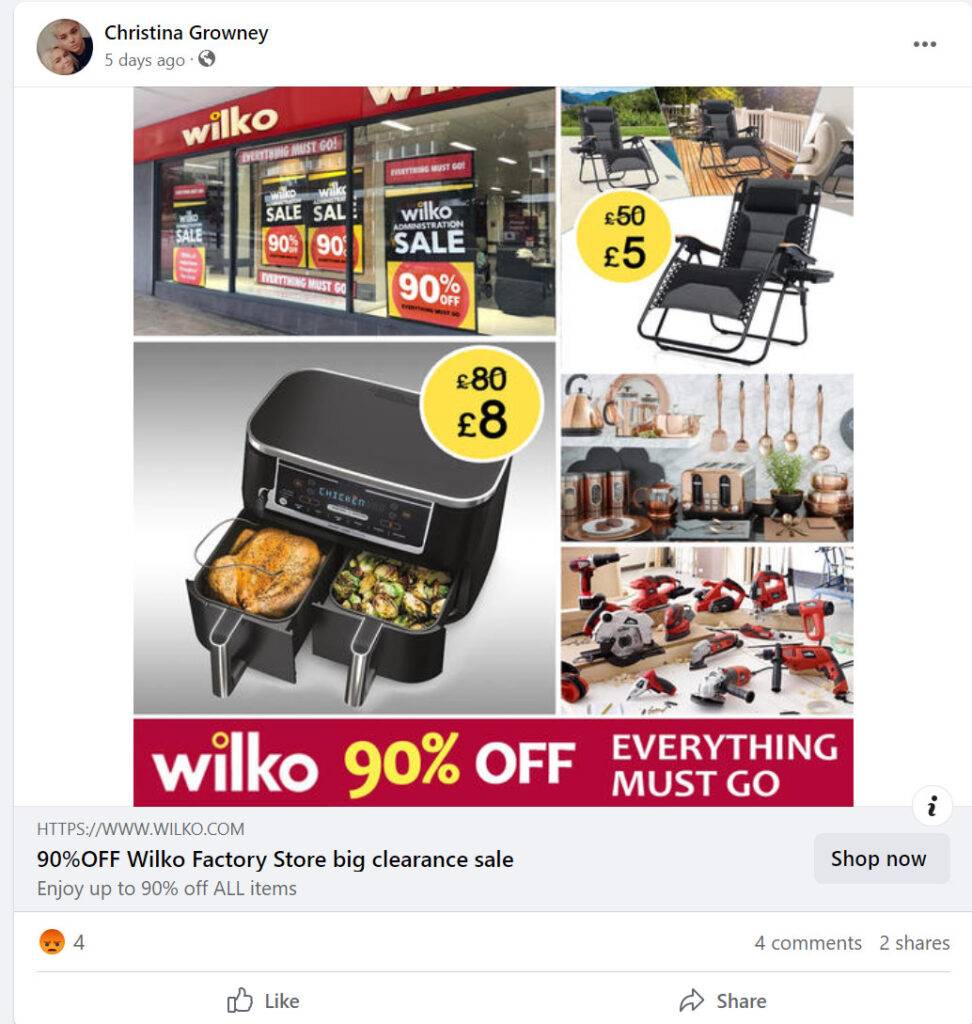
Many Facebook users lately have reported seeing sponsored ads promoting a “Wilko Clearance Sale! Up to 90% Off!”. However, these ads are a complete scam trying to trick users into providing their personal and financial information. This article will explain how to identify these Wilko Facebook scam ads and avoid falling victim.

Overview of the Scam
The scam ads in question generally start with “Wilko Clearance Sale! Up to 90% Off!” or a similar variant suggesting Wilko is holding a huge online clearance event with extreme savings. They promote limited-time deals on top brands of up to 90% off.
However, clicking these Facebook ads leads not to Wilko’s legitimate website but instead redirects to fake retailer sites completely unaffiliated with Wilko. These fraudulent storefronts are expressly designed to continue deceiving visitors so their personal and financial information can be harvested.
The sham websites feature all the typical scam hallmarks like fake customer reviews, stock product images, dubious contact information, missing business details, and more. Deceived shoppers lured in by the ads end up handing over sensitive data and payment info, receiving only compromised finances and identities in return.
This “Wilko Clearance Sale!” con exploits the familiarity and trust associated with major UK brand Wilko. The unbelievable savings promoted stoke irrational urgency that pushes viewers toward the ads without scrutiny. But in reality, this is an elaborate bait-and-switch fraud playing off human psychology to profit off stolen data.
How the “Wilko Clearance Sale! Up to 90% Off!” Scam Works
At first glance, the “Wilko Clearance Sale! Up to 90% Off!” Facebook ads appear quite legitimate. They use Wilko’s official branding, images of its products, and claims of a storewide clearance sale offering up to 90% off all items. Many mention a going out of business or liquidation sale.
The ads link to professional-looking websites made to resemble Wilko’s official online store. However, Wilko confirmed they are not running any clearance sales, liquidations, or closing down. These ads are fabricated by scammers to deceive Facebook users.
The criminals creating these ads leverage recent news that Wilko has entered bankruptcy administration and begun shuttering some locations. They pretend to be affiliated with Wilko, claiming the ads offer consumers one last chance for huge savings as the company winds down operations.
In reality, the scam sites have zero relationship with Wilko. But they rely on the brand’s current struggles and consumer trust to trap victims into thinking they are legitimate. The rock-bottom prices dangled in the ads help override user skepticism.
If users click on one of the sponsored links, they are taken to elaborate scam websites that closely mimic Wilko’s real website design and product listings. The sites tempt visitors with even lower prices on the page, often up to 90% or more off regular prices.
If a user tries purchasing something, they are directed to a checkout process asking them to enter a great deal of sensitive personal and financial information including their name, address, phone number, email, and credit card details.
In actuality, these websites are only phishing for victims’ confidential data. The scam sites have no inventory or any ability to actually fulfill orders. No products ever ship out.
Once users submit their information at checkout, the criminals behind the sham websites collect the data for identity theft and financial fraud purposes. In some cases they process bogus charges to the credit cards entered.
They then disappear without a trace, shutting down the scam sites. Users never receive any products, and often have their information stolen. Since the sites are untraceable, it is almost impossible for victims to recoup lost money or repair identity theft damages.
How to Identify the Fake Wilko Facebook Ads
While the scam ads are sophisticated, some key indicators can help identify them as fraudulent:
- Promote unrealistic discounts of 70% or more off site-wide
- Use time pressure tactics like “Today Only!” or “Limited Time”
- Have grammatical errors and other typos
- Link to scam websites with slightly different URLs than the real Wilko site
- Scam sites lack any contact information beyond a web form
- Scam sites do not have real profile information, customer reviews, or other signs of authenticity
Facebook users should apply extra scrutiny to sponsored posts promoting unbelievable blowout sales on bankrupt brands. These scam ads try to capitalize on brand struggles to exploit victims, but can be detected with careful examination.
How to Avoid Falling Victim to the Scam Ads
It is best to completely ignore and report any sponsored ads promoting too-good-to-be-true Wilko clearance sales. However, here are some tips if you encounter one:
- Hover over the ad link and inspect the URL destination carefully for any red flags.
- Search online to confirm real brands are not actually offering the deep discounts being advertised.
- Check site registrations and domain history using WHOIS tools to reveal scam sites.
- Avoid clicking ad links altogether – go directly to a brand’s official site if you want to check for sales.
- Use ad blockers to help prevent the scammy ads from even appearing while browsing Facebook.
- Report any fake ads/websites you discover to Facebook, other authorities, and the real brands being impersonated.
Staying vigilant for unbelievable sale prices and inspecting scam indicators on ads and sites protects you from having your data stolen through these Facebook scams impersonating struggling brands like Wilko.
What to do if you have fallen victim to the “Wilko Clearance Sale! Up to 90% Off!” scam
If you made a purchase or entered personal information this website, acting quickly can help you minimize financial loss, secure your accounts, and prevent further misuse of your data. Follow these steps carefully:
- Contact your bank or payment provider immediately
If you paid with a credit or debit card, call your bank’s customer service line and explain that you placed an order on a website that may be fraudulent. Request to dispute the transaction or initiate a chargeback.
If you used PayPal or another payment processor, file a dispute through their resolution center and provide order confirmations, emails, or screenshots as supporting evidence.
Fast action gives you the best chance of recovering your money and preventing additional unauthorized charges. - Freeze or replace your payment method
If your card or account details were entered on this website, it’s safest to have your bank or provider issue a replacement card. This prevents future unauthorized transactions and protects your financial accounts.
Some banks may also offer temporary holds or fraud alerts, ensuring no additional transactions can be made without your consent. - Run a personal data removal scan
Fraudulent websites often collect personal information such as names, phone numbers, addresses, and emails. This data may be shared with third parties or added to marketing and phishing lists.
A trusted service such as Malwarebytes Personal Data Remover can identify where your information is listed across data broker networks and help you request its removal. - Check your digital footprint
Even if you didn’t lose money, your personal data could already be circulating online. Running a digital footprint scan can help reveal whether your email address, phone number, or other personal information is present in leaks or broker databases.
This allows you to take proactive measures such as changing credentials, monitoring accounts, or setting up alerts before your data is misused. - Change your passwords and enable 2FA
If the same email or password used during checkout is also used on other websites or services, update those credentials immediately.
Choose strong, unique passwords and enable two-factor authentication (2FA) on all important accounts, especially your primary email, banking apps, and social media. This extra security layer makes unauthorized access significantly harder. - Scan your device for potential threats
Many fraudulent sites contain hidden tracking scripts, phishing pop-ups, or files designed to compromise your security.
Run a full system scan using a trusted security solution such as Malwarebytes Free or ESET Online Scanner to make sure your device hasn’t been exposed to malware or spyware during the visit.
If any suspicious files are found, remove them and restart your device. - Check your accounts and statements regularly
Monitor your bank and credit card statements closely for any unauthorized activity. Look for unfamiliar charges, subscription renewals, or repeated small test transactions.
Also review your email inbox and online accounts for password reset notices or sign-in alerts you didn’t initiate. Report anything unusual to your bank or account provider immediately. - Report the incident to the appropriate authorities
Reporting helps law enforcement track fraudulent websites and can support your claim if needed.- In the U.S., file a report with FTC ReportFraud.ftc.gov.
- In the EU, contact Europol or your national cybercrime unit.
- Globally, you can also submit the site to ScamAdviser to help warn other consumers.
Providing the website URL, order details, and communications increases the impact of your report.
- Save all evidence and communication
Keep copies of order confirmations, emails, payment records, chat logs, and screenshots of the website. This documentation can be crucial for supporting your chargeback request, reporting the case, or pursuing legal remedies if needed.
Store everything in one secure folder so you can easily provide it to your bank or relevant agencies. - Be cautious of follow-up contact
After incidents like this, affected individuals may receive fake refund messages, phishing emails, or phone calls pretending to offer “assistance.”
Do not click on unsolicited links, download attachments, or provide additional personal information. If you receive any message related to this website, verify its authenticity directly through your bank or official payment provider channels.
Conclusion
Fake advertisements on Facebook claiming to offer massive clearance discounts on bankrupt or closing retailers like Wilko are a growing scam tactic to be aware of. While appearing legitimate, the ads link only to fraudulent websites designed exclusively to phish victims’ sensitive personal and financial information by impersonating real brands. Applying extra scrutiny and skepticism to any sponsored posts promoting outrageous liquidation sales through unfamiliar sites is the best way to avoid becoming ensnared by these identity theft scams.

Join the discussion
0 commentsShare your experience or ask a question about this article.
Discussion
Start the conversation
Have a question or something useful to share? Add the first comment.