

With health gadgets flooding social media, it’s easy to believe you’ve found the next revolutionary therapy tool. The Vitality MagicPro 2.0, with its sleek design and “FDA-approved” badges, gives the impression of a cutting-edge medical device used by professionals. Its ads show smiling doctors, impressive animations, and users claiming miraculous relief within minutes.
But once you start digging deeper, questions arise:
Who actually manufactures this product?
Is it backed by real clinical research?
And why does it cost nearly $100 when identical devices are listed on Chinese marketplaces for under $10?
Let’s take an in-depth look at what the Vitality MagicPro 2.0 really is, how the operation works, and why so many users are calling it a dropshipping scam disguised as a health innovation.
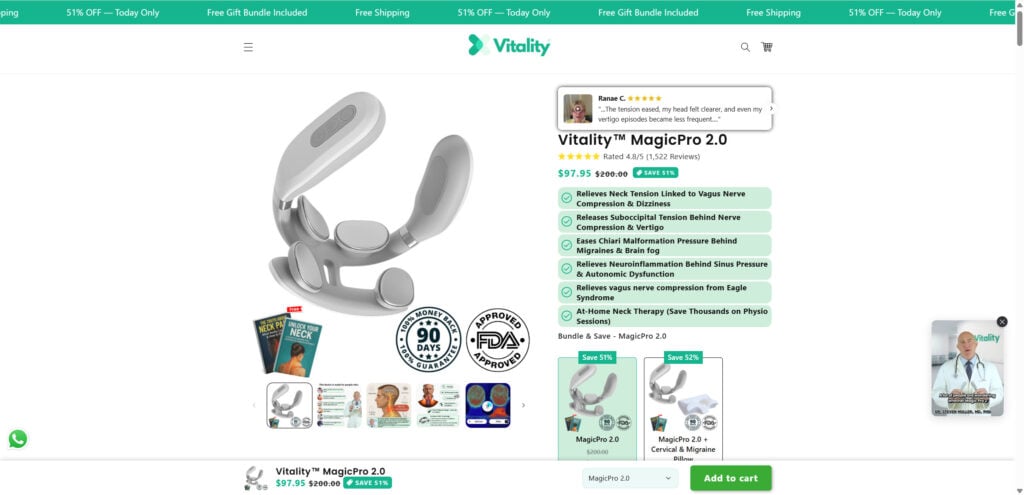
Vitality MagicPro 2.0 Overview
The official Vitality website advertises the MagicPro 2.0 as a medical-grade neck therapy device designed to relieve tension and improve circulation by stimulating the vagus nerve and cervical muscles. It’s priced at $97.95 (a supposed “51% off” from $200) and comes with bold promises like:
- “Relieves Neck Tension Linked to Vagus Nerve Compression & Dizziness”
- “Releases Suboccipital Tension Behind Nerve Compression & Vertigo”
- “Eases Chiari Malformation Pressure Behind Migraines & Brain Fog”
- “At-Home Neck Therapy (Save Thousands on Physio Sessions)”
At first glance, these claims sound scientific and convincing. The website features an alleged “Dr. Steven Muller, MD, PhD,” presented as a neurorehabilitation specialist from Harvard Medical School, who appears in promotional videos holding the device and explaining its benefits. There’s also a large “FDA Approved” logo and a “90-Day Money-Back Guarantee” seal.
However, upon closer inspection, many aspects of this presentation raise serious doubts.
1. The Product’s True Origin
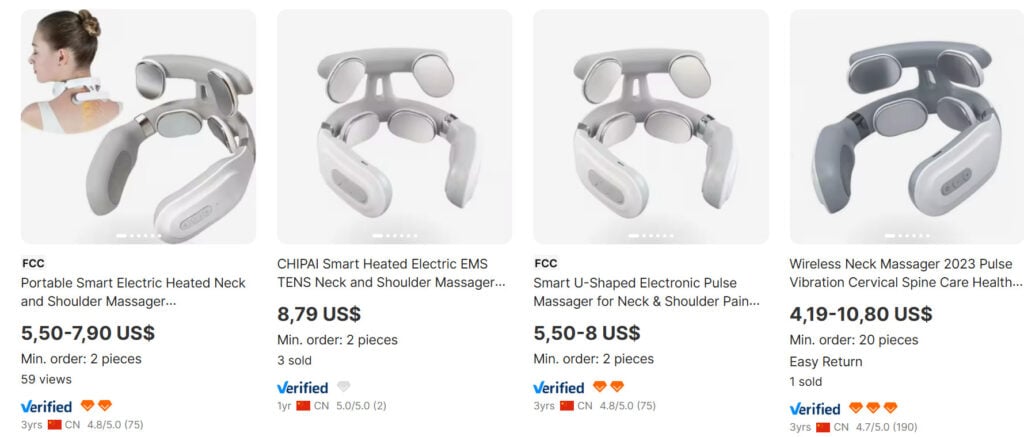
A quick reverse-image search of the Vitality MagicPro 2.0 shows that identical devices are sold across Alibaba and AliExpress under names like:
- “Smart Electric Heated EMS Neck and Shoulder Massager”
- “U-Shaped Electronic Pulse Neck Massager”
- “Wireless Neck Massager 2023 Pulse Vibration”
The wholesale price? Between $4.19 and $10.80 USD, depending on quantity.
That’s over 90% cheaper than the retail price charged by Vitality’s site.
This massive markup, combined with reused stock photos from Chinese suppliers, strongly suggests that Vitality MagicPro 2.0 is a generic mass-produced EMS (Electrical Muscle Stimulation) neck massager, not a proprietary medical invention.
2. Misleading “FDA Approved” Label
One of the most concerning claims on the Vitality website is the prominent “FDA Approved” badge displayed below the product images.
However, this is misleading.
The U.S. Food and Drug Administration does not “approve” over-the-counter massage devices. At most, certain general wellness or low-risk EMS devices may be FDA-registered, which only means that the manufacturer has filed documentation — not that the FDA has tested or endorsed the product.
When a company falsely implies FDA approval, it crosses into deceptive marketing territory, violating consumer protection laws in several countries.
3. Exaggerated Medical Claims
Vitality’s marketing language includes phrases like:
- “Releases neuroinflammation behind sinus pressure & autonomic dysfunction.”
- “Eases Chiari malformation pressure behind migraines.”
- “Stimulates vagus nerve activity for improved digestion and mental clarity.”
These are medical claims, not relaxation benefits. There is no credible peer-reviewed research showing that a handheld consumer neck massager can treat Chiari malformations or vagus nerve compression — both serious neurological conditions that require professional diagnosis and care.
In reality, the device simply delivers low-level electrical impulses and heat to the skin — the same mechanism as a $10 TENS (Transcutaneous Electrical Nerve Stimulation) unit.
4. Fake Doctor Endorsements and Unverified Testimonials
The site prominently features “Dr. Steven Muller, MD, PhD”, introduced as a Harvard-trained neurorehabilitation specialist. A reverse search reveals no academic record, publications, or verified medical license under this name. The video appears to be filmed with a hired actor wearing a white coat in front of a green screen with the “Vitality” logo.
This is a common tactic used in dropshipping operations to create perceived legitimacy.
Additionally, the website lists dozens of glowing reviews — but none are linked to verified purchases, social media profiles, or review platforms like Trustpilot or BBB. Most use generic first names, AI-generated avatars, and repetitive phrasing (“This changed my life! My neck feels 20 years younger!”).
5. The Unrealistic “90-Day Money-Back Guarantee”
Vitality claims that every order is protected by a “90-Day Peace-of-Mind Guarantee.”
Yet, numerous online complaints — including those on Reddit, Trustpilot, and consumer forums — indicate that refund requests are ignored or delayed for weeks. Customers report being told to ship the product back to overseas addresses at their own cost, often without receiving a return authorization number or confirmation afterward.
This makes the refund policy practically unenforceable, which is a hallmark of unreliable online storefronts.
6. Unverified Media Mentions
Vitality’s homepage claims the MagicPro 2.0 has been “featured in Men’s Health, Women’s Health, and Healthline.”
However, there are no traceable articles or backlinks to any of those outlets mentioning the product. A quick search across those domains confirms that no such features exist. These references are likely fabricated to lend an illusion of credibility.
7. Marketing Manipulation and “Fake Urgency”
The site uses multiple layers of psychological persuasion:
- “51% OFF — Today Only” (resets daily).
- “Free Gift Bundle Included” banners.
- “Only 6 left in stock” counters.
- “Order now to get it by November 8th.”
These scripts are automated and designed to pressure users into impulsive purchases. Such countdowns and scarcity tactics are standard in dropshipping funnels, not legitimate medical e-commerce operations.
8. Lack of Company Transparency
Vitality provides no physical address, corporate registration details, or official ownership disclosure. The contact section lists only a support email — no phone number or live chat option.
That means if something goes wrong (delayed delivery, faulty device, or refund denial), customers have no clear method of escalation.
9. Overblown “Clinical Data” and Statistics
Vitality claims that:
- “92% of users reported instant relief after first use.”
- “90% noticed posture and circulation improvement within 14 days.”
- “90% experienced better nervous system balance.”
None of these numbers are sourced or backed by clinical data. They appear fabricated for marketing purposes. No scientific study or independent testing supports these claims.
10. Identical Products, Different Brand Names
The same device is also sold under numerous aliases, including:
- NexonPulse 2.0
- MagicFlex EMS Neck Pro
- PosturePulse Therapy Device
- NeuroRelief 2.0
Each website uses identical layouts, fonts, fake doctor videos, and green-themed branding — clear evidence of a mass dropshipping network recycling the same template across multiple domains.
How the Operation Works
To fully understand what’s happening behind the scenes, let’s break down exactly how this kind of dropshipping and marketing operation runs — from sourcing to sale.
Step 1: Finding a Viral Product
Dropshippers scour Alibaba for inexpensive gadgets that can be marketed with emotional or scientific appeal.
The EMS neck massager is a perfect candidate: it looks futuristic, is cheap to import, and fits into trending wellness niches like “vagus nerve therapy,” “digital detox,” and “neck tension relief.”
Step 2: Rebranding Under a Medical-Sounding Name
They rename it to something more credible — “MagicPro 2.0” sounds like an advanced medical device rather than a $5 gadget.
They design a clean, clinical-looking website with pastel green tones, logos, and doctor images to mimic professional health brands.
Step 3: Creating Fake Authority and Legitimacy
A fake doctor persona (“Dr. Steven Muller”) is introduced to lend medical authority. Stock footage or AI-generated videos are used to simulate a physician endorsement.
At the same time, they add fake “FDA Approved” and “Clinically Tested” logos, knowing most consumers won’t verify them.
Step 4: Exaggerating Claims
The marketing team writes persuasive ad copy packed with pseudo-medical terminology like “vagus nerve stimulation,” “neuroinflammation,” and “cervicovagal relief.”
These terms sound legitimate but are rarely supported by science — they’re chosen specifically to exploit the language of health credibility.
Step 5: Inflating the Price and Adding Fake Discounts
On Alibaba, the device costs about $6. On the Vitality site, it’s marked at $200 but “discounted” to $97.95.
That fake 51% discount tricks the brain into perceiving a limited-time bargain. The profit margin per sale is over 900%, making it a goldmine for marketers.
Step 6: Running Aggressive Ads on Facebook, TikTok, and YouTube
Short videos show people claiming relief from headaches and neck stiffness within minutes. These ads often include stock testimonials and emotional hooks like “I finally feel like myself again.”
Influencers are paid small amounts to post about the product, generating social proof without real medical testing.
Step 7: Order Processing Through Third-Party Warehouses
When someone orders from vitality-official.com (or similar domains), the company doesn’t actually hold stock. Instead, orders are automatically forwarded to a Chinese supplier via AliExpress, CJ Dropshipping, or 1688.com, who ships the product directly to the customer.
That’s why shipping takes 2–4 weeks, and packages arrive in generic boxes without branding.
Step 8: Ignoring Refund Requests
Once customers start realizing the product isn’t as described, they attempt to return it. At this stage, emails go unanswered, or they’re told to send the item to an undisclosed address overseas.
Some are even asked to pay return postage higher than the device’s value, effectively discouraging refunds.
Step 9: Disappearing or Rebranding
After collecting thousands of orders, the website often shuts down, deletes its domain, or rebrands as a new “model” — for example, Vitality MagicPro 3.0.
Meanwhile, the same operators launch another site using identical templates and the same videos, starting the cycle all over again.
Step 10: Exploiting Health-Related SEO and Ads
Because “neck pain relief,” “vagus nerve therapy,” and “tension headaches” are popular Google searches, dropshippers target those keywords aggressively with paid ads.
These SEO tactics ensure that their websites appear legitimate and rank high, even though the products are generic and unsupported by science.
What to Do If You Have Bought the Vitality MagicPro 2.0
If you’ve already purchased this product, don’t panic — but act quickly. Here’s a step-by-step action plan to protect your money and information.
1. Check the Payment Method
Locate your purchase confirmation email. Identify whether you paid via PayPal, Shopify Payments, Stripe, or a credit card. This determines your refund options.
2. Contact Your Payment Provider Immediately
If the order is still processing, request a chargeback or cancellation.
Explain that the company made false claims (FDA approval, clinical backing) and that you suspect deceptive advertising.
Most banks and PayPal support disputes within 60–120 days of the transaction.
3. Save All Evidence
Take screenshots of:
- The product page, including medical claims and prices.
- The checkout confirmation.
- Any emails or messages exchanged with support.
This will help if you need to file a formal complaint or dispute later.
4. Track the Shipment
If your package was already shipped, track it using tools like 17Track.net or Cainiao. Expect long delays, as most items are shipped directly from China under ePacket or Yanwen logistics.
5. Inspect the Device Carefully
Once it arrives:
- Check packaging quality and labeling.
- Look for spelling errors or missing certifications.
- Test it — most units provide weak electrical pulses and mild warmth, not clinical results.
If it feels cheaply made or causes discomfort, stop using it immediately
6. Request a Refund (The Right Way)
Avoid relying on the seller’s “support@” email. Instead:
- File a PayPal dispute under “Significantly Not as Described.”
- Or call your bank’s dispute department for a chargeback.
Provide evidence of misleading claims, fake FDA approval, and unverified medical statements.
7. Warn Others
Report the site to:
- FTC.gov (U.S.)
- eConsumer.gov (international)
- Scamwatch.gov.au (Australia)
- Trustpilot.com — leave a detailed review warning others.
Public exposure helps prevent others from losing money.
8. Protect Your Data
If you entered your payment info directly on the site (not through PayPal), monitor your bank account closely.
Unscrupulous operators sometimes reuse customer data across multiple scam stores.
The Bottom Line
The Vitality MagicPro 2.0 is a generic Chinese EMS neck massager rebranded and sold at an enormous markup using deceptive marketing, false medical claims, and fabricated endorsements.
While the device itself may provide minor heat or pulse relief (similar to any inexpensive neck massager), its medical claims are grossly exaggerated, and its marketing practices are deceptive.
If you genuinely need relief from neck or nerve pain, consult a licensed physiotherapist or neurologist. Proven alternatives like TENS therapy units from established brands (Omron, Beurer, or iReliev) are medically registered and available from verified retailers at a fraction of the risk.
Final Verdict:
The Vitality MagicPro 2.0 is not worth buying. It’s a textbook dropshipping product wrapped in pseudo-medical marketing. The exaggerated claims, fake endorsements, and ignored refunds make it a high-risk purchase.








