

A new “Anniversary Sale” is spreading fast across Facebook and Instagram, promising up to 80% off elegant footwear and timeless women’s fashion from a boutique named Harrison & Clarke.
The website looks convincing — clean design, mature models, heartfelt storytelling, and a sentimental farewell message supposedly written by lifelong friends Claire Harrison and Rachel Clarke.
But beneath the polished surface, this sale is not what it seems.
Just like the Jolie Blake and Clara Hart Minnesota scams that appeared earlier this year, Harrison & Clarke is part of a growing network of fake online stores running identical “anniversary” or “closure” sale schemes — exploiting emotion, urgency, and trust to steal money from unsuspecting shoppers.
This investigative report exposes how the Harrison & Clarke Anniversary Sale Scam works, how it manipulates social media algorithms, what red flags prove it’s fake, and what you can do if you already placed an order.
Scam Overview
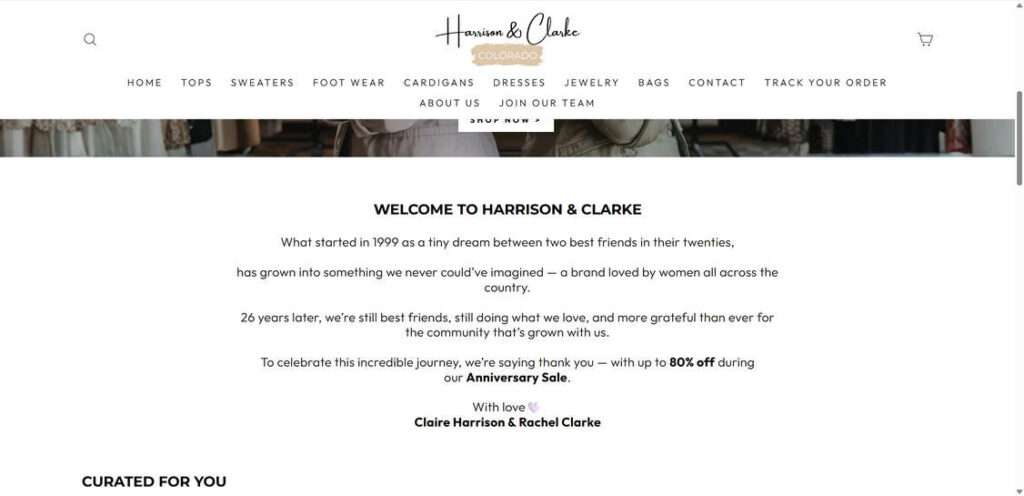
At first glance, harrisonandclarke.com seems like an established brand. The homepage opens with elegant photography: racks of linen clothing, warm lighting, and two smiling women standing confidently in a boutique doorway. The message reads:
“What started in 1999 as a tiny dream between two best friends has grown into something we never could’ve imagined — a brand loved by women across the country. To celebrate our 26-year journey, we’re offering up to 80% off during our Anniversary Sale.”
Everything about the design is crafted to create credibility and nostalgia. The text evokes friendship, longevity, and gratitude — sentiments that make the reader feel emotionally connected to the supposed founders. The tone is gentle and trustworthy, appealing to a demographic of women aged 40 and above who appreciate timeless style and online convenience.
However, a deeper look at the site’s infrastructure, history, and content reveals that none of this story is true.
1. Domain Registration and Timeline Discrepancy
According to WHOIS records, harrisonandclarke.com was registered on August 1, 2025 — less than a few months before its supposed “26-year anniversary.” No trace of the brand exists before that date. There are no archived versions on the Wayback Machine, no trademark filings, and no evidence of a fashion label named Harrison & Clarke in Colorado or anywhere else.
This “founded in 1999” backstory is a fabricated brand history, identical in style to several previous scam stores — such as Clara Hart Minnesota (“26 years of Sarah & Kate Charleston”) and Kirra Valae Coral Bay (“Resilience after Setback”). All reuse the same script with slight name changes and AI-generated photography.
2. Stolen Imagery and Fabricated Founders
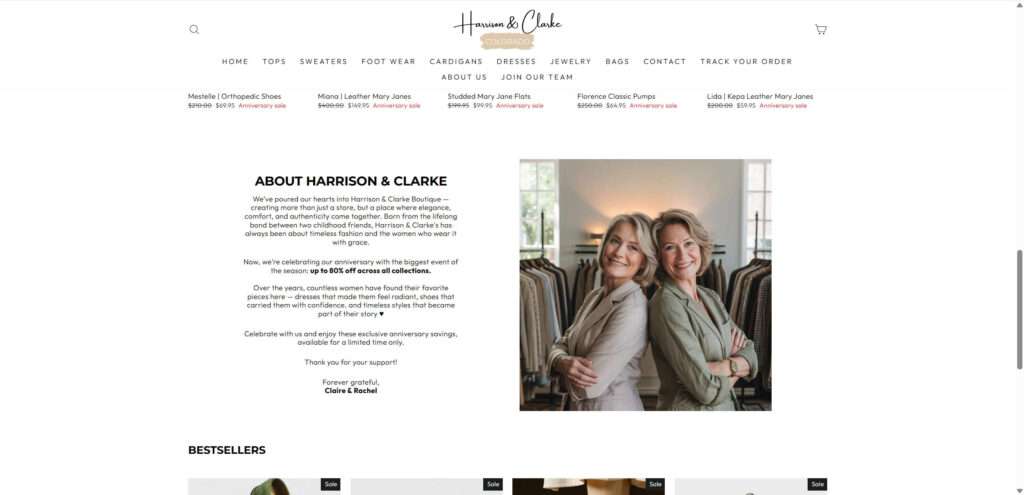
The two women displayed throughout the site — allegedly “Claire Harrison and Rachel Clarke” — are stock-photo models. Reverse image searches reveal that their photos appear on multiple commercial image banks used for advertising templates. The background storefront, supposedly the Harrison & Clarke Colorado Boutique, also appears under different names on other scam domains.
These AI-edited and stock-image composites are intended to build trust by portraying authenticity — often mimicking the branding of ethical fashion boutiques or small family-owned shops.
3. Copy-Paste Website Structure
The website layout is identical to dozens of other fraudulent “Anniversary Sale” or “Closure Sale” stores: same fonts, menus (Home – Tops – Sweaters – Footwear – Cardigans – Dresses – Bags – Jewelry – About Us – Track Order), and identical product listings with only color changes.
The so-called “Lisa Orthopedic Shoes”, “Matilda Leather Mary Janes”, and “Florence Classic Pumps” are copied wholesale from AliExpress and Taobao catalogs, yet priced as if they were premium American-made products “crafted with love in Colorado.”
4. Unrealistic Discounts and False Urgency
The homepage promotes “All Items Up to 80% Off – Limited Time Only,” reinforced by emotional copy such as “26 Years of Memories – Thank You for Your Support.”
This marketing tactic — mixing nostalgia with scarcity — is one of the oldest psychological manipulation methods in online fraud. The promise of heavy discounts plus the illusion of a long-standing brand triggers FOMO (Fear of Missing Out), pushing visitors to purchase before researching.
5. Absence of Corporate Legitimacy
A legitimate U.S. or U.K. boutique would include a verifiable address, business registration, phone number, and return policy tied to a physical company. Harrison & Clarke lists none of these. Its “Contact Us” page offers only a generic email — info@harrisonandclarke.com — and no customer-service hotline. The “Colorado” label in the logo is purely decorative; there is no such company registered in the state’s business registry.
6. Fake Testimonials and Fabricated Reviews
Many scam stores populate their pages with AI-generated reviews written in fluent but unnatural English (“The fit is perfect and the quality amazing for the price!”). Some even use synthetic profile pictures created by generative AI tools such as ThisPersonDoesNotExist. These fake reviews reinforce the illusion of popularity and reliability, especially among shoppers who glance quickly at customer feedback before buying.
7. Pattern of Clone Stores
Harrison & Clarke is not operating in isolation. Security analysts and consumer forums have identified dozens of cloned boutiques under different names, each reusing the same structure:
- Clara Hart Minnesota
- Kirra Valae Coral Bay
- Jolie Blake Boutique
- Whitmore Oxford
- Eleanor Cove London
- Mary Tess New York
Each follows the same life cycle: rapid Facebook ads launch → short burst of orders → domain vanishes after chargebacks begin.
8. Target Audience and Psychological Manipulation
These scams predominantly target women over 40 interested in boutique-style clothing and shoes. Ads appear on Meta’s network, particularly Instagram Reels and Facebook Marketplace, where the demographic skews toward users who value nostalgic storytelling.
By presenting the shop as a “women-founded small business closing after 26 years,” the scammers tap into empathy and loyalty — emotional levers that make consumers feel they are helping rather than being defrauded.
9. Red Flags Across Technical Analysis
- Newly created domain (August 2025)
- No SSL organization validation
- Shared hosting with multiple known fraudulent sites
- Recycled product photos
- Unrealistic discount structure (70–80 % off everything)
- No legal company name, tax ID, or privacy policy
10. Why It Matters
Scams like Harrison & Clarke erode public trust in online shopping and disproportionately harm older demographics, who are statistically more likely to trust polished websites. Once victims realize the truth, chargebacks are difficult, refunds rare, and their personal data often reused for future fraud.
How the Harrison & Clarke Scam Works
The Harrison & Clarke Anniversary Sale scam follows a highly organized, repeatable formula used by networks of fraudulent e-commerce operators. These groups design polished websites that appear to represent small local boutiques while secretly being part of a centralized dropshipping and payment-harvesting scheme.
To understand how this scam deceives so many, it’s important to break it down step-by-step — from how it reaches shoppers to what happens after you place an order.
Step 1: Targeting Shoppers Through Emotional Facebook and Instagram Ads
The scam begins with social media advertising.
Scammers launch sponsored posts on Facebook and Instagram showing relatable women — often in their 40s, 50s, or 60s — smiling in boutique settings. The ads use inviting phrases like:
- “After 26 wonderful years, we’re closing our beloved boutique.”
- “As we celebrate our final anniversary, enjoy up to 80% off storewide.”
- “A heartfelt thank-you to all our loyal customers — this sale is our goodbye gift.”
These phrases sound personal, sentimental, and authentic. Combined with believable imagery (often generated or borrowed from real stores), they make users feel they’ve discovered a local, woman-owned small business.
When you click the ad, you’re taken to harrisonandclarke.com, a fully functional Shopify-style storefront designed to appear legitimate. The page loads fast, the design feels elegant, and there’s a sense of warmth — carefully chosen to reduce suspicion.
Step 2: Building False Trust with Emotional Branding
On the homepage, shoppers are greeted by a heartfelt story. “Claire Harrison” and “Rachel Clarke” — supposedly lifelong best friends — claim to have started their boutique in 1999 and grown it through dedication and friendship. The tone evokes nostalgia and gratitude:
“After 26 years, we’re still best friends doing what we love. To celebrate this journey, we’re offering our biggest anniversary sale yet — up to 80% off all collections.”
To further reinforce the illusion of legitimacy, the site includes professional photography of the founders standing in front of racks of clothing. These are AI-generated composites or licensed stock images edited to include the “Harrison & Clarke Colorado” signage.
This emotional backstory accomplishes two goals:
- It humanizes the store — shoppers feel they are supporting real people, not a faceless company.
- It justifies the discount — the sale is presented as an act of gratitude, not desperation.
Step 3: Fake Product Listings and Artificial Scarcity
The store features dozens of categories: Tops, Sweaters, Dresses, Footwear, Jewelry, Bags, Cardigans.
Every product listing includes:
- A marked-down price (e.g., $250 → $69.95)
- The phrase “Anniversary Sale” in red
- A “Sale” tag and limited stock messages like “Only 3 left!”
The images are lifted directly from AliExpress, DHGate, and Chinese wholesale platforms, but stripped of brand logos. These items are mass-produced products costing $10–$15, presented as premium boutique pieces supposedly “crafted in Colorado.”
Scammers rely on false urgency. Timers, “final day” banners, and pop-ups such as “Sarah in Texas just bought the Lisa Orthopedic Shoes” push users to buy quickly. These notifications are fake and generated by a plug-in that mimics live sales.
Step 4: Secure Payment Illusion
At checkout, everything looks authentic. The site uses HTTPS encryption and offers what appear to be secure payment options: Visa, Mastercard, PayPal, and Apple Pay. There’s even a “30-Day Money-Back Guarantee” and a “Free Shipping” icon.
However, the payment processor is usually linked to offshore merchant accounts that allow high-risk transactions. This setup ensures scammers can withdraw funds quickly and vanish once complaints begin.
Some users who pay via PayPal may initially see a legitimate merchant name, but this changes later when the payment gets routed through a shell entity.
The moment you complete your payment, your details — including full name, address, email, and card info — are harvested. The transaction is logged into the scam network’s central dashboard.
Step 5: Automated Confirmation and the Waiting Game
Buyers immediately receive an email that looks professional, often from “support@harrisonandclarke.com” or “order@harrisonandclarke.com.”
The email includes:
- Order number
- Estimated shipping time (7–14 business days)
- Tracking link placeholder
The tracking link usually leads nowhere, or to a generic shipment tracker that never updates. In many cases, a “shipped” status appears after a few days — creating a false sense of progress.
Some victims may receive cheap knockoffs weeks later, usually shipped from China under unrelated sender names. This is a deliberate strategy: sending a low-value item (like socks or keychains) creates false evidence of delivery, making refunds through banks harder.
Step 6: Disappearing Customer Support
When buyers attempt to contact support, their emails go unanswered. Some receive automated replies claiming delays due to “high demand during the anniversary sale.”
Within 3–4 weeks, the website either:
- Shuts down completely, redirecting to an error page
- Changes its domain name and reappears under a new identity (for example, “Eleanor Cove London,” “Harrison & James Boutique,” etc.)
The pattern ensures continuity: once too many complaints accumulate or chargebacks start, the scammers simply relaunch under a new name with the same design and script.
Step 7: Recycling and Expansion
Scammers behind these operations manage multiple domains simultaneously, using a shared content management system. They buy expiring domains with British or American-sounding names, such as “Harrison & Clarke,” “Whitmore Oxford,” or “Clara Hart Minnesota,” because these evoke prestige and familiarity.
Each domain runs for 4–8 weeks, collects thousands of dollars, and shuts down before law enforcement or payment processors can intervene.
This “burn-and-rebuild” strategy ensures constant profitability with minimal risk to the operators.
What to Do If You Have Fallen Victim to the Harrison & Clarke Scam
If you ordered from harrisonandclarke.com or a related site and now suspect it’s a scam, act immediately. The faster you respond, the higher your chances of recovering your money and preventing further damage.
1. Contact Your Bank or Credit Card Company
If you paid by card, contact your bank or card provider and request a chargeback.
Explain that the transaction was made to a fraudulent online store impersonating a legitimate business. Provide any proof you have — the website link, receipts, or screenshots of ads.
Banks often have buyer protection for online scams, especially when the merchant fails to deliver goods or ships counterfeit products.
If you used PayPal, open a dispute through the Resolution Center under “Item Not Received” or “Significantly Not as Described.” Escalate the case quickly if the seller provides no response.
2. Report the Scam
Reporting helps authorities track scam networks and warn others. Submit detailed complaints to:
- FTC (Federal Trade Commission): reportfraud.ftc.gov
- IC3 (Internet Crime Complaint Center): www.ic3.gov
- Better Business Bureau (BBB): file under “Online Purchase Scam”
- Your local consumer protection agency
If you live outside the U.S., report to your national cybercrime center (for example, Action Fraud in the UK or eConsumer.gov internationally).
3. Warn Others and Document Everything
Leave factual reviews on consumer websites such as Trustpilot, Reddit’s r/Scams, or Scamwatcher.com. Include the domain name, screenshots, and order details (without exposing personal info).
Sharing helps protect others from falling victim to the same operation once it rebrands under a new name.
4. Secure Your Devices and Accounts
Scam websites like Harrison & Clarke often contain tracking scripts and malicious ad networks. After visiting or purchasing, you should:
- Run a full scan with Malwarebytes or a similar anti-malware program to remove potential tracking cookies or injected scripts.
- Install Malwarebytes Browser Guard to block known phishing and scam websites.
- Use AdGuard to block deceptive ads that may lead to clone stores or fake shopping promotions.
These tools prevent exposure to similar scam ads in the future.
5. Change Your Passwords and Monitor for Unusual Activity
If you used the same password on multiple sites, change it immediately. Scammers sometimes attempt credential stuffing, reusing stolen login details to access other accounts.
Monitor your email and financial transactions for unusual activity or subscription charges.
6. Learn How to Recognize Similar Scams
Future scams will likely look just as convincing — same aesthetic, emotional storytelling, and fake founders. To avoid them:
- Always check the domain’s creation date (use WHOIS). A recent registration is a major red flag.
- Look for real company registration numbers or business addresses.
- Search “[store name] + scam” before buying.
- Be skeptical of global shipping boutiques offering 80% discounts and no phone number.
- Reverse-image search product photos to see if they appear on AliExpress.
7. Stay Alert for Related Domains
These scammers often reuse content across different sites. If you encounter any boutique with a similar style, it may be part of the same network. Known connected domains include:
- kirravalae-coralbay.com
- clarahartminnesota.com
- jolieblake.com
- whitmore-oxford.com
Bookmark legitimate retailers and avoid shopping through random social media ads.
The Bottom Line
The Harrison & Clarke Anniversary Sale Scam is yet another example of how sophisticated online fraud has become — blending emotional storytelling, realistic design, and automated marketing to deceive consumers.
It hides behind a heartwarming narrative of friendship and gratitude, but everything — from the supposed founders to the photos and reviews — is fabricated. The site was registered only weeks before launching and mirrors dozens of previous scams that follow the same formula: promise unbelievable discounts, collect payments, and disappear.
If you’ve already purchased from this site, act immediately: request chargebacks, report the fraud, secure your devices, and spread awareness. Installing tools like Malwarebytes, AdGuard, and browser-level scam protection can help block similar sites before they load.
Ultimately, remember this golden rule:
If a store claims to be decades old but its domain is brand new — and everything is 80% off — it’s not a sale, it’s a setup.
Stay cautious, verify before you buy, and help others recognize these digital traps before they lose their money too.








