

Across Facebook, Instagram, YouTube Shorts, and TikTok, emotional ads for Henry’s Caps have been spreading quickly. The ads show an older gentleman in a workshop filled with caps. He appears friendly and humble. A short message claims that after fifty-seven years of working with his hands, he is finally retiring. The supposed farewell sale offers up to eighty percent off every cap because he is closing his workshop.
The story feels warm and personal, and the website looks modest and charming. However, the reality behind Henry’s Caps is vastly different from what the ads present. The entire story is fictional, the website was created recently, and the photos of the elderly man in the workshop were produced using artificial intelligence or taken from unrelated sources. Henry’s Caps is part of a network of fake online boutiques that use manipulated stories, fabricated founders, and unrealistic discounts to steal money from unsuspecting online shoppers.
This detailed investigation explains how the Henry’s Caps Closing Sale Scam works, how it attracts victims, what red flags expose the deception, and what to do if you already placed an order.

Scam Overview
At first glance, Henry’s Caps feels like a small, long-standing artisan workshop. The homepage shows a white-bearded man standing beside shelves of wool caps, flat caps, and newsboy hats. The tone is nostalgic, calm, and humble. The introductory message reads like a farewell letter from an aging craftsman who wants to thank his customers before closing his shop forever.
The site claims:
“After fifty-seven wonderful years of creating caps by hand, I am ready to retire. This is my farewell sale. Every cap must find a home.”
The story is touching, but a detailed analysis reveals that every major claim on the website is false.
A fabricated history presented as truth
Henry’s Caps claims to have been in business for fifty-seven years. However, the domain henrys-caps.com was registered recently. The associated clone domain byhenrys-caps.com is also new. There is no evidence of any business named Henry’s Caps in public directories, no registered business name, no history of customer reviews, and no mentions in local media archives.
A store that existed for more than half a century would have left some trace online, especially in an era where even small family-run workshops maintain a social media presence or appear in local Google Maps listings. Henry’s Caps has no historical footprint of any kind.
A fictional founder created with synthetic images
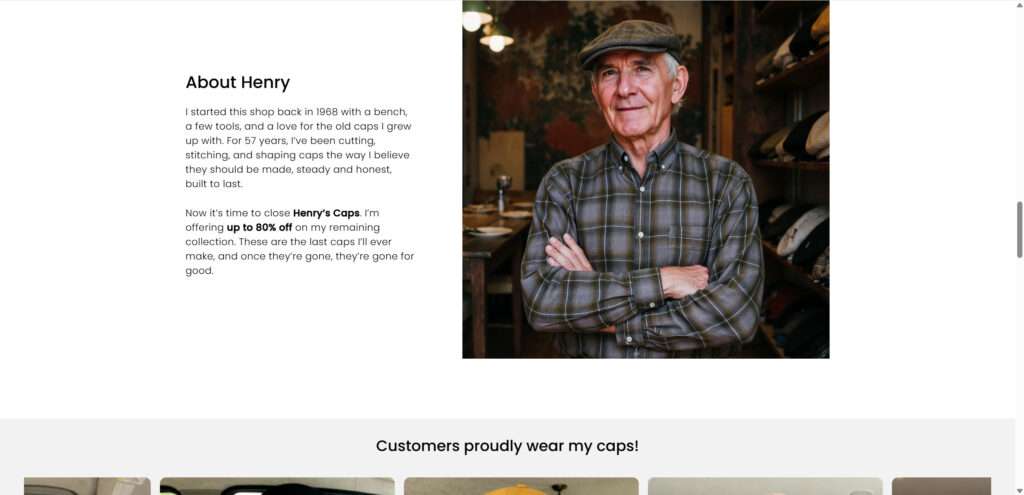
The friendly elderly gentleman who appears in Henry’s Caps advertisements does not exist. His photos are AI generated or taken from unrelated stock photo collections. In some images, the background changes between different scam websites. The wooden shelves, workshop tables, and lighting vary in subtle ways, despite claiming to be one consistent workspace.
There are small visual inconsistencies that signal artificial generation. For example, some photos show mismatched shadows, distorted fingers, or inconsistent fabric folds. These anomalies are typical results of AI image generation tools.
Identical structure to other closure sale scams
Henry’s Caps is not unique. It is part of a larger network responsible for dozens of similar fake boutiques that share almost identical design templates and narrative structure. Examples include:
Carmen Bella Closing Sale
Whitmore Oxford Clearance
Clara Hart Minnesota Anniversary Sale
Kirra Valae Coral Bay Celebration Sale
Harrison and Clarke Colorado Farewell Sale
Each of these online boutiques follows the same formula:
A personal goodbye message from a supposed founder
A claim of twenty to sixty years of business history
A dramatic announcement of a final sale with up to eighty percent discounts
Stock or AI generated photos of people posing as founders
A brand story designed to evoke trust and nostalgia
No business registration or verifiable corporate information
Henry’s Caps fits this pattern perfectly.
Unrealistic discounts across the entire store
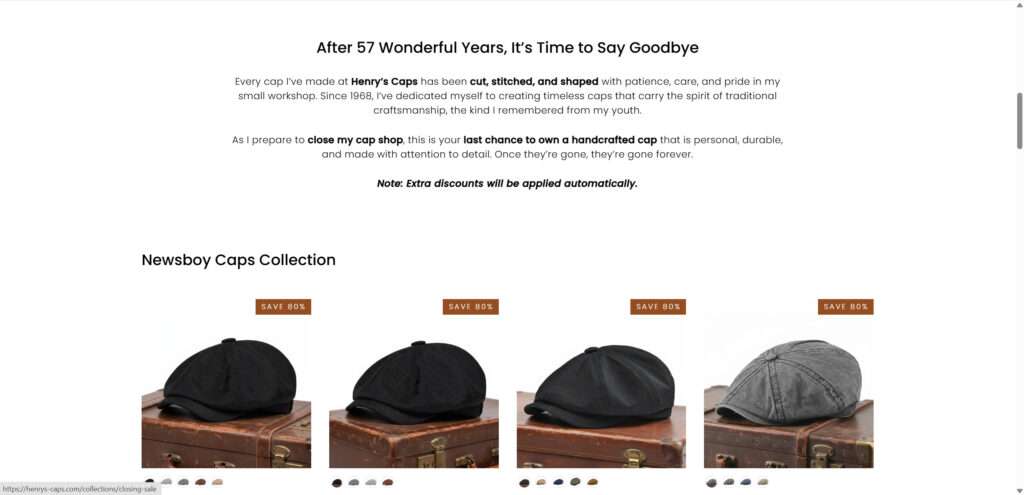
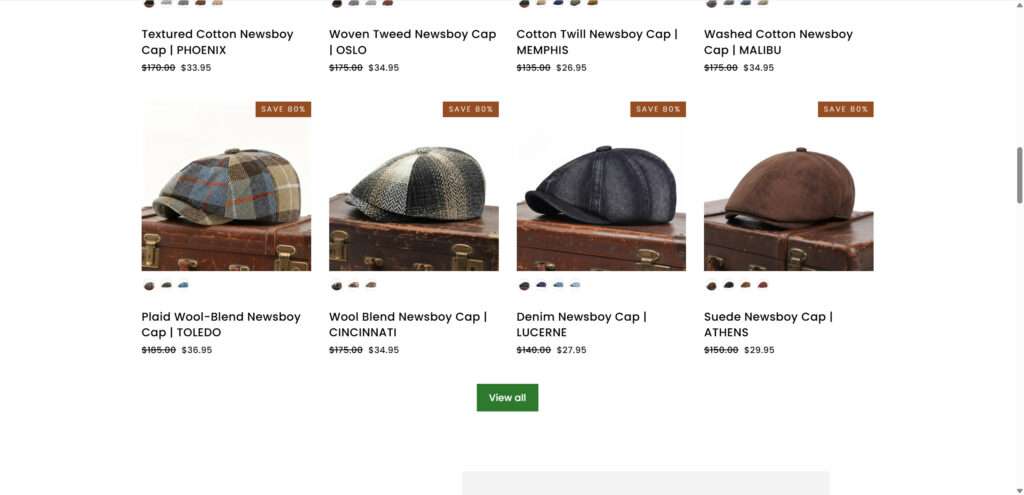
Every cap on Henry’s Caps is discounted by sixty to eighty percent. The site claims that every item must go because the shop is closing. Real boutiques do not discount every item uniformly. Real clearance sales have variation in pricing depending on inventory, quality, and demand. The uniform discount structure is a typical signal of a fraudulent dropshipping scam where the products are not genuinely in stock.
No proof of craftsmanship or original products
The caps shown on Henry’s Caps appear on numerous Chinese wholesale platforms. They also appear on other scam boutiques with different brand names. The photos have no unique labeling or watermarks. There is no evidence that Henry, the supposed founder, ever crafted these items.
A complete absence of corporate identity
Henry’s Caps lists no physical address, no manufacturer, no business registration, and no verifiable contact details. There is only a generic email address on the Contact page. Most legitimate retailers provide real phone numbers or licenses. The absence of these details signals that the store is not tied to any legal entity and is designed to disappear once enough victims complain.
No social media presence despite claiming fifty-seven years of business
The website includes small icons for Facebook, Instagram, and Pinterest, but all icons lead nowhere. The brand has no social media accounts despite claiming decades of loyal customers. For a store that supposedly existed for more than half a century, the complete lack of online engagement is suspicious.
Cloned domains released simultaneously
Henry’s Caps operates on multiple domains at the same time. When one domain becomes flooded with negative reviews or flagged by consumers, a second domain is activated with identical content. This approach allows scammers to continue receiving orders even when complaints begin to accumulate.
This rotating domain strategy is used by many scam networks because it allows them to extend the scam’s lifespan and avoid immediate shutdown.
The promise of “handmade quality” at impossibly low prices
Henry’s Caps claims that every cap is handmade from premium wool or tweed and takes hours of craftsmanship. However, the same caps appear on wholesale marketplaces for a few dollars. Premium materials such as high quality wool and linen cannot be produced at such low costs, especially when combined with claims of individual craftsmanship.
The contradiction between the handmade artisan story and the mass produced product images is a major red flag.
Next, let’s break down exactly how scammers carry out this scam from start to finish.
How the Henry’s Caps Scam Works
The Henry’s Caps Closing Sale Scam is not a random or amateur effort. It follows a precise operational model that has been used successfully across hundreds of fraudulent boutique websites. This section explains in detail how the entire scheme functions, from the moment a victim sees an advertisement to the point where the scammers disappear with the collected money.
Step 1: Emotional storytelling through paid social media ads
The entire scam begins with targeted advertisements on Facebook, Instagram, TikTok, and sometimes Google Display Network. The ads show an elderly man in a cozy workshop filled with caps. The message is crafted to evoke emotion rather than logic. It presents the story of a man named Henry who has been making hats for fifty-seven years and is now retiring. He wants to offer his remaining stock at massive discounts to thank loyal customers.
These ads are not random. Scammers pay very little per ad impression because they use emotional narratives that produce high engagement. The message appeals to older audiences, especially people who value craftsmanship, handmade products, and small businesses.
Step 2: A website designed to feel warm, honest, and familiar
Once a user clicks the ad, they land on the Henry’s Caps website. The site is built with a template that repeats across dozens of scam boutiques. However, it uses soft colors, cozy imagery, and touching text that feel relatable and trustworthy. The site is laid out clearly, with product categories and promotional banners for the closure sale.
This emotional presentation lowers the shopper’s guard. They feel as if they are buying from a small business owner, not a faceless corporation. This type of presentation is specifically chosen because it appeals to older demographics who often feel positive about supporting independent artisans.
Step 3: Manipulation through urgency and scarcity
Almost every item is displayed with a large discount and a small timer indicating that the sale ends soon. Many products show messages such as “Only two left in stock” or “Five people are viewing this item right now.” These messages are not real. They are generated by scripts intended to create a sense of urgency.
The goal is not to provide accurate inventory information. The goal is to pressure the visitor into buying quickly before they have time to research the store. The scarcity effect is one of the strongest psychological triggers used in fraudulent ecommerce.
Step 4: The checkout process hides the true merchant
Once the victim adds items to the cart and proceeds to checkout, the site uses a payment screen that looks professional. However, the payment gateway does not display a verified business name. Instead, it processes the charge through shell companies or foreign entities that are not registered to Henry’s Caps.
This setup allows scammers to collect money quickly and move it through offshore accounts. It becomes difficult for victims to identify who took their payment. It also makes it harder for banks to trace the funds.
Step 5: A fake confirmation email and a long waiting period
After payment, victims receive a confirmation email containing a professional looking receipt. This email often includes an order number and an estimated delivery time. The confirmation email is meant to create a feeling of normalcy. Victims often relax at this stage and assume the order is legitimate.
Within two to five days, the victim may receive a second email with a tracking link. This link usually directs them to a generic tracking site that either does not update or displays vague information such as “shipment preparing.”
This long delay has two purposes. First, it delays chargeback attempts because victims are uncertain. Second, it allows scammers to continue collecting money from new victims while earlier victims remain confused.
Step 6: No product arrives or a counterfeit item is sent
There are three outcomes for victims:
No item arrives at all.
A completely unrelated item arrives.
A poor quality replica arrives that is worth only a few dollars.
Some victims receive a flimsy cap with no resemblance to what was advertised. Others receive unrelated items such as socks or scarves. Scammers do this intentionally because a delivered package can make chargebacks more difficult. The goal is not to provide a real product but to create just enough confusion to slow down complaints.
Step 7: Customer service disappears
Victims who attempt to contact Henry’s Caps receive no meaningful response. Emails go unanswered, or automated replies request patience because of “high order volume.” The store does not provide real support. It never intended to.
Step 8: The domain shuts down and a new one appears
Once enough negative reviews accumulate online, Henry’s Caps closes the domain. The scammers then launch a new version of the site under a different name. They repeat the process with fresh ads, fresh victims, and new branding. The entire network relies on rapid brand turnover to avoid identification and legal action.
What to Do If You Have Fallen Victim to the Henry’s Caps Scam
If you placed an order on the Henry’s Caps website and now realize it is fraudulent, it is important to act quickly. There are several practical steps you can take to recover your money, protect your accounts, and prevent further harm. The sooner you begin the process, the better your chances of receiving help from your bank or payment provider.
Step 1: Contact your bank or card issuer immediately
If you paid with a credit or debit card, contact your bank as soon as possible. Explain that you made a purchase from a website that turned out to be fraudulent. Ask for a chargeback under the category of “goods not received” or “fraudulent merchant.”
Be ready to provide evidence. This may include:
Your order confirmation
Screenshots of the website
Screenshots of advertisements you saw
Email correspondence
Tracking information (if any)
Most banks offer protection for unauthorized or fraudulent purchases. Acting quickly increases the likelihood that the bank can recover your money.
Step 2: If you paid with PayPal, open a dispute
If you used PayPal, log into your account and open a claim in the Resolution Center. Choose either “Item Not Received” or “Significantly Not as Described.” PayPal usually requires sellers to provide proof of delivery. Since scam sellers often cannot provide authentic tracking information, many victims receive refunds.
If a counterfeit product was delivered, explain in detail how it differs from what was advertised. Upload photos to support your claim.
Step 3: Report the scam to consumer protection agencies
Reporting the scam will not only help you but may also assist others who are at risk. Submit a complaint to:
The Federal Trade Commission (United States)
The Internet Crime Complaint Center
The Better Business Bureau
Your national consumer protection agency if you are outside the United States
Your local authorities if financial loss is significant
Include both primary domains that Henry’s Caps uses, which are henrys-caps.com and byhenrys-caps.com.
Step 4: Scan your device for malicious scripts or trackers
Scam websites sometimes contain harmful scripts that track activity or install unwanted files. It is important to clean your device.
Run a full system scan with a trusted security program such as Malwarebytes.
Install Malwarebytes Browser Guard to block known scam domains in the future.
Use AdGuard to filter deceptive advertisements that promote scam stores on social media.
These tools improve safety when browsing and reduce the risk of falling for similar scams again.
Step 5: Change passwords and monitor accounts
If you used an account with the same password on multiple sites, change that password immediately. Scammers sometimes reuse stolen email and password combinations in credential stuffing attacks.
Check your financial accounts for:
Unusual charges
New subscriptions
Unrecognized logins
If you see suspicious activity, notify your bank or payment provider immediately.
Step 6: Warn others to prevent further harm
Scammers rely on silence. Victims who speak up help stop others from being harmed. Share your experience on reputable platforms such as Trustpilot, Reddit’s r/Scams community, Scamwatcher, or consumer protection forums. You can also report scam advertisements directly on Facebook and Instagram using the “Report Ad” option.
Step 7: Watch for clone sites that repeat the same scam
Scam networks frequently recycle the same template under different names. If you see another boutique claiming to have a founder retiring after fifty or more years and offering eighty percent discounts, it is likely related to Henry’s Caps. Avoid purchasing from similar sites and always check domain registration dates before placing orders.
The Bottom Line
The Henry’s Caps Closing Sale Scam is a well designed and emotionally manipulative online fraud that pretends to be a retirement sale run by an elderly craftsman. The storyline is crafted to appeal to older consumers who appreciate traditional craftsmanship and want to support small businesses. Unfortunately, the entire presentation is fiction. There is no Henry, no workshop, no fifty-seven year history, and no genuine inventory.
This scam follows a predictable cycle. It launches emotional ads, collects payments through unverified processors, delays victims with automated emails, provides either counterfeit products or nothing at all, and then closes the domain once complaints rise. Afterward, the scammers reopen under a new name and repeat the process.
The best defense against scams like this is awareness and caution. Before buying from an unfamiliar online store, take a moment to research the domain, verify the business information, read independent reviews, and search the store name alongside the word scam. If something feels out of place, trust your instincts and avoid purchasing. Using secure payment options and browser protection tools can also reduce risk significantly.
Stay alert, act quickly if you are affected, and help others by sharing accurate information. Scam networks succeed when victims remain silent and fail when people speak up and expose them.
Frequently Asked Questions
Is Henry’s Caps a real business?
No. Henry’s Caps is not a real business. The website pretends to be an artisan workshop run by an elderly man named Henry who is retiring after fifty-seven years of work. However, the domain was created recently, there is no traceable business registration, and the photos used on the site are AI generated or taken from unrelated sources.
Why does Henry’s Caps claim to be closing after fifty-seven years?
The closure story is part of an emotional manipulation strategy. Scam websites often claim long histories to create trust and nostalgia. By saying they are closing after many decades, they encourage shoppers to act quickly and take advantage of fake discounts before the shop disappears.
How do scammers make the site look genuine?
Scammers use several techniques. They design the site with a professional layout, display stock photos of workshops, include fake reviews, and insert emotional text that feels authentic. They also add meaningless trust badges and vague return policies. These elements are meant only to convince visitors that they are dealing with a real business.
Why are all items discounted by seventy or eighty percent?
Unrealistic discounts are a major red flag. Scam boutiques use high discount percentages to create urgency and encourage impulse buying. Real clearance sales do not discount every item uniformly and do not apply such extreme reductions across an entire catalog.
What happens after you make a purchase?
Victims usually receive an order confirmation followed by a fake tracking number. No real shipment is prepared. Some victims receive cheap or unrelated items sent from offshore warehouses. Many receive nothing at all. Customer service disappears after payment is processed.
Can victims get their money back?
Yes, but quick action is important. Victims should contact their bank or card issuer and request a chargeback. Those who paid with PayPal should open a dispute in the Resolution Center. Providing evidence increases the chances of a successful refund.
What should I include when filing a chargeback?
Include your order confirmation, screenshots of the website, proof that the domain is recently registered, and any email communication you received. If you received a counterfeit item, photograph it alongside the product shown on the website to demonstrate the difference.
What should I do if I clicked on an advertisement for Henry’s Caps?
If you clicked the ad but did not enter payment information, scan your device to ensure no tracking scripts remain. Install protection tools such as Malwarebytes Browser Guard or AdGuard. If you entered payment information, contact your bank immediately to check for unauthorized transactions.
How do I recognize similar scams in the future?
Look for these signs:
Recently created domain names
No business registration information
Emotional backstories with no proof
Uniform high discounts across all products
Generic policies with no physical return address
Stock or AI generated photos
No social media presence despite claims of long history
If you see several of these signals, avoid purchasing.
Are there other scams that copy the same structure?
Yes. Many scam boutiques use identical templates, only with different names. Examples include Harrison and Clarke, Carmen Bella, Whitmore Oxford, Clara Hart Minnesota, and many others. All follow the same pattern of emotional storytelling and unrealistic discounts.
Can browser protection help prevent these scams?
Yes. Tools such as Malwarebytes and AdGuard can block malicious ads, prevent access to known scam domains, and filter deceptive promotions on social media. Using these tools reduces exposure to fake boutiques and phishing websites.
Why do scam stores disappear so quickly?
Scammers shut down their sites once complaints accumulate. They then launch a new website under a different name using the same template. This strategy avoids legal consequences and extends the lifespan of their operation.
How do scammers avoid being caught?
They hide behind unregulated payment processors, offshore hosting, privacy protected domain registration, and rapidly changing brand identities. This makes it difficult for authorities to track them. However, widespread reporting and consumer awareness significantly reduce their impact.








