

Something strange has been happening online. A cute, fluffy robotic puppy called WiggyDog has been popping up in Facebook ads, TikTok videos, and YouTube shorts, charming millions with its soft curls and supposed AI powered personality. The clips feel innocent enough, almost irresistible, and for a moment you might even believe this little toy could become a child’s new best friend.
But the closer you look, the more the story begins to shift.
The promises get bigger. The claims get bolder. And behind those heart melting images is a reality that looks nothing like what buyers expect.
Before you decide whether WiggyDog is worth your money, here is what you need to know about the operation behind it.
Scam Overview
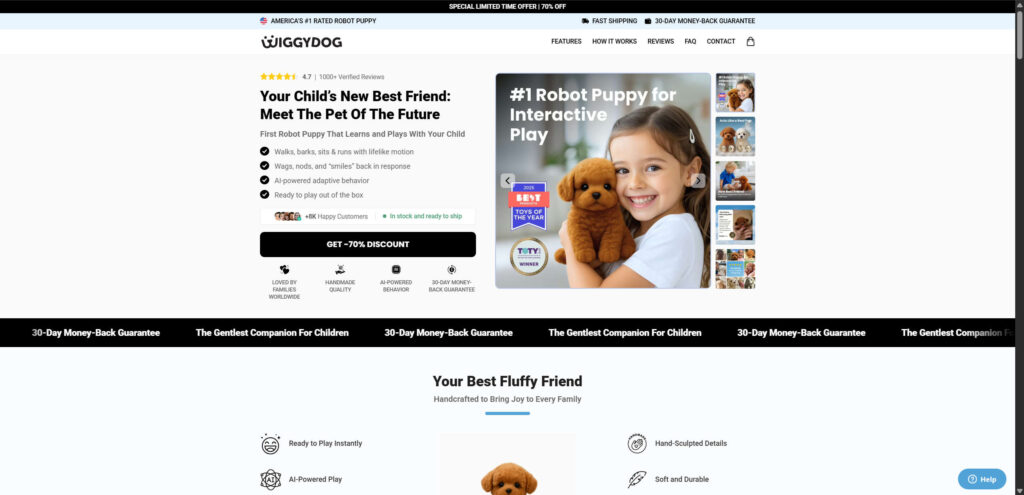
WiggyDog is presented as a high tech robotic companion designed for children. The website claims it has intelligent behavior, sensor driven reactions, emotional engagement, and adaptive motion that makes it feel almost alive. The marketing copy emphasizes how it teaches empathy and kindness. The homepage includes shiny badges that claim the toy won awards. It even shows a fake testimonial from a “kindergarten teacher” who supposedly uses WiggyDog in the classroom.
When you look at the images on the site, the patterns are familiar. One image shows a child kneeling in the park with the WiggyDog toy in front of her. She is holding a leash, which implies the puppy can walk beside her. Another image shows someone pressing a button on the toy’s belly to turn it on, implying a built in motor and sound system. Many of these photos resemble the ones used in previous robotic dog scams, often with the same color schemes and identical plush designs.
The homepage also includes a comparison chart. It contrasts WiggyDog with generic “other toys,” suggesting that the competitor toys lack realism, craftsmanship, and interactive ability. According to the chart, WiggyDog offers realistic behavior, touch responsive interactions, premium materials, and a sense of companionship. None of this aligns with what customers actually receive.
The reviews that appear on the page are another sign something is wrong. They show perfectly staged photos of smiling parents and children holding what appears to be a fluffy robotic dog. Yet the expressions, camera angles, and background styling reveal that most of these images come from stock photography libraries. In some cases, the faces are AI generated. The names under the reviews vary from region to region depending on your location, which is typical of this scam network.
One striking fake review shows a woman holding a white fluffy dog. Another shows a young girl hugging the brown version of the toy. Both images are designed to spark emotional connection. They encourage buyers to imagine their own family in the same joyful moment.
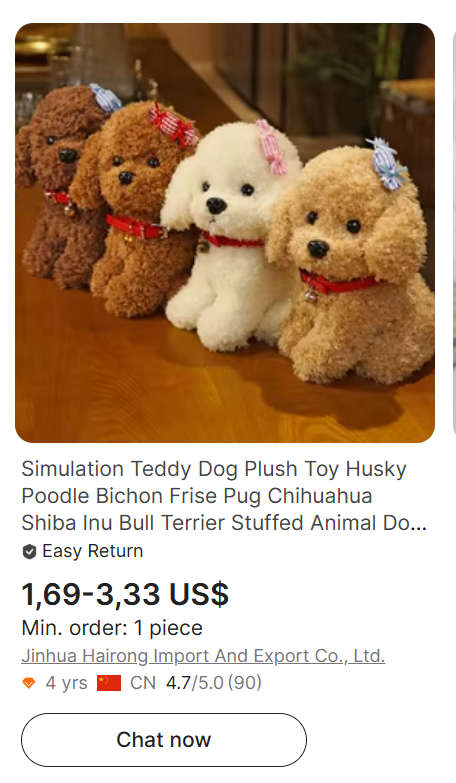
Another suspicious detail involves the claim that WiggyDog is built with “German engineering excellence.” This phrase appears repeatedly even though the company hides all manufacturing details. There is no mention of a real business address, no company registration number, and no manufacturing certification. When you look closely at the packaging images, the toy strongly resembles a $2 to $4 plush dog sold on Alibaba and AliExpress. In one of your images, the exact same dog shape, color, and posture appear in a product listing from a Chinese supplier. The listing shows several plush dogs with a price that tops out at just over $3.
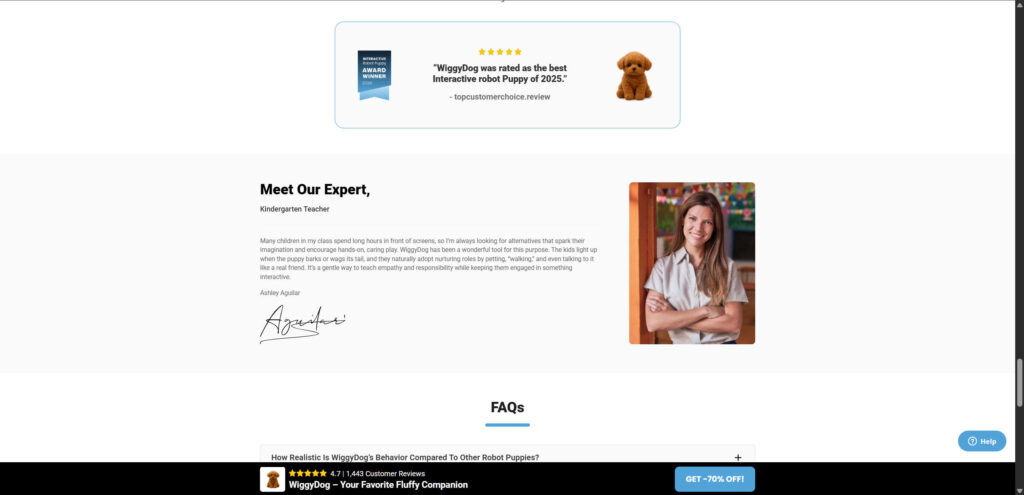
The website goes even further by displaying awards that do not exist. For example, one image on the WiggyDog website shows a digital badge labeled “Interactive Robot Puppy Award Winner 2025.” There is no such organization offering awards of this type. These graphic badges are created solely to boost trust and increase conversions.
The homepage includes a claim that the toy is “America’s #1 rated robot puppy.” Yet the business does not operate from the United States. It does not ship from the United States. It does not even list a United States office. Instead, orders ship from warehouses in China, exactly like the other robotic dog scams that have circulated under different names.
The videos on social media also deserve closer attention. Some clips show a dog that appears to walk, move its head, or wag its tail smoothly. When you examine these videos closely, they appear to be AI generated animations or digital manipulations. There is no mechanical structure inside a $3 plush toy that could replicate this level of movement. The real toy has no joints, motors, or servo mechanisms.
Another notable sign appears in the marketing language. The website uses phrases like “AI powered play,” “adaptive behavior,” and “touch responsive interaction.” Yet none of these features exist in the real item. These descriptions are used repeatedly across multiple scam stores, each time paired with different product names.
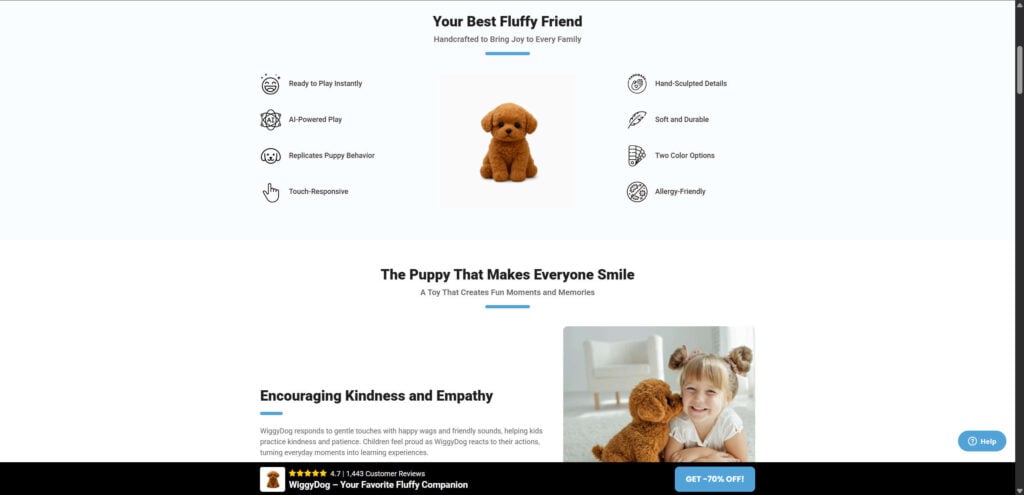
The site also displays a floating pop up at the bottom, showing a customer rating of 4.7 out of 5 from 1,443 reviews. This number is fabricated and automatically inserted using a script. It is not linked to any real review platform such as Trustpilot, Google Reviews, or Amazon. Stores in this scam network use identical pop ups regardless of the product being sold.
The “How It Works” section also raises questions. It shows a three step process where the buyer places batteries in the toy, greets the dog by petting its head, and then supposedly enjoys interactive play. In the images, the little girl bends down to say hello to the toy and the toy appears to look up at her. This is not possible with the real item. The real toy has a fixed head and no moving parts.
Another questionable detail involves the guarantee banner. The WiggyDog website displays a “30 day money back guarantee” across the header in bold text. Scam stores use this technique because they know most customers will never be able to return the product. The return policy usually requires the customer to ship the toy back to China at their own expense. The shipping cost is significantly higher than the price of the item itself, which discourages returns completely.
The expert endorsement section is also fabricated. One image shows a woman in a classroom setting, labeled as a kindergarten teacher named Ashley Aguilar. Below her name is a signature. However, the photo is a stock image commonly used in educational marketing. There is no evidence she exists or that any teacher has endorsed this product. This is a common persuasion tactic in scam networks, where fake authority figures create the illusion of legitimacy.
Finally, the site prominently advertises a 70% discount. Large, dramatic discounts are another common hallmark of dropshipping scams. They are designed to push buyers into acting quickly without researching the product. By creating the impression of limited supply and high demand, these stores boost conversion rates. Yet the item being sold is identical to the inexpensive plush toys shown in your final image: cheaply made, mass produced, and devoid of any robotic function.
Taken together, all of these elements form a clear pattern. WiggyDog is not the intelligent robotic puppy it claims to be. It is another carefully presented dropshipping scam that uses emotion, staged imagery, false authority, and fabricated reviews to sell a toy that has no resemblance to what is advertised.
How the Scam Works
1. The marketers design an emotional product story
The scam begins with an idea that appeals to parents, grandparents, and anyone who loves pets. The creators design a narrative around a “robot puppy” that offers emotional comfort without the responsibility of caring for a real dog. They build their story around themes like childhood joy, empathy building, reduced screen time, and family bonding.
The homepage uses warm, soft colors, friendly language, and photographs that feel personal. One image shows a young girl in a green dress, crouched down in the park, smiling at the toy in front of her. Another shows a mother holding the toy, smiling proudly. These visual cues are designed to create trust and emotional resonance.
2. The sellers build a professional looking store that looks legitimate
The next step involves building a website that looks polished, modern, and official. Scam operators use Shopify templates or similar page builders. They add:
- award badges
- heartwarming testimonials
- staged product photos
- bold guarantee banners
- AI generated marketing language
They also include sections like “Why WiggyDog” or “Comparing Our Product to Others,” which use simple tables to show their toy outperforming generic competitors. These visual comparisons are crafted to make readers believe they are viewing a premium, handcrafted product with advanced technology.
3. They fill the website with fake reviews and fake experts
Next, the scammers manufacture credibility. They include reviews with staged photos, star ratings, and personalized stories. In one of your images, a woman is shown hugging a white plush puppy with a glowing smile. This image appears to be a stock photograph. Another review shows a mother and daughter sharing a moment with the toy, paired with a caption about how it helps with empathy.
The site also includes a fabricated expert endorsement from a kindergarten teacher. Her portrait is crisp and warm, but it is taken from a stock library. The signature under her testimonial is automatically generated to give the illusion of authenticity.
4. They run aggressive targeted ads on social media
Once the site is ready, the scammers invest heavily in advertising. They run short video clips claiming the dog walks, sits, wags its tail, and reacts to touch. These clips are created using AI tools or animation software. None of the movements shown match the real toy.
The ads target audiences who are already vulnerable to emotional marketing, such as:
- parents of young children
- gift buyers
- pet lovers
- people who recently searched for interactive toys
The ads often include a 70% discount or limited time offer. The goal is to push the buyer to purchase immediately, without researching further.
5. They collect payment and send a cheap plush toy from China
After checkout, buyers expect a robotic dog. Instead, the sellers forward the order to a low cost supplier in China. Your final image shows the exact type of plush dog the customer receives. It is small, soft, and visually appealing, but it has no mechanical parts, no sensors, and no AI features. It often arrives in a vacuum sealed plastic bag with no instructions.
Shipping takes two to four weeks, which is typical of dropshipping operations. Many customers forget about their order during the wait, which reduces the number of refund disputes.
6. They avoid refunds by forcing customers to return the product to China
The website promises a 30 day money back guarantee, but this guarantee is meaningless. The return policy requires customers to ship the toy to a remote address in China. International return shipping is expensive. It often costs more than the price of the toy itself. If the customer attempts to return the item, the seller may stop responding or claim the package was not received.
This strategy eliminates the financial risk for the scammers. Most customers give up trying to secure a refund.
7. They close the store and rebrand under a new name
Once too many complaints surface, the scammers shut down the site and relaunch under a new identity. They may use a new brand name like Froplay, WiggyDog, WuffyPup, Dachy 2.0, or several others. The same images, product descriptions, and videos are recycled. This cycle continues indefinitely, making it very difficult for law enforcement and consumers to track them.
What To Do If You Fell Victim
If you purchased WiggyDog and discovered it is not what was advertised, there are several steps you can take to recover your money and protect your devices.
1. Contact your bank or credit card provider and request a chargeback. Explain that the product was misrepresented and that the seller is refusing a reasonable refund. Chargebacks are often successful in cases involving deceptive advertising.
2. Document everything. Take photos of the toy you received, screenshots of the product page claims, and any emails exchanged with the seller. This documentation helps support your dispute.
3. Do not return the item to China unless your bank specifically requires it. The return shipping cost will often exceed the value of the item and the seller may never confirm receipt.
4. Change your passwords if you created an account on the website. Scam stores sometimes reuse customer login data or share it with third parties.
5. Run a full malware scan on your device using Malwarebytes. Some scam stores deploy tracking scripts or redirect customers to unsafe pages. Malwarebytes helps remove unwanted trackers, scripts, or hidden programs.
6. Install AdGuard or a similar ad blocker. This helps prevent future exposure to misleading ads that mimic legitimate promotions.
7. Report the scam to your local consumer protection agency. Reports help authorities identify patterns in international scam networks.
Taking these steps can often lead to a full refund, even if the seller is uncooperative. It also reduces the risk of being targeted again.
The Bottom Line
WiggyDog may look charming in the photos and videos, but the truth becomes very clear once you examine the evidence. The product advertised does not exist. The real item is a low cost plush toy with no robotic features, sold under the disguise of an AI powered companion. The website is filled with fabricated reviews, fake endorsements, staged photos, and misleading claims about German engineering and lifelike behavior.
For families looking for a real interactive toy, WiggyDog is not the answer. It is a carefully designed scam that uses emotional marketing to sell inexpensive products at inflated prices.
If you were considering purchasing it, the safest decision is to stay far away. If you already bought it, follow the steps in this article to recover your money and protect yourself from future scams.
FAQ
- Is WiggyDog a real robot puppy?
No. The ads show an AI powered robotic dog, but the item delivered is just a basic plush toy with no movement or intelligence. - Why does WiggyDog look so advanced in the ads?
The videos use AI animation, digital effects, and staged imagery. The real toy cannot perform any of the actions shown. - What do customers actually receive?
Buyers receive a cheap stuffed dog worth only a few dollars. It does not walk, bark, respond, or interact in any meaningful way. - Is WiggyDog a dropshipping scam?
Yes. The site forwards orders to low cost suppliers in China, while advertising a product that does not exist. - Why are there so many positive reviews online?
Most of the five star reviews shown on the website are fake. Many use stock photos or AI generated faces. - Can I get a refund from the seller?
Refunds are extremely difficult. Customers are told to ship the toy back to China, which usually costs more than the toy itself. - What should I do if I already bought WiggyDog?
Contact your bank or credit card provider and request a chargeback. Explain that the product was misrepresented. - Is the WiggyDog website trustworthy?
No. It hides company information, uses fake awards, and relies on misleading advertising. - Does WiggyDog have any AI or robotic features at all?
None. There are no sensors, no motors, no chips, and no interactive components. - How can I avoid scams like this in the future?
Research the product name before buying, check the domain age, read independent reviews, and avoid sites making unrealistic promises.








