

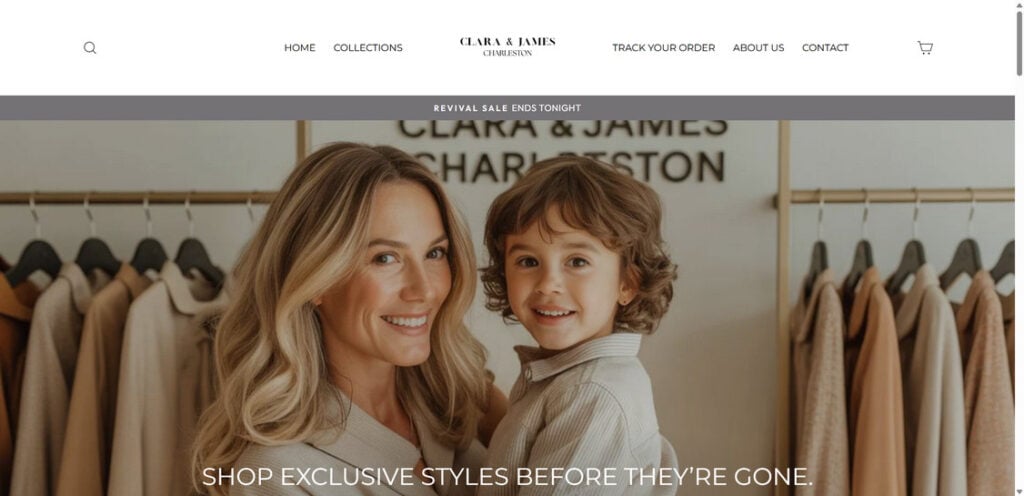
At first glance, Clara & James Charleston looks like a dreamy coastal boutique, full of soft sweaters, warm lighting, and a heartfelt story about a small family business fighting to survive.
Look a little closer, though, and the picture starts to change.
Behind the “Revival Sale ends tonight” banners and huge discounts, many shoppers are discovering late deliveries, poor quality items, or no package at all, followed by silence when they ask for help. This article walks you through how the Clara & James Charleston sale scam operates, the red flags hiding in plain sight, and what you can do if you were caught in it.
Stay with me, because understanding this one store will help you spot dozens of similar scams in the future.
Scam Overview
The charming story that pulls people in
Clara & James Charleston presents itself as a warm, family owned fashion brand.
The homepage usually tells a sentimental story. It talks about Clara and James, inspired by coastal life and a dream of effortless, comfortable style. It claims the brand was founded years ago, often around 2015. The tone is personal, emotional, and designed to build trust quickly.
The message is simple: this is not a big corporation, it is “our life’s work” and your purchase helps a mother and her son keep their dream alive.
For a shopper who loves supporting small businesses, it feels genuine and disarming. That is exactly why it works.
The “Revival Sale” pressure
Central to the scam is the never ending “Revival Sale” or similar event.
You will see things like:
- “Revival Sale ends tonight”
- “Shop exclusive styles before they are gone”
- “Every order helps our family survive this difficult year”
These lines combine urgency and guilt. They tell you the sale is about survival, not just discounts. If you hesitate, you might feel like you are letting down a struggling family.
In reality, the sale is not a rare event at all. It is simply the default state of the site. Prices stay “slashed” nearly all the time.
Discounts that are too good to be true
The product pages display very high “original” prices, often $150 to $250 for a sweater, then show huge markdowns, sometimes 60% or 70% off.
For example, you might see:
- “Was $229.95, now $64.95”
- “Save 71%”
- “Save 77%”
These numbers are not based on real market value. They are invented to make you feel like you are grabbing a luxury item at a once in a lifetime price.
Scam boutiques often do this for two reasons:
- The inflated “before” price makes the current price feel like a steal.
- If the product arrives and feels cheap, they can still argue that “for $64.95 you should not expect true designer quality.”
A catalog that looks suspiciously familiar
The clothing catalog at Clara & James Charleston is another red flag.
The photos often look like glamorous lifestyle shots, with models in bright, well lit interiors. But if you look carefully:
- Faces are cropped out in many images.
- Poses, backgrounds, and body shapes repeat across multiple “brands” on the web.
- Some photos have subtle artifacts that suggest AI editing, odd proportions, or blurred edges.
These are classic signs that the pictures are not original brand photography. The same images can often be found on large marketplaces or stock catalogs, where they were originally used to sell cheaper bulk items.
In other words, Clara & James Charleston is likely reselling low cost mass produced clothing, while pretending that they are unique, hand chosen designs from a small Charleston studio.
The domain and “history” do not match
The brand story claims the store has been around for many years, typically since 2015. However, the domain registration is often very recent.
This mismatch is crucial:
- A domain created in the last few weeks clearly cannot honestly claim a 10 year brand history.
- It suggests that the story was copy pasted or invented to make the store look established and trustworthy.
Scam networks often spin up a new domain, attach a sentimental backstory, and run ads as if they had been in business for a decade.
When that domain collects enough bad reviews, they quietly shut it down and open a new one with a slightly different name.
Vague or problematic policies
If you dig into the refund, shipping, and return policies, you usually find more warning signs.
Common patterns include:
- Returns only accepted for “quality problems” that must be “approved”.
- Customers must pay for return shipping, often to a warehouse in another country.
- No physical business address in Charleston, or only a vague email contact form.
- No clear phone support, or phone numbers that never answer.
These rules are written to make refunds difficult and to discourage chargebacks. The more friction there is, the fewer people will push hard enough to get their money back.
A familiar “Charleston family boutique” template
Clara & James Charleston does not exist in isolation.
Very similar stores follow the same structure:
- Double name brand with “Charleston” added for charm.
- Cozy family backstory that mentions a mother and child.
- Revival or survival sale that claims to decide the future of the brand.
- Identical or nearly identical clothing photos and product descriptions.
This pattern suggests a larger network behind the scenes, not individual families running separate boutiques. The front story changes name and details, but the underlying operation appears to be the same.
Why it works on smart people
It is easy to think “I would never fall for that,” but this style of scam targets emotions, not intelligence.
It is effective because:
- The site design looks clean and professional.
- The story appeals to empathy and kindness.
- Discounts feel plausible for an online sale, even if they are exaggerated.
- Social media ads push people directly to individual products, where they have less time to evaluate the whole brand.
Even experienced online shoppers can get caught when they are tired, distracted, or simply in love with one specific sweater.
Understanding how the scam is built is the first step to protecting yourself.
How the Clara & James Charleston Sale Scam Works
1. The emotional hook and targeted ads
The process usually starts on social media or through display ads.
You might see:
- A carousel of beautiful sweaters with captions about “Revival Sale ends tonight”.
- A touching story in the ad copy about a mother and son trying to keep their shop alive.
- Coupon codes such as “BUY 2 SAVE 15%” or “BUY 3 SAVE 20%”.
These ads are targeted to people who like cozy fashion, handmade or small business content, or who have previously looked at similar products.
Clicking the ad takes you directly to the product page or the story filled homepage.
The emotional hook is powerful: you feel that you are not only buying clothes, you are helping a family survive.
2. The illusion of urgency and scarcity
Once you are on the site, everything is designed to push you to buy quickly.
You might notice:
- Banners that say “Revival Sale ends tonight” or “Sale ends in a few hours”.
- Messages like “Limited quantities” or “Styles will not be restocked”.
- Copy that emphasizes how this sale will decide whether the brand lives or dies.
In many cases, the sale actually runs constantly. The countdown timers reset, and the “last chance” messages remain for weeks.
Urgency is crucial because it stops you from slowing down, comparing prices, or researching the brand first.
3. Inflated original prices and fabricated savings
The next layer is financial manipulation.
Every product shows a high “original” price, often over $150, with a discounted sale price around $50 to $70. It might also show a green badge that says “Save 66%” or “Save 71%”.
This does three things at once:
- Makes the sale look like an incredible opportunity.
- Justifies the sentimental story, as if the family is sacrificing profit to survive.
- Hides the actual quality level, since the true wholesale cost of the item could be under $15.
To the shopper, it feels like luxury at a bargain. To the scammer, it is high profit with low investment.
4. Checkout upsells and pressure
When you add an item to the cart, you are nudged to buy more.
Typical tactics include:
- “Buy 2 and save 10%, buy 3 and save 15%, buy 4 and save 20%.”
- Pop ups that say “Customers also bought…” with more knitwear suggested.
- Free shipping thresholds that encourage you to add one more item.
Many victims end up buying several pieces at once, not just one sweater. That multiplies the profit for the scam operator.
You pay with a card or payment processor, receive an order confirmation email, and feel satisfied that you supported a small coastal brand.
At this point, the money is in the scammer’s hands.
5. Slow, partial, or non existent fulfillment
What happens after payment can vary, but the pattern is usually some mix of these scenarios.
Scenario A: The package never arrives
- You receive a tracking number that either does not update or shows strange routes.
- Weeks pass with only vague “in transit” status lines.
- When you contact support, responses are delayed or generic, often promising that the package is on the way.
- Eventually, emails stop responding altogether.
Scenario B: The items arrive, but the quality is poor
- The fabric feels thin, scratchy, or completely different from the photo.
- Colors and patterns do not match the pictures shown on the website.
- Sizing is wildly inconsistent, with sleeves too short or shoulders too narrow.
- Tags or labels may be generic, with no real brand information.
In this scenario, the scammer can argue that you did receive a product, even if it looks nothing like what you ordered.
Scenario C: Wrong items or partial shipment
Sometimes customers get the wrong size or design, or only part of what they ordered.
When they ask for help, they may receive complicated instructions or be blamed for “ordering the wrong size”. Support agents might offer a small partial refund to avoid a full return.
6. The return and refund trap
For victims who are unhappy and want their money back, the next phase is designed to wear them down.
Common tactics include:
- Asking for photos and videos to “verify” the problem.
- Offering 20% or 30% partial refunds if you agree to keep the item.
- Saying that you must pay return shipping to a distant warehouse, often in another country.
- Delaying communication so that your payment dispute window closes.
The goal is to minimize refunds while looking “technically compliant” on paper.
Many people give up after a few back and forth emails, deciding that the stress is not worth the cost of the sweater. The scammers profit from this fatigue and silence.
7. Reputation reset and rebranding
Once enough customers complain publicly, the brand name becomes toxic.
At that point, the operators often:
- Quietly abandon the domain.
- Launch a new site with a different “family” name, but almost identical design, story, and catalog.
- Start the cycle again with fresh ads and a new emotional hook.
This pattern is exactly why it is important to share your experience and report suspicious stores. The more people know how these networks work, the harder it becomes for them to recycle the same tricks.
What To Do If You Fell Victim
If you have already placed an order with Clara & James Charleston and are worried it might be a scam, there are concrete steps you can take.
1. Gather all your evidence
Before you contact anyone, organize your information.
Collect:
- Order confirmation emails and receipts.
- Screenshots of the product pages, prices, and sale claims.
- Tracking numbers and shipping updates.
- Photos or videos of any items you received, showing the quality issues.
Having everything in one place makes it easier to prove what happened and to argue for a refund.
2. Contact the store, but set a firm limit
It is reasonable to try contacting their customer support once.
- Be polite but clear.
- Explain the issues: non delivery, poor quality, wrong items, or misleading advertising.
- Request a full refund within a specific timeframe.
If they respond with stalling tactics, tiny partial refund offers, or confusing instructions, do not stay stuck in endless emails. Set a mental limit, for example 1 or 2 replies, then move on to your bank or payment provider.
3. Dispute the charge with your bank or payment service
Your strongest protection usually comes from your bank or payment processor.
Take these steps:
- Call the customer service number on the back of your card or log into your online banking.
- Explain that you believe you were misled by an online store, and that the items were not delivered or were not as described.
- Ask to open a dispute or chargeback for the transaction.
Provide the evidence you collected. Emphasize that the website presented itself as a small established brand, but the domain is very new, the goods are low quality, or nothing arrived at all.
Banks deal with this type of issue often, and many will reverse the charge if the evidence is clear.
4. Scan your devices for malware
Some scam stores are only about bad products, but others are part of larger networks that may host risky scripts, pop ups, or malicious ads.
To be safe, run a full security scan on every device you used to visit the site or make the purchase.
A good approach is:
- Install and run a reputable security program such as Malwarebytes, then perform a full system scan.
- Allow it to remove any detected threats, potentially unwanted programs, or suspicious browser extensions.
This is not about fear, it is basic digital hygiene whenever you interact with questionable sites.
5. Strengthen your browser protection with AdGuard
Many victims first encounter these boutiques through aggressive social media or display ads.
To reduce the chances of stumbling into similar traps:
- Install an ad blocking and privacy tool such as AdGuard on your browser or device.
- Configure it to block pop ups, trackers, and malicious ad domains.
This does not mean you will never see any ads, but it significantly lowers risky exposure and makes browsing calmer and safer.
6. Change passwords if you reused them
If you created an account on the Clara & James Charleston site and reused a password that you also use elsewhere, change it immediately.
Focus first on:
- Email accounts
- Banking or financial sites
- Major shopping platforms
Use a strong, unique password for each site, ideally managed with a password manager.
Even if the scam boutique never suffers a data breach, reusing passwords anywhere is a long term risk.
7. Report the store to authorities and platforms
Your experience can help protect others.
Consider:
- Reporting the website to your local consumer protection agency or equivalent.
- Filing a complaint with organizations that document online fraud, if available in your country.
- Reporting their ads when you see them on social media platforms.
- Leaving honest reviews on scam reporting sites, forums, or communities where people research suspicious stores.
You do not need to attack anyone personally. Simply describe what happened, calmly and clearly. That information can be incredibly valuable for other shoppers who are still unsure.
8. Be kind to yourself
Falling for a well crafted scam can feel embarrassing or infuriating, especially if you see yourself as careful online.
Remember:
- These operations are designed by professionals who specialize in psychology and persuasion.
- Your desire to help what looked like a small family business is not a flaw, it is a strength that was exploited.
- Taking action, learning, and sharing your story turns a bad experience into protection for others.
You are far from alone, and you are not foolish for having believed a story that was cleverly constructed to feel real.
How To Avoid Similar “Family Revival Sale” Scams
While this article focuses on Clara & James Charleston, the lessons apply to many lookalike boutiques.
Here are practical habits that make you much harder to trick.
Check the domain age
Use a simple WHOIS lookup or any domain checker to see when the website was created.
- If the domain claims a long history but was registered in the last few months, treat that as a serious warning sign.
- Newly created domains are not automatically bad, but they should not pretend to be decade old brands.
Look for real, independent reviews
Before you buy:
- Search the brand name plus words like “reviews”, “scam”, or “complaints”.
- Check independent platforms, not just testimonials on the store itself.
- Be cautious if you find almost no mentions of the brand, despite their claims of thousands of customers.
Silence or only glowing, vague reviews can be just as suspicious as negative ones.
Examine product photos and copy
Ask yourself:
- Do these photos look like the style you see on mass marketplaces, not small studios?
- Are the faces cropped off or blurry?
- Are descriptions generic, with little detail about fabric composition, fit, and care?
If everything feels copy pasted or AI generated, the brand is probably not what it claims to be.
Study the return and refund policy
Before placing an order, scroll to the bottom of the site and read the policies.
Red flags include:
- Returns only for “major quality defects” judged solely by the seller.
- Requirements to ship items back at your expense to another continent.
- No clear business address, or only a vague contact form.
Legitimate clothing brands usually have straightforward policies, even if they are strict.
Be suspicious of extreme discounts framed as survival
Big sales do happen, especially around the holidays. However, when every single item is discounted by 60% or 70%, and the sale is wrapped in a life or death story about a family business, caution is wise.
A genuine small brand fighting to survive will usually be transparent about their margins and limitations. They cannot slash prices across the entire catalog and still stay afloat.
The Bottom Line
Clara & James Charleston dresses itself up as a heartfelt coastal family boutique, complete with a Revival Sale that promises to decide the future of the brand.
Underneath the warm photos and emotional copy, however, the patterns match a familiar type of online scam boutique. New domains, recycled product photos, extreme discounts, and difficult return policies all point to a business built on misleading impressions rather than honest craftsmanship.
If you already ordered from this store, you are not alone, and you are not powerless. Collect your evidence, talk to your bank, secure your devices with tools like Malwarebytes and AdGuard, and share your experience so others can learn from it.
If you are still deciding whether to click “Buy now,” take a breath, step back, and research first. The best defense against scams like the Clara & James Charleston sale is a mix of curiosity, patience, and a healthy dose of skepticism.
Your money, time, and trust are worth protecting.








