

If you have been eyeing the SnuggleWarm HeatHug Blanket in those cozy winter ads, you are not alone. The promise is irresistible: a premium heated wearable blanket that wraps you in soft fabric, warms your feet, and helps you drift off in comfort.
But something important is hiding behind those perfect photos and five star claims. Before you spend $60 on this “miracle” blanket, it is worth seeing what real customers discovered when their orders finally arrived.
Scam Overview
What SnuggleWarm Claims To Sell
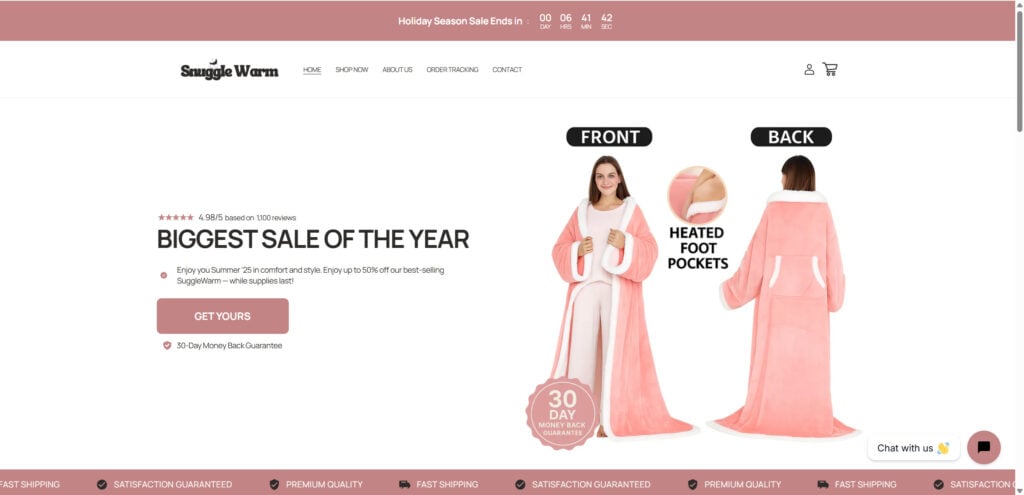
On the official SnuggleWarm website, the HeatHug Blanket is presented as a premium heated wearable blanket.
The product page highlights features such as:
- Built in heating wires that run through the blanket
- Multiple heat levels controlled with an included remote
- Heated foot pockets to keep your feet warm
- Smart safety shut off after a set period of time
- Premium fabric that looks thick, plush, and luxurious
The site places this offer in a dramatic sales frame. You often see:
- A banner like “Holiday Season Sale Ends In 00:06:41” counting down in real time
- Claims like “Biggest sale of the year” and “Up to 50% off”
- A star rating around 4.9 out of 5 based on more than 1,000 or even 17,000 reviews
- Testimonials that talk about better sleep, relief from pain, and improved mood
On the surface, it feels like a trusted, fast growing brand selling a high end electric blanket at a temporary bargain price.
What Customers Actually Receive
Now compare that marketing to what many buyers report receiving at their door.
Instead of a high tech heated blanket system, customers describe opening the package and finding:
- A simple fleece robe or oversized hoodie style blanket
- No heating wires inside
- No handheld controller
- No power cord or plug of any kind
- No buttons or temperature settings
- No dedicated foot pockets
- No documentation for any heating system
In other words, they paid for an electric blanket and got a regular polyester robe that could have been bought locally for $10.
You mentioned your own order: you paid about $60 and received:
- No heating system
- No controller
- No power cord
- No temperature control
- No foot pocket
This lines up perfectly with the pattern seen in many public complaints.
Huge Gap Between Website Reviews And Independent Reviews
Another big red flag is the huge mismatch between on site reviews and independent feedback.
On the SnuggleWarm website, you see claims like:
- “Excellent 4.8 / 5 rating from 17,673 reviews”
- Glowing customer stories with perfect or near perfect scores
However, when you look at third party platforms, the picture flips.
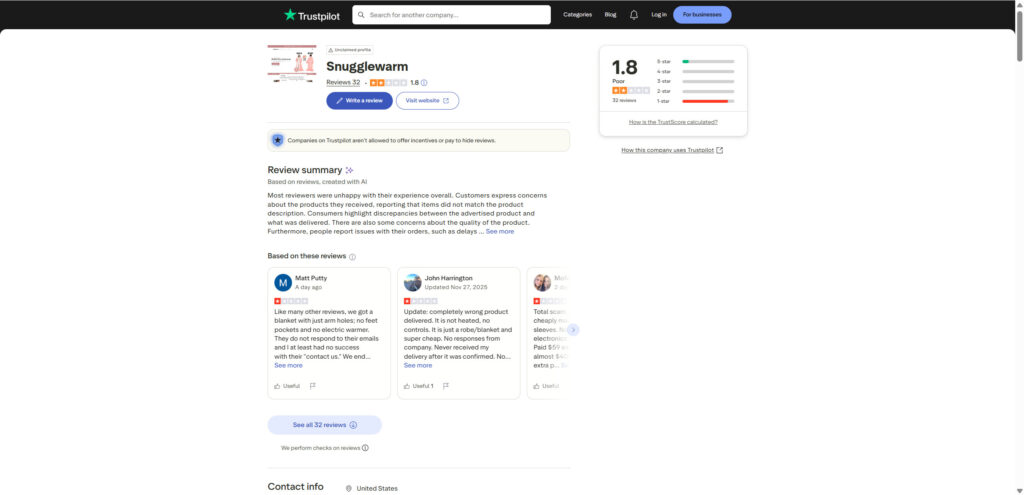
On Trustpilot, for example, Snugglewarm has a poor rating around 1.8 out of 5 with the overwhelming majority of reviews at 1 star. Buyers use words like “total scam”, “fake website”, and “bait and switch”. They say:
- They ordered a heated blanket but got a plain robe without electronics
- Customer support never responded or gave only canned replies
- Requests for refunds were ignored or blocked
- Orders took many weeks to arrive, if they arrived at all
- When they tried to dispute charges, the company claimed the order was delivered correctly
This sharp contrast between the polished, almost perfect reviews on the brand’s own site and the harsh criticism on independent sites is a classic scam signal. Real brands might have some negative reviews, but the pattern tends to be balanced and consistent. Here, it looks like one reality on the sales page and a completely different reality everywhere else.
Evidence Of A Cheap Dropshipping Operation
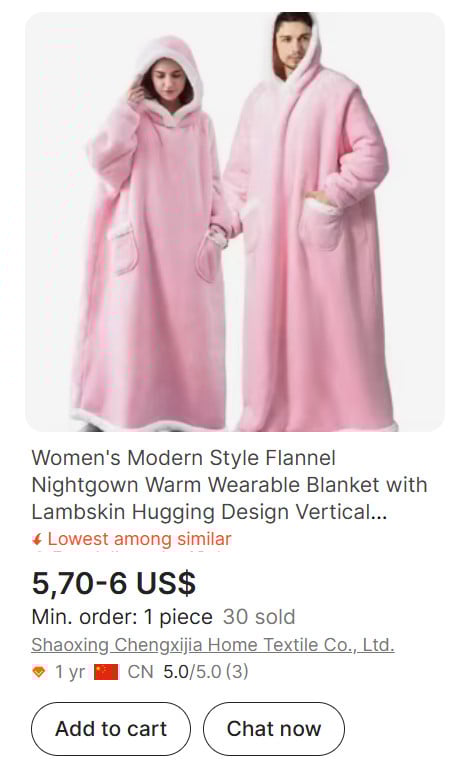
There is another piece of the puzzle. The same style of blanket robe that SnuggleWarm advertises as the advanced “HeatHug” can be found on wholesale sites for about $5.70 to $6 per piece.
These listings show:
- Very similar colors and cuts
- Same oversized hooded shape
- Same pockets and cuffs
- No mention of heating wires or electronics
This strongly suggests that SnuggleWarm is not a specialist brand building unique products. Instead, it appears to buy or dropship very cheap generic robes from suppliers in China, then market them as high tech heated blankets at around $60 or more.
The profit margin is huge:
- Cost from supplier: roughly $6 for the robe
- Retail price charged to customers: around $59 to $69 or higher
- Shipping charged separately or folded into the price
That kind of margin is only possible when the retailer massively inflates expectations and misrepresents what the product can do.
Confusing Company Details And Shell Addresses
Legitimate brands are usually transparent about who runs them and where they are based. SnuggleWarm’s legal and contact information is not so straightforward.
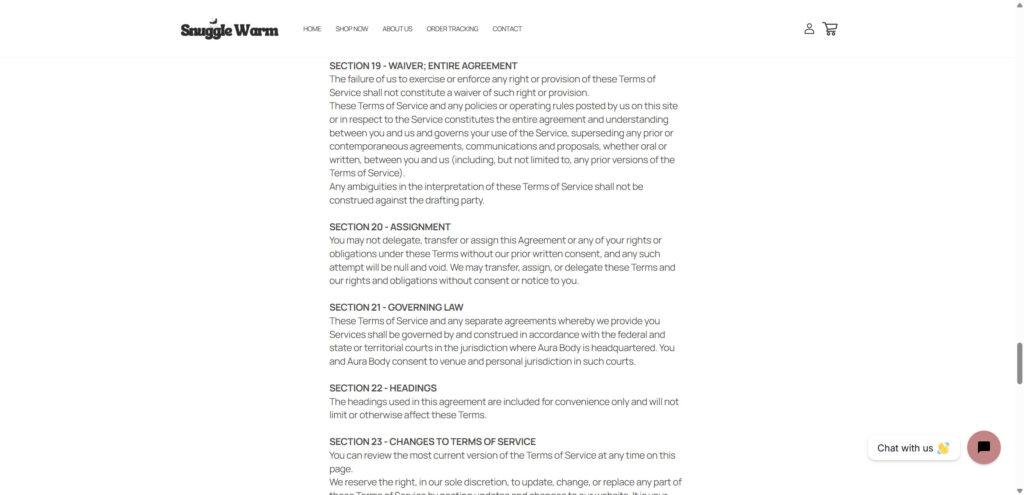
In the Terms of Service, you can find references such as:
- “Grabby Loots LLC, 30 N Gould St Ste R, Sheridan, WY 82801, USA”
- Support email addresses like contact@cloggly.com, which look like they were copied from another storefront
- A separate “Contact Us” section listing “MG Infotech LLC” with an address at 9720 Wilshire Boulevard, Beverly Hills, California, and the email contact@snugglewarm.com
So the same website talks about:
- One company name in the legal fine print
- Another company name in the contact section
- An address in Wyoming that is widely used as a virtual mailbox service
- A second address in Beverly Hills that appears to function as yet another mailbox or front
This mix of unrelated entities, reused legal text, and virtual address services is common in networks of short lived web shops that sell generic items under different brand names. When complaints pile up and chargebacks rise, they simply rebrand, register a fresh domain, and start again.
Return Policy That Makes Refunds Almost Impossible
SnuggleWarm promotes a “30 Day Money Back Guarantee” which sounds reassuring. But when you read carefully, the actual process makes it extremely difficult to get any money back.
Typical patterns in these kinds of policies include:
- Returns are only accepted if the item is unused, unopened, and in original packaging
- Customers must pay to ship the product back to a warehouse in China or another overseas location
- Tracking and customs forms are required, which are costly and complicated
- The company reserves the right to charge restocking fees or refuse returns that do not arrive “as new”
- Refunds can take an unspecified amount of time and may never materialize
In practice, sending a bulky robe back to China with tracking can cost half or more of what you paid in the first place. Most buyers decide it is not worth the hassle. The result: the seller keeps almost all the revenue, even if the product is misrepresented.
Why SnuggleWarm Looks Like A Scam Operation
When you put all of this together, the SnuggleWarm HeatHug Blanket looks less like a legitimate heated blanket and more like a deceptive dropshipping scheme.
Key warning signs include:
- Advertising an electric blanket with advanced features but shipping a non electric robe
- Inflated review scores on the homepage that do not match independent reviews
- Conflicting company names and mailbox style addresses
- A warranty and return process that is extremely hard to use in real life
- Evidence that the same product is sold wholesale for about $6 as a regular robe
You are not just overpaying for a mediocre product. You are paying for something that is fundamentally different from what was advertised. That gap between promise and reality is what leads so many customers to describe SnuggleWarm as a scam.
How The Scam Works
Step 1: Building The Perfect Emotional Hook
The SnuggleWarm marketing funnel starts by targeting a very specific emotional need.
Their ads and product page focus on:
- People who are always cold at home
- Individuals struggling with aches, pains, or poor sleep
- Shoppers looking for comforting, cozy gifts for family members
The photos show relaxed, smiling models wrapped in plush fabric, often in soft pink colors. The copy talks about “instant warmth”, “me time”, and improved mood.
Cold weather, rising energy bills, and health concerns make this type of product very attractive. That emotional appeal is what gets people to click and keep reading.
Step 2: Making The Product Sound Technologically Advanced
Once you are on the page, SnuggleWarm layers on technical sounding features to justify the high price.
They present the HeatHug Blanket as if it were a carefully engineered medical grade device, with claims like:
- Built in heating wires inside the blanket
- Smart multi level heat settings adjustable with a controller
- Heated foot pockets for full body warmth
- Automatic shut off timer for safety
- Premium, skin safe materials
These features create the impression that you are buying something closer to an advanced electric mattress pad or high end heated throw, not just a robe.
For shoppers who already know that good electric blankets at reputable stores can cost $80 to $150, a price around $60 with a “50% off” tag suddenly looks like a bargain.
Step 3: Manufacturing Urgency And Social Proof
Next, the site leans hard on urgency and social proof to stop you from leaving the page or doing deeper research.
Common tactics include:
- A live countdown timer for a “Holiday Season Sale” or “Today Only Offer”
- Messages like “Selling out fast” or “Limited stock available”
- Fake looking real time popups saying “Sophia in Texas just purchased 2 HeatHug Blankets”
- Star ratings above 4.8 out of 5 from thousands of supposed customers
These design tricks are common in aggressive dropshipping funnels. They are not always illegal, but they are very manipulative. The goal is simple: push you to buy right now before you have time to look up Trustpilot or search for “SnuggleWarm HeatHug Blanket scam”.
Step 4: Hiding The True Nature Of The Business
While the homepage and product page look polished, the underlying business structure stays vague.
The Terms of Service reference one company name and a Wyoming mail forwarding address. The contact section displays a different company and a California address. Support email addresses vary.
This setup has several purposes:
- It makes it harder for buyers to understand who legally owes them a refund
- It allows the operators to shut down one entity and continue under another if problems arise
- It discourages chargebacks and legal complaints because victims do not know where to start
Instead of a clear corporate identity, SnuggleWarm presents a shifting maze of names and addresses.
Step 5: Fulfilling Orders With Cheap Generic Robes
Behind the scenes, SnuggleWarm appears to rely on wholesale suppliers in China that manufacture simple flannel robes and wearable blankets.
These suppliers list prices around $5.70 to $6 per piece when ordered in bulk. There is no mention of electric heating systems, power cords, controllers, or thermostat technology. The designs match what buyers actually receive: normal wearable blankets without electronics.
The likely workflow looks like this:
- A customer orders an expensive “HeatHug” heated blanket from SnuggleWarm.
- SnuggleWarm forwards the order details to a Chinese supplier.
- The supplier ships a generic robe directly to the customer’s address.
- The parcel may take two to four weeks to arrive, sometimes longer.
At that point, the customer opens the package, realizes there is no heating system, and feels cheated.
Step 6: Making Returns So Painful That Most People Give Up
Once customers complain, the next stage of the scam kicks in: obstructing refunds.
Standard responses in similar operations often include:
- Advising the customer to “give the blanket more time to warm up” even though it has no heater
- Claiming that the item shipped matches the order description
- Offering a small partial refund, such as 20% or 30%, to avoid the cost of a full refund
- Requiring the buyer to ship the robe back to China at their own expense before processing any refund
Shipping a bulky blanket overseas with tracking can easily cost $20 to $40. For many people, that destroys the financial logic of returning the item.
As a result:
- Some accept a tiny partial refund and keep the useless product.
- Others give up entirely and simply warn others in reviews.
- A few try chargebacks with their bank or PayPal, but this takes time and persistence.
From the seller’s perspective, this system works extremely well. They keep most of the money while facing relatively little pushback.
Step 7: Relying On Rebranding And Short Lifespans
When complaints and chargebacks reach a certain level, many low trust dropshipping stores close, rename, or move to a fresh domain.
The pattern typically looks like this:
- Register a new brand and domain name.
- Reuse the same product photos, FAQ wording, and policies.
- Plug in new company names and addresses into the legal text.
- Start a new wave of ads and influencer promotions.
Because these operations lean heavily on paid social media campaigns, they do not rely on long term brand reputation. If one name becomes toxic, they simply pivot to another.
SnuggleWarm fits this pattern: borrowed legal language, conflicting company identities, heavy reliance on paid ads, and a product that clearly originates from the same generic suppliers as many other “miracle blanket” scams.
What To Do If You Have Fallen Victim to This Scam
If you already bought the SnuggleWarm HeatHug Blanket and discovered that it is not the heated product you expected, you are far from alone. The situation is frustrating, but you still have options.
Here is a calm, step by step plan.
1. Document Everything Immediately
Start by collecting and organizing evidence. This will help if you decide to open a dispute or report the seller.
- Take clear photos of the blanket you received from several angles.
- Photograph the packaging, shipping label, and any inserts or instructions.
- Capture screenshots of the product page that show promises like “heating wires”, “multiple heat levels”, “foot pockets”, and “auto shut off”.
- Save confirmation emails, invoices, and any messages with customer support.
If the website later changes its description, your screenshots and records will still show what was originally advertised when you placed your order.
2. Contact SnuggleWarm Support In Writing
Even if you expect a poor response, it is important to give the seller a chance to fix the problem. This shows good faith and creates a paper trail.
- Use the official contact email listed on the site, such as contact@snugglewarm.com.
- Clearly explain that the product is not as described because it has no heating system, no controller, and no power cord.
- Request a full refund, not just a partial credit.
- Ask for a prepaid return label if they want the item back.
Keep your message polite but firm. Save copies of everything you send and any responses you receive.
3. Refuse Unfair Partial Refund Offers
Some buyers report being offered a small partial refund, such as 20% or 30%, and told they can keep the robe.
While accepting a partial refund is your choice, understand what it means:
- You are acknowledging that you are willing to keep a product that does not match the description.
- You are allowing the seller to keep most of your money for something that was misrepresented.
- You may weaken your position if you later try to dispute the charge through your bank.
If the product is clearly not what was advertised, you have the right to insist on a full refund. Politely decline unfair offers and make it clear that the listing claimed features the product does not have.
4. Start A Chargeback Or Dispute With Your Payment Provider
If customer support refuses to help or only offers a tiny partial refund, your best next step is to involve your bank, credit card issuer, or PayPal.
- For credit or debit card purchases, call the number on the back of your card or log in to your online banking and look for the “dispute a transaction” option.
- Explain that the item was “significantly not as described”. Emphasize that it was advertised as an electric heated blanket with specific features, yet you received a regular fleece robe with no electronics.
- Provide all evidence you collected: photos, screenshots of the product page, records of email exchanges, and order details.
Banks and card networks often have strong consumer protections for cases where products are misrepresented. If you act within their time limits, you stand a good chance of recovering your money.
For PayPal transactions:
- Go to the Resolution Center and open a dispute under “Item not as described”.
- Upload your photos and screenshots.
- Escalate the dispute to a claim if the seller does not cooperate.
PayPal may refund you directly if they agree that the listing was misleading.
5. Avoid Shipping The Blanket Back To China At Your Own Cost
Many drop shippers use return policies designed to drain victims’ energy and money. They might tell you that:
- You must ship the blanket back to a warehouse in China, often without a clear name or guarantee.
- You must pay the full shipping cost, which can be very high for tracked parcels.
- The refund will only be processed after the item arrives and passes inspection.
Before agreeing to any overseas return, get a shipping price quote from your local post office or courier. In many cases, you will find that returning the blanket would cost half or more of your original payment.
If the cost is unreasonable, tell your bank or PayPal that the seller’s return demands are disproportionate and appear designed to prevent refunds. This can strengthen your case.
6. Leave An Honest Review To Warn Others
Once your dispute is underway, consider sharing your experience on independent review platforms.
- Write a clear, factual review on Trustpilot or a similar site.
- Describe exactly what was promised and what you received.
- Mention if support ignored you, delayed responses, or refused a proper refund.
Your review not only helps other shoppers avoid the same trap, but it also adds public pressure that can encourage the seller or payment processors to take complaints more seriously.
7. Report The Website To Consumer Protection Agencies
If you feel comfortable doing so, you can report SnuggleWarm to relevant authorities.
Options include:
- Your national consumer protection agency or trading standards office
- The Federal Trade Commission (FTC) in the United States, if you live there or the business advertises to US consumers
- Your state or provincial consumer affairs office
Provide links, screenshots, and a short summary of what happened. While a single report might not lead to immediate action, many similar complaints together can trigger deeper investigations into deceptive businesses.
8. Secure Your Financial And Personal Information
If you only used a credit card on the SnuggleWarm site, your main concern is the payment itself. But be mindful of any extra information you may have shared.
- Monitor your bank or card statements for any unfamiliar charges.
- If you see any, contact your bank immediately to block your card and issue a new one.
- If you created an account with a password, change that password and avoid reusing it on other sites.
If you accidentally shared more sensitive information than usual, such as a full date of birth or other personal data, keep an eye out for phishing emails that pretend to know your order details.
9. Learn From The Experience For Future Purchases
Falling for a scam like the SnuggleWarm HeatHug Blanket can feel embarrassing, but it happens to smart people every day. The marketing is designed to bypass your usual skepticism.
Use this experience as a learning opportunity:
- Be wary of brands you have never heard of that appear suddenly in social media ads.
- Check independent reviews on Trustpilot or other sites before buying from a new store.
- Look up the business address to see if it is a real office or just a virtual mailbox.
- Be suspicious of huge discounts, countdown timers, and perfect ratings with thousands of reviews.
The more familiar you become with these warning signs, the harder it becomes for similar scams to trick you in the future.
The Bottom Line
The SnuggleWarm HeatHug Blanket is marketed as a high tech heated wearable blanket with actual heating wires, multiple temperature levels, safe auto shut off, and cozy foot pockets. In practice, many buyers receive nothing more than a basic fleece robe with no electronics at all.
Between misleading product claims, conflicting company details, poor independent reviews, and a return process that forces customers to ship items back to China at their own cost, SnuggleWarm looks far closer to a deceptive dropshipping scheme than a trustworthy comfort brand.
If you have not ordered yet, the safest choice is simple: do not buy the SnuggleWarm HeatHug Blanket. If you already did, treat it as a misrepresented purchase, gather your evidence, and work with your bank or PayPal to recover your money. Your warmth, comfort, and peace of mind are worth more than an expensive robe that never heats up.
FAQ
Is the SnuggleWarm HeatHug Blanket a real heated blanket?
No. Many customers report receiving a simple fleece robe with no heating wires, no controller, no cord, and no temperature settings, even though the listing advertises a full electric blanket with multiple heat levels.
Why do some people call SnuggleWarm a scam?
Because the product they receive is very different from what is advertised. The site promises an electric heated blanket with smart features, but buyers say they get a basic robe that could be bought locally for a fraction of the price and refunds are difficult to obtain.
Can I return the SnuggleWarm HeatHug Blanket for a refund?
In theory, yes, but in practice returns are very hard. Customers are usually told to ship the blanket back overseas, often to China, at their own expense. For a bulky item, that cost can be so high that most people give up.
What should I do if I already bought one?
Document everything, contact SnuggleWarm in writing, then open a dispute with your card issuer or PayPal if they refuse a full refund. Clearly state that the item is “not as described” because it has no heating system as advertised.
Is it safe to buy heated blankets from random ads online?
It is risky. Before buying, search the brand on Trustpilot or Google, check the business address, and compare the product to items on major retailers. If the brand is unknown, the reviews look fake, or the deal seems too good to be true, it is better to skip it.








