

If you have seen those heartwarming ads for the Waggy AI Robot Puppy, you already know the script.
A sleepy child. A fluffy “AI powered” puppy that reacts like a real dog. A bold claim that this is the toy of the year and that stocks are almost gone.
It looks wholesome, clever, and harmless.
The problem is that many parents who clicked “Buy Now” did not receive anything close to what was promised.
In this article we will unpack how the Waggy AI Robot Puppy operation really works, why so many buyers feel tricked, and what you can do if you already placed an order and regret it.
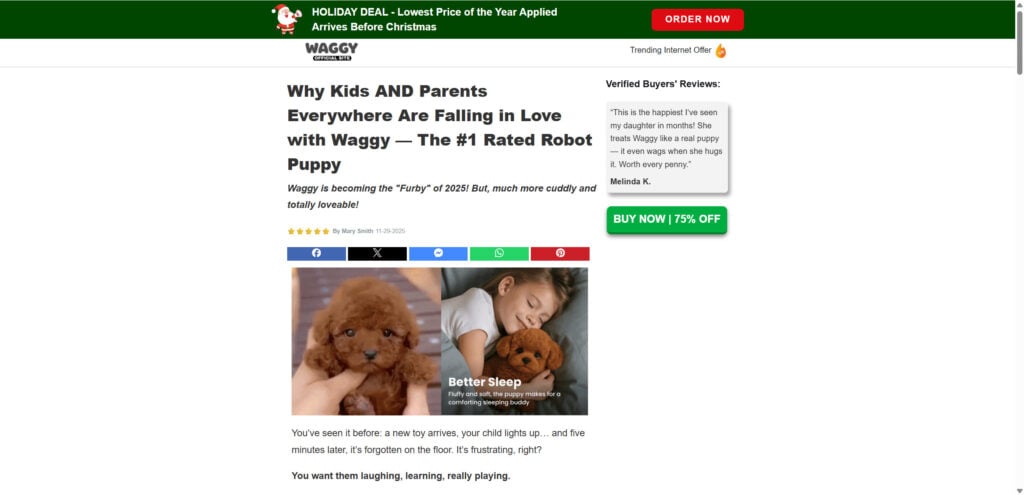
Overview: What Is Waggy AI Robot Puppy Really Selling?
On the surface, the Waggy AI Robot Puppy brand appears to offer a premium, high tech toy.
The sales pages are filled with emotional language and polished images that show children hugging an ultra realistic puppy that supposedly uses artificial intelligence to “learn” from your child and respond in lifelike ways.
You will see claims like:
- “AI powered robot puppy that adapts to your child”
- “Teaches empathy, reduces meltdowns, and supports development”
- “Award winning toy of the year”
- “Loved by thousands of families worldwide”
There are glowing testimonials from parents, expert endorsements from “teachers,” and impressive star ratings that make Waggy look like a trusted, widely loved product.
However, when you step behind the marketing curtain, a very different picture starts to appear.
Most buyers who share their experiences report receiving a very basic plush dog with a tiny battery compartment inside.
It usually:
- Barks or beeps in a simple loop
- May wag its tail or nod its head in a single repeated motion
- Has no app, no WiFi, no AI, and no learning behavior
- Feels like a cheap toy that could be bought for a few dollars from a generic marketplace

In other words, the real product is a low cost, mass produced plush dog, not an advanced AI robot pet.
This is why many people call Waggy a scam operation rather than just a disappointing toy. The gap between the promise and the reality is enormous.
High tech story, low tech product
The core problem is not that a simple plush dog exists. Basic battery operated toys have been around for decades, and many kids enjoy them.
The issue is that the marketing frames Waggy as something closer to a $300 premium robot pet, while the product itself is closer to a $5 novelty item sold wholesale on large Chinese marketplaces.
Ads and landing pages use language like “cutting edge AI,” “adaptive behavior,” and “pet of the future.”
Yet the dog that arrives in the box is usually:
* Very small, often smaller than it looks in the photos
* Lightweight, with thin fur and a hollow plastic interior
* Limited to one or two simple motions
* Sometimes poorly stitched, with fur that sheds easily
Parents who were hoping for a near robotic companion often feel embarrassed when they see what actually arrived. Some children even ask if they got “the wrong one” because it behaves nothing like the dog in the videos.
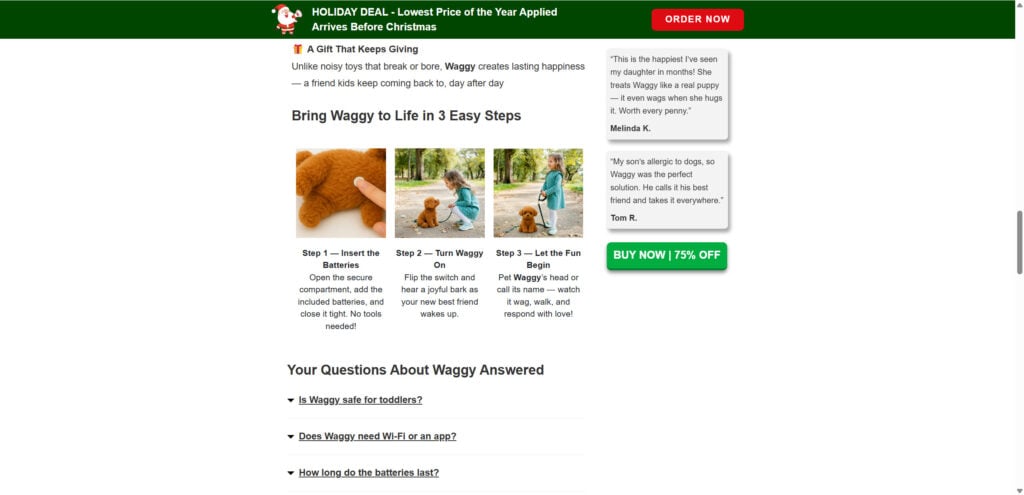
AI generated photos and videos
One major red flag is that many of the images and clips used in Waggy style campaigns do not appear to show a real toy at all.
Instead, they often look like they were created with AI image tools:
- The fur texture is unnaturally perfect and glossy.
- The lighting and camera angles are hyper polished, more like digital renders than casual product photos.
- In some cases, the dog’s paws, eyes, or ears look subtly distorted, which is typical of AI generated imagery.
When photo after photo shows different “families” in different living rooms, yet the dog’s fur, pose, and expression are almost identical, it strongly suggests that you are looking at generated content rather than real user photos.
The same pattern appears in other clones such as Wuffy, WiggyDog, and similar “AI puppy” brands.
The core product is the same cheap plush dog, but the brand name, logo, and ad creatives change regularly.
Recycled marketing playbook
If you have researched other “viral toy” scams, the Waggy campaign will feel very familiar.
The entire structure of the funnel is recycled:
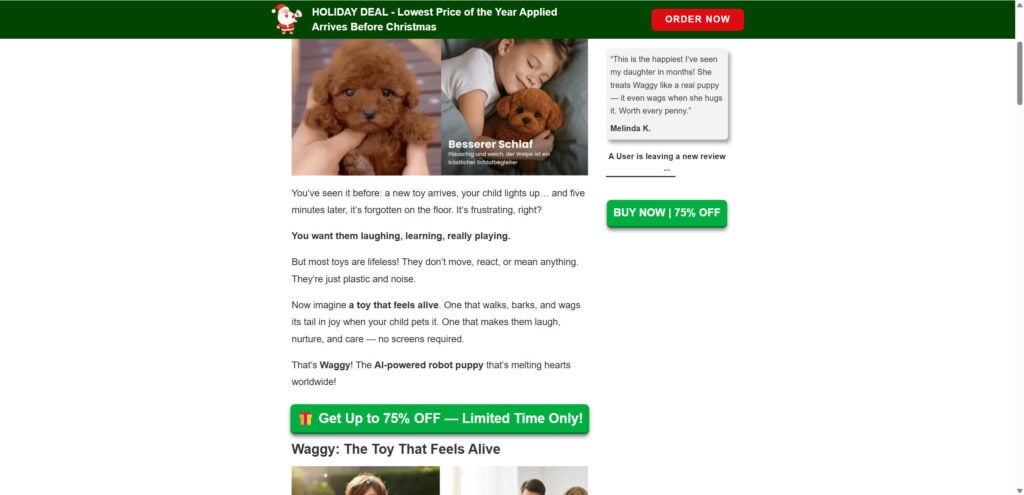
- A long, emotional “article” style page that looks like a news story instead of a sales pitch
- Headlines like “Why Kids And Parents Everywhere Are Falling In Love With [Brand Name]”
- Claims that the toy is becoming the “Furby” or “toy of the year” for the current season
- A promise that it keeps kids off screens, builds empathy, and brings families closer
- A prominent “limited time” discount, usually 50% to 75% off
- Fake scarcity, such as “Only 103 items left” or countdown timers that reset when the page is reloaded
- A 30 day or 90 day money back guarantee that sounds generous but is extremely hard to use in practice
Behind the heartwarming language, the real goal is simple. Convince you to impulse buy a high margin item before you have time to research whether it is legitimate.
Why returns are so difficult
Many customers only fully realize what has happened when they try to return the dog.
The landing pages often highlight generous guarantees and stress free returns. In reality, those guarantees typically come with small print conditions such as:
- The product must be returned unused and in original packaging.
- Returns must be shipped to a warehouse in China, at your own cost.
- Packages without a proper RMA number may be rejected.
- Refund approval can take several weeks or months, if it happens at all.
For a low cost toy, international tracked shipping back to China can easily cost more than the original purchase.
At that point, most parents simply give up. The “money back guarantee” becomes an empty slogan, not a real safeguard.
Why this matters for parents and gift buyers
On its own, a single disappointing toy is annoying but not life changing.
However, the Waggy style operation creates several serious problems:
* Parents are misled into paying premium prices for a low quality item.
* Children may feel confused or disappointed when the toy behaves nothing like in the ads.
* Personal and payment data is handed over to a company that is willing to use deceptive tactics to sell a product.
* The same playbook can be used again under new names, catching more people who never saw the original warnings.
That is why it is important to treat campaigns like Waggy AI Robot Puppy with extreme caution, and to understand in detail how this type of operation works behind the scenes.
How The Operation Works
In this section we will walk through the Waggy AI Robot Puppy funnel step by step.
Understanding the mechanics will help you recognize similar scams in the future, even if they use a different brand name or product.
We will break it into six key stages.
1. Crafting the emotional hook
The operation starts with a simple insight.
Parents want their children to have less screen time and more imaginative play. They also know that real pets involve allergies, mess, and long term responsibility.
The marketers behind Waggy build the entire campaign around those desires and fears.
Typical ad narratives include:
- “Your child is glued to screens, but you want them laughing and playing again.”
- “You cannot have a real dog due to allergies or landlord rules, so this is the perfect solution.”
- “This is not just a toy. It is your child’s new best friend that teaches empathy and responsibility.”
The idea is to present Waggy as a magical middle ground.
You get the benefits of a dog, such as companionship and emotional connection, without any of the hard parts.
From the first sentence, the message is personal, emotional, and focused on the parent’s guilt and hopes.
2. Building the illusion of trust and popularity
Once your attention is captured, the campaign needs to convince you that Waggy is trusted and popular.
This is usually done with a combination of:
- “As seen on” media logos that are never actually backed by real coverage
- Fake or heavily edited reviews with stock photos or AI generated faces
- Claims of “over 75,000 happy customers” or similar large numbers
- Expert endorsements from “teachers” or “child psychologists” whose names cannot be traced to any real person
- Trust badges, security icons, and star ratings that are easy to copy and paste onto any website
The goal is to create an illusion of social proof.
Most visitors will not dig deeper or verify whether any of those claims can be confirmed outside the sales page.
In many cases, if you try to search for “Waggy robot puppy reviews” you will find multiple near identical articles on different domains. These are often part of the same marketing network and are written from the same template, all pushing you toward the checkout.
3. Hiding the real product behind AI imagery
At this stage, the team behind Waggy has to solve a problem.
The real product is a generic plush dog that uses a tiny motor and a simple sound chip. If they show it honestly, very few people will pay premium prices.
So they create a fantasy version of the toy instead.
Many ads and landing pages use images where:
- The puppy looks incredibly fluffy and perfectly styled, with fur that almost glows.
- Movements are implied through blur effects or clever editing, not shown in full, continuous motion.
- The dog’s face is unusually expressive, which is easier to create with AI tools than with a low cost toy.
- Children appear delighted, calm, or sleeping peacefully in ways that feel more like staged stock photos than real home snapshots.
Some videos are made by overlaying sound effects and smart editing on top of very limited original footage.
You might see one or two simple motions repeated with different angles and background music to make them feel more dynamic.
The result is a powerful illusion.
Viewers come away believing that Waggy is a sophisticated companion, not a basic mechanical toy.
4. Turning urgency into impulse purchases
Once a visitor is emotionally invested in the idea of Waggy, the next step is to remove hesitation and push for a fast purchase.
The checkout pages use a range of urgency and scarcity tactics, such as:
- Countdown timers that say your discount expires in a few minutes
- Messages like “Only 103 items left” that do not actually track real inventory
- Tiered discounts that encourage you to buy 2 or 3 units at once for a “family bundle”
- Claims that this is a “holiday special” or “lowest price of the year”
- Popups showing “Freya from Germany just bought 3 units” or similar activity banners
Psychologically, these tricks tap into fear of missing out and the desire to secure a good deal before it disappears.
Many parents, especially during the holiday rush, feel a strong urge to grab the offer quickly.
They tell themselves that if it really keeps their child off screens and builds empathy, it is worth the price, especially with a 50% or 70% discount.
There is rarely any clear mention of where the product ships from, how long it truly takes to arrive, or how returns work beyond vague promises of “happiness guarantees.”
5. Processing payments through a dropshipping backend
Behind the glossy front end, the Waggy operation appears to function like a classic dropshipping setup.
Here is how that typically works:
1. You place an order on the Waggy site and pay a premium price, often around $30 to $60 per dog, sometimes more for bundles.
2. Your order details are forwarded to a supplier in China that sells the same or similar plush dog for a few dollars per piece at wholesale prices.
3. The supplier ships the toy directly to you, using low cost international shipping services that can take several weeks.
4. The brand running the Waggy website keeps the difference between what you paid and what the supplier charged, minus advertising costs.
This model is not inherently illegal. Dropshipping can be done honestly when the product is represented accurately.
The problem arises when the product is drastically misrepresented, prices are inflated far beyond the real value, and after sales support is minimal or obstructive.
In many Waggy style operations:
- Tracking numbers are slow to arrive or difficult to interpret.
- Customer support replies are scripted and often ignore direct questions about refunds.
- When buyers complain, they are sometimes offered small partial refunds instead of full refunds, on the condition that they keep the toy.
- When full returns are allowed, customers are required to ship the product back to a Chinese address at their own cost.
This structure heavily favors the seller. Once the money is paid, most customers find it difficult or uneconomical to reverse the transaction.
6. Rebranding and repeating the cycle
Because many buyers eventually realize they have been misled and start leaving negative comments, these operations rarely stick with one brand forever.
Instead, they recycle the entire setup with new names and slightly different designs, such as:
- Wuffy Robot Puppy
- WiggyDog Robot Puppy
- Froplay ZoomerPup
- Wuffy AI Dog
- Other similar “cute” names that sound playful and harmless
The product photos change, the color scheme shifts, and the logos are updated.
However, the core script, layout, and claims remain almost identical.
From the outside, each brand looks like a new viral sensation.
From the inside, it is the same basic pattern, selling the same cheap toy with a new story.
Understanding this cycle is crucial for consumers.
If you see another “AI robot puppy” with emotional storytelling, huge discounts, and a checkout that feels almost identical to another site you visited, treat it as a loud warning signal.
What To Do If You Have Fallen Victim to This Scam
If you already ordered a Waggy AI Robot Puppy and feel misled, you are not alone. Many parents find themselves in the same situation.
The good news is that you still have options.
Follow these steps calmly and methodically.
1. Gather every piece of evidence
Start by collecting and saving:
1. Order confirmation emails and receipts
2. Screenshots of the product page, including claims about AI, guarantees, and discounts
3. Screenshots or links to the ads you clicked on
4. Photos or videos of the actual toy you received
5. Any email exchanges with customer support
Store these files somewhere safe. They will be useful if you contact your bank, payment provider, or consumer protection agencies.
2. Contact the seller, but set a clear deadline
Next, write a calm, firm message to the company that charged your card or PayPal account.
Explain:
- What you were promised (AI powered robot puppy, lifelike behavior, etc)
- What you actually received (simple plush dog with basic battery motion)
- Why you believe this is misrepresentation, not just a minor issue
- What resolution you want, such as a full refund without sending the toy back to China
Give them a clear deadline, for example 7 to 10 days, to respond with a satisfactory solution.
Do not threaten or use aggressive language. Clear, factual messages are more effective and easier for banks to review later if needed.
3. Decide whether returning the toy to China makes sense
If the company replies with instructions to return the product to a Chinese warehouse at your own expense, pause before agreeing.
In many cases:
- International tracked shipping can cost almost as much as the toy itself.
- Packages can get lost or rejected if the company refuses to accept them.
- Even when the tracking shows delivery, some customers still struggle to get their refund approved.
If the return shipping cost is very high compared to the purchase price, note that in your records.
This information will be important when you speak to your bank or PayPal, because it shows that the “guarantee” is effectively unusable in practice.
4. Contact your bank or payment provider
If the seller refuses a fair solution, or insists on an unreasonable return process, your next step is to dispute the charge.
1. Contact your card issuer or PayPal as soon as possible.
2. Explain that the item was not as described and that the marketing claims were misleading.
3. Share your evidence, including screenshots and photos.
4. Mention that the company is asking you to pay high international shipping just to exercise the money back guarantee.
Many banks will open a dispute for “goods not as described” or “misrepresentation.”
Outcome is never guaranteed, but many victims of similar scams have successfully received chargebacks when they provided clear documentation.
Time matters.
Some card networks have strict windows for disputes, so do not delay this step.
5. Scan your devices for malware and unwanted trackers
Some scam websites are not just about selling poor quality products. They may also be loaded with aggressive tracking scripts, pop ups, and occasionally malicious redirects.
As a precaution:
1. Run a full system scan with a reputable security tool such as Malwarebytes. It can help detect unwanted programs, browser hijackers, and other threats that may have slipped in while you were browsing or clicking suspicious ads.
2. Consider using a tool like AdGuard or a similar content blocker to reduce the number of malicious or misleading ads you see in the future. Blocking shady ad networks can greatly lower the chance of stumbling into similar scams again.
These steps do not guarantee absolute safety, but they significantly reduce the risk that your encounter with the Waggy campaign also exposed you to malware or aggressive tracking.
6. Monitor your bank statements closely
After making a purchase with a suspicious company, keep an eye on your bank or PayPal statements for at least a few months.
Look for:
- Duplicate charges
- Unexpected subscription fees
- Charges from unfamiliar merchants that may be related to the same network
If you see anything suspicious, report it to your bank immediately.
Ask them to block further charges from that merchant and issue a new card if necessary.
7. Share your experience to warn others
One reason scams like Waggy keep working is that many people feel embarrassed and stay silent.
If you feel comfortable, consider sharing your experience:
- Leave honest reviews on consumer review platforms.
- Post warnings in parenting groups or forums where these ads are circulating.
- Report the ads to the platform where you saw them, such as Facebook, Instagram, or TikTok.
You do not need to overshare or reveal sensitive details.
Even a short comment like “I ordered this and it is just a cheap plush dog, not an AI robot. Hard to get a refund” can help others pause and research before they buy.
8. Learn to recognize the wider pattern
Finally, use this experience as a learning moment, not as a source of shame.
Look back at the Waggy campaign and ask:
- What emotional buttons did it press for me?
- Which claims did I believe without verifying?
- What would I do differently next time before buying from a brand I have never heard of?
This reflection will help you spot similar patterns in future campaigns, such as:
- Emotional stories that feel more like a movie script than a product description
- Multiple brands using the same layout and wording, just with different names
- Huge discounts, countdown timers, and “only X items left” notices
- Vague contact information and no clear company details
The more familiar you are with these signals, the harder it becomes for the next copy of Waggy to catch you by surprise.
FAQ
1. Is Waggy AI Robot Puppy a real AI robot?
No. Buyers report receiving a basic battery powered plush dog with a simple bark or wag function, not a true AI robot that learns or adapts. The marketing greatly exaggerates its technology and capabilities.
2. Why do people call Waggy a scam?
Because the ads and website promise an advanced “AI powered” puppy, while the actual product is a cheap toy that behaves nothing like the videos or photos. On top of that, getting a refund is extremely difficult, especially when returns must be shipped back to China at the buyer’s expense.
3. Are the photos and videos of Waggy real?
Many images look like they were created with AI tools or heavily edited. The dog often appears more detailed, expressive, and lifelike in the ads than any real toy at this price point, which is a major red flag.
4. Why are returns so hard or impossible?
The company usually requires you to send the toy back to a warehouse in China with tracked shipping that can cost almost as much as the toy itself. Some customers say their returns were ignored or rejected, which makes the “money back guarantee” practically useless.
5. What should I do if I already bought Waggy?
Document everything, contact the seller once, then go to your bank or PayPal and dispute the charge as “item not as described.” Also run a security scan on your devices and consider using tools like Malwarebytes and AdGuard to block future shady ads and pop ups.
6. How can I avoid similar toy scams in the future?
Be wary of unknown brands promising advanced AI toys with huge discounts and urgent countdown timers. Check independent reviews, search the brand name plus “scam,” verify where the product ships from, and avoid buying when returns require shipping to China for low cost items.
The Bottom Line
Waggy AI Robot Puppy is marketed as a breakthrough companion that uses artificial intelligence to learn, react, and support children emotionally.
In reality, most buyers receive a cheap battery powered plush dog that behaves nothing like the toy shown in the ads and on the website.
This operation follows a familiar playbook.
Emotional storytelling, AI generated images, heavy use of fake social proof, high markups on a low quality product, and refund policies that become almost impossible to use once you realize you want your money back. It is not the first time we have seen this type of “AI puppy” scam and it will probably not be the last. Waggy is simply the latest name on a long list.
If you are still deciding whether to buy, the safest move is simple.
Avoid Waggy and similar “AI robot puppy” offers that come from unknown brands, and if you want a robotic pet, look for established manufacturers with verifiable reviews, clear company details, and realistic product demonstrations.
If you already bought it, follow the steps above to protect your money, your devices, and your peace of mind.
You are not alone, and with the right actions, you can limit the damage and help make it harder for operations like this to fool the next parent looking for the perfect gift.









I think we should bomb the factory like we did Iran. That should get their attention about selling a lie.
I understand the anger – being lied to and having no way to reach anyone is genuinely infuriating – but no, and I would not want that sitting in the comments unanswered. Bombing anything is not on the table, and I do not think you seriously mean it. It also would not touch the people responsible: what these operations actually consist of is a domain, a payment account and a marketing affiliate, with the goods coming from an ordinary contract factory that makes them for anyone who orders and has no idea what claims are being made in the advertising.
The thing that does get their attention is duller and works. Payment processing is their single point of failure: chargebacks cost them a fee each and, once the ratio climbs, the processor drops the merchant account and the operation stops trading within weeks. That is why disputing the charge with your card issuer matters more than any complaint. On top of that, reportfraud.ftc.gov and your state Attorney General are what build the cases that produce judgments and, occasionally, refunds to the people who filed.
If you paid for one of these and want a hand working out which dispute reason to use, say what happened and I will help.
I am 80 and can’t afford to have a real dog… I thought this little cutie would be something to love… WRONG!! My sweet and precious daughter bought this for me for my birthday and more than feeling bad for myself, I feel so bad for her!!
Verita, I’m really sorry this happened, especially since it was a gift. These “AI puppy” ads are often heavily edited and overpromise what the toy can actually do.
If your daughter paid by card or PayPal, the best path is to dispute the charge as “not as described / misleading advertising” and keep screenshots of the ad plus photos of what arrived. Also watch the statement for any follow-up charges.
AI uses 10’s of thousands of GPUs, how do they fit all these GPUs in a stuffed toy dog?
Exactly. A stuffed toy is not running “real AI” locally. What you are seeing in ads is marketing hype, edited footage, or scripted demonstrations, not a toy packed with GPU hardware.
Why aren’t all the companies who play these fraudulentl AI puppy ads endlessly, like YouTube, held responsible, as well, some how? Why aren’t they charged with false advertising or something?
Susan, fair question. Platforms and ad networks do remove ads and accounts when reported, but enforcement is inconsistent and scammers constantly rotate new pages, domains, and creatives. The most effective step is to report the ad directly on the platform (and include “misleading or scam”), then report the payment processor if one is shown.
I wanted to buy waggy but it looks too good to be true. Thank you for exposing this scam. Sandra.
Sandra, good call trusting your instincts. When an ad promises premium features at a too-good price, it’s often a dropship product with aggressive marketing and weak customer support.
If you still see the ad, reporting it to the platform helps reduce its reach for others.
Fuck off you dirty Chinese cowards.
Hi Raymond, I’m sorry this happened to you. Just to clarify: MalwareTips is not the seller. We publish scam investigations to warn people.
What you describe is common with these operations: buyers receive a cheap, unrelated item (or nothing), then the “store” becomes unreachable. If you paid by card or PayPal, contact your payment provider and request a chargeback/dispute. Save any emails, order confirmations, and tracking pages as evidence.
Direct your cussing to the creators of fake Waggy not the malwaretips website.
Thank you – that is a distinction we appreciate, and you are right. We do not make, sell, ship or bill for any of the products in these articles; we are an independent site that writes about them. When someone arrives here furious, it is usually because a search for the product name led them to the only page that was honest about it, which is a strange kind of compliment.
That said, we would rather people vent here than stay silent, because the useful information tends to come out with it. And for anyone who has lost money to the fake version: your card issuer is the place to start, and reportfraud.ftc.gov is where to put it on the record.
Why’d I receive a stuffed animal from you? You are nothing more than scammers and liars who live in china where we can’t go to beat your ass for the scam
Hi Raymond, I’m sorry this happened to you. Just to clarify: MalwareTips is not the seller. We publish scam investigations to warn people.
What you describe is common with these operations: buyers receive a cheap, unrelated item (or nothing), then the “store” becomes unreachable. If you paid by card or PayPal, contact your payment provider and request a chargeback/dispute. Save any emails, order confirmations, and tracking pages as evidence.
I have noticed that scams in general all use a strong sense of urgency to hook the victim. Here, it is limited stock or expiring discounts. But email phishing uses the same techniques – you are about to lose access to your account; an (imaginary) undeliverable item is about to be returned to sender; respond now or face legal action.
Learning to catch myself starting to lean in to the urgency has been invaluable. Just even a momentary “wait, does this even make sense?” can start to clear your head.
Catching that knee-jerk reaction to urgency has been a skill I have had to use – and improve – time and time again.
Randall, you nailed it. Urgency is one of the strongest levers scammers use, whether it’s “limited stock” on shopping ads or “account will be closed” in phishing emails. That short pause you described, “does this even make sense?”, is the best habit you can build.
If more people slowed down for 10 seconds before clicking or paying, a lot of these scams would collapse. Thanks for sharing this, it’s genuinely useful advice for others reading the comments.