

You are scrolling through Facebook when you see it.
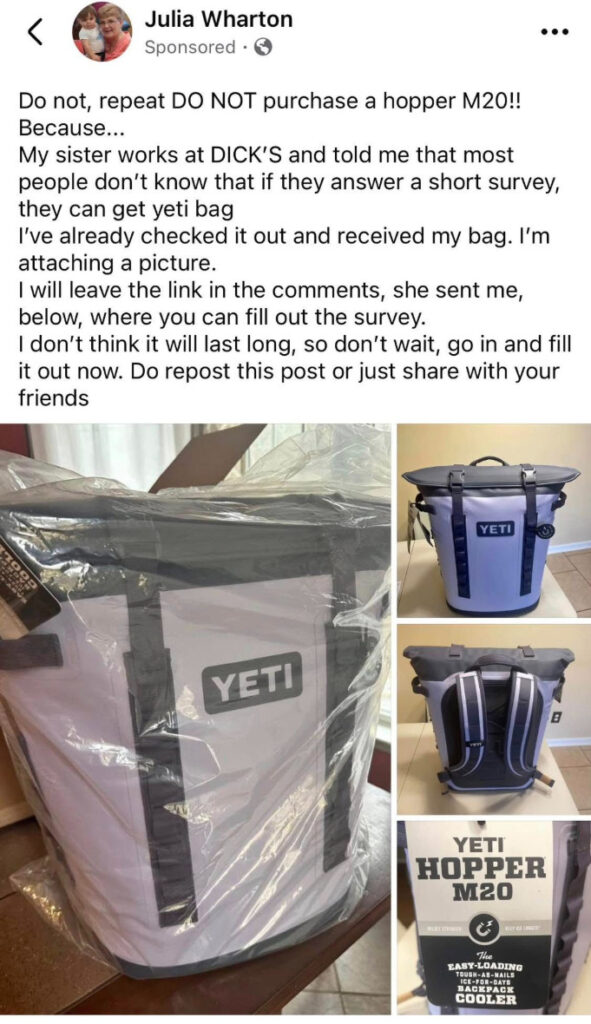
A friendly face, a casual warning, and a headline that starts with “Do not, repeat DO NOT purchase a Hopper M20!! Because…” Then comes the hook: “My sister works at DICK’S and told me that if you answer a short survey, you can get a free Yeti Hopper M20 bag.”
There are photos of a brand new Yeti cooler backpack still in the plastic. The post sounds personal, urgent, and almost too good to ignore. Why pay full price at Dick’s Sporting Goods when there is a “secret” way to get one nearly free?
This is exactly how the Dick’s Yeti Hopper M20 Giveaway Scam lures people in. It looks like an insider tip from a regular shopper, but behind that friendly post is a subscription trap that has nothing to do with Dick’s or Yeti at all.
In this article, we will walk through how the scam works, the red flags to look for, and what to do if you have already entered your information.
Scam Overview
The Dick’s Yeti Hopper M20 Giveaway Scam is part of a larger family of “free product” scams that misuse big brand names to trick people into paid subscriptions. Instead of paying $300 or more for a Yeti Hopper M20 cooler, the scam promises a bag for almost nothing if you just complete a “short survey” and cover a small shipping fee.
On the surface, the post looks like a helpful warning. It usually reads something like this:
- “Do not, repeat DO NOT purchase a Hopper M20!!”
- “My sister works at DICK’S and told me that most people do not know about this.”
- “If you answer a short survey, you can get a free Yeti bag.”
- “I have already checked it out and received my bag, see the picture.”
- “I will post the link in the comments, it will not last long, fill it out now and share with friends.”
This style of storytelling does several things at once:
- Builds trust with a personal connection
Mentioning a sister or friend who “works at DICK’S” makes it sound like an insider tip rather than a corporate promotion. It creates the impression that the post might even be against the rules, which makes people rush to use it before it disappears. - Triggers fear of missing out
Lines like “I do not think it will last long” and “do not wait” push you to act immediately. There is no time to verify details or check the official Dick’s website. - Uses proof photos as bait
The images of a Hopper M20 in its packaging, standing in a kitchen or living room, are there to make the story feel real. Even if those photos are stolen or reused from somewhere else, they convince people that someone actually got a free bag. - Moves the link into the comments
Leaving the link “in the comments” is a common scam tactic. It helps the scam dodge some automatic filters and makes the offer feel more like something you only see if you really pay attention.
Once you click that link, you are taken off Facebook and into a network of scam pages that are not run by Dick’s Sporting Goods, not run by Yeti, and not affiliated with any real rewards program.
The initial landing page may still mention Dick’s or show Yeti branding, but the domain name will be something generic or suspicious, not an official dicks.com or yeti.com address. The website may include:
- A short survey about shopping habits
- A headline promising a free Hopper M20
- A note that you only have to pay a small shipping fee
- Countdown timers and stock counters to create urgency
Hidden in the fine print is the real purpose of the page: enrolling you in a subscription membership that charges your card every month, often for $50 or more. The free bag is just the excuse used to collect your personal and financial details.
In many reported cases of similar “Yeti giveaway” scams, victims never receive a Hopper M20 at all. In others, they might get a cheap imitation or an unrelated product. The main goal is not to ship expensive coolers. The goal is to sign people up for memberships they did not realize they were agreeing to.
This scam spreads quickly because it plays perfectly into how people use social media. Friends share the post thinking they are helping others save money. The personal tone feels more credible than a normal advertisement. And the high price of genuine Yeti gear makes the offer extra tempting.
Understanding that the Dick’s Yeti Hopper M20 post is not a secret tip but a deliberate setup is the first step to staying safe.
How The Scam Works
To really see through the Dick’s Yeti Hopper M20 Giveaway Scam, it helps to break it into clear stages. Each stage has a purpose and uses specific tricks to keep you moving forward.
1. The Facebook “sister works at DICK’S” story
Everything starts with a sponsored post or shared status update. The pattern is almost always the same:
- A person with a normal looking profile picture
- A bold warning not to buy the Hopper M20 at full price
- A claim that a relative works at Dick’s Sporting Goods and knows a trick
- A promise that answering a short survey gets you a free Yeti bag
- Photos of a Hopper M20 cooler backpack, often still in its packaging
The language is casual and slightly messy, which actually makes it feel more real. Grammar mistakes and imperfect sentences can be deliberate, because people expect “real” users to write that way.
The post usually ends with:
- A note that the link will be in the comments
- Urgent encouragement to act fast
- A request to “repost this” or “share with your friends”
This turns victims into unpaid promoters, helping the scam spread far beyond the original ad.
2. The first landing page with survey and “reward” language
Clicking the link takes you to a landing page that may still mention Dick’s Sporting Goods and Yeti Hopper M20. It often includes:
- The logos of Dick’s and Yeti copied without permission
- A few lines about a limited time customer reward or inventory clearance
- A button that says “Start survey” or “Claim your Yeti bag”
The site is designed to look clean and professional, but the domain will not be an official one. Instead of dicks.com or yeti.com, you might see a long and odd URL with words like “rewards,” “survey,” “lucky,” or random numbers.
The survey itself is usually short and meaningless. It might ask:
- How often you shop at Dick’s
- What kind of outdoor gear you like
- Your age range or region
Your answers do not matter. Everyone who starts the survey passes it. The point is to make you feel like you earned the reward, which makes you more willing to continue to the next step.
3. The fake “congratulations” and limited stock trick
After the survey, the site celebrates your “success.” A message appears saying that you qualify for a free Yeti Hopper M20 and that there are only a limited number available. You may see:
- A large “Congratulations” banner
- Text saying “You are one of a few selected customers”
- A countdown timer, maybe 5 minutes, warning the offer expires soon
- A line stating “Only 37 bags left” or “Limited to 100 units”
These elements are there to create urgency and scarcity. If you feel like you are getting something rare, and you might lose it if you wait, you are much less likely to stop and think.
4. The shipping fee page that collects personal data
Next, you are moved to a page that looks like a standard checkout form. It repeats that you are getting a Yeti Hopper M20 for free and only need to pay a small shipping fee.
The page asks for:
- First and last name
- Full address and zip code
- Email address and phone number
- Credit or debit card details
At this point, most people feel comfortable. They believe they are dealing with a semi secret Dick’s promotion, and they have already invested time in the survey. The shipping fee usually sounds small compared to the high retail price of a Yeti cooler, so it feels like a bargain.
What you might not notice is a small block of fine print under the form or near the “Complete order” button. That tiny text is the heart of the scam.
5. Hidden subscription terms
The terms in that small print often explain that:
- By paying the shipping fee you are also joining a membership program
- The membership has a short trial period, sometimes 7 or 21 days
- After the trial, you will be charged a recurring monthly fee
- The fee can be $50 to $80 or more every 30 days
- The membership continues until you cancel through a specific process
This information is deliberately hard to see. The font is small, the wording is dense, and it is placed where your eyes are least likely to linger. At no point does the Facebook post or main heading clearly say “You are signing up for a monthly subscription.”
The shipping fee for the fake Yeti bag is just the hook. The real product the scammers are selling is a subscription you never really wanted.
6. After you pay: data harvesting and recurring charges
Once you submit the form, your card is charged for the shipping fee and your details are stored. Several things can happen next:
- You might receive a confirmation email for a membership you do not recognize.
- You might get a generic “order received” message that mentions only the shipping fee.
- You might receive nothing at all.
In many cases, the promised Yeti Hopper M20 never arrives. In others, victims end up with a cheap knockoff or a promotional bag that is nowhere near the quality of the real thing.
The real damage often shows up a few weeks later. After the trial period ends, your card is charged again, this time for a much higher amount. The descriptor on your bank statement might be a strange company name, a digital service, or a “savings club” that has nothing to do with Dick’s or Yeti.
If you do not spot the charge right away, it will continue every month, slowly draining your account.
7. Difficult cancellation and support that stalls
Trying to cancel is rarely simple. The email address or phone number listed in the fine print might:
- Take a long time to respond
- Send canned replies that do not answer your questions
- Tell you that you need to complete extra steps to cancel
- Offer “discounts” or “free months” instead of closing your account
These tactics are intentional. The scam thrives on confusion and delay. The longer you stay enrolled, the more months of fees they can collect.
8. Why the Dick’s Yeti Hopper M20 scam is so convincing
This scam works well for several reasons:
- Strong brand names: Dick’s Sporting Goods and Yeti are both trusted, which lowers your defenses.
- High retail value: A Hopper M20 is expensive, so a nearly free one feels like an amazing win.
- Personal story framing: The “my sister works at DICK’S” angle feels like a tip from a friend, not a corporation.
- Visual proof: Photos of the bag in someone’s home make it feel authentic, even if they are stolen.
- Clever use of urgency: Warnings that it “will not last long” and “answer the survey now” stop you from thinking deeply.
Knowing this pattern makes it much easier to recognize similar scams in the future, whether they involve coolers, tumblers, meat boxes, or anything else.
What To Do If You Have Fallen Victim to This Scam
If you clicked the link, filled in the survey, and paid the supposed shipping fee, do not blame yourself. These scams are designed by professionals who understand psychology very well. What matters now is taking the right steps to limit the damage.
Follow this checklist calmly and methodically.
- Check your bank or card statement right away
Look for the initial shipping charge and any other unfamiliar transactions that appeared after that date. Note the amounts, dates, and company names associated with each suspicious charge. - Contact your bank or card issuer
Call the customer service number on the back of your card and explain what happened. Tell them you believed you were participating in a Dick’s Yeti Hopper M20 promotion and later found out it was a subscription scam.Ask them to:- Block future charges from the merchant
- Consider canceling your card and issuing a new one
- Help you dispute any recurring charges that you did not authorize knowingly
- Search your email for confirmation messages
Use your email search function to look for terms like “membership,” “subscription,” “order confirmation,” or the suspicious company names from your bank statement.These messages can give you more detail about what you were enrolled in. Save copies or take screenshots of anything related to the scam. - Attempt to cancel through the merchant
If the emails or website provide a cancellation link or customer service contact, try to use them.- Fill out any cancellation forms
- Send clear emails stating that you revoke consent for any further charges
- Keep screenshots or copies of all correspondence
- File a formal dispute or chargeback
If charges have already gone through, ask your bank how to start a dispute or chargeback. Provide all the evidence you collected:- The original Facebook post screenshot if you have it
- Any emails from the scam company
- A description of how the offer was presented as a Dick’s Yeti Hopper M20 free bag in exchange for a survey and shipping only
- Change passwords and secure your accounts
If you created an account on the scam site or used a password that you also use elsewhere, change that password immediately on all other services.Turn on two factor authentication for your main email and financial accounts. This reduces the risk of any further misuse of your data. - Report the scam to Dick’s Sporting Goods and Yeti
Visit the official websites of Dick’s and Yeti and use their customer service or contact forms to report the fake promotion. Include links, screenshots, and any details you have.Large brands take impersonation seriously, and your report helps them track and shut down fraudulent campaigns that target their customers. - Report the post or ad on the platform
Go back to the social media platform where you saw the post and report it as a scam or fraud. If you shared it before you realized the problem, consider adding a comment to your post warning others not to click. - Warn friends and family
Let people around you know what happened. Scammers often reuse the same script with different names and slightly different photos. Your warning might stop someone else from falling for the same trick. - Watch for follow up scams
Once scammers know your email and phone number are active, they might target you with additional offers. Be very cautious with any “customer service” emails claiming to help you get your money back or complete your order. These can be new scams piggybacking on the old one.
The Bottom Line
The Dick’s Yeti Hopper M20 Giveaway is not a hidden employee deal or a secret survey reward. It is a subscription scam that uses a personal sounding Facebook post, borrowed Yeti photos, and the reputation of Dick’s Sporting Goods to convince people to share their card details.
Instead of a nearly free Hopper M20, victims usually receive nothing or a cheap imitation, then discover surprise recurring charges for memberships they never knowingly agreed to.
If you see a post claiming that someone’s sibling at Dick’s can hook you up with a free Yeti bag for answering a short survey, treat it as a red flag, not a lucky break. Always verify promotions on the official Dick’s and Yeti websites, read the fine print on any checkout page, and remember that “free” gear that requires a credit card is rarely free at all.
FAQ
Is the Dick’s Yeti Hopper M20 giveaway real?
No. The viral “Dick’s survey reward” posts offering a free Yeti Hopper M20 for a small shipping fee are not official promotions from Dick’s Sporting Goods or Yeti. They are designed to push victims into hidden subscription charges.
Why does the post say “my sister works at DICK’S”?
That line is a trust trick. Scammers use a personal connection to make the offer feel like an insider tip rather than an advertisement, so people click before they verify anything.
If I complete the survey, do I actually win a Yeti Hopper M20?
In most cases, no. The “survey” is a scripted step where everyone qualifies. Many victims never receive anything. Some may receive a cheap, unrelated item or a low quality knockoff, but not a legitimate Yeti Hopper M20 from Dick’s.
Why are there photos of the bag still in plastic?
Those images are used as bait. They are often stolen from real listings, reused across multiple scam posts, or taken from unrelated sources to make the offer look proven and legitimate.
What is the real goal of the scam?
To collect your personal information and card details, then enroll you in recurring paid memberships. The initial “shipping fee” is just the hook.
What kind of charges can show up after the shipping fee?
Victims often see recurring charges that can be $50 to $80 (or more) every 30 days. The merchant name on your statement may not mention Dick’s or Yeti at all, which makes the charges harder to recognize quickly.
Where are the subscription terms hidden?
Usually in small print near the payment button or inside a terms and conditions link. It may say you are enrolling in a “membership program” or “benefits club” that renews automatically unless canceled within a short window.
Why do these pages use countdown timers and “limited stock” warnings?
To rush you. Fake timers and “only 100 left” claims are pressure tactics meant to stop you from reading the fine print or checking whether the offer is mentioned on the official Dick’s or Yeti website.
I entered my card details. What should I do now?
Act quickly:
- Contact your bank or card issuer and report it as a deceptive subscription offer
- Ask about blocking future charges and issuing a new card
- Monitor your statements for additional charges
- Save screenshots and any emails you received
Can I get my money back?
Often, you have a chance. Many banks will consider disputes or chargebacks for misleading “free gift” subscription traps, especially if you report it quickly and provide evidence like screenshots, emails, and the dates of charges.
How can I tell if a Dick’s or Yeti giveaway is legitimate?
Real promotions will be posted on official channels:
- Dick’s Sporting Goods official website and verified social accounts
- Yeti official website and verified social accounts
If the link goes to a random domain, asks for a card to “pay shipping,” and uses survey or reward language, treat it as suspicious and avoid it.








