

The Vera California sale looks like the kind of find you brag about to a friend.
A clean boutique-style website. Soft lifestyle photos. Deep discounts that feel generous, not suspicious. A holiday message that sounds heartfelt. A promise that stock is limited and the deals are ending today.
But if you slow down and read it like a shopper who has been burned before, small details start to feel… off.
And once you notice them, it gets harder to unsee the pattern.
Scam Overview
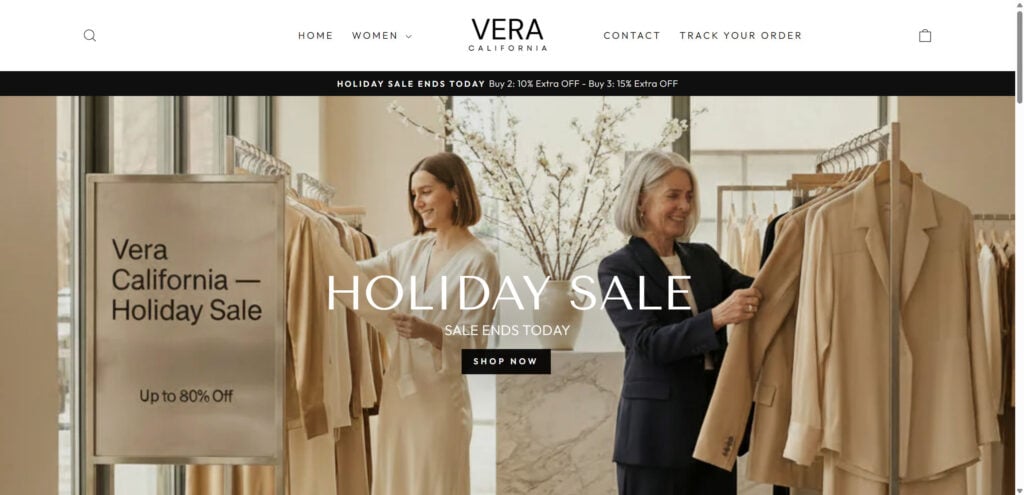
Vera California presents itself like an established fashion brand running a seasonal promotion. The site leans heavily on a familiar, comforting story: tasteful minimal design, “premium” positioning, and a limited-time event that encourages you to grab items before they sell out.
On the surface, it looks like a normal online store.
In practice, the Vera California sale has many of the same red flags seen in a recurring “boutique sale” operation: a freshly created storefront, heavy urgency marketing, questionable brand history claims, and customer support and return policies that leave buyers stuck once the package arrives.
Below is what stands out, and why it matters.
The “Holiday Sale Ends Today” pressure is the engine
The site pushes urgency in multiple places:
- “Holiday sale ends today”
- “Up to 80% off”
- Extra discounts for buying multiple items (for example, Buy 2: extra 10% off, Buy 3: extra 15% off)
This kind of stacking discount is not automatically proof of fraud. Real stores do it.
The problem is how it’s used here: as constant pressure. The entire shopping experience nudges you away from thinking and toward clicking “Shop Now.”
This matters because urgency is how these operations reduce scrutiny. If you feel like the sale is disappearing in hours, you are less likely to:
- search for independent reviews
- check domain age
- compare product photos across other sites
- read the return policy carefully
The “About Us” story does not match the domain reality
One of the most telling red flags is the mismatch between the brand’s “we’ve been around forever” story and the website’s actual footprint.
In the site footer, the “About Us” section claims years of experience in fashion “since 1999” and suggests a long-standing reputation for quality and reliability.
But the domain information shown in your screenshot indicates the veracalifornia.com domain was registered on 2025-11-07.
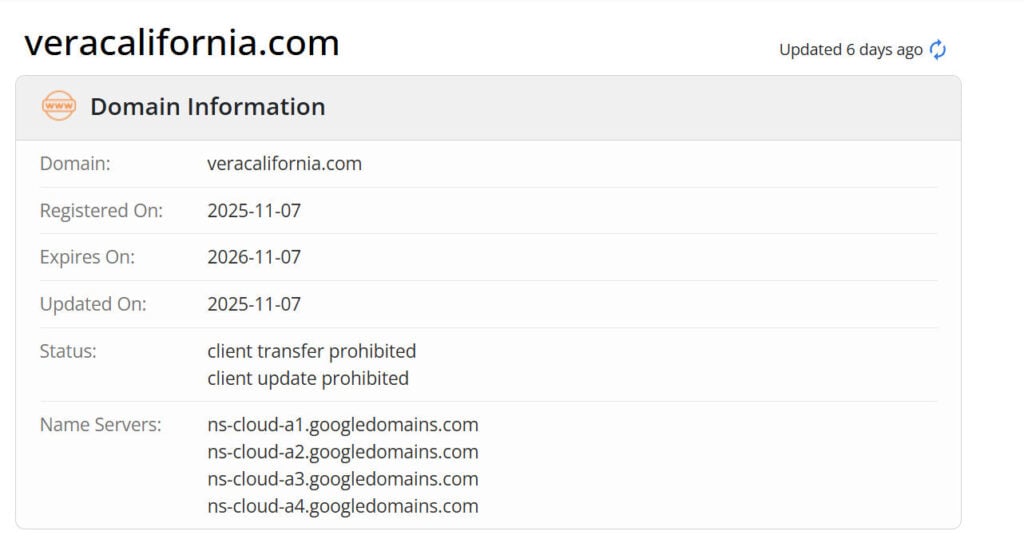
That gap matters.
A legitimate brand that has been operating since 1999 usually leaves a trail: older domains, older press mentions, older customer reviews, older social profiles, older archives, or consistent branding across time.
A newly registered domain paired with a “since 1999” claim is a classic credibility shortcut. It’s meant to create instant trust without providing evidence you can verify.
The branding feels polished, but the store structure is generic
These “sale boutiques” often look professional because they use a standard ecommerce theme and high-quality visuals.
A polished layout does not equal a trustworthy business.
What tends to repeat across this network-style setup is the structure:
- Minimal company details (often no verifiable physical address)
- A “Contact” page that is basically a form
- A support email that looks official but is hard to get meaningful help from
- Policy pages that are broad, vague, or written like templates
From your screenshot, the footer shows a customer service email (support@veracalifornia.com) and a schedule (“Monday to Friday 9 am to 5 pm,” “Weekends 10 am to 4 pm”), which sounds reassuring.
But schedules and emails are easy to publish. The real test is whether customer service can actually solve problems quickly and fairly when something goes wrong.
The product photos and listings raise “sourced inventory” concerns
The product grid shows a familiar mix of sweaters, cardigans, and cozy seasonal items.
This category is a common target for dropship-style stores because:
- sizing issues are easy to blame on “fit preference”
- fabric quality is hard to judge online
- photos can be copied from other sellers, catalogs, or generated/edited
- returns become complicated, expensive, and slow
In many similar operations, buyers report one of two outcomes:
- Items arrive and the quality does not match the photos. Fabrics feel thin, stitching is rough, sizing is inconsistent, and the garment looks different in shape and finish.
- Items do not arrive for a long time, tracking is confusing, and customer service responses become slow or repetitive.
Even if a package eventually arrives, the “resolution phase” is where the real trap often springs: returns that require international shipping and partial refund offers that quietly close the door on a full refund.
The return policy is often the hidden deal-breaker
For shoppers, the biggest risk is not always “Will I receive something?”
It’s: “If what I receive is disappointing, can I get my money back without a fight?”
With this type of storefront, returns commonly become “technically possible” but practically unrealistic because they require:
- shipping the item back internationally, frequently to China
- paying return postage yourself
- meeting tight timelines
- navigating slow email-only support
- accepting that the seller may claim the item was not received, received late, or received in a different condition
Then comes the most common tactic: partial refunds.
Instead of providing a simple return label and a clear refund timeline, the seller may offer:
- “Keep the item and we’ll refund 15%”
- “We can do 20% if you accept today”
- “We’ll do 30% as a special exception”
Those numbers are not random. They are calibrated to be just enough to tempt a tired customer into giving up.
Once you accept, the dispute is effectively over.
Why this pattern keeps showing up online
This “Vera California sale” style works because it combines three ingredients:
- A brand identity that feels safe
Words like “California,” clean typography, soft neutral photos, and boutique positioning create a calm, premium impression. - Discounts that push you into higher cart totals
Extra % off for buying more items increases revenue per order and makes customers feel like they “won” the deal. - Policies that control the outcome after purchase
If the product disappoints, the business side of the operation is designed to minimize refunds.
It’s not always a traditional “take the money and disappear” scam.
More often, it’s a value mismatch operation: you pay premium-ish prices for products that behave like low-cost mass inventory, and the refund process is structured to wear you down.
How The Scam Works
What follows is a step-by-step breakdown of how the Vera California sale style of operation typically runs, from the first ad to the final refund email.
Even if every detail is not identical for every buyer, the flow is consistent enough that you can recognize it quickly once you know what to look for.
Step 1: The shopper meets the “perfect” ad
Most people do not find these stores by searching for the brand directly.
They find them through:
- social media ads
- “holiday sale” placements
- influencer-style videos that look organic
- discount-style posts that claim a limited-time event
The ad usually focuses on one emotional hook:
- “Once-a-year sale”
- “Everything must go”
- “Holiday clearance”
- “Limited stock”
- “Up to 80% off today”
The goal is not to explain the brand.
The goal is to get the click.
Step 2: A clean storefront builds instant trust
Once you land on the site, you see what looks like a legitimate boutique.
Key trust cues are placed immediately:
- a strong sale headline
- a “sale ends today” message
- professional product photos
- a tidy navigation bar (Home, Women, Contact, Track Your Order)
- payment icons in the footer (to signal “safe checkout”)
This is a psychological handoff: the ad got your attention, and the store layout reassures you that you are in a normal shopping experience.
Step 3: Urgency messaging blocks careful thinking
Then the pressure ramps up.
The site encourages you to act fast with lines like:
- inventory is limited
- items will not be restocked
- sale ends soon
This matters because careful shoppers do “friction steps” like:
- searching “Vera California reviews”
- checking domain age
- reading policy pages
- looking for a physical address
- reverse image searching product photos
Urgency reduces those steps.
The buyer thinks, “I’ll just grab a couple things before it ends.”
Step 4: Discount stacking pushes larger carts
The extra discount tiers for buying multiple items are not just “generous.”
They are strategic.
They push you into:
- 2 items instead of 1
- 3 items instead of 2
- “I’ll add one more to hit the next discount”
This increases the order value and makes refunds more painful.
If you buy one sweater and it’s disappointing, you might walk away.
If you bought four items to unlock the best deal, you now have a bigger financial reason to fight for a refund. That gives the seller leverage.
Step 5: Checkout feels normal, and that’s the point
At checkout, the process usually looks standard:
- shipping address
- payment
- confirmation email
Nothing feels obviously malicious.
That is what makes this style of operation effective. It blends into the normal rhythms of ecommerce.
Step 6: Shipping becomes vague, slow, or confusing
After purchase, the next phase begins: waiting.
In many cases, buyers report:
- long processing times
- delayed shipping updates
- tracking numbers that update slowly
- packages that appear to originate overseas even when the branding implies a local boutique
Some buyers receive items. Some wait much longer than expected. Some get incomplete orders.
But the bigger issue comes next.
Step 7: The product arrives and does not match expectations
When the order arrives, the most common complaints in this model are:
- fabric feels cheaper than expected
- fit and sizing are inconsistent
- stitching and finishing are poor
- the item looks different from the photos
- colors and texture are not the same
- “premium boutique” becomes “mass-produced fast fashion”
Even when the item is wearable, the buyer realizes they did not get what the photos and branding suggested.
That emotional shift is important: disappointment turns into “I want to return this.”
Step 8: Customer service switches from friendly to procedural
When you email support, the responses often become:
- slow
- short
- repetitive
- focused on policy instead of solutions
Common patterns include:
- asking for photos (even when the issue is obvious)
- asking you to restate the order number multiple times
- offering “solutions” that keep you from returning
- suggesting you gift the item or keep it
The tone often stays polite, but the structure is designed to delay and reduce refund rates.
Step 9: Returns are framed as possible, but made unrealistic
If you insist on a return, the next barrier appears:
- return shipping is on you
- returns must go to an international address
- the shipping cost can be high relative to the item price
- tracking and delivery confirmation become your responsibility
Even if the return is accepted in theory, it becomes a practical problem:
- Paying $25 to ship back a $49 item feels pointless.
- Paying $60 to ship back a multi-item order feels painful.
- Waiting weeks for international delivery and then waiting again for a refund adds stress.
This is where many buyers give up.
Step 10: The partial refund “settlement” arrives
At this stage, many victims receive an offer like:
- “We can refund 15% and you keep the item”
- “We can refund 20% as a courtesy”
- “We can offer 30% as our best solution”
This is presented as helpful customer service, but it is also a conversion tactic.
The seller is trying to turn a refund request into a “discount after the fact.”
If you accept, you stop being a refund request and become a completed sale.
Step 11: If you refuse, the process drags on
If you decline the partial refund and continue to push for a full refund, the conversation may become:
- slower
- more policy-heavy
- more conditional
Sometimes the seller will continue to offer slightly higher percentages, hoping you will eventually accept to end the frustration.
Step 12: The buyer is left with two realistic options
In many cases, the buyer ends up choosing between:
- Accept a partial refund and keep the item
- Escalate outside the merchant, usually through a chargeback or payment dispute
That is not how a legitimate boutique typically operates.
A real brand that stands behind quality usually makes returns straightforward, not exhausting.
What To Do If You Have Fallen Victim to This Scam
If you already placed an order from Vera California and you are worried, you still have options. The key is to move calmly but quickly, and to document everything.
Here’s a step-by-step plan that works for most buyers.
1) Save proof of everything right now
Create a folder and save:
- order confirmation email
- receipts and invoices
- screenshots of the product page (photos, description, pricing)
- screenshots of the return policy and shipping policy
- screenshots of tracking updates
- all emails exchanged with support
If the site changes later, your screenshots matter.
2) If the order has not shipped, request cancellation in writing
Email support and clearly state:
- your order number
- that you are requesting cancellation and a full refund
- that you do not authorize shipment
Keep it short and firm.
Even if they refuse, your request creates a timeline that can help in a dispute.
3) If the item arrived and it is not as advertised, photograph it clearly
Take well-lit photos of:
- the item in full
- close-ups of stitching, fabric, logos, tags
- any defects
- the packaging label if it shows an origin or sender you did not expect
If the issue is “not as described,” show the differences compared to the product page.
4) Ask for a full refund and a return label
Do not negotiate against yourself.
Use direct language:
- “I am requesting a full refund.”
- “Please provide a prepaid return label.”
- “Please confirm the refund timeline in writing.”
If they offer only partial refunds, do not accept if you want a full refund.
5) Do not let the return-to-China hurdle stall you
If they require international shipping at your expense, you have a decision to make:
- If the order value is small, a chargeback or payment dispute may be more practical than paying high shipping costs.
- If you do ship it back, use tracked shipping and keep proof of postage and delivery.
Be realistic. Many people spend more on return shipping than the refund is worth.
6) Escalate through your payment method
If customer service is unhelpful or delays too long, escalate.
Options include:
- Credit card chargeback (often best protection)
- PayPal dispute (if used)
- Debit card dispute (possible, but protections can be weaker)
When you file, use clear reasons:
- “Item not as described”
- “Misleading merchant”
- “Return refused or impractical”
- “Seller offered only partial refund”
Attach your screenshots and emails.
7) Watch for subscription traps or unexpected charges
Some questionable stores attempt:
- follow-up charges
- “shipping insurance” confusion
- or hidden subscription style billing
Check your statements for at least a few weeks.
If you see unfamiliar charges:
- contact your bank immediately
- request a card replacement if needed
8) Report the store to help other shoppers
Reporting does two things: it creates a public record, and it helps reduce the reach of the ads.
You can report to:
- your card issuer or payment platform
- the advertising platform where you saw the ad
- consumer complaint agencies in your country
And if you have time, leave a factual review describing:
- what you ordered
- what arrived
- how returns were handled
- whether you received a refund
Stick to what you can prove.
9) If you are outside the refund window, still try a dispute
Do not assume it’s too late.
Many payment networks allow disputes for a period after delivery, especially for “not as described” issues.
Even if the first representative says no, ask what documentation would be needed to proceed.
10) Protect yourself for next time
This type of storefront is common. A quick pre-purchase routine can save you money:
- check domain age
- search “brand name + reviews”
- read return policy for return address and who pays shipping
- reverse image search product photos
- look for a real company address and a verifiable footprint
If you cannot verify the brand beyond its own website, treat it as high risk.
The Bottom Line
The Vera California holiday sale checks too many boxes associated with a recurring “boutique sale” scam pattern: heavy urgency marketing, deep discounts designed to push bigger carts, credibility claims that clash with a newly registered domain, and policies that can make refunds and returns feel nearly impossible once the order arrives.
If you have not ordered yet, the safest move is to skip it and shop from a retailer with a clear history and straightforward returns.
If you already ordered, focus on documentation, firm refund requests, and escalation through your payment provider if support stalls or tries to funnel you into a small partial refund.
In this kind of operation, the sale is not the real product.
The real product is how hard they make it to get your money back.








