

It usually starts with a scroll and a split-second decision.
A slick ad promises “wave therapy” from home, a confident doctor quote, and the kind of results that sound almost too good to be true, stronger erections, better control, even “long-term” improvement without pills.
The Neuman Wave Therapy Pro looks polished, medical, and everywhere right now. Multiple websites. Endless discounts. Testimonials that feel suspiciously perfect.
So I did what most people do not have time to do.
I followed the trail behind the ads, the branding, the claims, and the checkout pages to see what this device really is, and what buyers are actually signing up for.
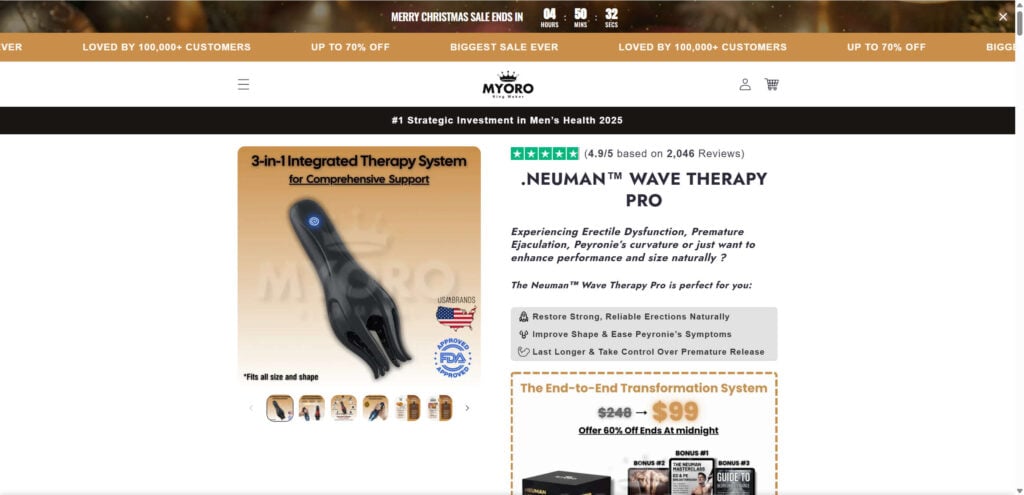
Overview
The Neuman Wave Therapy Pro is marketed as a “clinical-grade” at-home wave therapy device for men. Depending on the website selling it, it is positioned as a solution for erectile dysfunction, premature ejaculation, low sensitivity, “performance issues,” and sometimes even Peyronie’s disease related claims.
The pitch usually follows a familiar structure:
First, it creates urgency and emotional pressure.
Then, it offers an “easy fix.”
Finally, it wraps the fix in medical-style language to make it feel legitimate.
The core promises you will see again and again
Most Neuman Wave Therapy Pro landing pages include claims like:
- Improves erectile function by “boosting blood flow”
- Enhances sensitivity and nerve response
- Helps men “last longer”
- Restores “confidence” and sexual performance naturally
- Uses “wave therapy” or “acoustic wave” technology inspired by clinics
- Produces results in weeks, sometimes with specific numbers like “76% improvement” or similar
On the surface, that sounds similar to real clinical treatments you may have heard about. That is not accidental.
The real shockwave therapy people think they are buying
In actual medical settings, there is a treatment sometimes called low-intensity extracorporeal shockwave therapy (often abbreviated Li-ESWT) that has been studied for erectile dysfunction, especially for men whose ED is linked to blood vessel function.
A few important points that marketing pages often blur:
- Clinical shockwave therapy is delivered with specialized medical devices designed to produce controlled energy.
- It is typically administered by trained professionals following specific protocols.
- Evidence varies by patient type and study design, and it is not a guaranteed cure for everyone.
- It is not the same thing as a small handheld gadget that vibrates and calls itself “wave therapy.”
So when a website implies you are getting “clinic-grade wave therapy at home” for $99, you should immediately ask: what exactly is the device doing physically?
What the Neuman Wave Therapy Pro appears to be
Based on the way it is presented and the way similar devices appear on wholesale marketplaces, the Neuman Wave Therapy Pro is best understood as a consumer-grade vibrating massager designed for stimulation, not a regulated medical shockwave device.
Many of these listings highlight features like:
- Multiple vibration modes (often 10 modes)
- “Targeted pulsation” language
- A flexible wrap design that fits different sizes
- USB charging
- Instructions that include using water-based lubricant and placing the device on specific areas
That is not automatically “bad.” A vibrator is a vibrator.
The problem is when a vibrator is sold as a medical breakthrough.
The “doctor recommended” credibility layer
A common persuasion tactic on these pages is a “Recommended by Experts” panel featuring a doctor name, a board-certified specialty, and a short quote about non-invasive solutions.
Here is the consumer reality:
- Legitimate medical endorsements are verifiable.
- Real doctors and clinics do not usually attach their name to random direct-to-consumer gadgets sold through anonymous storefronts.
- If the page does not link to a real clinic profile, licensing details, published statements, or verifiable credentials, the endorsement is just marketing.
Even if a name is listed, you should treat it as unproven until you can confirm it outside the sales page.
The “As seen on” media logos
Another credibility trick is a strip of major media logos: NBC, Forbes, Men’s Health, Healthline, ABC News, and similar.
This creates an impression that the product was featured or reviewed by these outlets.
What you should know:
- Many low-quality dropshipping sites place media logos without permission.
- A logo on a landing page is not evidence of coverage.
- If there is no link to the actual article, segment, or review, assume it is just decorative.
This is one of the most common patterns across aggressive social media products, especially in the men’s health niche.
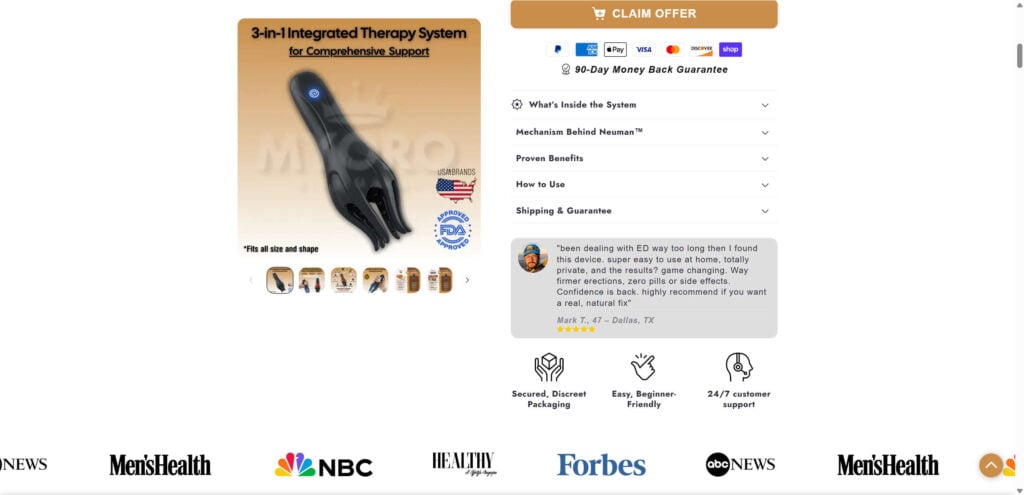
The pricing story often does not make sense
A major red flag is when the retail price jumps wildly across sites.
You might see:
- A “regular price” of $248 slashed to $99
- A “today only” $89 deal
- A “60% off ends at midnight” countdown
- A local currency price on one version of the page and a completely different one elsewhere
Constant “limited-time” urgency is not a sign of a serious health product. It is a sign of conversion optimization.
Even more concerning, versions of the same device design appear on wholesale sites for under $15, sometimes far less. That does not automatically prove every seller is dishonest, but it does strongly suggest:
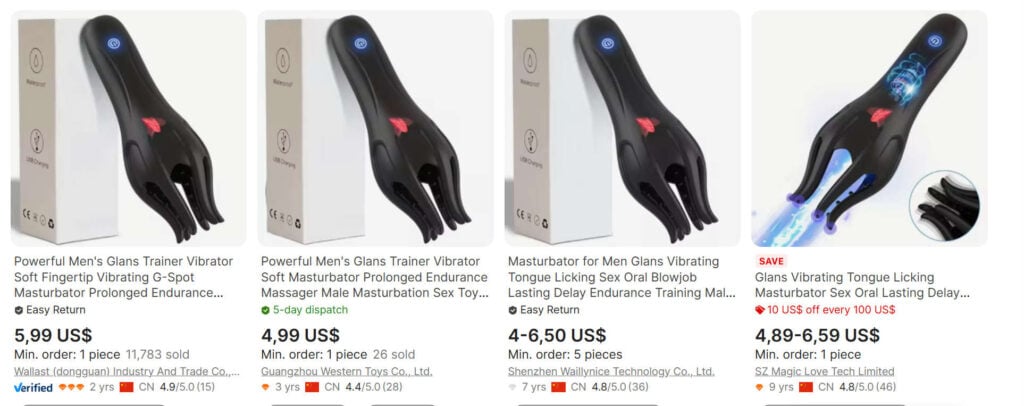
- The device is mass-produced and rebranded
- The “medical breakthrough” story is the value wrapper, not the engineering
What about the claim that it helps erectile dysfunction?
ED is real, common, and often treatable. But it is also medically complex. It can involve:
- Blood flow and vascular issues
- Hormonal factors
- Stress, anxiety, depression, and performance pressure
- Medication side effects
- Diabetes or cardiovascular conditions
- Lifestyle factors like sleep, alcohol, and smoking
A vibrating device might help some people with arousal, stimulation, or confidence in the moment. That is not the same as “treating erectile dysfunction.”
If a product claims it can fix ED, increase size permanently, and improve multiple medical conditions, you should pause. Those are enormous claims, and extraordinary claims require extraordinary evidence.
“Clinically inspired” is not “clinically proven”
You will see phrases like:
- “Clinically inspired”
- “Clinical-grade”
- “Based on wave therapy”
- “Proven benefits”
These phrases are carefully chosen because they sound scientific while staying vague.
If a brand truly has clinical evidence, they typically provide:
- Clear device specifications
- Studies that match the exact device model
- Regulatory information where applicable
- Transparent company details, not just a flashy landing page
Most of these Neuman Wave Therapy Pro pages do not offer that level of transparency.
Why these products go viral in the first place
The marketing works because it targets a painful mix of emotions:
- Privacy concerns
- Fear of judgment
- Anxiety about aging or performance
- The desire for a quick fix
- Hope that “technology” can solve what feels personal
A well-built clinic or physician relationship takes time. A dropshipping landing page takes 5 minutes, and it can be scaled to millions of people through ads.
That is why you keep seeing this product everywhere.
Who should be especially careful
If you are considering the Neuman Wave Therapy Pro, be extra cautious if you:
- Have diabetes, heart disease, or take nitrates or blood pressure meds and are trying to self-treat ED
- Have pain, curvature, or suspected Peyronie’s disease and are tempted by “straightening” claims
- Have numbness, nerve symptoms, or pelvic pain
- Are buying mainly because the site claims size increases or “permanent results”
In those scenarios, the safest path is a real medical conversation. Not because you should be embarrassed, but because you deserve answers that are tailored to your actual situation, not a one-size-fits-all gadget pitch.
So, should you buy it?
If you strip away the marketing layers, you are likely looking at a rebranded vibrating device being sold as medical “wave therapy.”
If you want a vibrator and you are comfortable paying a premium for convenience and privacy, you might be satisfied, as long as you keep expectations realistic.
If you are buying it because you believe it will medically treat erectile dysfunction, fix curvature, regenerate tissue, or permanently increase size, you are walking into the highest-risk version of this purchase: paying a lot for hope.
And that is exactly where dropshipping operations make the most money.
How The Dropshiping Operation Works
The reason the Neuman Wave Therapy Pro shows up across multiple sites with slightly different branding is simple: the business model is designed for cloning.
What you are often seeing is not one stable brand, but a repeatable template.
Below is how this type of operation commonly works, step by step, and what to look for at each stage.
1. Start with a mass-produced product that already exists
The foundation is usually a generic factory-made device sold on wholesale platforms. These products are designed to be:
- Cheap to manufacture
- Easy to ship
- Easy to rebrand with a new name and logo
- Visually “high tech” enough to support big claims
In the men’s wellness space, this often includes:
- Vibrating devices
- “Massage” tools
- Red light gadgets
- Magnetic bracelets
- Posture correctors
- “Detox” patches
The Neuman Wave Therapy Pro fits this pattern closely.
2. Rename it into something that sounds medical and premium
A generic “male massager” does not sell well at $99.
But a name like “Neuman Wave Therapy Pro” sounds like:
- A patented technology
- A clinic device
- A brand with history
- A German-engineered vibe, even if the product is made elsewhere
The name is part of the illusion of legitimacy.
3. Build a single high-converting landing page, not a real store
Most of these websites are not designed like normal ecommerce stores.
They are designed like funnels.
You will typically see:
- Very long pages
- Minimal navigation
- Repeated “Check Out” buttons
- A countdown timer
- A “limited supply” warning
- A dramatic before-and-after style graphic
- Big blocks of claims with very little technical detail
The goal is not to educate you. The goal is to keep you scrolling until you buy.
4. Add trust symbols people associate with authority
This is where the operation becomes manipulative.
Common “trust layers” include:
Fake or unverified doctor endorsements
A photo in a white coat plus a urologist title can instantly reduce skepticism.
But if:
- The page gives no verifiable details
- The “doctor” cannot be found through legitimate medical directories
- The quote is generic and could apply to anything
- The photo looks like a stock image
Then it is not a medical endorsement. It is a conversion tool.
Media logos without proof
A row of recognizable outlet logos creates a shortcut in the brain: “This must be real.”
But without links to real coverage, those logos are just props.
Big review scores that are hard to verify
You might see “4.9/5 based on 2,046 reviews” or similar claims.
Ask yourself:
- Where are those reviews hosted?
- Can you click into them?
- Do they look like real customers, or like templated testimonials?
- Do multiple sites show the same reviews word-for-word?
A high review number on a private landing page is not the same as a real reputation.
5. Use high-pressure pricing psychology
Dropshipping funnels often rely on pricing tricks like:
- Inflated “original” price, then a huge discount
- “Get 60% off” buttons everywhere
- “Sale ends at midnight” messaging every day
- A ticking countdown timer that resets when you reload
This is designed to make you buy now, before you think too long.
It is especially common in products targeting sensitive issues like sexual performance, where people may not want to research deeply.
6. Run aggressive social media ads with multiple angles
These products rarely spread organically first. They are pushed.
Ad strategies commonly include:
- A “doctor explains” style video
- A concerned partner angle
- A confidence and masculinity angle
- A “new breakthrough banned by Big Pharma” style narrative
- A “real men are using this” vibe with vague claims
Sometimes these ads also use:
- Celebrity lookalikes
- Deepfake-style voiceovers
- Fake interview clips
- Staged reaction videos
Even when the ads are not technically deepfakes, they can still be misleading because they imply authority and proof that does not exist.
7. Send buyers to cloned domains and rotating storefronts
One reason refund battles get messy is that these operations can rotate domains quickly.
You might see:
- One domain in the ad
- A different domain on the checkout
- A different business name on the credit card statement
- A support email that changes later
When customers complain, the seller can:
- Shut down that domain
- Launch a new one
- Keep selling under a new name
This is why you can find “the same product” sold by many sites.
8. Fulfillment happens through a third party, often from China
In many dropshipping setups:
- The seller does not store inventory
- The order is forwarded to a supplier
- The supplier ships the product, often internationally
That is why shipping may take:
- 7 to 21 days
- Sometimes longer, depending on customs and logistics
It also explains why tracking can be confusing and why customer support can feel scripted or slow.
9. Returns and refunds become the trap
This is where a lot of buyers get stuck.
Refund policies may look reasonable at first glance, like “90-day money back guarantee,” but the fine print often includes obstacles such as:
- You must return the product to an international address
- You must pay return shipping
- The return must be received within a short window
- You must include original packaging
- You must get approval first
- A “restocking fee” may apply
- “Used” products may be excluded
For a low-cost item, return shipping to China can be expensive enough that many people give up.
That is not an accident. It is part of the math.
10. The product keeps getting re-skinned, re-shot, and re-sold
Once a funnel proves it can convert, it gets copied.
You will see:
- The same product photos
- The same before-and-after graphics
- The same medical claims
- The same testimonials
- Minor changes in brand name and color theme
This is why these operations feel like they are “everywhere” at once. They are.
The biggest tell: the claims are doing the heavy lifting
A legitimate health-related device can stand on:
- Clear specs
- Transparent company info
- Real customer support
- Verifiable evidence
- Reasonable marketing
A dropshipping funnel stands on:
- Emotional pressure
- Authority theater
- Urgency
- Vague science language
- Hard-to-use refund policies
When you see the second set of signals, you are not looking at a medical breakthrough.
You are looking at a conversion machine.
What To Do If You Have Bought This and Are Unhappy
If you already purchased the Neuman Wave Therapy Pro and you regret it, you are not alone, and you still have options. The key is to move calmly, document everything, and take the steps that give you the most leverage.
- Save evidence immediately
Take screenshots of:- The product page claims (especially medical claims and guarantees)
- The refund policy and return instructions
- Your order confirmation page
- Any emails from the seller
- Your tracking page and delivery status
If the site changes later, your screenshots matter.
- Find the exact merchant name on your bank statement
The store name and the charge name may not match. Write down:- Merchant name
- Date of charge
- Amount charged in $
This helps if you need to dispute the transaction.
- Email support with a clear, simple request
Keep it short and direct:- State you want a refund
- Provide order number
- Ask for return instructions in writing
- Ask them to confirm the return address and deadline
Do not write an emotional essay. You want a clean paper trail.
- Do not accept endless troubleshooting as a substitute for a refund
Some sellers respond with scripts:- “Try a different mode”
- “Use it for 2 more weeks”
- “We can offer you 15% back”
If you want a refund, repeat your request and stick to it.
- If they require return shipping to China, ask for a prepaid label
You can say:- You will return it, but you want a prepaid return label
Many sellers will refuse. That refusal is useful documentation later.
- You will return it, but you want a prepaid return label
- Check the return window carefully and do not miss deadlines
If the policy says you must request a return within 14 days, treat that as a hard deadline even if the site says “90 days.”
Some sellers use multiple conflicting timelines. - If the product is not as described, say that explicitly
Use phrases that matter in disputes:- “Item not as described”
- “Misleading advertising”
- “Medical claims not supported”
- “Unable to verify endorsements”
Keep it factual, not insulting.
- If the seller stalls, escalate to your payment provider
Depending on how you paid:- Credit card: file a dispute for “item not as described”
- PayPal: open a dispute in the Resolution Center
- Shop Pay or similar: check buyer protection routes
The earlier you start, the better.
- Use your evidence to support your dispute
Provide:- Screenshots of the claims
- Screenshots of refund policy
- Emails showing stalling or refusal
- Proof of delivery if it arrived
Dispute teams respond well to organized documentation.
- If you decide to return it anyway, use tracked shipping and keep receipts
If you return it internationally:
- Use tracking
- Photograph the package before sending
- Save the receipt
- Save the tracking number screenshot
If the seller claims “we never received it,” your tracking is your defense.
- Change expectations and protect your privacy going forward
If you created an account on the site:
- Change the password if you reused it anywhere
- Watch your email for upsell spam
If you are worried about card safety: - Consider a new card number after the dispute process if your bank recommends it
- If you are dealing with ED, shift your plan toward evidence-based help
This is the part that actually helps long-term:
- Talk to a licensed clinician or urologist
- Ask about lifestyle factors, labs, medications, and proven treatments
- Be wary of any product that promises permanent size gains or guaranteed cures
You deserve solutions based on your body, not a generic gadget pitch.
The Bottom Line
The Neuman Wave Therapy Pro is marketed like a medical breakthrough, but it behaves like a classic dropshipping product: big claims, heavy urgency, trust symbols that are hard to verify, and a device design that appears widely available at low wholesale prices.
If you want a consumer vibrator and you are comfortable with the cost, you might find it does something for stimulation. Just do not confuse that with medical shockwave therapy or a proven treatment for erectile dysfunction.
If you are buying it because the ads promise clinical results, permanent changes, or doctor-verified benefits, the risk is high that you will end up disappointed and stuck in a frustrating refund process.
When it comes to men’s health, the safest money is usually spent on clarity: real diagnosis, real options, and real support that does not need fake authority to sell.
FAQ
What is the Neuman Wave Therapy Pro?
It is marketed as an at-home “wave therapy” device for men, usually promoted for erectile dysfunction, stamina, and sensitivity. In practice, it appears to be a consumer vibrating device sold under different brand names across multiple storefronts.
Does the Neuman Wave Therapy Pro actually treat erectile dysfunction?
There is no clear proof that this specific device delivers the same type of clinical shockwave therapy used in medical settings. Some users may feel temporary benefits from stimulation, but that is not the same as treating the underlying causes of ED.
Is it real shockwave therapy?
Most signs point to no. Clinical shockwave therapy uses specialized medical equipment with controlled energy settings and is performed under clinical protocols. Many “wave therapy” gadgets online use the term loosely to describe vibration or pulsing.
Why is it sold on so many different websites?
That is a common pattern with dropshipping and rebranded products. One supplier product gets marketed under multiple names, domains, and “brands,” often with similar page layouts and the same claims.
Are the doctor endorsements and “As seen on” media logos legit?
Often, they are not verifiable. If there are no links to real medical profiles or real media coverage, treat them as marketing graphics, not proof.
Why does the price vary so much?
Because the pricing is usually funnel-based: inflated “original” prices, constant discounts, and urgency timers are used to push quick purchases. Identical-looking devices can also appear on wholesale marketplaces for far less.
What if I bought it and want a refund?
Start by saving screenshots of the product page, guarantees, and refund policy. Email the seller requesting a refund in writing. If they stall or demand expensive international returns, consider disputing the charge with your card issuer or PayPal using “item not as described.”
Is it safe to use?
If it is a standard consumer vibrator, safety depends on materials, hygiene, and proper use, but you cannot assume medical-grade standards. Avoid use if you have pain, injury, numbness, or any medical condition that needs professional evaluation.
What are better alternatives if I have ED?
A licensed clinician can help identify the cause and offer evidence-based options, which can include lifestyle changes, addressing stress or anxiety, medication when appropriate, or other medically guided treatments. If you want a device-based approach, look for options that are clinically supported and sold by transparent, reputable providers.








