

A product shows up in your feed promising a cleaner kind of energy.
Not the jittery, coffee-spike kind. The “wake up refreshed, no brain fog” kind.
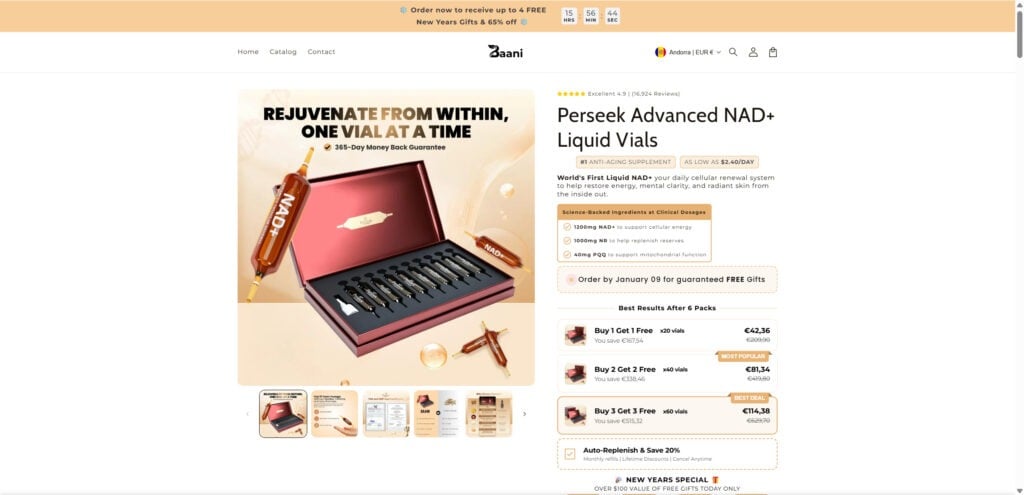
Perseek Advanced NAD+ Liquid Vials is marketed like a next-generation wellness shortcut: rapid absorption, cellular renewal, better focus, better mood, younger-looking skin, and a routine so simple it feels almost unfair.
And if you have been feeling run down, stressed, or simply tired of feeling tired, that message hits hard.
The problem is that the more you look at how this product is being sold, the more it starts to resemble a familiar pattern: glossy branding, big claims, very little verification, and sales tactics that push you to buy before you have time to think.
This article walks through what Perseek is, what the site claims, the red flags to pay attention to, how these operations typically work behind the scenes, and what to do if you already bought it.
No panic. No shaming. Just a clear, practical breakdown.
Overview
What the product claims to be
Perseek Advanced NAD+ Liquid Vials is promoted as a liquid NAD+ formula designed to support:
- Energy and stamina
- Mental clarity and focus
- Mood and “vitality”
- Recovery
- Skin and “radiance”
- A more youthful feel overall
The marketing leans heavily into the idea of “cellular renewal” and “mitochondrial support,” often pairing NAD+ with NAD+ precursors and add-ons that sound science-forward.
From the sales page style shown in your screenshots, the positioning is clear: this is not framed like a basic supplement.
It is framed like a premium, almost clinical-grade wellness system, delivered in sleek vials, with “doctor approved” vibes and the kind of certainty you usually only see in prescription marketing.
What NAD+ actually is (in plain language)
NAD+ (nicotinamide adenine dinucleotide) is a molecule your cells use for energy metabolism.
Think of it like a helper molecule involved in turning food into usable cellular energy and supporting processes tied to cellular repair.
NAD+ levels can decline with age, and that fact is often used in supplement marketing to imply a simple fix: raise NAD+, feel younger.
But here is the key point many ads blur.
Even if NAD+ is important, that does not automatically mean a random consumer product can reliably raise it in your body in a meaningful way, or that raising it produces dramatic results like “feel 10 years younger,” “erase fatigue,” or “fix brain fog” quickly.
Liquid vials and “faster absorption” claims
A major hook in Perseek-style marketing is “liquid absorbs faster than capsules.”
Sometimes you will see lines like “up to 10x faster” or “bypasses digestion.”
This sounds persuasive, but it usually skips the part that matters:
- Faster absorption is not the same as better results
- Absorption depends on the ingredient, the dose, the formulation, and the evidence
- “10x faster” is a specific claim that should have specific proof
If a product makes strong, numeric performance claims, you should expect to see:
- A clear explanation of what was tested
- Who tested it
- How it was tested
- Where the results are published
- What exactly was measured
When those pieces are missing, the “faster absorption” pitch is often just a marketing multiplier.
The “featured on major media” credibility hack
One of the biggest red flags you called out is the claim that the product has been featured on big-name outlets like Forbes, Men’s Health, or Women’s Health, without evidence.
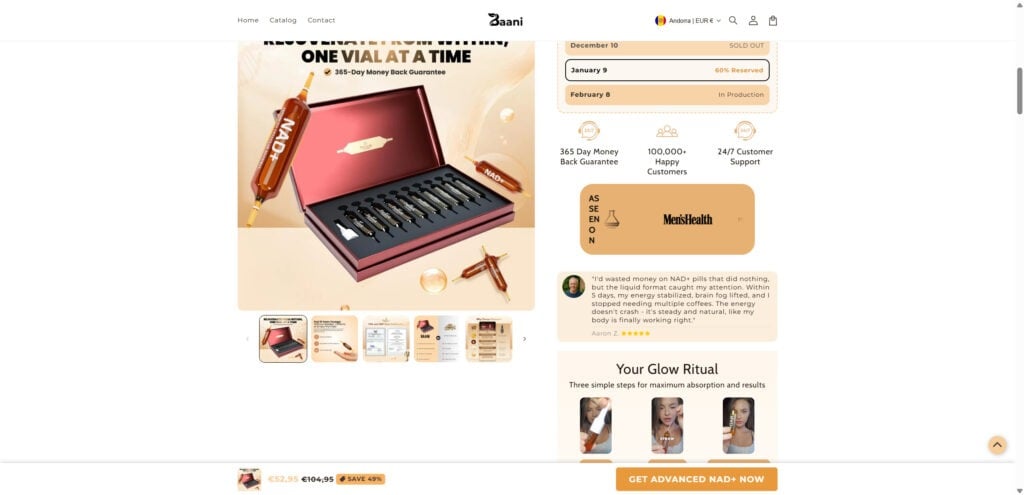
This matters because “as seen on” logos are not decoration.
They are used as authority signals to lower your skepticism. Many shoppers assume that if a brand was covered by a major outlet, someone vetted it.
If there are no working links, no article titles, no author names, and no searchable proof, treat the media badge as a sales tactic, not validation.
A legitimate feature is easy to verify.
A vague badge with no receipts is a warning sign.
The doctor image problem
Another issue you flagged is a “doctor” image that appears AI-generated.
Even when a site does not explicitly say “this is a real doctor endorsing the product,” placing a medical-looking professional front and center strongly implies medical authority.

That implication can be misleading, especially if:
- The person is not real
- The person is a stock photo used across unrelated products
- The person is AI-generated
- There is no name, credentials, licensing region, or verifiable identity attached
A serious health-adjacent brand does not need a mystery doctor.
They can cite real experts, real credentials, and real evidence.
Unverified statistics that sound too perfect
You also mentioned on-page stats like:
- 96% felt more energy
- 93% reported better mental clarity
- 79% noticed improved mood
- 89% enjoyed a simpler routine
Numbers like these are designed to feel scientific.
But if the site does not provide:
- Sample size (how many people?)
- Recruitment method (customers? paid testers? friends?)
- Study duration (a week? a day? a month?)
- Methodology (survey? blinded trial? comparison group?)
- Raw data or publication
Then these percentages are essentially marketing copy dressed as data.
And because they are precise, they can be more persuasive than vague promises.
That is why they are used so often.
“Clinically proven” and “lab tested” language without the lab
A lot of supplement-style sales pages use phrases like:
- Clinically proven
- Backed by science
- Lab tested
- FDA approved facility
- Pharmaceutical grade
Some of these phrases can be technically true while still misleading.
For example:
- A facility can be registered while the product itself is not approved
- An ingredient may have studies, but not this specific formula, dose, or delivery method
- “Lab tested” might mean nothing more than internal testing with no public documentation
If a claim sounds like a guarantee, it should come with proof you can read, not just trust.
The “perfect reviews” problem
You also noted that the on-site reviews look polished and overly consistent.
This is another common pattern.
A website can display any testimonials it wants. That does not mean they are fake, but it does mean they are not independent.
What you want to see for credibility is a spread of real-world feedback on platforms the brand does not control, such as:
- Trustpilot
- Reddit threads
- Better Business Bureau complaints (when relevant)
- Independent review sites that show both positive and negative feedback
- Forum discussions with details, not just praise
If you cannot find any real discussion outside the brand’s ecosystem, that does not prove the product is a scam.
But it does mean you should be cautious, especially when the claims are aggressive.
The sales pressure tells you a lot
Your screenshots show classic urgency triggers:
- Countdown timers
- “Order by [date] for free gifts”
- “Up to 65% off”
- Buy 1 get 1 free, buy 2 get 2 free bundles
- “Most popular” and “best deal” labels
This is not automatically wrong.
But when a health-related product is sold like a flash-sale gadget, it is worth asking why.
High-pressure urgency is often used when:
- The product is easy to replace with another rebranded version
- The seller expects high chargeback risk and wants volume quickly
- The operation relies on impulse buying, not long-term trust
The private label and “many names” issue
A big theme in your examples is that these products often appear under multiple names, across many websites, with slightly different branding.
That is common in dropshipping and private label operations.
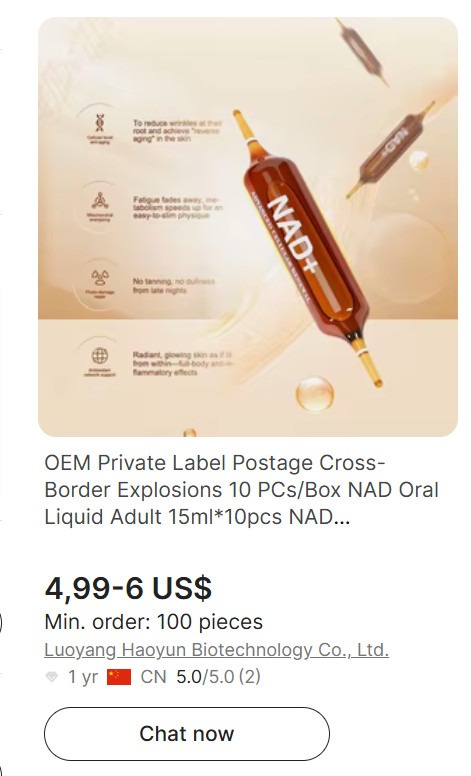
A single manufacturer listing can produce:
- Multiple storefronts
- Multiple “brands”
- Multiple packaging variants
- Multiple ad angles
- Multiple price points
The consumer experience is the same: you are not buying from a stable, established supplement brand.
You are often buying a marketing funnel that can disappear, rebrand, or redirect support after complaints pile up.
Why “NAD+ wellness” products are especially ripe for this
NAD+ is the perfect buzzword for aggressive marketing because:
- It sounds scientific
- It is connected to aging and energy, two high-emotion topics
- Most shoppers do not have an easy way to verify claims
- The benefits described are subjective (energy, clarity, mood), which makes them hard to disprove
- Even modest improvements can be framed as a miracle
This creates a space where bold claims can flourish without accountability.
So, buy or skip?
Based on the red flags you listed and the way this product is being marketed, the safest call for most people is skip.
Not because NAD+ as a concept is fake.
But because Perseek-style sales pages rely on credibility signals that are hard to verify, and the claims are far stronger than what the average consumer supplement can responsibly promise.
If you still want to explore NAD+ support, you will likely do better with:
- Brands with clear company ownership and a real track record
- Transparent labeling and third-party testing disclosures
- Claims that are cautious, not absolute
- Refund policies that do not require international shipping to an opaque address
How the Operation Works
Step 1: A high-performing ad hooks the pain point
Most people do not discover products like this through search.
They discover them through ads that target a feeling:
- “You wake up tired.”
- “You feel foggy.”
- “Your energy is not what it used to be.”
- “You do not feel like yourself.”
The ad then offers a story-based solution.
Not a supplement.
A breakthrough.
This framing is deliberate. It moves the product out of the “maybe” category and into the “I need this” category.
Step 2: The landing page builds authority fast
The page typically includes:
- Medical imagery (doctor photos, lab visuals, clinical-looking icons)
- Media logos (as seen on)
- Bold statistics (96% felt energy, etc.)
- “Science-backed ingredients” panels
- A premium, minimalist design that feels expensive
This is the credibility stack.
Even if each element is weak on its own, together they create an impression: this must be legitimate.
Step 3: The page floods you with benefits, not evidence
You will see a lot of:
- “Supports” language
- “Designed to” wording
- “Backed by science” claims
- “Clinically dosed” statements
But often you will not see what matters:
- Full sourcing details
- Independent clinical trials on the exact product
- Clear ownership and responsible party information
- Manufacturing documentation you can verify
- Real, independent customer feedback
This is where many shoppers get stuck.
It feels convincing, but it is hard to pin down.
Step 4: Urgency triggers push you into an impulse decision
The checkout journey is usually engineered to reduce hesitation:
- Countdown timer near the top
- “Reserved” inventory bars
- “Order by [date]” messaging
- Bundles that make the single bottle look like a bad deal
- Pop-ups about “someone in your area just bought”
This creates artificial scarcity.
The goal is simple: shorten your decision window so you do not research.
Step 5: The pricing strategy anchors high, then “discounts” hard
A common structure:
- A high “regular price” is shown, often $100+
- A “limited time” discount drops it sharply
- Bundles claim massive savings
- Free gifts are added for extra momentum
This is designed to make you feel like you are winning.
But in many private label funnels, the “regular price” is not real.
It is just an anchor so the discounted price feels irresistible.
Step 6: Auto-ship or subscriptions can be baked into checkout
You specifically noted victims reporting subscriptions or unexpected shipments.
This is one of the most important things to watch for.
How it often happens:
- A checkbox for “subscribe and save” is preselected
- An “auto-replenish” option is positioned as a discount, not a commitment
- The terms are small, or placed below the fold
- The confirmation email references recurring billing more clearly than the page did
Not every site does this, but enough do that it should be part of your risk evaluation.
If you ever see language like:
- Auto-replenish
- Monthly refills
- Subscription
- Membership
- VIP savings
Treat it as a serious decision, not a minor add-on.
Step 7: Fulfillment often runs through cross-border shipping channels
In dropshipping and private label models, the storefront is not the warehouse.
Orders can be routed through:
- Third-party logistics providers
- International fulfillment hubs
- Direct-from-manufacturer shipments
That is why shipping timelines can be vague, and tracking may look unusual.
It is also why returns can become painful.
Step 8: Refund friction is not an accident
You mentioned a pattern where refunds are “impossible” or require shipping to China.
This is a known friction tactic in some cross-border operations:
- Support responds slowly
- They offer partial refunds to avoid chargebacks
- They request photo evidence, then more evidence
- They push store credit instead of refunds
- They require returns to an international address with expensive tracked shipping
- They set short return windows that the shipping time itself can break
The result is predictable.
Many customers give up.
Step 9: The brand can vanish or rebrand when complaints grow
When a product is sold across multiple sites under different names, the “brand” is often disposable.
If chargebacks rise or ad accounts get restricted, the seller can:
- Launch a new domain
- Rename the product
- Swap packaging
- Run the same funnel with a different face
This is why transparency matters.
If you cannot clearly identify who owns the brand and where they are based, you are taking on extra risk.
Step 10: The product itself may be generic, even if the story is unique
This is the heart of the issue.
The marketing is carefully crafted.
The product may not be.
That does not automatically mean the product is harmful, but it does mean you are paying for the story, not proven performance.
And when the claims include major improvements in energy, mood, focus, and anti-aging, that gap becomes a problem.
What To Do If You Have Bought This
If you already purchased Perseek Advanced NAD+ Liquid Vials (or a similar NAD+ vial product sold through a high-pressure funnel), here is a calm, practical checklist.
1) Look for subscription language immediately
Check:
- Your order confirmation email
- The checkout receipt
- Your account page (if one exists)
- Any line that mentions auto-replenish, monthly refills, or recurring billing
If you see recurring billing, take screenshots.
Save copies of the policy pages, too.
2) Document everything before you contact support
Create a small folder with:
- Order number
- Date of purchase
- Screenshots of the product page claims
- Screenshots of any “money back guarantee” language
- Emails and receipts
- The exact URL of the checkout and policy pages
This is useful if the site changes later.
3) Contact support in writing and be specific
Ask direct questions:
- Confirm whether my order is a one-time purchase
- Confirm there is no subscription attached
- If there is a subscription, cancel it immediately and confirm cancellation in writing
- Provide return instructions and the return address
- Confirm the refund amount and timeline
Keep it short and clear.
4) If you receive the product, photograph the packaging and labels
Take photos of:
- Front and back of the box
- Ingredient panel
- Any lot number or manufacturing code
- Inserts or instructions
This protects you if you need to dispute misrepresentation later.
5) Be careful with health claims and side effects
If you choose to use it, be cautious.
If you have medical conditions, take prescriptions, or are pregnant or breastfeeding, it is smart to talk to a clinician before trying any supplement marketed for energy, mood, metabolism, or “cellular renewal.”
If you notice any adverse reaction, stop and seek medical advice.
6) If the refund process turns into a maze, set a deadline
If support:
- Delays repeatedly
- Refuses to honor the policy
- Pushes endless “proof” steps
- Demands expensive international return shipping as the only option
Respond with a firm but calm message:
- You are requesting a refund according to the stated policy
- You need a response by a specific date
- You will escalate through your payment provider if needed
7) If you suspect deceptive billing, contact your bank or card issuer
If you see:
- Unexpected recurring charges
- A different merchant name than expected
- Multiple charges
- Charges after cancellation
Then contact your payment provider and ask about:
- Blocking future charges from that merchant
- Filing a dispute (chargeback)
- Replacing the card if necessary
Do not wait weeks hoping it resolves itself.
8) Report the ad if it used deceptive claims
If you found it through social media ads, you can report:
- Misleading health claims
- Fake endorsements
- Fake urgency
- Misleading “as seen on” badges
It will not fix your purchase, but it helps reduce the spread.
9) Leave a factual public review where possible
If the brand is hard to find on major platforms, you can still:
- Post on Reddit in relevant communities
- Comment on ad posts (if available)
- Share your experience on forums that track suspicious products
Stick to facts:
- What you ordered
- What you received
- Shipping time
- Refund experience
- Any billing issues
Avoid assumptions you cannot prove.
10) If you still want NAD+ support, switch to a safer buying strategy
If your goal is energy and focus, consider:
- Buying from established retailers with clear return policies
- Choosing brands with transparent ownership and independent testing disclosures
- Avoiding funnels that rely on countdown timers and unverifiable stats
You want boring, reliable purchasing.
Not a high-drama checkout.
The Bottom Line
Perseek Advanced NAD+ Liquid Vials is marketed like a premium wellness breakthrough, but the credibility signals do not hold up well under scrutiny.
When you see unverifiable media logos, a doctor image that appears AI-generated, precise percentages with no methodology, no supporting lab studies, aggressive urgency tactics, and reviews that look too polished to trust, the risk rises fast.
Add in the broader pattern of rebranded products sold across multiple sites, plus customer reports of subscriptions and refund barriers that can involve expensive international returns, and the safest recommendation for most shoppers is simple:
Skip it.
If you already bought it, focus on documenting your purchase, checking for recurring billing, and acting quickly if support becomes evasive.
You deserve products that earn trust through evidence and transparency, not pressure and performance theater.
FAQ
What is Perseek Advanced NAD+ Liquid Vials?
It’s a liquid supplement sold as an NAD+ and “cellular renewal” product, marketed for energy, focus, and vitality.
Does Perseek NAD+ actually work?
There’s no reliable public evidence showing it works as advertised. The biggest issue is the lack of transparent, independent proof behind the strongest claims.
Is Perseek Advanced NAD+ FDA approved?
Be cautious with any “FDA approved” wording. Supplements are not FDA-approved the way prescription drugs are, and vague claims without clear documentation are a red flag.
Why do people call this a dropshipping-style product?
Because similar NAD+ vials appear across multiple websites under different branding, with aggressive discounts, urgency timers, and polished on-site reviews that are hard to verify elsewhere.
Are the “featured on major media” claims real?
If there are no direct, verifiable links to those features, treat it as unproven marketing.
What are the biggest red flags to watch for?
Unverified statistics, AI-looking “doctor” imagery, heavy urgency tactics, unclear company details, and little to no independent reviews.
What should I do if I already bought it?
Check your email for an order confirmation and any subscription terms, monitor your bank statements, and contact your card issuer quickly if anything looks off.
Can I get a refund easily?
Often no. Many buyers report difficult refund processes, including return shipping requirements that can be expensive or involve sending items back internationally.








