

If you have ever looked at your bank statement and thought, “Wait… when did I sign up for Prime?”, you are not alone.
That exact feeling sits at the heart of a major U.S. consumer-protection case that just turned into one of the biggest FTC settlements on record: Amazon agreed to a $2.5 billion resolution tied to allegations that Prime sign-ups were misleading and cancellations were intentionally difficult.
And yes, the part everyone cares about most is real: there is a refund program, and some Prime members have already received payments.
But it is not “everyone gets a check,” and it is not worldwide.
Let’s break it down clearly, calmly, and in a way that helps you figure out whether you might actually be eligible.
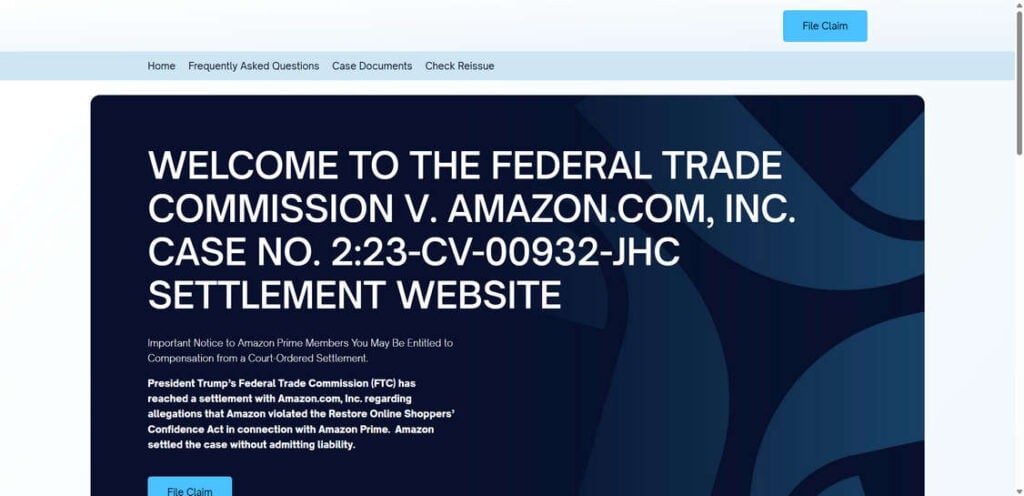
The settlement in one minute
Here’s the simplest version of what happened:
Amazon agreed to a settlement with the Federal Trade Commission over allegations that the company used deceptive interface designs to nudge people into Prime, and then used a cancellation flow that was hard enough to discourage quitting.
The settlement has three big pillars:
- $1 billion civil penalty (paid to the U.S. government).
- $1.5 billion for consumer refunds (the “refund pool”).
- Mandatory changes to Prime enrollment and cancellation, monitored under the agreement.
The FTC estimates about 35 million consumers are impacted.
And the headline number people keep repeating is also grounded in the official program details: refunds are “up to $51.”
How we got here: what the FTC said Amazon did
The FTC filed its Prime case in June 2023, accusing Amazon of two main things:
- Enrollment without clear consent
- A cancellation process designed to deter people from leaving
The FTC described Prime enrollment as a set of “dark patterns.”
That phrase can sound dramatic, but in plain terms it means: design choices that steer you toward an outcome you might not choose if everything were presented clearly.
According to the FTC’s complaint and later settlement statements, these patterns showed up in checkout and sign-up screens where Prime was presented in a way that could blur what you were agreeing to, including recurring billing.
The FTC also claimed Amazon made non-Prime shopping paths harder to find, and that some purchase flows did not clearly communicate that clicking to complete a transaction also meant agreeing to a Prime subscription.
The cancellation maze: why “hard to cancel” matters legally
The second half of the case is the one many people relate to instantly.
The FTC said Prime cancellation required customers to navigate multiple screens that repeatedly tried to divert them into staying, switching off auto-renew instead of canceling, or accepting discounted offers.
Reporting around the case also highlighted that Amazon internally referred to its cancellation path as “Iliad,” an allusion to a long epic journey. The FTC’s own 2023 press release references this reporting and describes how cancellation involved multiple steps before the customer could finally quit.
Whether you love Prime or never want to hear about Prime again, consumer law cares a lot about this specific pattern: subscriptions that are easy to start but exhausting to stop.
That leads us to the statute behind the case.
The legal backbone: the rule Amazon was accused of violating
The FTC said Amazon’s conduct violated the FTC Act and the Restore Online Shoppers’ Confidence Act (ROSCA), a U.S. law focused on online negative option marketing, meaning situations where silence or inaction can lead to charges, renewals, or recurring billing.
The FTC’s settlement announcement calls the case historic partly because civil penalties under ROSCA are relatively rare, and it describes this as only the third ROSCA matter where the FTC obtained a civil penalty.
That’s one reason this agreement landed so loudly.
It’s not just “Amazon pays money.”
It’s also a high-profile warning shot about subscription design across the internet.
The $2.5 billion deal: what Amazon agreed to pay
The settlement total is $2.5 billion, structured like this:
1) $1 billion civil penalty
This is a penalty paid to the U.S. government, described by the FTC as the largest ever in a case involving an FTC rule violation.
2) $1.5 billion for consumer refunds
This is the pool designed to reimburse consumers for Prime fees tied to the challenged enrollment and cancellation practices.
3) A court order requiring Prime changes
The FTC says Amazon must change Prime enrollment and cancellation so customers get clear disclosures, a clear decline option, and an easier cancellation method aligned with how they signed up.
Amazon settled without admitting liability, and said publicly it believes its processes were already clear, while also indicating the settlement largely requires maintaining changes already made.
So, are Prime members getting refunds?
Yes, refunds are real.
But eligibility is specific, and the program is U.S.-based.
The FTC’s refund page and the official settlement site describe a two-stage process:
- An Automatic Payment Group
- A Claims Process Payment Group
If you only remember one thing, make it this:
Some people were paid automatically in late 2025. Others have to file a claim in 2026, and those payments are expected later.
Let’s get concrete.
Who is affected: the eligibility window and the core idea
The covered time period for sign-ups is:
- June 23, 2019 through June 23, 2025
And the refunds are for:
- U.S. Amazon Prime customers who enrolled through specific “challenged enrollment flows” or had cancellation trouble during that time.
If you are outside the United States, this settlement’s refund program generally does not apply to you as described in the FTC’s own eligibility language.
That is frustrating for many international Prime members, but it is also a key detail that prevents false hope and refund scams.
The Automatic Payment Group: “you don’t have to do anything”
According to the official settlement website, you are eligible for an automatic payment if you meet all of these:
- You are a U.S. consumer who signed up for Prime in the covered period.
- You enrolled through a “Challenged Enrollment Flow.”
- You used no more than three Prime benefits in a 12-month period in that timeframe.
The settlement site also states that automatic payments were distributed within 90 days of the court order, “by December 24, 2025.”
The FTC similarly notes automatic refunds were sent in November and December 2025.
How much is an automatic refund?
Both the FTC and the settlement site describe refunds as reimbursement of Prime membership fees paid during the applicable timeframe, up to $51.
Some people received the maximum, but not everyone will.
If you had discounted trials, partial refunds, credits, or different billing patterns, your payment could be smaller. Multiple consumer-facing explainers have pointed this out, and the FTC frames it generally as a refund of subscription fees “up to” the cap.
The Claims Process Payment Group: “you need to file a claim”
This is where confusion is exploding online, because people hear “refund” and assume it is automatic for everyone.
It is not.
Per the official settlement site, the claims window opened January 5, 2026, and notices were expected by January 23, 2026 for people eligible to file.
You may qualify for the claims process if:
- You are a U.S. consumer who signed up during the same covered period.
- You used more than three but less than ten Prime benefits in a 12-month period.
- And you either unintentionally enrolled via a challenged flow or tried to cancel online and were unable to do so.
Now here’s the important timing detail that gets misreported in short videos:
The FTC states that for the claims process, Amazon expects to send payments in late 2026 and does not yet have a specific mailing date for those payments.
So yes, refunds exist today.
But if you are in the claims group, you should think in “file now, paid later” terms, not “money next week.”
How will you get paid?
The FTC says claimants can select payment by:
- Check
- PayPal
- Venmo
If you were in the automatic group, people reported receiving checks or electronic transfers, and mainstream outlets have described those methods as well, but the safest baseline is: follow what your official notice says, and rely on the FTC program page for the most reliable instructions.
How to check if you already received an automatic refund
Start with the boring checks, because they work:
- Search your email for references to the settlement (and check spam).
- Check whether you received a physical check at your address.
- Review PayPal or Venmo history if you use either.
The settlement website states automatic payments were distributed by December 24, 2025, and the FTC confirms the automatic refunds were sent in November and December 2025.
If you think you should have gotten one but did not, the FTC says Amazon began sending claim notices in January 2026 to eligible customers who did not get the automatic refund.
How to file a claim safely, step by step
If you receive a notice that you are eligible to file, the safest approach looks like this:
1) Read the notice slowly
Real notices explain why you are eligible and how to proceed.
They do not threaten you, pressure you, or demand urgency like a scammer.
2) Use the official settlement website
The FTC explicitly points people to the settlement site and to the email contact listed below.
3) Choose a payment method you control
If you pick PayPal or Venmo, make sure it is your account, and that you can access it.
If you pick a check, confirm your mailing address is correct.
4) Do not pay any “processing fee”
The FTC is blunt about this: nobody from the FTC will ask you for money, and nobody from Amazon will ask you for money to get the refund.
5) Use the official contact if you get stuck
The FTC lists support for the program at admin@SubscriptionMembershipSettlement.com.
If you are dealing with any other random Gmail address or someone in DMs “helping” you get paid, treat it like a scam attempt.
Refund scams are already riding this story
Any big settlement creates the same ugly side effect: scammers try to imitate it.
The FTC warns:
- The FTC is not calling people about refunds.
- The FTC will never demand money, make threats, tell you to transfer money, or promise a prize.
- Nobody legitimate will offer “special access” or a guaranteed refund for a fee.
If you get a call, text, or email that feels off, do not engage.
Instead, go straight to the FTC’s Amazon refunds page and cross-check the instructions there.
What changes is Amazon required to make to Prime?
This is the part that matters even if you never get a refund.
Because it is designed to stop the pattern from repeating.
The FTC says Amazon must make meaningful changes that include:
A clear “decline Prime” option
The settlement specifically calls out that Amazon can no longer use a decline button phrased like “No, I don’t want Free Shipping.”
Clear disclosures during enrollment
Including cost, when charges happen, how often, whether it auto-renews, and how cancellation works.
Easier cancellation that matches the sign-up method
The settlement requires an easy way to cancel using the same method used to sign up, and says the process cannot be difficult, costly, or time-consuming.
Oversight of compliance and refund administration
The FTC says Amazon must pay for an independent third-party supervisor to monitor compliance with the consumer redress distribution process.
In other words, this was not framed as “pay money and move on.”
It was framed as “pay money and rebuild the subscription experience so it can’t be a trap.”
Why the “dark patterns” label matters beyond Amazon
It would be easy to treat this as “Amazon got caught.”
But the larger story is that subscription design has become a battlefield.
Streaming services, apps, newsletters, delivery memberships, premium trials, cloud storage plans, even gaming add-ons all compete in the same psychological space: make sign-up frictionless, and make cancellation slow enough that people postpone it.
Regulators are increasingly telling companies: you do not get to call that “marketing.”
You call it a deceptive subscription trap.
And now there is a settlement in the trillions-of-clicks ecosystem with a refund program big enough that everyone noticed.
What Prime members should do right now
Even if you are not eligible, you can still use this moment to protect yourself from the exact problem the FTC described.
1) Audit recurring charges
Look at the last 3 to 6 months of card and bank statements.
List every subscription.
If you see one you do not recognize, investigate it immediately.
2) Keep receipts for cancellation attempts
If you ever get stuck in a cancellation loop:
- Take screenshots.
- Save confirmation emails.
- Note dates and times.
In disputes, documentation is everything.
3) Turn on payment alerts
Most banks and cards let you trigger a push notification for every charge.
This is one of the simplest ways to catch a subscription you forgot about.
4) Treat free trials like they are paid
Because most of them are.
The difference is just the date the billing starts.
What businesses should learn from this
If you run an e-commerce store, an app, or anything subscription-based, this case is not just tech gossip.
It’s a blueprint for what regulators consider unlawful design:
- confusing consent
- burying pricing terms
- “confirmshaming” copy and misleading buttons
- cancellation that feels like an obstacle course
The safer mindset is simple:
If a customer needs a tutorial video to escape your subscription, you are already in dangerous territory.
FAQ: Amazon Prime FTC settlement refunds
Is the $2.5 billion Amazon settlement real?
Yes. The FTC announced the settlement on September 25, 2025, and it is tied to a court-approved order in the U.S. District Court for the Western District of Washington.
Does Amazon admit wrongdoing?
No. Amazon settled without admitting liability, per the settlement website and coverage of the agreement.
How much is the refund?
Eligible consumers can receive a refund of Prime subscription fees paid during the applicable period, up to a maximum of $51.
Is every Prime member eligible?
No. Eligibility is limited, and it is a U.S. refund program tied to a specific date range and conditions.
What is the covered time period?
June 23, 2019 through June 23, 2025.
What are “challenged enrollment flows”?
The FTC refund page lists flows such as a universal Prime decision page, shipping selection page, single page checkout, or Prime Video enrollment flow.
I used Prime constantly. Can I still get paid?
Maybe not. The settlement’s groups and benefit-usage thresholds matter, and heavy Prime usage may reduce the likelihood you fall into the eligible categories as described.
When were automatic refunds sent?
The FTC says automatic refunds were sent in November and December 2025.
If I did not receive an automatic refund, what happens next?
The FTC says Amazon began sending claim notices in January 2026 to eligible customers who did not receive the automatic refund.
When do claims payments go out?
The FTC says Amazon expects claims-process payments in late 2026, and a specific mailing date was not yet set.
Do I have to file a claim to get money?
Not always. The settlement site describes an Automatic Payment Group that receives payments without taking action, and a Claims Process Payment Group that must submit a claim.
How do I file a claim?
Use the official settlement process described on the settlement site, typically after receiving notice.
What payment methods are offered?
The FTC says payments can be received by check, PayPal, or Venmo.
Will the FTC call me about my refund?
No. The FTC warns that calls claiming to be from the FTC about this refund are scams.
Will Amazon ask me to pay money to receive my refund?
The FTC says no one from Amazon will ask you for money to get a refund.
What email address is associated with help for the claims process?
The FTC lists: admin@SubscriptionMembershipSettlement.com.
What changes must Amazon make to Prime sign-ups?
The FTC says Amazon must provide a clear decline button and clear disclosures of material terms during enrollment.
What changes must Amazon make to cancellation?
The FTC says cancellation must be easy, not time-consuming, and available using the same method the consumer used to sign up.
Why is this settlement considered historic?
The FTC calls it a historic order and highlights the scale of the penalty and restitution, and notes the civil penalty is one of only a small number in ROSCA cases.
If I am outside the U.S., should I expect a refund?
Based on the FTC’s eligibility language, the refund program is for U.S. Prime customers.
Where should I go for the most trustworthy updates?
The FTC’s Amazon refunds page and the official settlement website are the safest sources to monitor.
Bottom line
This is not rumor, and it is not a made-up “internet settlement.”
It is a court-ordered FTC action with real money attached: $1 billion in penalties and $1.5 billion earmarked for consumer refunds, tied to allegations about Prime enrollment and cancellation practices.
Some refunds already went out automatically in late 2025.








