

The Sylvane LumaGlow LED mask looks like the kind of purchase you make on a quiet night, right after you see one more “before and after” photo that feels almost too perfect.
The page is polished. The claims are confident. The price says “premium.” And the promise is tempting: brighter skin, smoother texture, fewer breakouts, all from a few short sessions a week.
But if you slow down and look at the details people usually skip, a very different story starts to peek through. Not loud. Not obvious. Just enough to make you wonder what you are actually buying, and who you are really buying it from.
This guide walks through what the LumaGlow LED mask is, how this kind of operation is commonly sold online, and what to do if you already checked out and now something feels off.
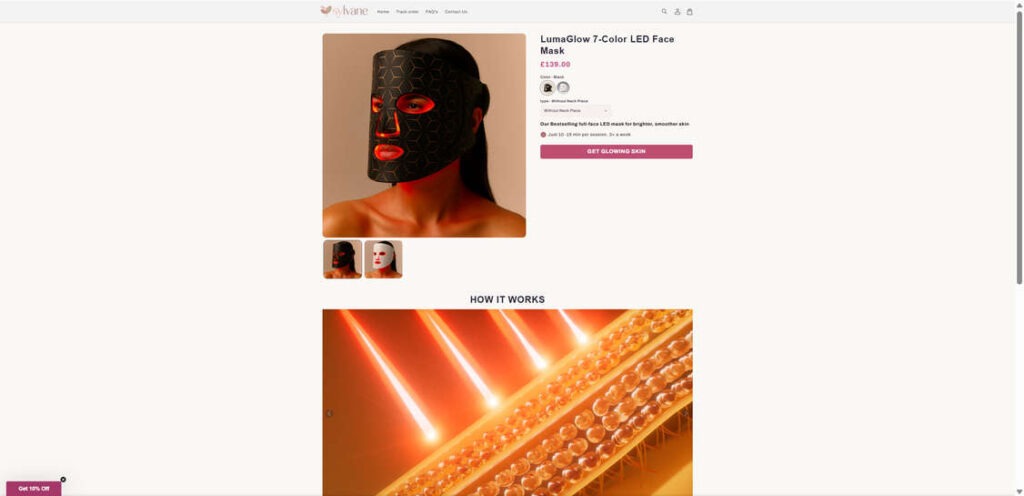
Overview
If you are searching for “Sylvane LumaGlow LED mask review” or “Should I buy the LumaGlow LED mask,” you are probably in one of these situations:
- You saw an ad for a “7-color LED face mask” that promised fast results.
- You landed on a site that looked UK-based and professional.
- You noticed a price that positions the mask as a high-end skincare device (often around $139 for the face mask, and higher for bundles).
- You started looking for real reviews and found a lot of warnings.
That pattern matters, because it is the exact funnel many dropshipping style beauty offers use: a premium-looking storefront, a “beauty device” with broad claims, and a checkout experience designed to nudge you into buying more than you planned.
What the product is supposed to be
The Sylvane LumaGlow product pages typically present the mask as a full-face LED light therapy device with multiple colors (often described as “7-color” or “7 wavelengths”). The pitch usually includes:
- Short sessions (often marketed as 10 to 15 minutes)
- Several uses per week
- A “spa-like” at-home routine
- Claims tied to common skincare goals, such as:
- clearer-looking skin
- smoother texture
- fewer visible blemishes
- reduced appearance of fine lines
- brighter tone
- “collagen support” language
LED light therapy as a category is real. Dermatology clinics have used light-based treatments for years, and some at-home LED devices can provide modest benefits for certain concerns when used consistently.
But here’s the key difference: legitimate brands are usually very careful about what they promise, what their device can realistically do, and what the buyer should expect.
The marketing around the LumaGlow style offers often does the opposite. It bundles many results together, makes them feel fast, and frames the mask as a near-effortless shortcut.
Why the price raises eyebrows
One of the biggest tells in these campaigns is price anchoring.
You will see the product sold as a premium device, commonly in the $100+ range, sometimes alongside:
- a “neck piece” add-on
- a free gift
- a voucher or store credit offer
- bundle discounts that make multi-unit purchases feel “smart”
At the same time, the exact same style of silicone LED mask (very similar cutouts, strap shape, and controller style) is widely available via wholesale marketplaces, where the price per unit can be a fraction of the retail price when purchased in bulk.
That alone does not prove wrongdoing. Many brands source components from overseas.
What matters is whether the seller is transparent about:
- who they are
- where the product ships from
- how returns actually work in practice
- whether customers are hit with unexpected charges
- whether customer support resolves issues without games
That is where a lot of complaints tend to cluster.
What reviewers report
On Trustpilot, the profile for sylvane.co.uk shows a very low rating and a large share of 1-star reviews, with many people describing a similar experience: thinking they ordered from a UK-based business, then discovering shipping originates from China, tracking issues, long delays, and refund problems.
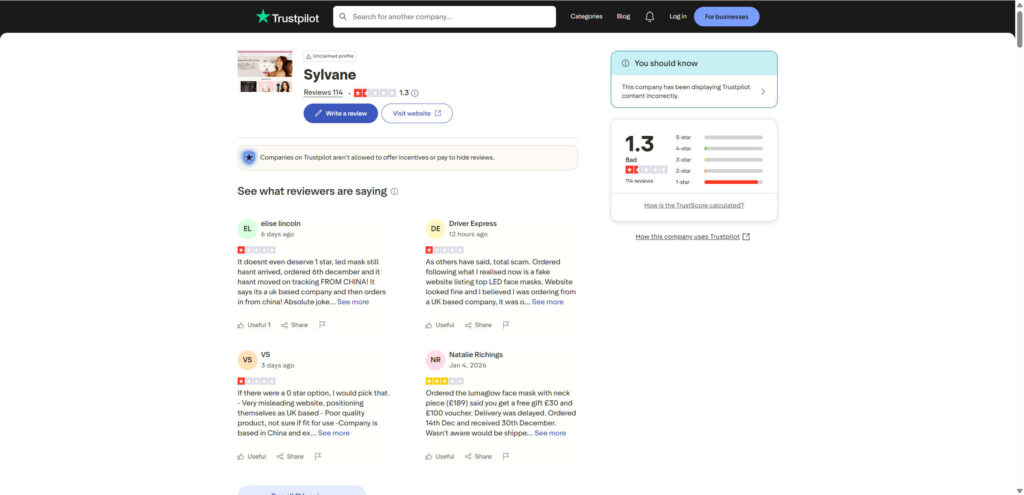
Some reviewers also describe specific tactics that are extremely common in dropshipping refund friction:
- being offered a partial refund (often around 15% to 30%) to keep the product instead of returning it
- being told to return the product internationally (often to China or Hong Kong) at their own cost
- being urged to close a PayPal dispute before a refund is issued
- confusing “free gift” deliveries being used to muddy the waters in disputes
Those themes appear repeatedly in the review excerpts visible on the Trustpilot page.
Trustpilot also displays a notice on the sylvane.co.uk profile stating: “This company has been displaying Trustpilot content incorrectly.” That is not something you want to see when you are trying to verify social proof.
The name confusion trap
Another detail that trips people up is brand name similarity.
Trustpilot’s “Suggested companies” area shows a “Sylvane” with a much higher rating on a different domain (sylvane.com), while the UK-focused profile is sylvane.co.uk and has a much lower rating.
That can create instant confusion for shoppers who do a quick search, see a “Sylvane” name that looks reputable, and assume it is the same business.
If you are researching, always match the exact domain name you purchased from. Not the brand name. Not the logo. The domain.
What LED masks can realistically do (and what they cannot)
It is easy to get swept up in the promise of “7 colors” like it is seven separate miracles.
In reality, the research and real-world results for at-home LED masks tend to be:
- gradual, not instant
- modest, not dramatic
- inconsistent, not guaranteed
- dependent on device quality and consistent use
You will often see reputable coverage emphasize that claims can be overhyped, and that consumers should be cautious about miracle marketing in the LED mask space.
That is why the seller’s credibility matters so much. With a device like this, you are not only paying for LEDs. You are paying for:
- build quality and safety standards
- accurate specifications (wavelengths, power, timers)
- warranties that actually work
- customer support that does not disappear
- return policies you can realistically use
When those pieces are weak, the product becomes a gamble even if the category itself is legitimate.
The biggest risks buyers report
Based on the consistent patterns seen in complaints for sylvane.co.uk and similar operations, the main risks are not just “Does it work?”
They are:
- Shipping origin surprises: You thought it was shipping locally, but it ships from China or Hong Kong with long transit times.
- Tracking that stalls: Numbers exist, but the package does not move for days or weeks. (Trustpilot)
- Refund friction: You get delayed, redirected, or offered partial refunds instead of a straightforward return.
- Return-to-China barrier: You are told to ship it back internationally at your own cost, which can be expensive and impractical.
- Payment dispute pressure: Some reviewers describe being asked to close disputes before refunds are processed.
- Unexpected charges: Depending on the checkout flow, people sometimes report multiple units charged, or unwanted subscription style billing (a common add-on tactic in similar funnels).
When you see these problems stacked together, the purchase is no longer a simple product decision. It becomes a customer service and payment recovery problem.
How The Operation Works
This section matters because the “Sylvane LumaGlow LED mask” is not usually sold like a normal skincare device from a straightforward retailer.
It is commonly sold through a conversion funnel built to do two things:
- Get you excited enough to buy quickly
- Make it harder to reverse the purchase if you change your mind
Here is the typical step-by-step playbook.
Step 1: The ad that pushes emotion, not details
Most buyers first encounter the mask through a social ad, sponsored post, or “recommended product” style content.
The creative usually focuses on:
- glowing skin imagery
- close-up “after” shots
- claims like “never touch your skin problems again”
- a routine that sounds effortless
- urgency language
What is usually missing:
- the real business identity behind the storefront
- the true shipping origin
- clear return logistics
- device specifications that can be verified
It is not unusual to see multiple sites selling the same mask under different names, with slightly different colors, logos, or bonus offers.
That is a key hallmark of a rebranded supply product being marketed as a unique premium invention.
Step 2: The landing page that looks premium
When you click, you land on a page that feels like a real brand site.
Common design elements include:
- clean typography
- large product photos
- icons for benefits (“deep cleaning,” “fast penetration,” “removes odor,” etc. in other niches, or “anti-aging,” “acne,” “brightening” in skincare)
- “money back guarantee” badges
- review widgets
- an FAQ section with confident answers
This is where many shoppers relax. The site looks legitimate.
But dropshipping storefronts can be built quickly using templates and pre-made apps. A premium look does not equal a premium operation.
Step 3: The “science” section that sounds right, but stays vague
LED mask pages often include a “How it works” section with phrases like:
- stimulates collagen
- repairs skin cells
- reduces inflammation
- clears acne bacteria
- tightens pores
- boosts circulation
A legitimate brand will usually:
- specify wavelengths (not just “colors”)
- explain what each wavelength is used for
- cite studies carefully or link to clinical data
- add safety guidance (eye protection, contraindications)
- avoid sweeping guarantees
A dropshipping style page often keeps it vague and absolute, because vagueness sells more units.
Step 4: The offer stack that nudges you into spending more
This is where the funnel gets aggressive.
You will often see:
- multi-unit bundles highlighted as “best seller”
- “save up to 70%” style claims
- a timer suggesting your discount is reserved for a limited time
- “only X left” stock bars
- bonus items (free gifts, vouchers, add-ons)
The goal is to increase average order value.
Many people who intended to buy one mask end up buying:
- multiple masks
- a face + neck set
- extra controllers or add-ons
And later, if something goes wrong, the refund problem is now larger.
Step 5: Checkout tricks and surprise charges
Depending on the exact site version and payment setup, buyers sometimes report problems like:
- being charged for more than one unit
- not noticing that a higher-quantity option was selected
- add-ons being pre-checked
- “shipping protection” or similar extras being quietly included
- subscription style billing tied to a “club,” warranty, or “VIP offer”
Not every buyer will experience this.
But it is common enough across similar operations that it deserves attention: always review your final order summary before paying, and screenshot it.
Step 6: Fulfillment starts, and the shipping origin becomes clearer
After purchase, you get a confirmation email.
This is often the first moment buyers realize the order may not be shipping from where they assumed.
On the Trustpilot page for sylvane.co.uk, multiple reviewers describe tracking that indicates China or Hong Kong origin, and frustration that the company appeared UK-based from the domain and site presentation.
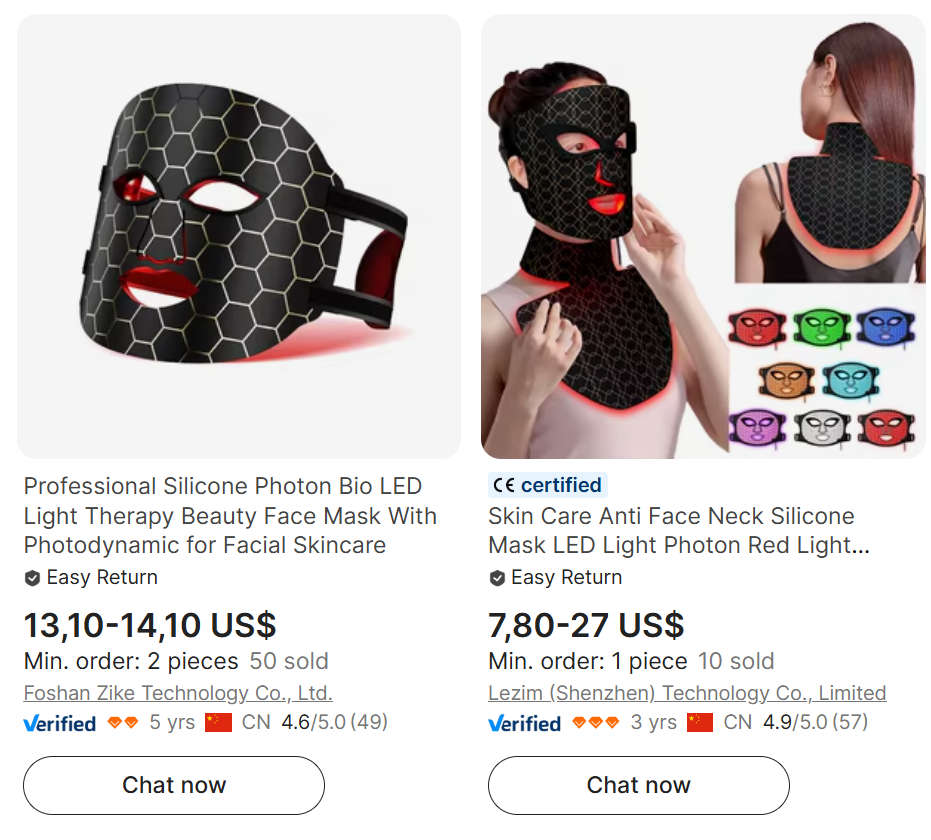
This is the moment the buyer anxiety starts:
- tracking shows “label created” and stays there
- carrier names you do not recognize appear (often cross-border logistics)
- customer support replies with generic delays
- delivery windows stretch
Step 7: Support replies, but progress does not happen
A common pattern in dropshipping complaint cycles is “fast replies, slow solutions.”
You might receive:
- polite responses
- repeated promises that it is “on the way”
- requests to wait a few more days
- mentions of processing delays
- vague explanations about warehouses or carriers
The key is whether your problem is solved.
If weeks pass and you still do not have the item, or the item arrives but is not what you expected, the next step becomes the real test: returns.
Step 8: The return policy becomes a wall
This is where many people get stuck.
The most common friction points are:
- returns must be shipped internationally (often to China or Hong Kong)
- the buyer must pay return shipping
- tracking must be provided
- refunds are delayed until the item is received
For a bulky item, international tracked shipping can be expensive.
That is why many buyers are offered the “compromise” instead.
Step 9: The partial refund offer (the classic move)
A very common complaint in the Trustpilot reviews for sylvane.co.uk is being offered a partial refund (around 15% to 20%) to keep the product, rather than a straightforward return and full refund. (Trustpilot)
This tactic serves the seller:
- they avoid a costly return
- they reduce chargeback risk
- they keep most of the revenue
- they close the case with “a refund was offered”
For the buyer, it often feels like an insult, especially if the product did not arrive, arrived late, arrived incomplete, or felt poor quality.
Step 10: Dispute pressure (especially with PayPal)
Some reviewers describe a pattern where the company urges the customer to close a PayPal dispute in exchange for a refund promise. (Trustpilot)
This is important:
- If you close a dispute, you may lose leverage.
- Reopening is not always guaranteed.
- The safest approach is usually to keep the dispute active until the refund is actually received.
If you paid by card, the same principle applies: do not cancel your chargeback just because someone says “We will refund you.”
Step 11: The “free gift” confusion
Another common tactic across these funnels is shipping a small “free gift” separately.
Why it matters:
- It can create a delivery record that complicates disputes.
- It can be used to argue “the order was delivered” even if the main product was not.
- It can buy the seller time.
Even if the gift is real, it can still function as a dispute distraction.
Step 12: Outcome paths buyers typically face
At the end of this process, buyers typically end up in one of these outcomes:
- They receive the mask and decide whether it feels worth the price.
- They receive it late and feel misled, but keep it because returning is too hard.
- They receive something incomplete (missing add-ons, vouchers, or extras) and get a partial refund.
- They never receive it and fight through PayPal, their bank, or card issuer to recover funds.
- They get stuck in email loops and eventually escalate through disputes or consumer complaints.
That is why the question “Should you buy it?” is less about LEDs and more about the business practices behind the sale.
What To Do If You Have Bought This
If you already purchased the Sylvane LumaGlow LED mask (or any similar LED mask sold through this kind of funnel), here is a calm, practical plan.
1) Collect your proof immediately
Create a folder and save:
- order confirmation email
- invoice or receipt
- screenshots of the product page (especially claims, guarantees, and shipping promises)
- screenshots of the checkout total and items
- tracking numbers and tracking screenshots
- all support emails or chat logs
If your situation escalates into a dispute, documentation makes everything easier.
2) Check your bank or PayPal for unexpected billing
Look for:
- multiple charges
- separate charges for add-ons
- a second charge days later
- any recurring payment that you did not expect
If you see anything suspicious, take screenshots and note dates.
3) Search your email for “subscription,” “membership,” “VIP,” or “recurring”
Many unwanted subscriptions hide in:
- post-purchase “welcome” emails
- terms linked in the footer
- order confirmation fine print
If you find a subscription reference, take screenshots.
4) Track the package using more than one tracker
Use:
- the carrier’s official tracking page (if clear)
- a second tracking site that shows origin scans and handoffs
If tracking does not move for 7 to 10 days, document that pattern.
5) Contact the seller once, clearly, and set a deadline
Keep it short and firm:
- state your order number
- state the issue (no movement, wrong item, missing item)
- request a full refund
- set a deadline (example: 72 hours)
Do not write long emotional emails. Long emails get slower responses.
6) Do not close a dispute until you are refunded
If you open a PayPal dispute or a card chargeback:
- keep it open until the money is back
- do not accept “we will refund if you close the case” promises
Some Trustpilot reviewers describe refunds only happening after keeping disputes active.
7) If you paid by card, contact your card issuer quickly
If the seller delays, do not wait too long.
Ask your issuer about:
- chargeback time limits
- what evidence they need
- whether “item not received” or “not as described” applies
8) If you paid via PayPal, escalate properly
Within PayPal, make sure you:
- open the dispute in the right category
- upload screenshots of product claims and shipping expectations
- escalate to a claim if the timeline requires it
9) If the seller demands a return to China, price it first
Before you agree, check the actual cost of tracked return shipping.
If return shipping costs a large portion of the purchase price, that “return policy” is functionally a deterrent.
If you proceed, only ship with tracking and keep the receipt.
10) Watch for “partial refund” offers that do not solve the problem
If the product never arrived, a partial refund is not acceptable.
If you received the wrong item, a partial refund might still leave you paying premium pricing for a generic product.
Make decisions based on what you want:
- full refund, or
- keep the product at a price that reflects reality
11) Report the pattern if you believe you were misled
Reporting helps build public visibility.
Options include:
- Trustpilot review (stick to facts)
- your local consumer protection agency
- your bank’s fraud department (if you suspect unauthorized charges)
12) Protect yourself for the next purchase
For future “beauty device” buys:
- search the exact domain name plus “review” and “scam”
- reverse image search product photos
- check where returns must be shipped
- pay with a method that offers buyer protection
A few extra minutes upfront can save hours later.
The Bottom Line
The Sylvane LumaGlow LED mask is marketed like a premium skincare breakthrough, but many buyer reports focus on something far more basic: misleading expectations about where the company operates, where the product ships from, and how hard it can be to get a refund.
When a site presents itself as local and trustworthy, but customers repeatedly report cross-border fulfillment surprises, stalled tracking, and partial refund pressure, the purchase stops being a simple “Does it work?” decision. It becomes a risk calculation.
If you want an LED mask, the safest move is to buy from a brand with transparent shipping, realistic claims, and a return process you can actually use without mailing a package across the world.
And if you already bought the LumaGlow mask and things are going sideways, focus on documentation, deadlines, and payment protection. That is usually what gets results when customer support does not.








