

It usually starts the same way.
A sleek ad slides into your feed, promising a “smarter” way to support metabolism with a simple patch. No complicated routines. No pills. No harsh stimulants. Just peel, stick, and let the patch do the work while you live your life.
And at first glance, it feels believable. The branding looks clean. The claims sound confident. The page is packed with reassuring language, big logos, glowing reviews, and urgency that makes you feel like waiting is a mistake.
But if you slow down and look closer, a different story begins to show.
Not in one obvious moment. In small details. Tiny inconsistencies. A few words that sound impressive but never fully explain anything. A handful of “proof” signals that don’t lead anywhere when you actually try to verify them.
By the time you notice what’s happening, many people have already paid.
So before you click “Order Now” or before you assume a refund will be easy later, let’s walk through what these Metabalance Patches really are, how this kind of operation typically works, and the quiet red flags most shoppers miss on the first read.
Overview
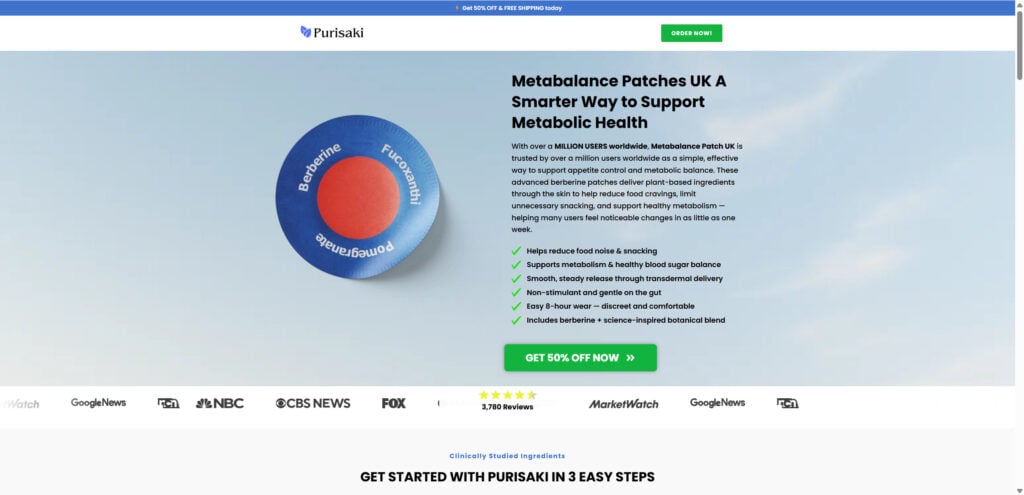
Metabalance Patches (sometimes presented as “Metabalance Patch UK” or promoted under other storefront names) are marketed as stick-on patches that support metabolic health. In many ads and landing pages, the patch is framed as a “smarter way” to control appetite and cravings, improve metabolic balance, and support weight loss without stimulants.
On the surface, that pitch feels appealing because it borrows credibility from real health topics. Metabolism, blood sugar balance, cravings, appetite regulation, and “food noise” are real concerns for many people. Berberine is also a real ingredient that has been discussed widely online, mostly as an oral supplement. Some pages even position berberine as the star ingredient and then add a botanical blend with a scientific-sounding explanation.
But here is the key issue: the marketing is usually not just optimistic. It often crosses into exaggerated, unverified, or misleading territory.
Why patches are a perfect product for this kind of marketing
Patches feel “medical-adjacent” without being medicine. They look like something you might pick up at a pharmacy. They can be photographed beautifully. They are easy to demonstrate in videos. And because they are worn on the skin, marketers can claim “steady release” and “targeted delivery” without needing to explain how much of any ingredient is actually absorbed.
That last part matters.
A serious product that claims transdermal delivery should be very clear about:
- Exactly what ingredients are in the patch
- The amount of each ingredient
- The method of delivery
- Any absorption testing
- Safety information and contraindications
- Clear manufacturer details
- Evidence for the specific product, not for an ingredient in general
Many Metabalance-style patch sites are vague on the details that would let a buyer evaluate the product fairly. Instead, they lean hard on lifestyle promises and generalized wellness language.

The “as seen on” credibility layer
One of the most common features on these pages is a row of familiar media logos. You might see names like NBC, CBS, FOX, MarketWatch, or “Google News,” along with a line suggesting the product has been covered or endorsed.
In legitimate coverage, there is almost always a way to verify it. There are links. There are article titles. There is context. There is an author. There is a date.
With many patch storefronts, the logos appear as design elements that create an impression of authority without providing proof. The result is powerful: readers subconsciously think, “If this was on big media, it must be real.”
If a site cannot show evidence for its biggest trust-building claim, that is not a small detail. It is a warning sign.
The review problem
Another common pattern is a huge number of reviews displayed on the site itself. Sometimes you will see a neat star rating and a count that implies the product is already widely used.
The problem is not that positive reviews are impossible. The problem is that these reviews are frequently difficult to verify anywhere else. When people search beyond the storefront, they often find either no independent discussion or only scattered complaints about shipping times and refunds.
A site-only review ecosystem can be manufactured, filtered, or imported. That does not automatically prove fraud, but it does mean you should not treat it as proof.
The product itself often looks generic
Many of these patch products share a similar “look” across different stores:
- A circular patch design
- A minimalist package mockup
- Similar claims and benefit lists
- Similar “clinical” wording without citations
- Similar discount structures (50% off, 60% off, buy more save more)
In a lot of cases, these similarities are not accidental. They can indicate that multiple storefronts are selling the same low-cost private label patch sourced from overseas suppliers.

That is the classic dropshipping model: a seller builds a branded page, runs ads aggressively, and fulfills orders through a third-party supplier. The customer pays a premium for the marketing layer, not for product quality or support.
“But berberine is real, so what’s the issue?”
This is where many people get stuck. They have heard berberine discussed in wellness communities, so they assume a berberine patch must be a modern, convenient extension of that idea.
The issue is not whether berberine exists. The issue is the leap from “an ingredient has been studied in some form” to “this specific patch will produce these specific results.”
There are two separate questions:
- Does the ingredient have evidence for certain outcomes in humans when taken in a certain way?
- Does this patch deliver a meaningful amount of that ingredient through the skin in a way that matches those outcomes?
A lot of marketing quietly skips question #2 and hopes you will not notice.
If a patch cannot clearly show dosage, absorption, and product-specific testing, the most responsible assumption is that the results will not match the promise.
Red flags commonly seen with Metabalance-style patch offers
These are patterns that frequently show up across many “metabolism patch” offers online. A single red flag does not prove anything. But when multiple show up together, the risk rises fast.
- Big claims with soft language like “clinically studied ingredients,” without linking to studies for the finished product
- A timeline that implies quick results, like “noticeable changes in one week”
- Urgency tactics such as countdown timers, low stock warnings, and “today only” pricing that resets
- Unverifiable media logos or “featured on” claims
- Reviews and testimonials that cannot be confirmed independently
- Vague company information or a brand that appears only on one sales page
- Return policies that are strict, unclear, or require international shipping at the buyer’s expense
- Customer service that relies on a form and generic email replies rather than a real support structure
- Pricing that makes no sense for a truly “clinically validated” transdermal product
Why the “UK” branding can be confusing
Some pages use “UK” in their branding or domain style, which can create the impression the company is local, regulated, or subject to strict consumer protections.
But branding is not proof of location.
A site can look “UK,” “US,” “EU,” or “local” while orders are fulfilled internationally. That is not inherently wrong, but it becomes a problem when the website presentation leads you to believe returns and customer service will be simple, and then reality looks very different.
What buyers often report when things go wrong
When buyers feel scammed by these patch offers, the story usually follows one of these paths:
- The product arrives much later than expected and looks cheaper than advertised
- The packaging is generic or different from the site photos
- The patches feel like basic adhesive discs with no obvious “active” experience
- The buyer tries to return and learns the process is expensive, unclear, or requires shipping to another country
- Support responds with scripted messages, partial refund offers, or requests to “wait longer”
- In some cases, buyers report unexpected charges or subscription-style billing after checkout
Not every buyer experiences every issue. But the pattern is consistent enough that it deserves serious caution.
So, scam or legit?
If we define “legit” as a product that can back up its claims, is transparent about manufacturing and dosing, provides easy returns, and does not rely on manipulative sales tactics, then many Metabalance-style patch offers do not look legitimate.
If we define “scam” as an operation that uses misleading claims, manufactured credibility, and customer-hostile refund processes to profit, then many of these patch sites share scam-like characteristics.
A careful way to say it is this: the business model and marketing patterns strongly resemble a high-risk dropshipping operation, and the health claims are often not supported in a way that a reasonable buyer can verify.
How The Operation Works
To understand why these products keep showing up, it helps to stop thinking like a customer and start thinking like a funnel builder. The product is only one piece. The real system is the marketing machine around it.
Below is the step-by-step structure that commonly appears in Metabalance-style patch campaigns.
Step 1: A product is chosen because it sells well in ads
Dropshipping-style sellers often choose products that meet a few requirements:
- Easy to explain in one sentence
- Visually simple and easy to demonstrate
- Strong emotional hook (weight loss, cravings, pain relief, sleep, anxiety)
- High perceived value, low manufacturing cost
- Repeat purchase potential
A “metabolism patch” checks every box. It is also easy to rebrand, which means one supplier product can be sold across dozens of websites.
Step 2: A “brand” is created in a weekend
This is where the operation begins to look polished.
The seller builds a website with:
- A clean logo and a simple name
- Professional-looking product mockups
- A landing page with bold benefit claims
- A story about why the product is “different”
- A tone that implies credibility and scale
The goal is not long-term brand building. The goal is to look trustworthy long enough for you to buy.
In many cases, the “brand” has little footprint beyond the sales page. If you try to find the company history, leadership, or a real-world presence, there may be almost nothing.
Step 3: Trust symbols are layered on heavily
This is where you will see:
- Media logos
- “Clinically studied ingredients” claims
- Doctor-like language
- Scientific icons and charts
- Big review counts
- Phrases like “recommended,” “validated,” “proven,” or “trusted”
These elements do not require real proof to display. They only need to create a feeling.
The psychological effect is powerful: trust first, details later.
Step 4: The copy is written to bypass skepticism
A strong sales page does not say, “You will lose weight no matter what.” That would be too direct and easy to challenge.
Instead, it uses softer promises that still feel guaranteed:
- “Supports” weight loss
- “Helps” control cravings
- “Promotes” metabolic balance
- “Designed to” reduce snacking
- “May” deliver noticeable changes fast
This wording is carefully chosen. It gives the reader a strong impression while giving the seller plausible deniability later.
Step 5: The “how it works” section stays vague on purpose
This is one of the biggest tells.
A truly serious transdermal product would clearly explain:
- Delivery mechanism
- Absorption data
- Ingredient quantities
- Safety cautions
A dropshipping-style page often uses phrases like:
- “Steady release”
- “Transdermal delivery”
- “Science-inspired blend”
- “Clinically studied ingredients”
But it does not provide the specifics that would allow scrutiny.
If you cannot tell how much of anything is in the patch and how it enters the body, you cannot evaluate the claim.
Step 6: The checkout is optimized for impulse buying
Once the visitor is warmed up, the page introduces pressure:
- Limited-time discount
- Low stock warnings
- A countdown timer
- Bonuses or “free gifts”
- A “most popular” bundle highlighted
This nudges buyers toward a larger purchase. The price ladder is designed so that buying more feels “smart,” even if you are not sure the product works.
Common structures include:
- 1 pack at full price
- 2 packs at a “big discount”
- 3 to 6 packs with the best price per unit
- A “subscription” option framed as convenience
Step 7: The small print carries the real terms
Many people never read the policy pages. That is part of the business model.
In the fine print, you may find:
- Shipping timelines that allow weeks for delivery
- A return window that starts at purchase, not delivery
- Rules that require unopened packaging for returns
- Requirements to contact support within a short period
- Conditions that put return shipping costs on the buyer
- International return addresses
This is where the buyer’s expectations often collide with reality.
A page can feel “local” until you reach the part where you are told to ship returns internationally at your own expense.
Step 8: Fulfillment is handled by a supplier, not the “brand”
In a classic dropshipping flow:
- The customer pays the storefront
- The storefront places an order with a supplier
- The supplier ships the product to the customer
- The storefront keeps the margin
The supplier might be an overseas manufacturer or wholesaler. The product might be a generic patch with a custom label or packaging.
This is why two different “brands” can sell extremely similar patches with identical claims.
Step 9: Customer service is built to delay, not resolve
When a buyer is unhappy, the support flow often looks like this:
- The buyer emails support
- Support asks for more details or tells them to wait
- Support offers a partial refund to keep the product
- Support suggests a different usage method or longer trial
- Support eventually mentions return shipping conditions
- The buyer gives up because it is not worth it
This is not always malicious, but it is a common pattern in low-support ecommerce operations. Refund friction reduces refund volume.
Step 10: The offer rotates and rebrands when complaints rise
If a storefront gains too many negative comments or chargebacks, the same operator can:
- Launch a new domain
- Rename the product
- Use the same supplier listing
- Run new ads with new creatives
That is why these patches feel like they are everywhere, yet any single brand feels strangely hard to trace.
Step 11: The ads do the heavy lifting
The storefront depends on paid traffic. Social media ads are especially effective because they can target interests related to weight loss, wellness, metabolism, and supplements.
The ad creatives often include:
- Before-and-after style messaging
- A “doctor recommended” vibe
- A claim of effortless results
- A short video showing the patch applied
- A simple story of someone who “finally found something that works”
The story sells the product. The patch is just the prop.
Step 12: The buyer becomes the “proof” in the next round
Even if a product does not work, some buyers still post hopeful reviews early on. Others post reviews based on shipping experience rather than outcomes.
Those reviews can be used as marketing material later.
This creates a loop:
- Ads bring buyers
- Buyers generate content
- Content becomes new ad material
- The cycle repeats
That is how low-evidence products can scale fast.
What To Do If You Have Fallen Victim to This Scam
If you already bought Metabalance Patches (or a similarly marketed berberine metabolism patch) and you now suspect you were misled, you are not alone. The good news is there are practical steps you can take, and you do not need to panic.
Use the checklist below and move calmly. The goal is to protect your money, stop any unwanted billing, and document everything in case you need to escalate.
1) Collect your proof now, before anything changes
Save and screenshot:
- The product page with the claims that convinced you
- The price you paid and any bundle terms
- The checkout page if it showed autoship, “priority processing,” or add-ons
- The order confirmation page and email
- Any shipping email and tracking details
- The refund policy and return policy pages
- Any “featured on” or “clinical” claims shown on the page
If the site changes later, your screenshots matter.
2) Check your bank or card statement for extra charges
Look for:
- A second charge you do not recognize
- A subscription or recurring billing
- A charge from a different merchant name than the website brand
- Multiple small charges that add up
If you see anything suspicious, write down the date, amount, and merchant descriptor.
3) Contact the seller in writing and be direct
Keep it short and calm. Ask for:
- A cancellation confirmation (if it has not shipped)
- A refund confirmation (if you want to return)
- A clear return address and return authorization steps
Do not rely on chat widgets alone. Email creates a paper trail.
If they try to push you into delays, restate your request and ask them to confirm the policy in writing.
4) If the package has not arrived, set a firm timeline
If your order is stuck in “processing” or tracking is unclear:
- Give a reasonable deadline for shipment confirmation
- Ask for a refund if they cannot confirm shipping
- Save the response
If days pass with no real update, that strengthens a dispute claim.
5) If it arrived and you want a refund, ask for the return process immediately
If the return requires international shipping at your cost, calculate the real price of that.
Many victims discover that returning a low-cost product internationally costs more than the refund. That is often why these operations resist easy returns.
If the return terms were not made clear at checkout, that can become part of a misrepresentation argument in a dispute.
6) If you suspect a subscription, stop it at the payment level
If you see recurring billing or you are worried it will happen:
- Contact your card issuer and ask about stopping recurring charges
- If you used PayPal, check the “automatic payments” area and revoke authorization
- Consider requesting a replacement card number if your issuer advises it
Do not wait for “next month” to see what happens.
7) Dispute the charge if the seller refuses to cooperate
If you cannot get a reasonable resolution, consider a dispute or chargeback through your payment method.
Common dispute reasons include:
- Product not as described
- Misrepresentation of claims
- Failure to deliver
- Unclear subscription terms
- Refusal to honor return policy
- Seller unresponsive
Dispute processes vary by issuer, but documentation makes a big difference. This is why screenshots matter.
8) Keep the product and packaging, even if you do not want it
If you escalate to a dispute, your issuer may ask for:
- Photos of what arrived
- Packaging details
- Any labeling showing origin
- The condition of the product
Do not throw it away until your case is resolved.
9) Warn others in the right places, briefly and factually
If you want to help others avoid the same trap:
- Leave a factual comment where you found the ad
- Post a short review on a platform that allows it
- Focus on verifiable facts: shipping time, return requirements, mismatch between claims and reality
Avoid exaggeration. Clear details help more than anger.
10) If you experienced health side effects, treat it seriously
Even “natural” products can irritate skin or cause reactions.
If a patch causes:
- Burning, rash, swelling, blistering
- Dizziness, nausea, unusual symptoms
- A reaction that worsens
Stop using it and contact a medical professional for advice.
This is especially important if you have allergies, sensitive skin, or existing conditions.
11) Protect your future self from similar checkout traps
Before buying any “miracle patch” product again, make it a habit to:
- Search the product name + “refund” and “complaints”
- Search the brand name + “subscription”
- Look for a real company address and phone support
- Read the return policy before checkout
- Avoid pressure timers and “today only” deals
- Use a payment method with strong buyer protection
12) If you want a safer alternative approach, go for boring and proven
If your goal is metabolic health or weight management, safer options usually look less exciting:
- Talk to a clinician if you have blood sugar concerns
- Use established brands with clear labeling and easy returns
- Be skeptical of fast timelines and effortless promises
Boring is often a sign that something is real.
The Bottom Line
Metabalance Patches are marketed as an easy, modern shortcut for cravings and metabolic support. The problem is that the sales pages for these patches often rely on the same high-pressure, low-verification playbook seen in many dropshipping-style wellness offers.
When a product’s biggest promises cannot be verified, when “as seen on” credibility is presented without proof, and when returns feel designed to be difficult, the safest move is usually to skip it.
If you already bought, you still have options. Document everything, check for extra charges, push for written answers, and escalate through your payment provider if the seller will not cooperate.
In the long run, anything that promises big metabolic change through a simple sticker deserves extra skepticism. Real health support is rarely that convenient, and it almost never comes wrapped in countdown timers.
FAQ
What are Metabalance Patches supposed to do?
They are marketed as wearable patches that “support” metabolism, reduce cravings, and help with appetite control through transdermal delivery. Most sales pages imply noticeable results quickly, often within 1 week.
Are Metabalance Patches a scam or legit?
Many Metabalance-style patch offers show common scam-like patterns: exaggerated claims, heavy urgency tactics, unverifiable media logos, and refund policies that can be difficult to use. Even if a product arrives, the marketing often does not match what buyers receive.
Do berberine patches actually work?
Berberine is usually studied as an oral supplement, not as a patch. For a patch to be credible, it should clearly show dosage, absorption evidence, and product-specific testing. Many patch pages do not provide enough information to verify meaningful transdermal delivery.
Why do these patch websites show big media logos like NBC or CBS?
Often, the logos are used as trust symbols without linking to real coverage. If there is no verifiable article, date, or source, treat the “featured on” display as marketing, not proof.
Why do some sites claim “millions of users” and thousands of reviews?
Large numbers can be used to create social proof. If you cannot find independent reviews outside the seller’s site, assume the review count may be curated, imported, or not representative.
Where do Metabalance Patches usually ship from?
Many similar patch offers are fulfilled through overseas suppliers, commonly in China, even when the branding looks local. Shipping times and tracking often reflect this.
Can I return them for a refund?
Some sellers advertise guarantees, but the return process may be restrictive: short windows, unopened product rules, or international return shipping at the buyer’s cost. If return instructions are unclear or support is evasive, consider escalating through your payment method.
What should I do if I already ordered and I think I was misled?
- Screenshot the product page, claims, price, and return policy.
- Check your statement for extra or recurring charges.
- Email support and request cancellation or a refund in writing.
- If they refuse or delay, contact your card issuer or PayPal to dispute as “not as described” or “misrepresentation.”
What if I see a subscription or extra charges I did not approve?
Contact your payment provider immediately to block recurring billing. If needed, ask about a replacement card number. For PayPal, revoke any automatic payment authorization tied to the merchant.








