

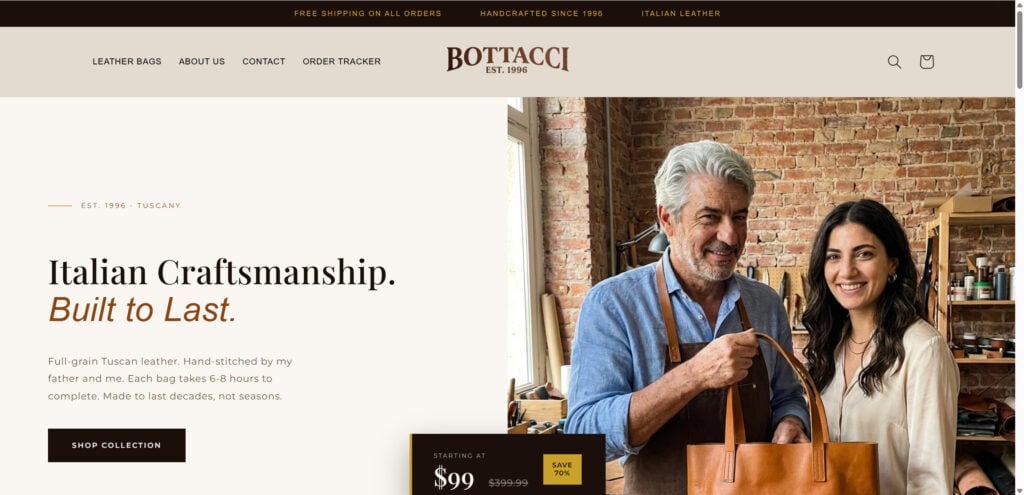
The site looks like it came from a real workshop.
Warm photography. A father-and-daughter origin story. “Handcrafted since 1996.” “Italian leather.” Even a polished breakdown of how each bag is supposedly cut, stitched, and inspected, step by step.
It’s the kind of presentation that makes you slow down and think, “Okay, this feels legit.”
But when a store leans this hard into a heritage narrative while pushing constant discounts and urgency, the smartest move is to pause and verify what’s actually behind the checkout button.
Because with shops like Bottacci, the gap between the story and the shipment is often where the problem lives.
This guide breaks down the biggest red flags tied to Bottacci Leather Bags, how these operations typically work, what customers tend to experience after ordering, and what to do if you already paid.
Scam Overview
Bottacci Leather Bags presents itself as a premium Italian leather brand built on tradition and craftsmanship. The website’s visuals and messaging focus on heritage, quality, and authenticity, using the same cues you would expect from a long-established boutique.
The pitch is simple and emotionally effective:
- A family workshop narrative that implies real artisans and real history
- A “made to last” positioning that signals premium materials
- Product photography that looks like high-end editorial content
- Discounted pricing that makes luxury feel suddenly reachable
That combination is powerful. It speaks to trust and value at the same time.
The problem is that this exact formula is also one of the most common templates used by short-lived ecommerce stores that sell mass-produced items sourced from overseas suppliers. In many cases, the “brand” is basically a storefront skin placed on top of a fulfillment pipeline.
The biggest tell: the domain timeline does not match the origin story
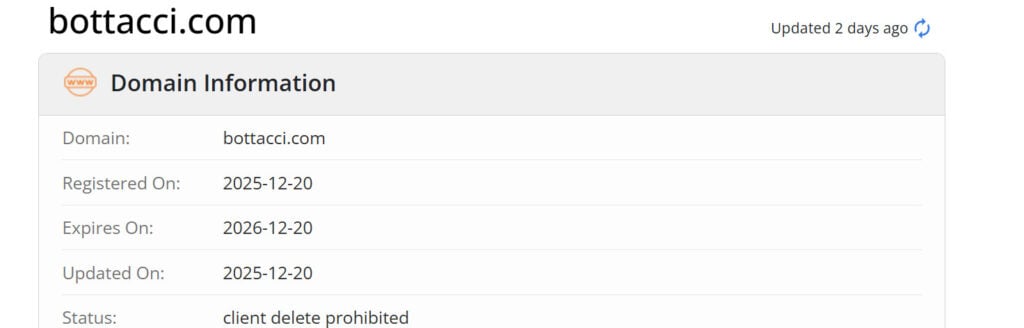
One of the clearest credibility checks for any “heritage” brand is the domain footprint.
If a company claims it has been operating since 1996, you would typically expect at least some long-term online trail: older domain records, older mentions, older reviews, older press references, older social pages with real history.
In Bottacci’s case, a domain lookup screenshot shows bottacci.com was registered on 2025-12-20, with an expiration date in 2026. A site that truly existed since the 1990s can still change domains, but when the entire brand appears to start online only recently, the “since 1996” framing starts to look like a marketing prop rather than a verifiable timeline.
A fresh domain does not automatically mean fraud.
But a fresh domain plus a heavy heritage story plus steep discounts is a pattern you should treat as high risk.
The pricing structure looks engineered, not natural
Bottacci’s site strongly emphasizes discounting, including banners like free shipping and aggressive markdowns such as “starting at $99” with savings shown around 70%.
Here is why that matters.
Real leather brands do run sales, but they usually do it in ways that still protect brand value: seasonal clears, limited runs, discontinued colors, end-of-line inventory.
What these “template” stores do instead is different:
- They keep products “on sale” indefinitely
- They show dramatic strikethrough pricing to anchor the buyer
- They create the impression of a rare deal, not a normal price
- They push you to purchase quickly before you verify details
This is not proof on its own. It’s a signal.
The most important question is what customers receive compared to what the site implies.
The product images and brand presentation often do not behave like a real workshop
In many cases, stores like this rely heavily on:
- Stock-style lifestyle photography
- Carefully staged “artisan” photos that can be licensed images
- Generic copy that could be used for any leather shop
- A brand story that reads like a script rather than a documented history
If you have reviewed enough of these sites, the structure becomes familiar:
- “Our story” page with emotional language
- A “how we work” page with a few steps (select, cut, stitch, inspect)
- Broad claims about full-grain leather and craftsmanship
- Little to no detail about where the workshop is located, who runs the legal entity, or what the actual return address is
That matters because when problems happen, the return address and business identity become the entire fight.
The most common outcome reported with this type of operation
You already summarized the expected pattern, and it matches what consumers commonly describe with similar “heritage” storefronts:
- The buyer orders expecting a premium leather bag based on photos and language.
- Shipping takes longer than expected, often due to overseas fulfillment.
- The item arrives and feels cheaper than the product page implied.
- The buyer complains.
- Support responds with a partial refund offer, often in the 15% to 30% range, in exchange for keeping the product.
- If the buyer insists on a return, the process becomes expensive, slow, or unclear, especially if the return destination is outside the buyer’s country.
This is not how strong brands protect trust. It is how fragile operations minimize refunds.
When a store’s standard solution is “keep it and take 20% back,” it suggests the product’s real cost basis is low enough that partial refunds are cheaper than handling proper returns.
Why “cheap bags from China” becomes a core risk
There is nothing inherently wrong with manufacturing in China. Many legitimate brands produce there.
The issue is transparency and expectation.
If a site markets “Italian craftsmanship” and “built to last,” but the supply chain behavior looks like bulk imports and customer support behaves like a dropshipping operation, the buyer is being guided into paying a premium for a story.
In other words, the core concern is not geography.
The core concern is deception.
What Bottacci appears to be, in practical terms
Based on the pattern, Bottacci Leather Bags strongly resembles a short-lived ecommerce storefront using a premium brand narrative to sell products that may not match the quality implied by the website.
That places it in a “high risk” category for shoppers, especially if you are expecting:
- True full-grain Italian leather
- Consistent craftsmanship across products
- Straightforward refunds and returns
- A stable brand identity that will exist next month if you need support
If you are considering ordering, the safest assumption is that the site is not operating like a traditional leather brand. It appears closer to a marketing-first storefront where the brand identity is flexible and the operational backbone is optimized for volume, not long-term reputation.
How The Scam Works
This section lays out the step-by-step mechanics behind this style of shopping scam. Even if you never buy from Bottacci, understanding the flow helps you spot the next rebrand instantly.
Step 1: Build instant trust with a “heritage” identity
The store starts by answering your first unspoken question:
“Who are these people?”
Instead of giving a verifiable company profile, they give you a story.
A family shop. A father teaching a craft. A daughter carrying it forward. A workshop image. A “since 1996” line to imply longevity.
This works because most people do not verify timelines. They feel them.
And the story creates a shortcut: if it feels old, it feels safe.
Step 2: Use premium language that suggests materials and methods
Next comes a layer of quality signals:
- “Italian leather”
- “full-grain” language
- “hand-stitched” framing
- “built to last decades” tone
- “not seasons” positioning
This primes the buyer to accept higher prices and lower skepticism.
Notice what is often missing:
- Specific leather grades with consistent definitions
- Tannery details
- Provenance for materials
- A named manufacturer or workshop address
- Certification claims that can be checked
The language is designed to sound premium without being pinned down.
Step 3: Make the deal feel rare and urgent
Then comes the pricing pressure:
- Large strikethrough pricing
- Savings shown like 70% off
- “starting at $99” anchors
- Free shipping banners
- “limited stock” style prompts (even when stock never ends)
The goal is to move you from evaluation to action.
The longer you wait, the more likely you are to search reviews, check domain age, reverse image search photos, or compare similar bags on other marketplaces.
So the store tries to compress your decision window.
Step 4: Offer a product catalog that looks curated but scales like a template
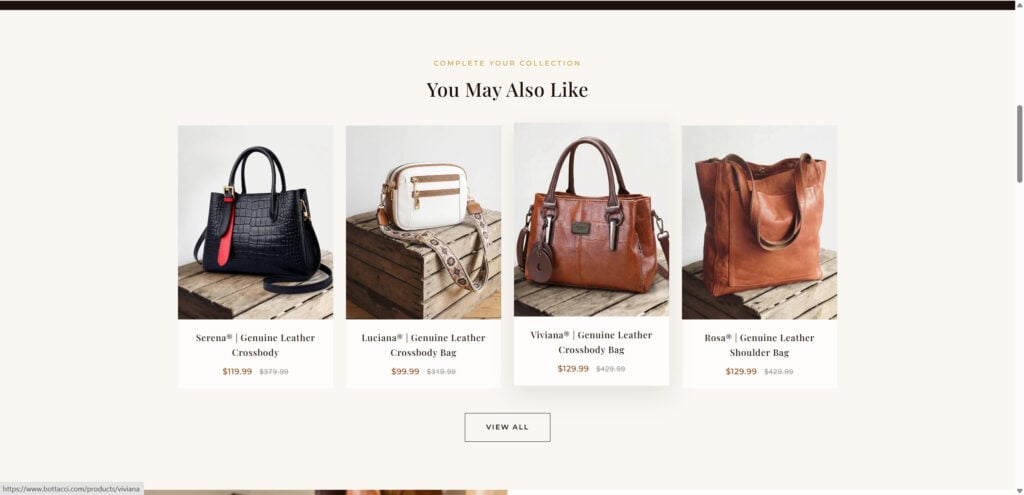
Many of these sites show a neat, boutique-like catalog.
But the structure often looks mass-scalable:
- Many models with clean, generic naming
- Consistent formatting across product pages
- Similar layouts you can find across multiple unrelated “brands”
- A mix of styles that feel more like supplier variety than a single design language
A real leather studio usually has a consistent design signature.
Template stores often feel like a nicely organized warehouse.
Step 5: Collect payment first, solve trust later
At checkout, the buyer expects a normal retail experience.
What can happen instead:
- The payment descriptor on the bank statement may not match the brand name
- Order confirmations may be basic or generic
- Support channels may be slow or copy-paste
- Shipping updates may be vague until the package clears origin
Again, any one of these can happen with a legitimate small business.
The difference is what happens when the customer complains.
Step 6: Use delay, friction, and partial refunds to reduce chargeback risk
When buyers report quality issues, these stores often use a specific playbook:
- Apologize and ask for photos.
- Offer a small discount or partial refund, often 15% to 30%.
- Frame the return as “not worth it” because shipping is expensive.
- If the buyer insists, provide a return address that is overseas, incomplete, or time-limited.
- Drag the timeline until the buyer gives up or misses dispute windows.
This is not random behavior. It is optimized.
A partial refund is cheaper than a full refund.
A complicated return is cheaper than an easy return.
A delayed response is cheaper than fast service.
And all of it reduces the number of successful chargebacks.
Step 7: Rebrand if reputation gets too noisy
When complaints build, the storefront can be abandoned and relaunched under a new name.
This is why the “brand story” is so reusable.
The photos stay.
The copy stays.
The product pages stay.
Only the logo and domain change.
That is why checking domain age and the legal business identity matters so much. It is one of the few parts they cannot easily fake for long.
What To Do If You Have Fallen Victim to This Scam
If you already ordered from Bottacci Leather Bags (or any similar “heritage sale” store), focus on speed, documentation, and banking protections.
1) Collect proof immediately
Before anything changes, save:
- Order confirmation email and order number
- Product page screenshots showing claims, pricing, and materials
- The return policy page
- Shipping policy page
- Any “about us” claims such as “handcrafted since 1996”
- Photos of what arrived, especially defects or quality mismatch
- Packaging labels and customs stickers (these can show origin)
Put everything in one folder. This makes disputes much easier.
2) Contact the seller once, in writing, and be direct
Send a short message that includes:
- Your order number
- What is wrong (quality, mismatch, damage, not as described)
- What you want (refund, not store credit)
- A clear deadline for response (example: 48 hours)
Keep it polite. Do not debate the brand story. Stick to the transaction.
3) Do not accept a partial refund if you want your money back
This is a key decision point.
If you accept 20% back, you may lose leverage with your card issuer later. Some banks treat partial refunds as a “resolution attempt,” which can complicate disputes.
If the product is not as described and you want a full refund, say that clearly and avoid negotiating down.
4) Check your payment method and move quickly on disputes
If you paid by credit card, you have stronger options than many debit payments.
If the seller delays, escalates, or refuses:
- File a dispute with your card issuer for “item not as described” or “merchandise not received,” depending on your case.
- Provide your screenshots and photos.
- Include any evidence of misleading claims (Italian leather, handcrafted since 1996, etc.).
If you paid through PayPal, open a dispute in PayPal first, then escalate to a claim if needed.
5) Watch your statements for extra charges
Even if you only bought once, review:
- The exact merchant descriptor on your statement
- Any follow-up transactions you do not recognize
- Any subscription-like charges
If anything looks off, contact your bank immediately and consider replacing the card.
6) If a return is required, do not spend money blindly
If they insist you must return the bag:
- Ask for the full return address in one message
- Ask who pays return shipping
- Ask for a prepaid label
If the return address is overseas and shipping costs are unreasonable, document that.
Some banks will consider “return required but cost-prohibitive” as part of the dispute context, especially when the product is not as described.
7) Report the site to help others
If you have strong evidence of misleading marketing, report it to:
- The payment processor (if shown on checkout)
- The ad platform where you saw it (Facebook, Instagram, TikTok)
- Your country’s consumer protection body
It does not always lead to immediate action, but it creates a record that helps.
The Bottom Line
Bottacci Leather Bags looks like a premium Italian leather brand on the surface, complete with a family workshop narrative and craftsmanship language designed to build trust.
But the surrounding signals tell a different story.
A domain registration date in late 2025 does not naturally align with “handcrafted since 1996.” Heavy discounting, polished heritage storytelling, and the familiar pattern of overseas fulfillment and partial refund offers are all consistent with a marketing-first operation that sells products that may not match the quality implied by the site.
If you are shopping for a real leather bag you plan to keep for years, Bottacci is a risky bet.
If you already ordered and the product does not match the listing, treat it as a dispute-ready situation: document everything, avoid partial refund traps, and use your payment protections quickly.
FAQ
Is Bottacci Leather Bags legit or a scam?
Based on the red flags, Bottacci appears high risk and consistent with a deceptive dropshipping-style operation. The branding leans heavily on an Italian heritage story that does not match the available timeline signals, and the overall pattern aligns with stores that frequently disappoint buyers.
Where do Bottacci bags ship from?
Customers dealing with similar operations often receive packages shipped from overseas fulfillment routes, commonly tied to China-based logistics. The clearest way to confirm is the shipping label and customs sticker on the delivered package.
Are Bottacci bags real Italian leather?
The site markets “Italian leather,” but with operations like this, the bigger issue is verification. If there is no clear, checkable supply chain and the product quality does not match the premium claims, treat the material claims as unproven marketing language.
Why are the discounts so big, like 70% off?
Large permanent markdowns are a common tactic used to create urgency and anchor perceived value. It makes a mid-quality product feel like a luxury bargain, even when the “original price” is not a real market price.
What if Bottacci offers me 20% back to keep the bag?
This is a common partial refund tactic. If you want a full refund, do not accept a partial refund just to end the conversation. Keep everything documented and move toward a dispute if the seller stalls.
Can I get my money back?
Often, yes, especially if you paid by credit card or PayPal and you act quickly. Your odds improve significantly if you have screenshots of the product claims and photos showing the mismatch.
What should I say when filing a chargeback?
Use clear categories like:
- “Item not as described”
- “Misleading product description”
- “Quality significantly different from listing”
- “Return process unreasonable or not provided”
Attach screenshots of the listing claims, the return policy, and photos of the item received.
How can I spot the next version of this scam?
Look for this cluster:
- Emotional “family workshop” story
- “Handcrafted since” claims with little history
- Huge discounts that never end
- Vague business identity and weak contact details
- Slow support and partial refund offers instead of real returns
- A brand that seems to appear out of nowhere








