

Clarity Blue Glasses are sold on a dream that feels almost personal.
Stop swapping pairs. Stop squinting at your phone. Stop buying “just one more” set of glasses because your vision keeps changing.
Instead, the pitch says: turn a small dial and everything snaps into focus.
It is a clean, satisfying idea. And it is exactly why these kinds of “adjustable focus glasses” are so easy to impulse-buy.
But the calmer question is the one that actually protects your money and your eyesight: do Clarity Blue Glasses work the way the sales page implies, and is this the kind of purchase you should trust?
Overview
What Clarity Blue Glasses claim
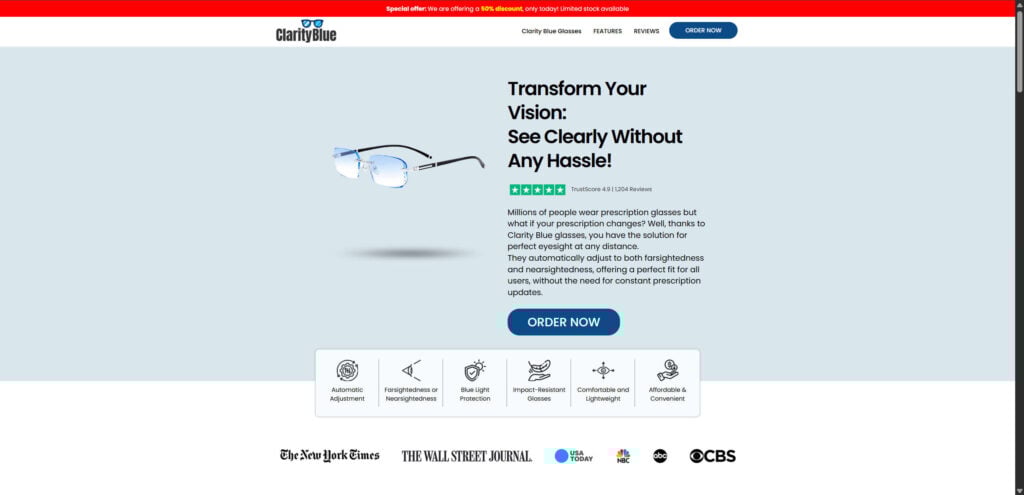
Clarity Blue Glasses are marketed as adjustable eyeglasses that let you see clearly at multiple distances by turning a dial on the frame.
The key claim, repeated prominently on the sales page, is a wide prescription range from $-6 to $+3 diopters “with just one pair.”
Along the way, the marketing stacks additional promises:
- One pair “fits all vision needs”
- One pair can replace multiple pairs of glasses
- Clear vision for reading, screens, and distance tasks
- UV protection
- Blue-light filtering
- Comfort, durability, and an “elegant unisex style”
- A $30-day satisfaction guarantee
- A large discount, repeatedly promoted as $72% off
These are not subtle claims. They are broad, universal, and designed to make you feel like the product is a complete solution, not a compromise.
What adjustable focus glasses can realistically do
Adjustable focus glasses are not inherently fake.
There are real optical concepts behind lenses that can change their effective power. Some designs use shifting elements or layered components to alter focus. You do not need magic for that.
The practical limitation is this: most people do not have a single, simple “strength” problem.
Real prescriptions can involve:
- Different strength in each eye
- Astigmatism correction (cylinder and axis)
- Prism correction (alignment)
- Progressive needs (near and distance in one lens, smoothly)
- Pupillary distance alignment for comfort and clarity
Adjustable focus glasses, in the common consumer versions sold online, generally address only one dimension: spherical power.
That means they may help some people reduce blur in certain situations, especially if:
- Both eyes are similar
- Astigmatism is minimal or not present
- The goal is occasional use rather than all-day wear
- Expectations are realistic
That is a very different promise from “one pair replaces all your other glasses.”
The diopter range problem: $-6 to $+3 is a huge claim
A range from $-6 to $+3 is enormous. It covers significant nearsightedness through moderate farsightedness.
There are two issues with how that range is presented.
1) Range does not equal usable clarity
A product can claim a wide adjustment range, but the user experience might still be:
- Narrow “sweet spot”
- Distortion around the edges
- Reduced clarity compared to a proper prescription
- Eye strain after longer wear
In other words, even if the dial moves, that does not guarantee that you will enjoy wearing the result as your primary eyewear.
2) Most people need different corrections in each eye
Many adults have different prescriptions in each eye.
If Clarity Blue uses a single control that adjusts both lenses the same way, then the best-case scenario for a lot of buyers is compromise. One eye is closer to correct and the other eye is not.
Some adjustable glasses designs have separate controls for each lens. If a product does not clearly explain that, you should assume it is not designed for precision correction across two different eyes.
When a sales page glosses over this reality and pushes “one dial, one pair, everyone,” that is not a technical explanation. It is marketing.
“Works for ages 25 to 85” is another broad net
The sales copy strongly implies that Clarity Blue works for a wide age range, from younger adults to seniors.
That sounds inclusive, but it also signals exaggeration.
Vision changes with age for many reasons, including presbyopia (difficulty focusing up close), cataracts, and other conditions that are not solved by simply changing spherical power.
A dial cannot “fix” every reason someone struggles to see. It can only adjust one part of the equation.
Astigmatism: the most common missing detail
Astigmatism is extremely common.
If your vision blur is driven by astigmatism, changing spherical power might make the blur shift, but it does not properly correct it. Many people with astigmatism get headaches or eye fatigue quickly when the lens correction is not right.
That is why “one adjustable dial for everyone” is an especially risky pitch.
It is not that adjustable glasses can never help.
It is that they cannot do what the sales page implies for a huge portion of buyers.
The sales page uses “proof language” without proof
Clarity Blue’s page uses a familiar set of phrases that sound technical or authoritative but are not measurable:
- “Perfectly balanced view”
- “Total focus control”
- “Vision without limitations”
- “High definition”
- “Instant clarity”
- “Anyone can use it and get results”
These phrases are persuasive because they describe feelings.
They are not persuasive because they provide verifiable specs, testing, or limitations.
A trustworthy optical product page usually includes concrete details such as:
- Lens material and coatings with clear ratings
- UV rating standard information
- Any compliance or testing references
- Clear limitations (who should not use it)
- Clear warnings about driving and safety-critical tasks
When a page focuses on emotion and urgency instead of specifics, it becomes harder to judge the product fairly. That benefits the seller, not the buyer.
The “UV protection” and “blue-light filtering” claims
These claims are common in online eyewear marketing because they increase perceived value quickly.
It is possible that the lenses include basic UV protection or some form of blue-light filtering.
The issue is that the page does not appear to anchor those claims to measurable standards. Without specifics, “UV protection” can mean anything from minimal to meaningful. “Blue-light filtering” can range from a marketing tint to a more deliberate coating, but the details matter.
If a product is sold primarily through emotional claims, you should treat feature claims as unverified until proven.
The review presentation is designed to convert, not inform
The sales page displays “Customer Reviews” in a floating sidebar style, paired with repeated purchase buttons.
The reviews are short and conveniently aligned with the most common buyer objections:
- “I can drive, read my phone, and work on detailed crafts”
- “They darken in sunlight”
- “Eye fatigue disappeared”
- “I was constantly switching glasses and this eliminated the hassle”
This is not how most authentic review ecosystems look.
It is how conversion-focused pages present reviews: as reassurance positioned next to the action button.
There is also a “live” style element suggesting “a user is leaving a new review,” which adds social pressure. Whether or not it is genuine, the effect is the same: it tries to make you feel like this product is in active demand right now, so you should buy now.
The checkout flow signals a performance-marketing funnel
The checkout page shows a classic “limited-time deal” layout with multiple psychological triggers:
- Countdown timer (“your discount is locked in”)
- Social proof counter (“people are viewing this right now”)
- Bundle pricing with “friends deal” and “couple’s pack”
- Large discount framing with “you save” percentages
- “Secure & Fast Checkout” branding
- Trust-style badge graphics clustered near the top
This is not automatically proof of wrongdoing.
It is evidence of a funnel built for conversion.
These funnels are common in dropshipping and direct-response operations because they increase impulse purchases and raise average order value with bundles.
The pricing and the “dropshipping” question
One of the strongest indicators of a dropshipping-style model is when the branded product appears identical to generic “adjustable focus” frames available through wholesale marketplaces.
A wholesale listing for a very similar adjustable-focus eyeglass product shows a per-unit price around $2, with minimum quantities typical of supplier catalogs.
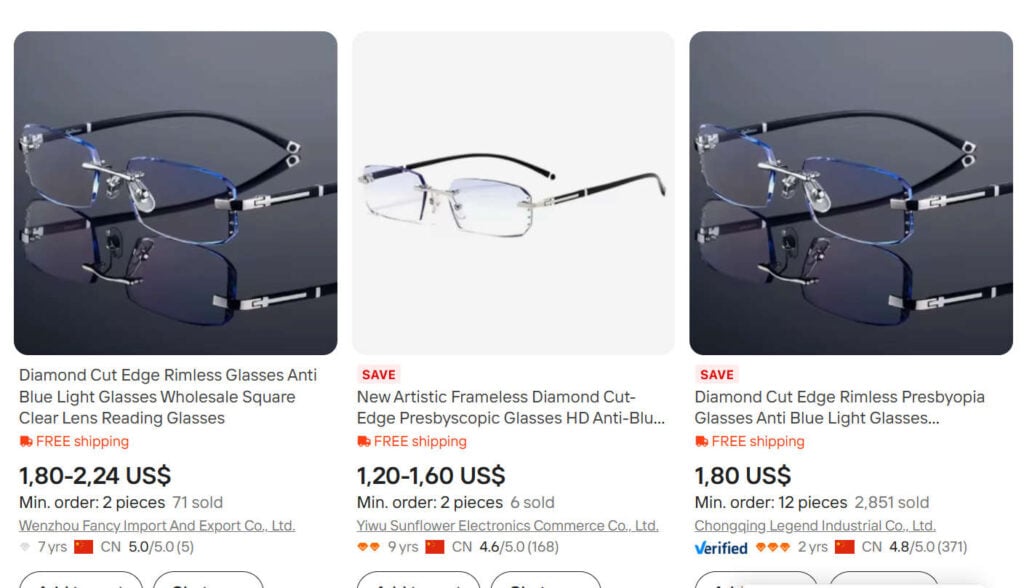
That matters because it changes the context of the Clarity Blue offer.
If the underlying product is a generic item sold to many resellers, then the “Clarity Blue” brand is likely a marketing wrapper. The value you are paying for is not optical innovation. It is advertising, branding, and funnel mechanics.
A brand can still be legitimate in that setup.
But it becomes far more important to scrutinize:
- Return policy execution
- Customer support responsiveness
- Shipping transparency
- Whether claims match reality
- Whether the product is safe and comfortable for your use case
Who Clarity Blue Glasses might be for
If you are considering Clarity Blue, the safest way to think about it is not “replacement eyewear.”
Think “backup tool,” and only in certain scenarios.
Clarity Blue-style adjustable glasses might be useful if:
- You want a temporary, occasional solution at home
- Your eyes are very similar in prescription
- You do not have significant astigmatism
- You understand you may get “good enough,” not crisp prescription clarity
- You do not plan to drive or do safety-critical tasks with them
If that is your expectation, the product might feel acceptable.
Who should not buy Clarity Blue Glasses
You should avoid relying on Clarity Blue as a primary pair if any of these are true:
- You drive frequently and need stable distance vision
- You have astigmatism
- You have different prescriptions in each eye
- You wear progressives or need multifocal correction
- You get headaches or eye strain easily
- You have an eye condition that requires proper medical care
- You are hoping to avoid an eye exam by buying a dial-based shortcut
If you are in any of those categories, the risk is not just wasted money.
The risk is discomfort, eye strain, and false confidence.
The verdict
Clarity Blue Glasses are marketed with an oversized promise: one pair, wide range, everyone, everything.
That promise is not realistic for a large share of buyers.
The sales funnel is engineered for urgency and conversion, and the product category itself is heavily associated with generic, rebranded items sold through dropshipping-style campaigns.
If you want a simple decision:
- As a primary replacement for real prescription glasses: don’t buy.
- As a backup experiment with strict expectations and no driving use: proceed only if you are comfortable with the risk and you can easily return it.
How The Operation Works
Below is a step-by-step breakdown of how Clarity Blue is being sold, and why that matters. This is not about one brand name. It is about a common playbook used to sell generic products at premium prices through high-pressure funnels.
Step 1: Start with a universal frustration
The pitch begins by describing a relatable problem:
- Your vision “refuses to stay the same”
- You keep buying new glasses
- You switch between readers and distance glasses
- You are tired of carrying cases and swapping frames
This framing is effective because it feels like empathy.
It also sets up the next move: turning a complex vision topic into a simple “one product fixes it” story.
Step 2: Offer a simple mechanism that sounds like innovation
Then the product is introduced as a clever device:
- Turn a small dial
- The focus adjusts instantly
- The lens “power” changes
The sales page even describes “two thin plates” that slide across each other when you turn the dial, changing the lens.
This explanation sounds technical enough to feel credible.
But notice what it does not do.
It does not address the hard parts, like different prescriptions per eye or astigmatism. Those details would create hesitation. The funnel avoids hesitation.
Step 3: Use a large numeric range as a trust anchor
The $-6 to $+3 diopter claim is the anchor.
It tells the buyer: “This will probably fit you.”
That is the real job of the range claim. It reduces doubt.
It also makes the product feel powerful and premium.
A smaller, more honest range would shrink the market. A larger range increases conversions.
Step 4: Expand the promise into “replacement” territory
Once the buyer believes the mechanism is real, the funnel stacks the big promise:
- One pair replaces multiple pairs
- One pair fits all needs
- One pair works indoors and outdoors
- One pair helps at any age
- One pair helps with reading, screens, and distance
This is where marketing crosses from “interesting” into “high risk.”
Because for most people, vision needs are not a single dial.
They are a set of measurements.
Step 5: Add bonus features to justify the price
Now the page adds features that increase perceived value:
- UV protection
- Blue-light filtering
- Durable materials
- Comfort claims
- Style claims
These features are common in low-cost eyewear too. They are not necessarily premium.
But in a funnel, they work as value padding. They make the price feel easier to accept.
Step 6: Place reviews next to the buy button
The “Customer Reviews” box is positioned near the call to action.
This is intentional.
The reviews are short and targeted. They answer objections without sounding like technical claims.
One review suggests the glasses work for driving and even darken in sunlight. Another claims reduced eye fatigue and less switching.
This review placement is a conversion tactic. It keeps the buyer emotionally reinforced while they scroll.
Step 7: Repeat the discount until it feels like a deal you cannot miss
The funnel repeatedly pushes a discount framed as $72% off.
This creates two effects:
- It reduces price resistance by making the buyer feel smart
- It injects urgency, because the deal is framed as temporary
When you see discount repetition at multiple scroll points, the goal is almost always to accelerate the decision.
Step 8: Shift to checkout and intensify the pressure
At checkout, the pressure increases.
The checkout flow includes:
- A timer that suggests your discount is “locked in” for a limited window
- A live viewer counter showing many people “viewing this right now”
- A limited-time deal step before receipt
- Trust-style badges and “secure checkout” language
These elements are designed to prevent the buyer from leaving to compare options.
Comparison is the enemy of funnels.
Step 9: Use bundles to raise the order value
The deal selection encourages buying multiple units.
It frames multi-pack options as special deals for friends or couples.
This is typical funnel economics.
If the seller’s cost of goods is low, profitability depends on:
- Conversion rate
- Average order value
- Refund rate
Bundles increase average order value quickly.
They also reduce the chance that a buyer requests a refund immediately, because the purchase feels like a bigger commitment.
Step 10: Use “trust signals” that are often just graphics
Many checkout pages display security badges because they raise conversion rates.
Sometimes they are legitimate integrations. Sometimes they are just images.
Either way, their presence is not proof of a reputable company. They are a persuasion layer.
A buyer should prioritize real trust signals instead:
- Clear company identity
- Transparent policies
- Responsive support
- Independent reviews outside the brand page
Step 11: Fulfillment often follows a dropshipping pattern
When a product matches generic wholesale listings, the most common fulfillment pattern is:
- Order is placed on the branded site.
- Payment is processed through the funnel checkout.
- Order data is sent to a supplier or agent.
- Product ships from the supplier’s channel.
- Brand customer support is the middle layer, not the manufacturer.
This can lead to predictable problems:
- Slower shipping than expected
- Packaging that looks generic
- Product quality that feels lower than the marketing tone
- Support that is slow, scripted, or difficult to reach
- Return friction, especially if international shipping is involved
Again, not guaranteed, but common.
Step 12: The guarantee becomes the real test
A $30-day satisfaction guarantee sounds reassuring.
But guarantees are only as good as the process behind them.
In funnel-based operations, common refund friction includes:
- Slow replies
- Requests for extra steps and photos
- Offers of partial refunds to avoid full refunds
- Complicated return instructions
- Return shipping costs that make the refund not worth it
A professional way to judge the operation is not the guarantee headline.
It is how quickly and clearly support handles a refund request.
Step 13: Why rebranding is easy in this model
A final reality of rebranded product funnels is that they can change quickly.
If complaint volume rises, operators can:
- Move to a new domain
- Change product name slightly
- Reuse the same creative and the same claims
- Relaunch the funnel under a new brand identity
That is why it is risky to buy based on the brand story alone.
The pattern matters more than the name.
What To Do If You Have Bought this
If you already purchased Clarity Blue Glasses, the goal is to protect your eyesight and protect your payment options. The steps below are practical and calm.
- Do not use them for driving until you are fully confident
If a product claims it can replace driving glasses, treat that as marketing, not permission. Test at home first. If vision feels unstable, do not drive with them. - Test them in short sessions, not all day
Start with a few minutes at a time. Watch for headaches, eye strain, dizziness, or blur that shifts as you move your head. Those are signs the correction is not right for you. - Document everything immediately
Save screenshots or PDFs of:
- The product claims (range, features)
- The guarantee wording
- The discount offer shown at purchase
- Your order confirmation
- Any shipping or tracking emails
This is the foundation for any refund or dispute.
- Check your statement for the merchant descriptor
The name on your bank statement may not match “Clarity Blue.” Write down the exact descriptor and the amount. - Contact support in writing and keep it simple
If you want a refund, send a clear message:
- Order number
- Date of purchase
- Request for a full refund
- Request for return instructions
- Request for written confirmation
Do not negotiate in the first message. Start with clarity.
- Set a personal deadline and follow through
If support does not respond within a reasonable time, escalate. Do not let the process drift until it is too late to dispute with your payment provider. - If you paid by card, ask your bank about dispute options
Use your documentation. Explain that the product does not match the claims or that the return process is not being honored, depending on your situation.
Dispute policies vary. Your issuer can tell you the window and the best category to file under.
- If you used an online payment processor, open a case early
Do not wait. Open a case while you still have strong documentation and clear timelines. - Monitor for unexpected charges
Most one-time purchases stay one-time, but it is still smart to watch for additional charges from the same merchant descriptor or related descriptors.
If anything looks wrong, contact your bank promptly.
- Keep the product and packaging until the case is closed
Even if you dislike the glasses, keep everything until your refund or dispute is resolved. Some processes require photos, labels, or proof of return. - Do not let this replace eye care
If your vision is changing, the best move is still an eye exam. Adjustable glasses can mask symptoms temporarily, but they cannot diagnose or correct the underlying issues that a professional prescription addresses.
The Bottom Line
Clarity Blue Glasses are marketed as a universal solution: one pair, one dial, all distances, almost everyone, and a sweeping $-6 to $+3 range.
That is the exact type of promise that sells well and delivers unevenly.
The funnel relies heavily on urgency triggers, conversion-focused reviews, and discount pressure, which is typical of dropshipping-style campaigns selling generic products under a new brand wrapper.
If you want a primary replacement for prescription glasses, especially for driving or daily wear, the smart answer is don’t buy.
If you already bought, treat it like a short trial at home, document everything, and move quickly if you need a refund.









Add I watched did not even mention the “ dial” to use to change vision. Made it seem as if this adjustment was automatic.
Good thing I double checked .
Thank you for being there to verify!
You caught an important mismatch, Renee. If the advertisement suggests automatic focusing but the delivered design depends on a manual dial—or the sales page hides that detail—the product is not being presented clearly. I am glad you checked before placing the order.
My husband talked me into ordering these pieces of garbage. They broke within 2 days, both pair. Stop advertising foreign crap. Because its absolutely crap. Im not apologetic, Im completely sick of garbage being advertised constantly. Stop letting these lazy creeps make money off of hard working people.
I’m sorry the glasses fell apart so quickly — that frustration is completely understandable. One thing worth clarifying, though: this article is a warning about Clarity Blue, not an advertisement for it. We investigate these products precisely because they’re pushed so aggressively and so often disappoint buyers like you. If you paid by card, it’s worth ringing the number on the back of it, disputing the charge as goods not as described, and asking them to block any further billing from that merchant. Thank you for taking the time to warn other readers.
Positively fantastic and no BS information.Thank you for thisinformation.
Thanks John, appreciate that.
I was sent a cheap pair of blue blockers, and immediately contacted them and demanded a full refund to include shipping. They sent me several counter offers, which I refused. I had paid with paypal, so took the matter to them. Bottom line is I got my full refund, with shipping from paypal.
Those “counter offers” are a script, not a negotiation – 30% back to keep the item, then 50%, then 70% – and the aim is to get you to accept anything at all, because a settled complaint cannot become a chargeback. You were right to refuse and go to PayPal instead.
If you have not already, make sure the PayPal claim is filed as “significantly not as described” rather than “item not received”, and upload the ad photo next to a photo of what actually arrived; that comparison decides most of these. If PayPal asks you to return the item, insist on a prepaid label with tracking – never post it back at your own expense to whatever address is on the parcel, because that address is usually a forwarding depot. If the claim is closed against you, PayPal has an appeal step, and a chargeback through the card behind your PayPal account is still an option.
I received two pairs today. Everything was blurred, and I couldn’t read anything on the internet or a printed copy,
That is the answer to whether these do anything: a real lens with a blue-light filter is barely noticeable to look through, so if everything is blurred, both near and far, you are looking through cheap uncorrected plastic with a tint on it. There is nothing to adjust to and no break-in period, whatever the follow-up email says.
Dispute the charge with your card issuer as not as described, and if they ask for the item back, only send it with a prepaid label and tracking. Do not accept the partial refund they will offer to keep you from filing – it is offered precisely because a settled complaint cannot become a chargeback.
Mr. Orsolya, thank you for this article! It is very clear and helped me understand the marketing scams more fully, especially Step 11: Fulfillment often follows a dropshipping pattern. I appreciate your efforts to keep the public informed.
Thank you, Nicole. We appreciate that. Dropshipping patterns are one of the clearest ways to understand why the ads look polished but the product experience is so poor.
Junk- Cheap Chinese Junk!
Hi Scott, thanks for sharing that.
Unfortunately, that is a very common pattern with these sites: the product looks much better in the ads, but what arrives is cheap, low-quality merchandise that feels nothing like what was promised. Comments like yours help other readers spot the warning signs faster.
It is worth noting that the Ad on Youtube doesn’t use real human beings, only A.I. generated garbage.
Agreed. A growing number of scam ads use AI-generated “people” and synthetic voiceovers to look credible and avoid accountability. Reporting the ad on YouTube helps, especially if you include that it appears AI-generated and misleading.