

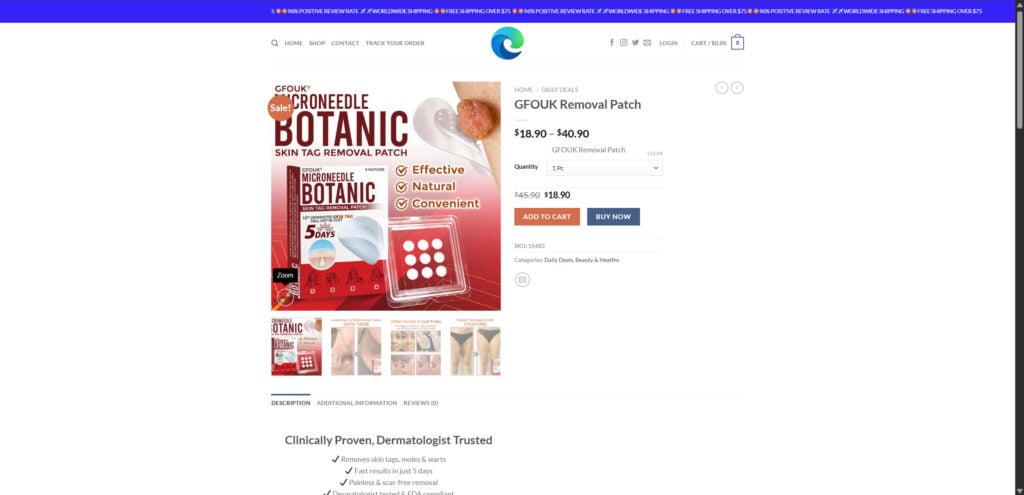
You have probably seen it in ads or on a slick-looking product page: the Gfouk Removal Patch (often shown as a Microneedle Botanic Skin Tag Removal Patch) promising fast, painless results and “clinically proven” performance.
The pitch is simple. Stick on a tiny patch and watch skin tags, moles, and even warts “fall off” in just 5 days. No pain. No bleeding. No scarring. “Dermatologist trusted.”
If that sounds too good to be true, it is.
This article breaks down what this product really is, why it shows the classic signs of a dropshipping operation, how the sales funnel works, what people report after buying, and what you should do if you already placed an order.
Overview
The Gfouk Removal Patch is marketed like a breakthrough skincare treatment. The product pages are packed with bold claims and dramatic before-and-after photos. It is typically priced around $18.90 to $40.90, often with a fake “sale” discount displayed to push urgency.
On the surface, it looks like a legitimate beauty product.
In reality, the pattern is extremely consistent with mass-produced, generic patches sourced from China, rebranded under different names, and sold through multiple storefronts at a huge markup.
Let’s walk through the red flags one by one.
Red flag #1: “Clinically proven” claims with no clinical proof
The product pages commonly state phrases like:
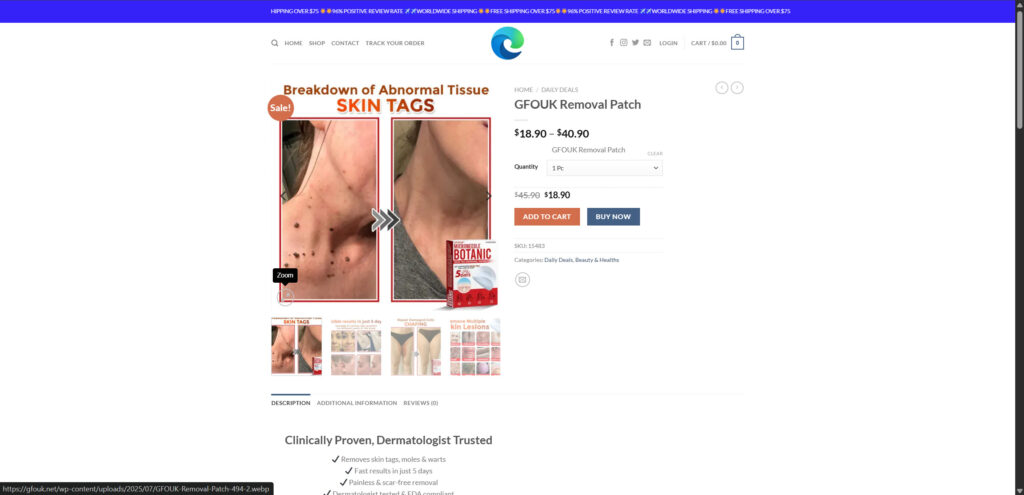
- “Clinically Proven, Dermatologist Trusted”
- “Fast results in just 5 days”
- “Painless & scar-free removal”
- “Dermatologist approved”
- “100% natural ingredients”
- Implied “FDA approved” style language, or “tested,” without real documentation
These are high-impact claims, but they are also the easiest claims to print on a landing page because they sound official and most shoppers do not know how to verify them.
A legitimate company making clinical claims would typically provide things like:
- A real clinical trial reference (title, authors, registry ID, publication link)
- Ingredient disclosures with concentrations
- Safety testing documentation
- Manufacturing details (facility, standards, batch numbers)
- Clear warnings, contraindications, and realistic outcomes
Dropshipping pages usually do not provide that because they cannot. They are not running trials. They are reselling generic inventory.
Red flag #2: The “treats everything” marketing is a classic scam move
One of the biggest tells is how broadly the patch is marketed.
Instead of being positioned as a limited cosmetic aid, the pitch expands to include multiple unrelated skin conditions, often using a grid of labels like:
- Wrinkles
- Freckles
- Chloasma
- Sunspots
- Acne
- Eczema
- Psoriasis
- Scaly skin
- Moles
- Warts
- Stretch marks
- Scars
This is not how credible dermatology products are marketed.
Skin tags, warts, moles, eczema, psoriasis, and acne are not the same problem. They do not have the same cause, and they do not respond to the same treatment. A single patch claiming to handle all of them is a bright, flashing warning sign.
Red flag #3: Fear-based comparisons to “surgery” are manipulative
Many Gfouk pages include a comparison chart designed to make medical removal look dangerous and complicated, while making the patch look safe and easy.
You may see claims like:
Patch:
- Cost-effective
- Convenient application
- For any size or location
- No pain, no bleeding
- No side effect
- 100% natural ingredients
Medical procedures:
- Expensive
- Complicated instructions
- Restrictions on size and location
- Risk of bleeding, pain, and scarring
- Potential side effects
- “Formulated with chemicals”
This framing is not just misleading, it is dangerous.
Professional removal is recommended in many cases because it allows a clinician to identify what the lesion actually is. That matters because not every bump is harmless.
Red flag #4: The product appears as a cheap wholesale listing in China
A major indicator that you are looking at a dropshipping product is when the same patch design appears on wholesale marketplaces.
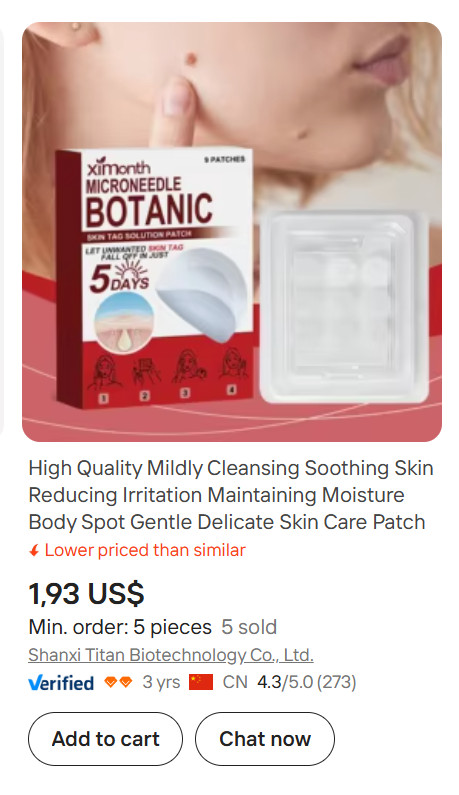
In the images you provided, the same style product is shown with a wholesale price around $1.93 per unit (with minimum order requirements), sold by a China-based supplier.
That price gap explains everything.
The business model is typically:
- Source ultra-cheap inventory.
- Rebrand it as a miracle solution.
- Sell it for 10X to 25X the cost through aggressive ads.
- Make returns painful or impractical so refunds rarely happen.
Red flag #5: Multiple storefronts selling the “same” patch under different names
Dropshipping operations rarely build a single brand and protect it long-term. They build multiple storefronts, test ads, and rotate product names.
That is why you might see:
- The same packaging style with different “brand” text
- Slightly different product titles
- Identical before-and-after photos
- The same benefit bullet points repeated word-for-word
If you search long enough (or just watch ads for a week), you will often see the same patch presented as a different “viral” solution.
Red flag #6: The reviews are missing, thin, or not believable
Many of these product pages show:
- “Reviews (0)” while claiming a huge customer base
- Generic star ratings with no detailed feedback
- Testimonials that read like ad copy
- Before-and-after photos that look like stock images or heavily edited “results”
- No independent review footprint outside the seller’s ecosystem
Legitimate products do not need to rely on manufactured trust signals. They can point to third-party retailers, verified purchases, or real clinical data.
Red flag #7: The website signals “quick store” behavior
You will often notice storefront patterns like:
- Minimal company details
- No verifiable business address
- A generic contact form and a single email
- Vague shipping timelines
- Confusing return terms
- No clear warranty process
- Copy-and-paste policy pages
This matters because the moment there is a problem, your ability to resolve it depends on whether the company is real, reachable, and accountable.
The bigger issue: Skin tags and “moles” are not DIY territory
Here is the part that most ads avoid.
Skin tags are usually benign, but you still need to be careful about:
- Location (eyelids, genitals, areas with friction)
- Bleeding risk
- Irritation and infection risk
- Underlying conditions (like diabetes-related skin changes)
Moles are a different category entirely. Some are harmless. Some are not.
Trying to remove a mole at home without proper evaluation can delay diagnosis of serious conditions, including skin cancer.
When a seller casually groups “skin tags, moles & warts” into one bullet point and suggests painless removal at home, that is not consumer-friendly. It is reckless marketing.
What these patches likely are (and what they are not)
A “microneedle” patch can mean many things in real medical or cosmetic contexts. There are legitimate microneedle systems used for drug delivery and skincare actives.
But what is being sold in dropshipping funnels is typically not that.
Most of these patches are more like:
- Adhesive patches
- Basic cosmetic patches
- Possibly patches with mild irritants
- Possibly patches with ingredients that cause superficial peeling
Even if a patch contains something active, “removing” lesions safely is not just about making tissue fall off. It is about knowing what it is, ensuring you are not harming surrounding skin, and preventing infection or scarring.
Why the “5 days” promise is so persuasive
“Results in 5 days” is a perfect ad promise:
- It feels fast but not instant (so it sounds plausible)
- It gives people a timeline to commit to
- It reduces hesitation (“I will just try it for a week”)
- It makes refunds harder (“wait a few days, results take time”)
In scammy product funnels, a short timeline is often used to keep you emotionally invested long enough for the charge to settle and for the return window to become complicated.
What buyers commonly report with these dropshipping patches
While experiences vary, the most common complaints you see with this type of operation include:
- The product arrives much later than promised
- The package shows overseas shipment origin
- The instructions are vague, poorly translated, or generic
- Results are weak, inconsistent, or nonexistent
- Skin irritation, redness, or discomfort occurs
- Customer support stops responding
- Refunds require shipping back to China at the buyer’s expense
- The return address is unclear or keeps changing
- Some buyers report being shipped multiple units or being charged in unexpected ways
You specifically noted an important complaint pattern: some people say they were sent multiple units even if they ordered 1. That issue often shows up in aggressive ecommerce funnels where upsells, subscription-like terms, or “bundle substitutions” are buried in small print or triggered by the checkout flow.
Why returns become “impossible” in practice
Sellers rarely say “no refunds” upfront.
Instead, they create a return process that looks normal until you try to use it.
Common tactics include:
- Requiring you to contact support first, then delaying replies
- Asking you to provide extensive “proof,” photos, videos, and order screenshots
- Offering a partial refund only, if you keep the item
- Requiring international shipping to China, tracked and insured
- Making you pay return shipping costs that exceed the refund value
- Setting tight return deadlines that are hard to meet given slow delivery times
- Rejecting returns due to packaging being opened (which is unavoidable if you tested the product)
When the product costs a couple dollars wholesale and sells for $20 to $40, the seller can still profit even if a percentage of customers complain. The goal is to minimize successful refunds, not to build long-term trust.
The trust tricks used on the page
If you look at these pages as marketing assets instead of “stores,” a lot of their structure makes sense.
They are built to trigger:
- Urgency: “Sale,” limited-time pricing, countdown vibes
- Authority: “Clinically proven,” “dermatologist trusted”
- Simplicity: “Just apply the patch”
- Fear of missing out: “We went viral”
- Disgust response: close-up images of lesions
- Hope response: perfect after photos
- Price anchoring: showing a higher crossed-out price like $45.90
None of these things prove the product works. They just increase conversions.
What you should consider instead (the practical, safer path)
If you are dealing with skin tags or other lesions, safer options include:
- Dermatologist evaluation for anything that is changing, bleeding, painful, irregular, or new
- Professional removal options like cryotherapy, cautery, snip removal, or ligation when appropriate
- For confirmed benign skin tags, discussing at-home options with a clinician (especially if you have sensitive skin or risk factors)
The key point is not “never try anything at home.” The key point is: do not trust an anonymous dropshipping patch to diagnose and remove skin growths safely.
How The Operation Works
This section explains the machinery behind the Gfouk Removal Patch offer, step by step. Once you see the pattern, you will notice it everywhere.
Step 1: A generic product is sourced cheaply
The patch itself is not the “innovation.” The marketing is.
The same packaging style appears in low-cost supply channels, with prices that can be around $1 to $3 per unit depending on order volume.
A seller does not need to invent anything. They only need:
- A supplier listing
- A few product photos or mockups
- A storefront template
Step 2: The product gets a brand name that sounds established
Names like “Gfouk” are often chosen because they:
- Sound like a brand, but are not tied to real corporate history
- Are easy to register as a domain
- Are flexible enough to be replaced if the store gets too many complaints
If a store burns out, the seller can relaunch under a new name with the same product photos.
Step 3: A high-converting landing page is built
The landing page is designed for emotional momentum:
- “Clinically proven” headlines
- Big promise: “Results in 5 days”
- Before-and-after images
- Simple bullet points
- Comparison charts that shame alternatives
- A price drop from a higher anchor price
- Buttons like “Buy Now” placed early and often
This is direct response marketing. It is not healthcare education.
Step 4: Social media ads drive impulse traffic
The main traffic sources for these offers are often:
- Facebook and Instagram ads
- TikTok-style short videos
- Native ad networks
These ads frequently use:
- Close-up visuals that trigger discomfort
- “Doctor” style narration
- Fake comment screenshots
- Viral framing (“everyone is using this”)
- Aggressive retargeting for people who clicked once
The goal is to catch you when you are most motivated to “fix” something quickly.
Step 5: Checkout is optimized for higher charges
A common tactic is to push:
- Bundles (2-pack, 3-pack)
- “Best value” options that anchor you to spend more
- One-click upsells after you submit payment
- “Shipping protection” add-ons
- Subscription-like terms or repeated charges in the fine print (varies by store)
Even if you think you ordered 1 unit, the final charge can reflect a bundle selection, a post-purchase upsell, or a confusing quantity dropdown.
Step 6: Fulfillment is slow, inconsistent, and outsourced
Dropshipping stores often do not hold inventory.
Instead, the order is forwarded to a supplier or fulfillment partner. That means:
- Shipping can take far longer than the site suggests
- Tracking may be delayed or vague
- The package may arrive in unbranded packaging
- The product may look different from the page photos
This is where the customer experience often collapses.
Step 7: Support becomes a wall, not a service
Once complaints begin, the system shifts from “sell” mode to “deflect” mode.
Support may:
- Respond with scripted messages
- Ask you to wait longer
- Offer a small partial refund to close the ticket
- Refuse refunds unless you pay international return shipping
- Stop responding entirely
This is why so many people describe returns as “impossible.” Technically there is a policy. Practically it is designed to fail.
Step 8: The store rotates, rebrands, or disappears
If chargebacks rise or ad accounts get restricted, the seller can:
- Move the product to a new domain
- Rebrand the name
- Copy the same page layout
- Run new ads with a new story
Meanwhile, the old store can be abandoned, leaving customers with no path forward.
What To Do If You Have Bought This
If you already ordered the Gfouk Removal Patch, focus on damage control. The goal is to protect your money, your accounts, and your skin.
1) Stop using the patch if you have irritation or if the lesion is not clearly a skin tag
If you experience:
- Burning
- Swelling
- Bleeding
- Severe redness
- Blistering
- Increasing pain
- Signs of infection (warmth, pus, fever)
Stop using it and seek medical advice.
Also stop if the spot might be a mole or something you are not sure about. If it is changing, irregular, or darkening, get it checked.
2) Document everything now
Create a folder and save:
- Order confirmation email
- Receipt and transaction ID
- Product page screenshots (especially claims and refund policy)
- Any support emails or chat logs
- Photos of what arrived (package label, product, instructions)
This documentation matters if you dispute the charge.
3) Check your card statement carefully
Look for:
- The exact merchant name (often not the brand name)
- Any extra charges
- Multiple charges close together
- Charges that appear a few days later
If you see anything you did not authorize, act immediately.
4) Contact the seller once, clearly, in writing
Keep it short and firm:
- State you want a refund
- State you do not accept international return shipping at your expense for a misleading product
- Ask for confirmation and a timeline
- Do not negotiate endlessly
You are creating a paper trail, not trying to “convince” them.
5) If they stall, move to a dispute or chargeback
If you paid by credit card, you often have protections against:
- Items not received
- Items not as described
- Misleading advertising
- Refusal to honor refund policies
If you used PayPal or another payment platform, open a case through that platform.
Do not wait weeks hoping the seller becomes helpful. Many buyers lose their best dispute window by waiting too long.
6) Cancel or replace your card if you suspect ongoing billing risk
If you notice:
- Multiple charges
- Strange merchant names
- A pattern of repeated billing attempts
Call your bank/card issuer and ask about blocking future charges or issuing a new card number.
This step is especially important if you suspect the checkout involved an upsell system or subscription-like billing.
7) Do not trust “partial refund if you keep it” offers unless you are satisfied
Some sellers offer a small refund to avoid disputes. That can be fine if you are okay with it, but be aware of the trade:
- Accepting partial refunds can close your case leverage
- You might lose the ability to dispute later
If you want a full refund, push for it quickly and move to a formal dispute if needed.
8) If you used the patch on a questionable lesion, get it evaluated
This is not meant to scare you. It is just practical.
If you used the patch on something that might be a mole or an abnormal spot, consider booking a skin check. Early evaluation is always better than delayed evaluation.
9) Report the store and the ad
You can report:
- The ad platform (Facebook, Instagram, TikTok)
- The payment platform (if applicable)
- Consumer protection channels in your country (where relevant)
Reporting will not always get your money back, but it can reduce the reach of the campaign.
10) Learn the pattern so you do not get hit again
This exact model repeats across products:
- “Miracle” result in days
- Fake authority claims
- China-sourced item at huge markup
- Return policy that routes you into expensive shipping
- Lots of storefront clones
Once you recognize the structure, you will spot it faster next time.
The Bottom Line
The Gfouk Removal Patch is marketed like a clinical-grade solution, but it behaves like a familiar dropshipping play: cheap China-sourced patches, rebranded and sold at a steep markup using exaggerated or questionable claims.
The pages lean heavily on authority language (“clinically proven,” “dermatologist trusted”) and dramatic visuals, while offering little real evidence, weak accountability, and a return process that often becomes impractical because it requires shipping back to China.
If you are tempted by this product, skip it. If you already bought it, document everything, watch your charges closely, and dispute promptly if the seller delays or refuses a reasonable refund.
When it comes to skin growths, your safest move is always the same: verify what it is first, then choose a treatment path that is based on reality, not viral marketing.

Reviews & discussion
0 commentsShare a firsthand experience, or ask a question.
Community reviews
Gfouk Removal Patch
Moderated reader experiences, not an editorial verdict.
Start the conversation
Have a question or something useful to share? Add the first comment.