

Glass Recon Windshield Cleaning Tool shows up in social media ads with a simple promise: wipe your windshield, remove the stubborn “oil film” haze, and get crystal-clear visibility in minutes. The pitch is compelling, especially if night glare and rainy driving have started to feel stressful.
But there is a big difference between a product that cleans glass and an operation that uses hype to sell a cheap, generic tool at a premium price, then makes support and returns painful. Glass Recon falls into the second category far more often than the first.
This article breaks down what Glass Recon is, what the marketing claims really mean, the red flags that matter, how this type of ecommerce operation typically runs, and what to do if money has already changed hands.
Overview
Oil film on a windshield is real. That matters, because scams often work best when they start with a real problem.
Over time, windshields collect a stubborn layer made from traffic pollution, road grime, washer fluid residues, wax overspray, and interior off-gassing that settles on the inside of the glass. Even when the windshield looks “clean,” that film can create:
- Headlight glare and halos at night
- A smeary look after using wipers
- Reduced clarity in heavy rain
- A foggy, greasy haze that never quite goes away
So when an ad promises a fast fix, plenty of drivers want to believe it.
What Glass Recon claims to be
Glass Recon is marketed as a professional-grade windshield tool that can:
- Cut through oil film and grime that “regular cleaners can’t remove”
- Deliver streak-free clarity
- Add long-lasting protection
- Improve visibility in rain with a repellent effect
- Reduce fogging
On the surface, these claims sound like a mix of cleaning and coating. Cleaning removes contamination. Coating changes how water behaves on the surface and sometimes reduces fogging.
That distinction matters because cleaning is easy to promise and hard to measure in marketing. Coating claims are easier to exaggerate because most buyers do not have a clean baseline for comparison.
What the product appears to be in reality
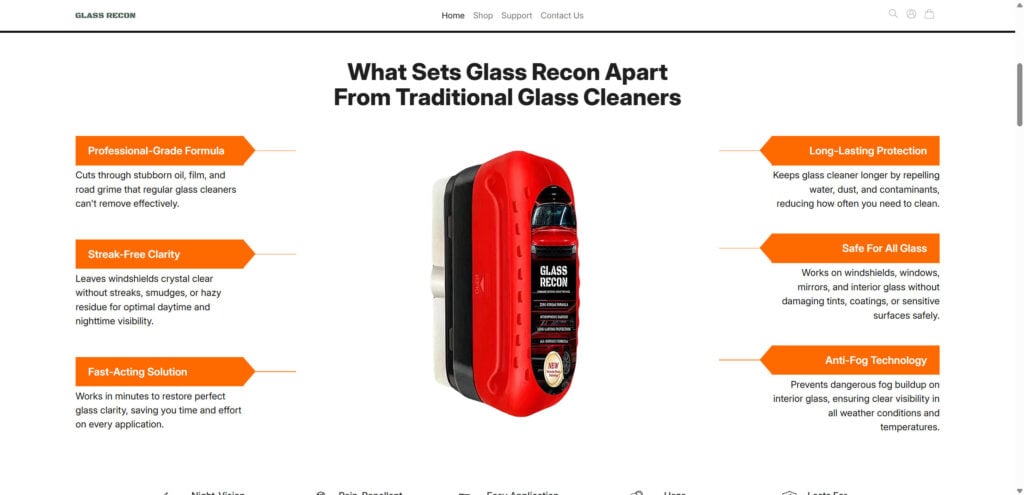
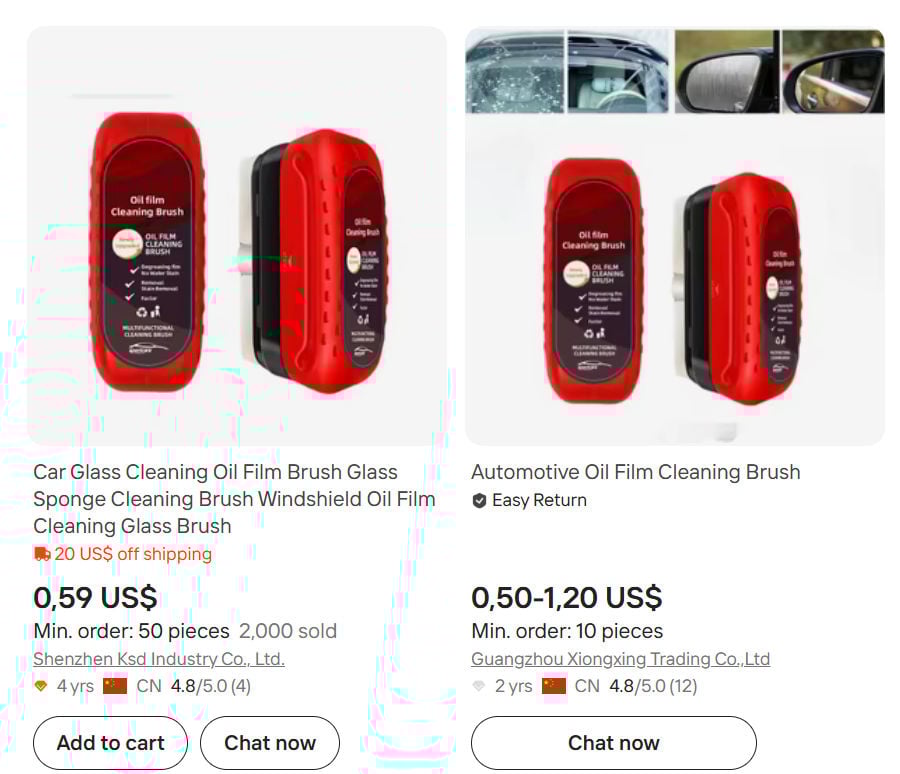
Glass Recon, as sold in many of these campaigns, appears to be a rebranded version of a common “oil film cleaning brush” or sponge applicator. Versions of this tool have been sold for years across wholesale and marketplace listings, often with small variations in housing, pad material, and included liquid.
That does not automatically mean the item is useless. A handheld sponge with an appropriate cleaner can remove a noticeable layer of grime, especially if the glass has been neglected.
The issue is not whether a sponge can clean glass.
The issue is the gap between the premium story and the commodity reality.
When a product is essentially a generic tool, a trustworthy brand earns the markup by offering:
- Consistent quality control
- Clear instructions that match real-world use
- Safety information and material disclosure
- Honest performance expectations
- Responsive customer service
- A return process that works without drama
The problem with the Glass Recon style of campaign is that it often delivers the opposite: big promises up front, then friction when the buyer asks questions later.
The red flags are in the selling system, not just the item
Plenty of decent products are made in China. Manufacturing location alone does not decide legitimacy.
What decides trust is the total pattern: how the product is marketed, how transparent the seller is, how billing is handled, how fulfillment works, and whether the return policy can realistically be used.
With Glass Recon style storefronts, the following patterns show up repeatedly in questionable dropshipping funnels.
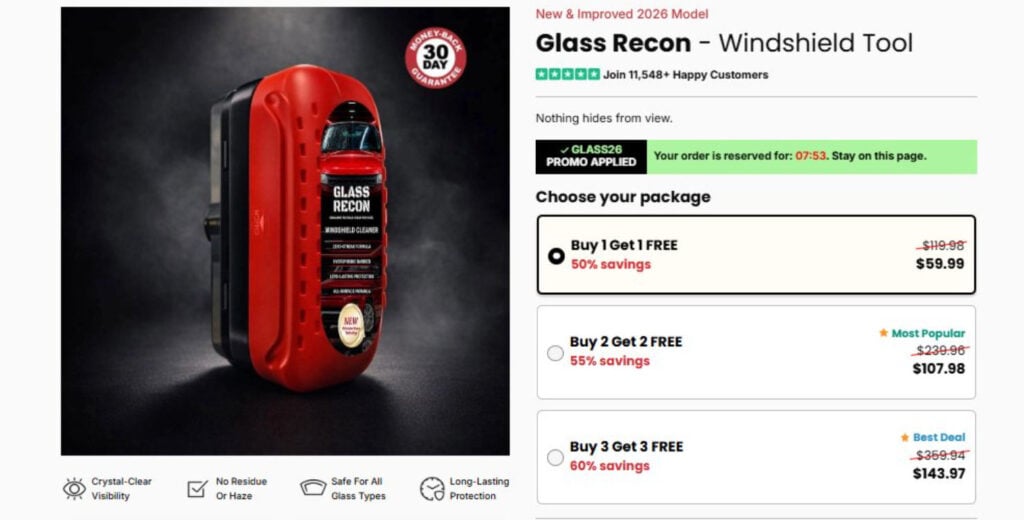
1) Urgency timers and “stay on this page” pressure
A countdown timer that claims an order is “reserved” for a few minutes is designed to trigger panic. It pushes people to buy before they have time to compare alternatives or read the fine print.
Legitimate brands do run sales. They rarely tell visitors that inventory is “reserved” for one person only if they do not leave the page.
If the offer collapses the moment someone takes a breath, that is not a deal. It is a tactic.
2) Discount theatrics and exaggerated anchors
Offers like “Buy 1 Get 1 FREE” and steep discounts like 50% to 75% are common because they create the illusion of massive value. The displayed “original” price is often inflated so the discount looks dramatic.
When the underlying product is a low-cost commodity, the operation has room to create almost any price story it wants.
That makes the numbers on the page feel impressive, but it does not prove the product is premium.
3) Generic social proof
High star ratings and “11,000+ happy customers” counters can be real, exaggerated, or simply unverified. A counter on a page is not evidence. Evidence is consistent, independent reviews across multiple platforms, with photos and detailed experiences that match the product being sold.
Dropshipping campaigns often rely on social proof that cannot be checked.
4) Big claims that are hard to test
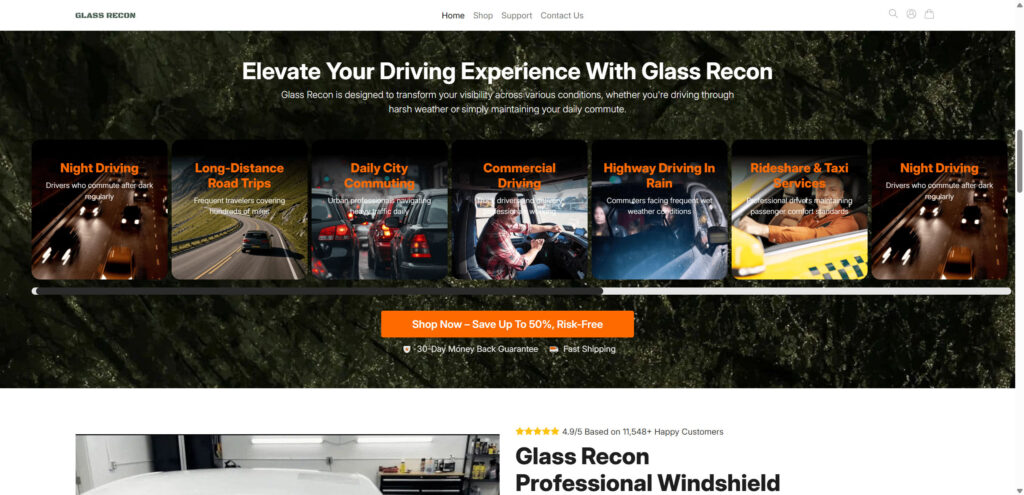
“Professional-grade formula.” “Hydrophobic barrier.” “Anti-fog technology.” “Long-lasting protection.”
Those phrases sound like engineering, but the details are usually missing. If a product truly performs like a coating, credible sellers typically provide:
- What type of chemistry it uses, at least at a category level
- How long the effect lasts under normal conditions
- Surface preparation steps and curing or buffing instructions
- Compatibility notes for tinted glass, coatings, sensors, and interior materials
When a page relies on bold labels but avoids specifics, it is often selling confidence rather than performance.
5) The return policy looks generous, but the process is not
“30-day money-back guarantee” badges are common. The real question is what happens when a buyer tries to use it.
In many dropshipping operations, returns are “possible” only in the sense that the policy exists. In practice, the buyer faces:
- Slow replies
- Vague instructions
- Long email chains that go nowhere
- Requirements to ship the product back internationally at the buyer’s expense
- Deadlines that run out while support delays the process
When a return requires expensive overseas shipping, most people will not follow through. That turns a “guarantee” into a marketing prop.
6) Reports of unexpected multi-unit charges
Some buyers report being billed for 2, 3, or 4 units even if they believed they ordered only one.
This can happen in several ways that are common in high-pressure funnels:
- The checkout defaults to a bundle option that is easy to miss
- One-click upsells appear after the initial order and add more units with a single tap
- The wording of “Buy 1 Get 1” offers can be confusing, and the billing can reflect multiple items
- The receipt and the mental model in the buyer’s head do not match
Whether it is deliberate or sloppy, the result is the same: the customer feels tricked, and the burden shifts to them to dispute it.
Why people say it “doesn’t match the ads”
Most disappointment comes from inflated expectations. Ads for these products often imply outcomes that a basic cleaning tool cannot deliver.
Here are the most common mismatches:
- Glare from micro-scratches: Cleaning cannot fix scratches.
- Hard water spots: Mineral etching may require polishing, not wiping.
- Heavy interior haze: This often needs a true degreaser step and multiple passes.
- Hydrophobic performance: Real rain-repellent behavior usually comes from dedicated coatings or proven repellents, applied properly.
- Anti-fog: Effective anti-fog products have specific application rules and limited durability.
A tool can help clean glass. It cannot rewrite physics.
What a legitimate glass solution usually looks like
If a seller is serious about improving windshield visibility, the product and instructions tend to be straightforward and verifiable. For example:
- A dedicated glass polish or glass-safe abrasive cleaner for stubborn film
- A separate rain-repellent coating with clear durability expectations
- Transparent use cases, including what it does not do
- Clear before-and-after examples that are not overly dramatic
- A recognizable company footprint with an address, support, and enforceable returns
That is the difference between a real car-care product and a fast-moving funnel.
So, is Glass Recon a scam or legit?
If “legit” means a unique product sold with honest claims, consistent quality, and customer-friendly support, Glass Recon campaigns often do not meet that standard.
If “scam” means a deceptive sales system that uses pressure tactics and exaggerated claims to move a cheap product, then Glass Recon style marketing fits the scam-adjacent dropshipping pattern closely.
The most accurate conclusion is this:
Glass Recon is typically a generic windshield cleaning tool sold through a high-pressure dropshipping funnel. The item may work at a basic level, but the marketing frequently exaggerates results, the price is often inflated, and the customer risk is high, especially around returns and billing confusion.
How The Operation Works
To understand why so many buyers walk away frustrated, it helps to zoom out. This is less about one sponge and more about the machinery behind it.
Below is a step-by-step breakdown of how these operations commonly work, from the first ad impression to the post-purchase friction that keeps refunds from happening.
Step 1: Build the perfect problem and trigger anxiety
The campaign starts by focusing on a problem that feels urgent and personal: visibility.
Ads often highlight:
- Night driving glare that looks dangerous
- Rainy conditions where water sheets across the glass
- “Invisible oil film” that supposedly makes the windshield unsafe
- Dramatic before-and-after wipes that look instant
This does two things:
- It makes the viewer feel behind, like their windshield is secretly unsafe.
- It positions the product as a safety solution, not a cleaning accessory.
When a product is framed as safety, people justify spending more money and buying quickly.
Step 2: Use visual demonstrations that are hard to verify
A common trick in cleaning-product ads is the controlled demo.
For example, a video might show:
- A half-and-half windshield where one side is perfectly clear
- A wipe that removes a thick layer instantly
- Water beading dramatically right after one pass
The viewer has no way to verify:
- What was applied to the glass before the demo
- Whether the glass was pre-treated with a coating
- Whether editing was used
- Whether multiple takes were combined
- Whether the “dirty” side was artificially made worse
This does not prove fraud in every case, but it is a known method for creating exaggerated expectations.
Step 3: Funnel the click into a one-page “brand world”
After clicking the ad, visitors typically land on a page built for one purpose: conversion.
The page often includes:
- A large headline promising professional results
- Safety-focused use cases like night driving and rainy highways
- Multiple benefit tiles like “streak-free clarity” and “anti-fog”
- A “best choice” comparison chart with invented scores
- A countdown timer and discount banner
The goal is to keep the visitor in an emotional state where buying feels like relief.
Step 4: Create urgency and scarcity that may not be real
Two common methods show up:
- A timer that implies the discount will vanish soon
- Inventory language like “selling out” or “limited stock”
In some cases, the same timer resets if the page is refreshed or opened again later.
Even when stock is not limited, the urgency still works because it pushes impulsive decision-making.
Step 5: Push bundles hard, because margin is the business model
Bundles like:
- Buy 1 Get 1 FREE
- Buy 2 Get 2 FREE
- Buy 3 Get 3 FREE
are not random. They are designed to maximize revenue per buyer, because the cost per unit is low and the advertising cost to acquire a buyer is high.
This is a common dropshipping math problem:
- Ads are expensive.
- Refunds reduce profit.
- Single-unit orders might not cover acquisition costs.
- Bundles increase revenue immediately.
That is why these pages often “recommend” the bigger package and label it “most popular” or “best deal.”
Step 6: Use price anchoring to make the offer feel irresistible
The page shows a crossed-out “original” price, then a discounted price that looks like a steal.
This leverages a psychological effect:
- The buyer does not evaluate the product’s real market value.
- The buyer evaluates the discount size.
If the underlying product is a commodity tool, the “original” price is often just a narrative device.
Step 7: Steer the checkout toward accidental upgrades
This is where many billing complaints begin.
Common friction points include:
- A pre-selected package that is easy to miss
- Add-ons that appear like required shipping protection
- Upsell pages after checkout with one-click acceptance
- Confusing wording around free units versus paid units
A buyer might remember choosing “one,” but the transaction may reflect a bundle or an additional offer.
When customers say they were billed for extra units, this step is often the reason.
Step 8: Fulfillment looks local, but shipping behaves overseas
Many of these operations present themselves like a brand storefront. The buyer expects fast domestic shipping and simple returns.
Instead, the package may arrive:
- With generic packaging
- With minimal instructions
- With a product that looks cheaper than expected
- After longer shipping times
- From an overseas logistics route
Again, overseas fulfillment is not automatically wrong. The problem is transparency. If the brand presentation implies one thing and fulfillment behaves like another, trust breaks fast.
Step 9: Customer support becomes a “delay engine”
When buyers reach out to complain about performance, missing items, or billing confusion, support often follows a familiar playbook:
- Ask for order number and photos
- Offer troubleshooting steps that do not address the real issue
- Suggest waiting longer or trying again
- Offer a partial refund to keep the customer from disputing
- Require extra steps before approving a return
Some businesses do this intentionally. Others do it because they are not set up for real support and are simply reselling.
Either way, the result is the same: delays that reduce the chance of a clean refund.
Step 10: Returns are technically possible, practically discouraging
The biggest practical barrier is cost and complexity.
Return instructions may involve:
- Shipping back internationally at the buyer’s expense
- A return address that changes depending on who replies
- Requirements for tracking and specific carriers
- Strict timelines that are hard to meet
When return shipping costs approach the product price, many people give up. That is why the “guarantee” badge can be misleading, even if it is not outright false.
Step 11: Disputes and chargebacks are treated like the enemy
From the seller’s perspective, disputes are costly:
- They risk losing payment processing access
- They incur chargeback fees
- They damage merchant reputation with processors
So some operations do everything possible to keep the customer inside private email support rather than letting the customer go to their bank or payment platform.
If support keeps offering small partial refunds or endless troubleshooting, it may be an attempt to prevent a dispute window from being used.
Step 12: The product continues under new names
One reason these campaigns spread quickly is that the underlying tool is generic.
If one storefront gets too many complaints or chargebacks, the same product can appear again under a new name, with new branding, new ads, and a fresh domain.
That is why the “brand story” matters less than the operational pattern.
What To Do If You Have bought this
If Glass Recon has already been purchased, the priority is to reduce financial risk first, then deal with the product second. Act calmly, but do not move slowly.
1) Save evidence immediately
Before anything changes, collect:
- The order confirmation page and email
- The product page and the package option selected
- The final checkout total
- Any upsell pages that appeared
- Screenshots of the ad that led to the purchase
- Tracking details and delivery confirmation
This documentation helps with disputes and chargebacks.
2) Check the transaction details, not just the receipt
Open the payment method used and verify:
- The exact merchant name on the charge
- The amount charged
- Whether there are multiple charges
- Whether any small “test charges” appeared
- Whether the currency conversion changed the total
If there are unexpected charges, treat it as a billing issue first.
3) If the amount is wrong, contact the card issuer fast
If the charge does not match what was authorized, contact the bank or card issuer and say:
- The order appears to include unauthorized additional units, or the amount is incorrect
- A dispute may be needed
- A replacement card may be appropriate
Time matters. Most dispute systems favor quick reporting.
4) Watch for follow-up charges over the next 7 to 14 days
Even if the first charge looks normal, monitor the account for:
- A second charge from the same merchant
- A different merchant name tied to the same operation
- Any additional “shipping” or “processing” fees
Set transaction alerts if the bank supports them.
5) Email the seller, but keep it short and structured
Even if support is difficult, send a clear message that creates a written record:
- Order number
- The issue (wrong quantity charged, item not as described, poor quality, etc.)
- What resolution is requested (full refund, refund for extra units, cancellation)
- A deadline for response (for example, 48 hours)
Avoid long arguments. A short, factual message is best.
6) If the product is not as described, do not waste weeks “testing”
One of the biggest mistakes buyers make is getting trapped in endless troubleshooting.
If the core complaint is “does not match the ads,” the situation is not a technical support issue. It is a misrepresentation issue.
Document the mismatch quickly and move to refund or dispute.
7) If the seller requires international return shipping, do the math
If support offers a return only if the item is shipped overseas at personal expense, calculate:
- Return shipping cost with tracking
- Time in transit
- Risk of the package being refused or lost
- Whether the dispute window may close while shipping
In many cases, it is more practical to dispute the transaction with the payment provider than to spend $30 to $60 shipping back a low-cost tool.
8) If a refund is refused or delayed, file a dispute
Depending on how payment was made:
- Credit card: request a chargeback for goods not as described or billing error.
- Debit card: disputes exist, but protection varies. Act quickly.
- PayPal: open a dispute in the resolution center and escalate if needed.
- Shop Pay or other processors: use their buyer protection pathways if available, then escalate to the card issuer if unresolved.
Use the evidence collected earlier and stick to facts.
9) Protect personal information going forward
If the checkout included email and phone, expect increased marketing.
Take basic steps:
- Watch for phishing emails pretending to be “support” or “delivery problems”
- Do not click unexpected tracking links from unknown senders
- Use strong passwords and enable 2-factor authentication on email
- Consider using a virtual card or privacy card service for future impulse purchases
10) Leave a factual review where it helps other buyers
If the operation is using social ads, warnings from real buyers matter.
Keep reviews factual:
- What was ordered
- What arrived
- Shipping timeline
- Whether support helped
- Whether the refund worked
Avoid threats or emotional language. Facts travel further and are harder to dismiss.
The Bottom Line
Glass Recon Windshield Cleaning Tool is usually not a breakthrough automotive product. It is typically a generic glass-cleaning brush or sponge tool sold through a high-pressure dropshipping funnel that leans on urgency timers, inflated discounts, broad performance claims, and heavy bundle pushes.
The tool may clean basic grime. It may even reduce some film if used with a decent cleaner and enough effort. But the marketing often implies dramatic, near-instant transformation, plus long-lasting protection and anti-fog performance that a cheap commodity tool is unlikely to deliver consistently.
The bigger risk is the purchase experience: confusing bundle pricing, reports of unexpected multi-unit charges, and a return process that can become expensive or impractical when shipping back overseas is required.
If the goal is truly safer, clearer driving, better options exist through well-known auto-care brands with transparent instructions and real support. If the goal is protecting your wallet, the safest move is to avoid hype-driven social ad funnels for car-care “miracle tools,” and buy from retailers with enforceable refunds and clear accountability.

Join the discussion
0 commentsShare your experience or ask a question about this article.
Discussion
Start the conversation
Have a question or something useful to share? Add the first comment.