

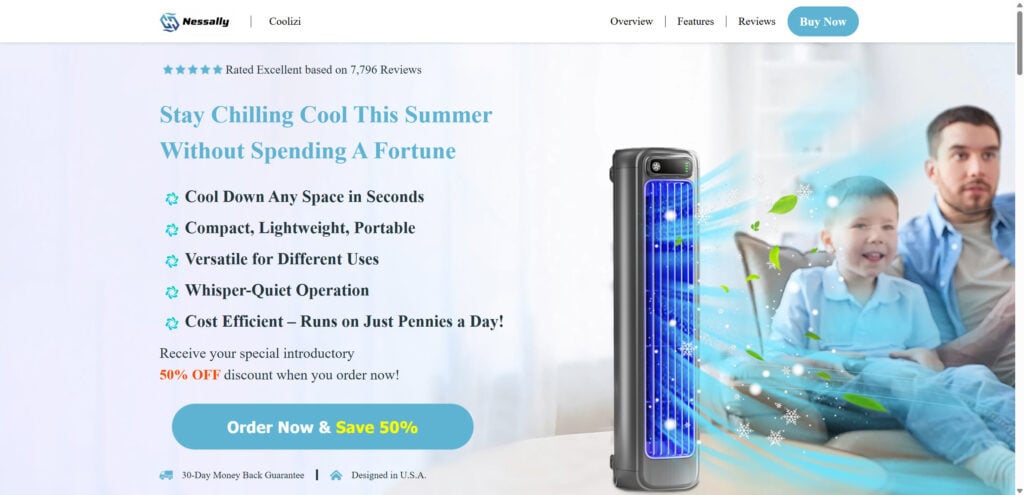
Nessally Cooling Ace is being promoted as a compact personal cooling device that can cool down spaces in seconds, run quietly, save energy, and help people stay comfortable during hot summer weather.
The product may be a real small fan or evaporative cooler, but the sales page raises several red flags. It uses “cool any space” language, big review numbers, a 50% discount, “Designed in U.S.A.” trust messaging, a third-party checkout link, and even leftover product-template text that appears unrelated to an air cooler.
What Is Nessally Cooling Ace?
Nessally Cooling Ace is advertised as a portable cooling device for bedrooms, offices, dorm rooms, workspaces, RVs, kitchens, and everyday summer use.
The page claims the product offers:
- fast cooling
- compact and lightweight design
- portable use
- whisper-quiet operation
- low daily running cost
- 50% discount
- 30-day money-back guarantee
- advanced evaporative cooling technology
- high-performance cooling cartridge
- rechargeable operation
- multiple airflow settings
- horizontal or vertical placement
- wall mounting
- “Designed in U.S.A.” messaging
- 7,796 customer reviews
At first glance, it looks like another mini portable AC-style product. The page says it can “cool down any space in seconds” and help create a cooler environment during hot summer days.
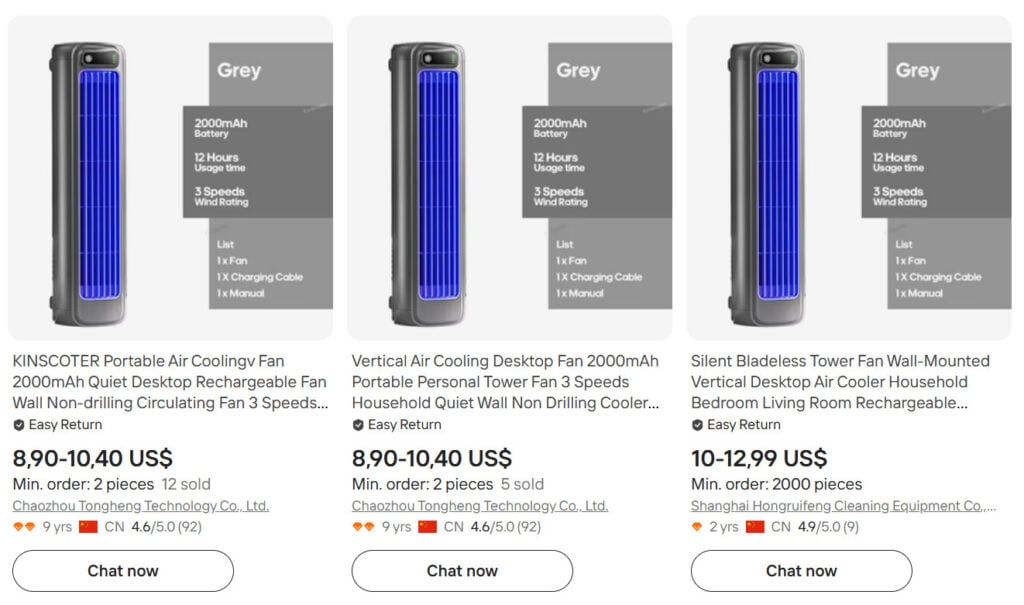
The concern is that Nessally Cooling Ace appears to be much closer to a small personal fan or evaporative cooling gadget than a real air conditioner.
That distinction matters.
A real air conditioner removes heat from a room using a refrigerant cycle, cooling coils, compressor, and a system for moving heat away from the space. A small personal cooler usually works by blowing air, sometimes through water or a cooling cartridge. It can make the air directly in front of it feel cooler, but it does not work like a real AC.
The Main Problem: It Is Marketed Like An AC Alternative, But Looks Like A Personal Fan
Nessally Cooling Ace is promoted with big summer-comfort language. The site says it can cool down any space in seconds, sustain the perfect temperature, reduce energy consumption, and deliver rapid cooling performance.
But the page itself also admits something important. It describes Nessally as a device that focuses on “targeted personal cooling directly where it is needed.” That is much more realistic than whole-room air conditioning.
A personal cooler can be useful if you are sitting at a desk, lying near a bedside table, or working in a small area. It may create a cooler breeze around your body.
But it should not be expected to cool a full bedroom, living room, RV, or office the way a real air conditioner can.
The difference is simple:
- A fan moves air.
- An evaporative cooler adds moisture and is simple:
- A fan moves air.
- An evaporative cooler adds moisture and may reduce air temperature in dry conditions.
- A real AC removes heat and humidity from the room.
If a product is small, lightweight, battery-powered, and has no compressor, no exhaust hose, no refrigerant, and no BTU rating, it should not be treated like a true air conditioner.
Why Nessally Cooling Ace Raises Red Flags
1. “Cool down any space in seconds” is too broad
The page says Nessally can cool down any space in seconds.
That is a strong claim.
A small fan may create instant airflow. It may feel refreshing if pointed at your face or body. But that does not mean it can cool the actual temperature of a room in seconds.
Room cooling requires removing heat from the space. A personal fan does not do that.
2. The product appears to rely on evaporative cooling
The page says Nessally uses advanced evaporative cooling technology and a high-performance cooling cartridge.
Evaporative cooling can work in some conditions, especially dry climates. But it is not the same as refrigerated air conditioning.
Evaporative cooling becomes less effective in humid conditions. It also adds moisture to the air. If the room is already humid, the device may feel weaker and may make the space feel muggy.
This matters because many shoppers buying a “portable AC” expect air conditioning, not a small evaporative fan.
3. The page uses “AC replacement” style positioning without real AC specs
Nessally is presented as a summer cooling solution that can help people avoid high energy costs and traditional cooling systems.
But the page does not clearly show the technical information buyers would expect from a true air conditioner:
- BTU rating
- compressor details
- refrigerant type
- exhaust hose
- room-size testing
- wattage
- decibel rating
- tank size
- measured output temperature
- certified energy testing
- independent lab results
Without those details, buyers should treat the product as a personal cooling fan, not a portable AC.
4. The review count is very high
The site says Nessally is rated excellent based on 7,796 reviews and later says it is loved and recommended by 7,796 customers.
That is a large number for a product promoted on a small, single-product landing page.
Large review counts are not automatically fake. But seller-controlled reviews should be treated cautiously, especially when the page does not provide a transparent independent review platform.
Buyers should ask:
- Where are all 7,796 reviews displayed?
- Can reviews be sorted by newest and lowest rating?
- Are reviews verified purchases?
- Are negative reviews visible?
- Are reviewer photos real?
- Were reviews imported from another product?
- Are the comments moderated by the seller?
- Can anyone leave a review?
A review number on a sales page is not the same as independent proof.
5. The testimonials sound very sales-friendly
The testimonials on the page say things like:
- the fan is powerful yet quiet
- it cools an RV bunkroom
- it definitely lowers the room temperature
- it is the best mini cooler tried
- it helps someone stay cool in an office where others are cold
- it works perfectly for someone living with an elderly relative
These testimonials directly support the main sales claims.
That does not prove they are fake. But they should not be treated as strong evidence unless they are hosted on an independent platform with visible negative reviews and verified purchases.
6. The page uses “Designed in U.S.A.” trust messaging
The sales page shows “Designed in U.S.A.”
That phrase can make a product feel domestic, premium, or more trustworthy.
But “designed in” is not the same as “made in.” The page does not clearly disclose where the device is manufactured, where it ships from, who makes it, or whether it is a private-label product.
This is important because many mini cooler funnels sell generic products sourced from overseas suppliers.
7. The checkout link points to a different domain
The Nessally page’s “Buy Now” links point to a domain called mynewsera.com rather than keeping the checkout on Nessally.net.
That is not automatically a scam. Many ecommerce funnels use external checkout systems, affiliate tracking pages, or fulfillment partners.
But it does reduce transparency.
A buyer may not immediately know:
- who processes the payment
- who ships the product
- who handles refunds
- who stores customer data
- who appears on the bank statement
- who provides customer support
- who is legally responsible for the order
When a product page and checkout page are separated across domains, buyers should slow down and verify the seller information before paying.
8. The site header shows “Coolizi,” not just Nessally
The page title and product name refer to Nessally Cooling Ace, but the top of the page also shows “Coolizi.”
That kind of brand mismatch is a red flag.
It may be a template issue, leftover branding, reused landing page code, or evidence that the same sales page structure is being repurposed across multiple product names.
A serious brand should keep its branding consistent.
9. The “tech specs” section contains unrelated product text
One of the most concerning details is the “What’s Inside & Outside” section.
Instead of normal air cooler specifications, the page lists:
- 4 upgraded omnidirectional tires
- long-lasting battery
- suitable for various terrains
- dazzling lights and music
- the fun never ends
That sounds like copy from a toy car or remote-control product, not a cooling device.
This is a major quality-control red flag.
If a page selling a cooling product contains leftover text about tires, terrain, lights, and music, it suggests the landing page may have been built from a reused template and not carefully reviewed.
That does not prove the product is fake, but it weakens trust in the page and its claims.
10. The 50% discount creates urgency
The page repeatedly promotes a special introductory 50% discount and says the offer may be taken down at any moment.
This is a common direct-response ecommerce tactic.
It pushes buyers to act quickly before comparing the product with generic alternatives, checking return terms, or looking for independent reviews.
A good rule: if a page pressures you to buy immediately, wait.
11. The guarantee sounds simple, but the full policy was not accessible
The page says there is a 30-day money-back guarantee and that buyers can return the package within 30 days for a refund, no questions asked.
That sounds reassuring.
However, the linked terms and contact pages could not be opened during review, even though the site lists them in the footer.
Buyers should not rely only on the sales-page guarantee. They should read the full return policy before ordering.
Important questions include:
- Can the product be returned after use?
- Who pays return shipping?
- Does the refund include shipping fees?
- Is original packaging required?
- Are discounted items refundable?
- Is there a restocking fee?
- Where is the return address?
- Is the return address domestic or overseas?
- How long does support take to respond?
- Does the guarantee apply if the product works only as a fan?
A guarantee is only useful if the written policy supports it.
12. The product may be part of a wider portable-AC funnel pattern
Nessally Cooling Ace fits the same pattern as many other viral mini AC-style products.
The pattern usually looks like this:
- small personal fan or evaporative cooler
- premium-sounding product name
- one-page sales site
- big cooling claims
- large review numbers
- “save energy” claims
- huge discount
- urgent offer
- third-party checkout
- vague company details
- hard-to-verify return terms
- stock-style testimonials
- AI-style ad creatives
These products may ship. The issue is whether the buyer receives what the advertising made them expect.
Is Nessally Cooling Ace A Scam?
Nessally Cooling Ace may ship a real product, so this may not be a simple “pay and receive nothing” scam.
The concern is misleading marketing and weak page credibility.
A fair conclusion is this: Nessally Cooling Ace appears to be a high-risk mini portable cooler offer because it uses broad cooling claims, a large seller-controlled review count, 50% discount urgency, external checkout links, inconsistent branding, and a product page that contains unrelated template text about tires, terrain, lights, and music.
The product may work as a small personal fan or evaporative cooler.
But buyers should not expect it to perform like a real air conditioner or cool an entire room in seconds.
What Nessally Cooling Ace May Actually Do
Nessally may help with:
- close-range airflow
- personal desk cooling
- bedside airflow
- mild evaporative cooling in dry conditions
- short-distance comfort
- white-noise style fan sound
- moving air around a small area
- portable use around the home
Nessally is unlikely to reliably:
- cool a full room in seconds
- replace a real air conditioner
- lower room temperature significantly
- work well in humid conditions
- remove humidity from the room
- cool an RV bunkroom like a real AC
- deliver the same results for every user
- justify buying multiple units before testing one
How The Nessally Funnel Appears To Work
Step 1: The ad targets summer discomfort
The funnel likely starts with a search ad, social media ad, or sponsored placement that speaks to people dealing with heat.
The message is simple: stay cool without paying a fortune.
This works because heat is uncomfortable, and people want fast relief.
Step 2: The product is framed as a clever cooling solution
Instead of calling it a small fan, the page uses words like cooling device, evaporative cooling technology, advanced cooling, and rapid cooling performance.
That makes the product sound more powerful than a normal fan.
Step 3: The page stacks benefits
The page lists several benefits quickly:
- cool down any space
- quiet operation
- compact design
- portable use
- low cost
- energy efficiency
- versatile placement
- multiple modes
- wall mounting
This makes the product feel more useful and more premium.
Step 4: Reviews reduce doubt
The page then adds a large review count and positive customer stories.
These reviews are meant to reassure the buyer that thousands of people already tried it and loved it.
Step 5: The discount pushes immediate action
The 50% discount appears repeatedly. The page says the offer may disappear at any moment.
This creates pressure and reduces comparison shopping.
Step 6: The buyer is sent to a different checkout domain
When the buyer clicks “Order Now,” the page links to mynewsera.com.
This may be a checkout partner or tracking page, but it makes the transaction less transparent than a normal single-brand store.
Step 7: Return problems may appear later
If the buyer receives the product and realizes it is only a small personal cooler, the refund process becomes important.
The sales page promises a 30-day guarantee, but buyers need the full return terms to know whether opened or used items qualify.
That is why screenshots and order documentation matter.
Main Red Flags
- Claims to cool down any space in seconds.
- Appears to be a personal fan or evaporative cooler, not a true AC.
- No clear BTU rating, compressor, refrigerant, or exhaust hose.
- Uses 7,796 review claim without transparent independent verification.
- Testimonials are seller-controlled.
- Uses 50% discount urgency.
- Shows “Designed in U.S.A.” without clear manufacturing disclosure.
- Buy buttons link to a different domain, mynewsera.com.
- The page shows “Coolizi” branding in addition to Nessally.
- The “tech specs” section contains unrelated text about tires, terrain, lights, and music.
- Full terms and contact pages could not be accessed during review.
- The guarantee sounds simple, but buyers should verify the full return policy before ordering.
- Similar mini cooler funnels often rely on AI-style ads, stock images, and exaggerated claims.
What To Do Before Buying
1. Treat it as a fan, not an AC
Do not buy Nessally expecting real air conditioning.
If you buy it, assume it is a personal cooling fan or evaporative cooler.
2. Look for real technical specs
Before ordering, check for:
- BTU rating
- wattage
- tank size
- battery capacity
- airflow rating
- noise rating
- output temperature test
- room-size testing
- warranty terms
- return address
- manufacturer name
- country of origin
If those details are missing, be cautious.
3. Compare generic alternatives
Search for:
- portable evaporative cooler
- mini desk air cooler
- rechargeable cooling fan
- personal air cooler
- wall mounted desk fan
- Coolizi fan
- Nessally Cooling Ace alternative
If a similar product appears under other names for less money, slow down.
4. Verify the checkout domain
Before paying, check who is actually processing the transaction.
Look for:
- seller name
- company name
- billing descriptor
- support email
- return address
- refund policy
- shipping time
- privacy terms
5. Avoid buying multiple units
Do not buy bundles before testing one unit.
If the product disappoints, extra units can make refunds harder.
6. Screenshot everything
Save screenshots of:
- product claims
- 50% discount
- review count
- guarantee wording
- checkout page
- selected quantity
- total price
- seller information
- return terms
- order confirmation
7. Use a protected payment method
Use a credit card or PayPal if possible.
Avoid payment methods that make disputes difficult.
What To Do If You Already Ordered
1. Check your confirmation email
Look for:
- product name
- number of units
- total charge
- shipping fee
- support email
- seller name
- payment descriptor
- order number
2. Save the sales page
Take screenshots showing the cooling claims, 30-day guarantee, review count, and discount.
3. Try to cancel quickly if needed
If you ordered by mistake or bought more than intended, contact support immediately.
Use wording like:
“I am requesting immediate cancellation of my order before shipment. Please cancel all units, add-ons, and future charges connected to this purchase.”
4. Keep packaging
If the product arrives, keep the box, labels, manual, accessories, and shipping package.
5. Test honestly
If you open one unit, test whether it actually cools the room or only blows air nearby.
Use a thermometer if possible and document the results.
6. Request a refund clearly
Use direct wording:
“The product was advertised as cooling down spaces in seconds, but it performs as a small personal fan or evaporative cooler and does not match the advertised claims. I am requesting a refund under the 30-day money-back guarantee.”
7. Dispute if necessary
Contact your bank, credit card issuer, or PayPal if:
- the product never arrives
- the seller does not respond
- you were charged more than expected
- you received more units than ordered
- the product is not as described
- the seller refuses the advertised guarantee
- the return process is unreasonable
- the checkout domain or merchant descriptor is unclear
Use dispute wording such as:
- “item not as described”
- “misleading cooling claims”
- “sold as cooling device but performs as a small fan”
- “merchant refuses advertised refund”
- “seller-controlled reviews and misleading advertising”
- “product page contains inconsistent specifications”
FAQ
What is Nessally Cooling Ace?
Nessally Cooling Ace is marketed as a compact portable cooling device using evaporative cooling technology and multiple airflow settings.
Is Nessally Cooling Ace a real air conditioner?
It does not appear to be a true compressor-based air conditioner. The page describes targeted personal cooling and evaporative cooling rather than real AC technology.
Can Nessally cool a whole room?
Be skeptical. A small fan or evaporative cooler may help one person feel cooler nearby, but it is unlikely to cool an entire room like an AC.
Is Nessally Cooling Ace a scam?
It may ship a real product, but the sales page has red flags, including exaggerated cooling claims, inconsistent branding, an external checkout link, a large review count, and unrelated template text.
Why does the page mention tires and lights?
The “tech specs” area includes unrelated phrases such as upgraded tires, various terrains, dazzling lights, and music. That appears to be leftover template copy and is a credibility red flag.
Are the reviews trustworthy?
Treat them cautiously. The page claims 7,796 reviews, but the reviews appear seller-controlled and are not clearly verified through an independent platform.
Does Nessally offer returns?
The sales page says there is a 30-day money-back guarantee, but buyers should read the full return policy before ordering.
Is Nessally made in the USA?
The page says “Designed in U.S.A.” That does not mean manufactured in the USA. The page does not clearly disclose the manufacturing country.
Should I buy Nessally Cooling Ace?
Only consider it if you want a small personal cooler and understand that it is not a true AC. Compare alternatives first and verify the return policy.
The Bottom Line
Nessally Cooling Ace may be a real personal cooling device, but the sales page has enough red flags to justify caution.
The product is promoted with fast-cooling claims, 50% discount urgency, a high review count, and energy-saving language. But it appears to rely on personal or evaporative cooling, not true air conditioning. The page also contains inconsistent branding, an external checkout link, and unrelated template text about tires, terrain, lights, and music.
If you want a small desk fan or personal cooler, compare it with cheaper alternatives first.
If you need real room cooling, buy a real air conditioner with a BTU rating, exhaust hose, verified specifications, independent reviews, and a clear return policy.








