

The promise is almost frictionless. Put on headphones, listen for seven seconds or seven minutes, and a hidden frequency supposedly begins pulling money, luck, and opportunities toward you.
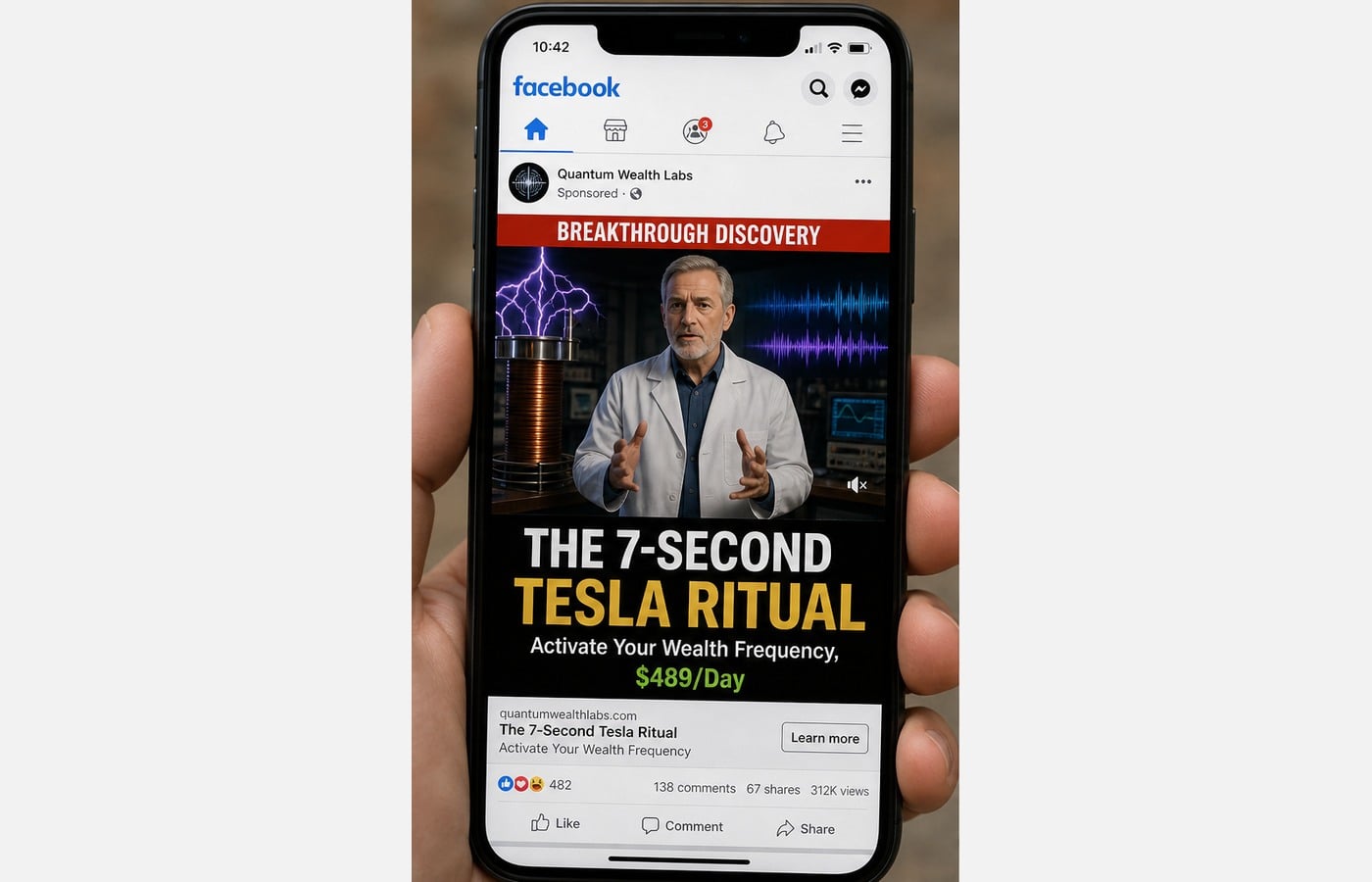
The Tesla 7-second sound ritual scam wraps that wish in coils, brain scans, and secret research. The result looks scientific long before the page shows anything that can actually be tested.
Overview
Tesla's name supplies genius and mystery
The Tesla 7-second sound ritual scam claims that Nikola Tesla discovered, encoded, or inspired a frequency capable of activating wealth. Some promotions also invoke leaked CIA documents, NASA research, famous universities, or Japanese scientists.
These references are not accompanied by a verifiable paper connecting an audio file with personal income. Tesla's historical work with electricity and resonance does not demonstrate that a modern digital sound attracts money.
A brainwave explanation turns metaphor into a financial claim
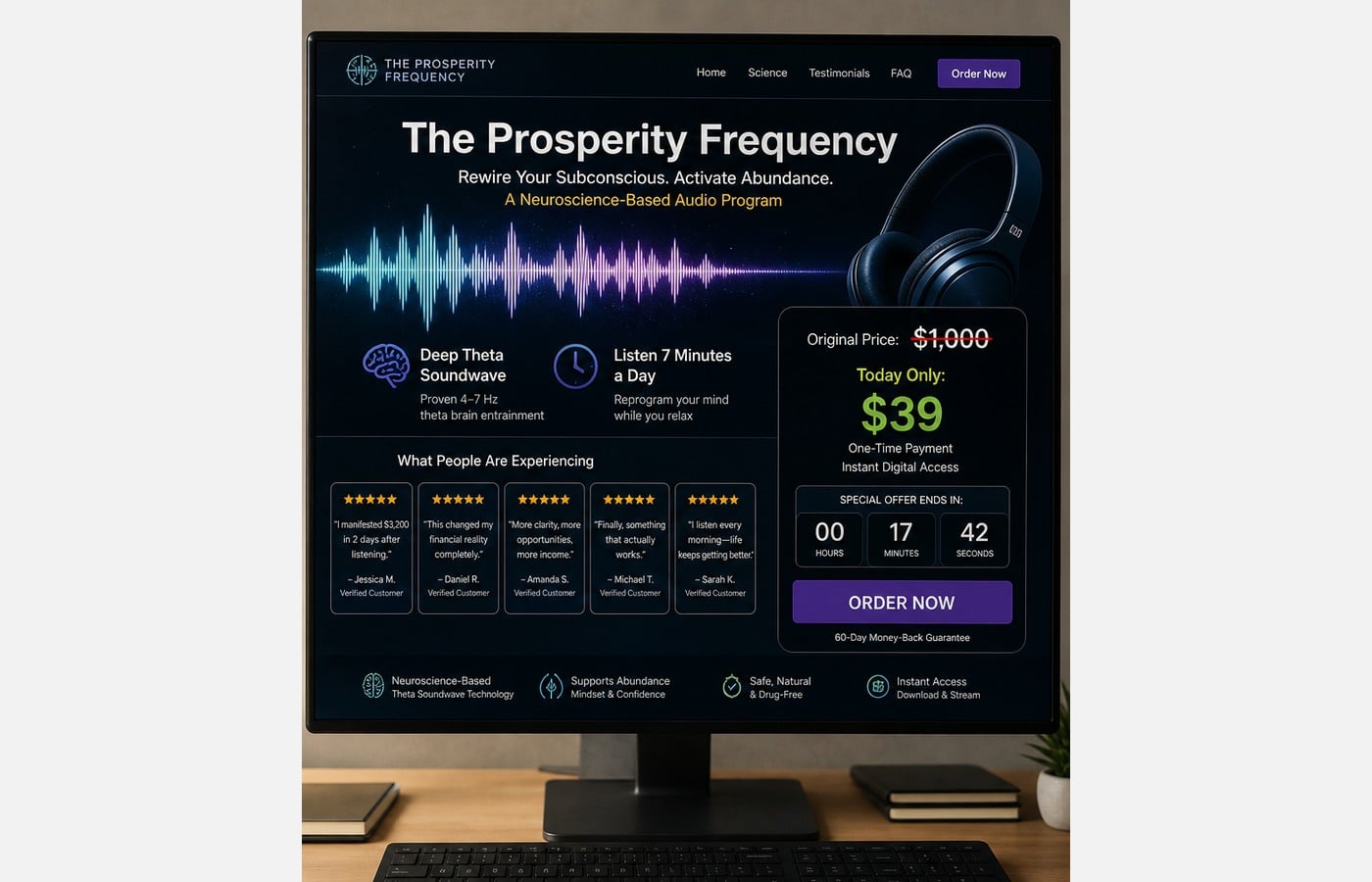
The sales page says deep theta sound targets the hippocampus, rewires the subconscious, or unlocks a dormant money wave. Binaural beats can be studied for mood, attention, or relaxation, but those topics do not establish guaranteed wealth or daily cash.
The marketing slides from feeling focused to receiving money as if they are the same outcome. Even if a track helps one listener relax, that does not prove it produces $489 a day or changes external financial events.
The buyer receives a digital program, not a wealth mechanism
Offers commonly present a dramatic reference price and then sell instant access for around $39. The product may include an audio file, book, affirmations, or bonus guides delivered through a checkout platform.
A file can be delivered successfully while the central earnings story remains unsupported. Refund terms and a secure processor reduce transaction risk, but they do not transform mystical or neurological claims into evidence.
- Tesla is credited with a wealth frequency he did not document.
- Fake experts and institutional references create scientific authority.
- The hippocampus and theta waves are linked to money without credible evidence.
- Testimonials claim rapid debt relief, windfalls, or daily income.
- The reference price falls dramatically to around $39.
- A countdown and bonuses pressure an immediate purchase.
- The delivered product is digital audio and self-help content.
What Brainwaves Can and Cannot Prove
Theta waves are a real pattern of brain activity. Researchers study them in connection with memory, navigation, sleep, and other cognitive processes. Their existence does not prove that a specific recording activates a financial force or causes outside people to send the listener money.
Binaural-beat research examines whether slightly different tones presented to each ear affect perception or mental state. Findings vary by method and outcome. A study about relaxation cannot be cited as proof of wealth manifestation, and a waveform graphic is not a clinical result.
The hippocampus is important to memory and spatial processing. Describing it as a money generator or the source of a wealth frequency is marketing language, not a recognized financial function of the brain.
A listener might feel calmer, more motivated, or more focused after using an audio exercise. Those subjective benefits can be real to the listener, but they should not be converted into promises of $489 a day, unexpected checks, lottery wins, or automatic opportunities.
Financial results depend on income, spending, savings, debt, skills, markets, decisions, and chance. A sound file cannot remove those variables. Any seller making numerical earnings claims should substantiate typical results, expenses, timeframe, and the percentage of purchasers who achieved them.
Safety claims also deserve care. Some promotional pages say the audio has no known harmful effects, while others advise people with seizure disorders to consult a clinician. The seller cannot simultaneously present the track as a powerful neurological intervention and dismiss the need for evidence.
Treat the product as entertainment or a self-help recording unless reliable research establishes more. Never delay medical, psychological, or financial help because a marketing page says a frequency will solve the underlying problem.
Invented Authority, Testimonials, and the $39 Offer
Promotional pages have used names such as Dr. Paul Winters and stories about classified discoveries. Search for the expert's credentials, publications, institution, and independent professional profile. A headshot and PhD label created by the seller are not enough.
Other pages have displayed Elon Musk, Bill Gates, Jeff Bezos, or celebrity investors around the offer. Those people have not thereby endorsed the recording. Their presence is a social-proof tactic designed to make a small digital product appear connected to extraordinary success.
One sales version advertised a 7-second Tesla ritual that supposedly produced $489 a day. Another page offered a deep-theta program for $39 after crossing out figures as high as $10,000, $5,000, and $1,000.
A descending reference price can create the illusion of immense value without showing that customers ever paid the higher amounts. The meaningful price is the actual current checkout total, including order bumps, subscriptions, and post-purchase upsells.
The landing page can list thousands of users, five-star reviews, and specific windfalls. Verify whether reviewers exist outside affiliate pages and whether their results are net, documented, typical, and connected causally to the audio rather than normal life events.
Some current sites describe the program more modestly as wellness, relaxation, mindset, or entertainment and explicitly deny guarantees. Read those disclaimers beside the headline. If the sales presentation promises money while the legal page disclaims financial outcomes, the contradiction matters.
ClickBank or another recognized checkout may handle an order. A payment platform can provide a refund channel and deliver files, but its involvement is not scientific peer review and does not endorse the seller's wealth claims.
How the Tesla 7-Second Sound Ritual Scam Works
Step 1: A social ad promises money from a sound
The ad claims a short song or frequency attracted $489 a day, paid off debt, or changed a listener's luck. Headphones and an audio waveform make the result appear easy and technical.
The message targets people who feel exhausted by work or financial setbacks. It offers action without additional labor, capital, or risk analysis.
Step 2: Tesla and secret institutions create authority
The video invokes Tesla, leaked government files, space research, or a respected university. These references are broad enough to sound plausible but rarely link to an original document supporting the financial conclusion.
Search the exact study title and authors. A general paper about brainwaves, electricity, or sound cannot substantiate a product-specific promise to attract money.
Step 3: A fictional expert explains the money wave
A scientist character describes theta frequencies, the hippocampus, neuroplasticity, and subconscious blocks. Technical terms are arranged around the desired conclusion rather than used to test it.
Verify the expert independently. If the biography exists only on sales pages and affiliate reviews, the person cannot serve as credible authority.
Step 4: Testimonials turn coincidence into causation
Stories describe unexpected checks, promotions, debt repayment, or lottery success after listening. The page presents the later event as proof that the audio caused it.
A before-and-after story cannot rule out work, existing income, family help, chance, or fabrication. Typical-user data and controlled evidence are missing.
Step 5: A huge markdown makes $39 feel safe
The product is compared with a price of $1,000 or more, then offered for $39 with a countdown. The buyer feels they are risking little to access something allegedly priceless.
Read the final cart carefully. Order bumps and bonus programs can increase the charge, and a crossed-out price does not establish market value.
Step 6: Digital delivery satisfies only the narrow order
The buyer receives an audio file, book, or members page. Because something arrived, the seller can frame dissatisfaction as failure to listen consistently or believe strongly enough.
Delivery does not prove the wealth claim. Save the headline and compare it with the product and disclaimers actually received.
Step 7: Upsells offer stronger or faster activation
Post-purchase pages may sell advanced frequencies, manifestation guides, prayers, or coaching. Each is presented as a way to amplify the first program.
Do not keep purchasing to force a result that was unsupported from the beginning. Use the refund period before it expires and reject new offers that repeat the same promise.
Company, Address, and Fulfillment Checks
The product brand may not identify a legal company
Numerous domains can call themselves the official Money Wave or Tesla ritual site. Some terms use generic company language without naming a verifiable owner, and affiliate pages can imitate an official storefront.
Use the checkout receipt to identify the actual seller and processor. Search that legal name, not only the product title printed above the waveform.
Hidden domain ownership weakens accountability
Privacy-protected registration is common, but a seller making neuroscience and income claims should still disclose a reachable business, support route, and refund policy on the site itself.
A generic contact form or copied terms generator cannot answer who produced the audio, who performed research, or who substantiated the testimonials.
Processor support does not verify the science
A marketplace can locate the transaction and enforce its own refund window. It normally does not certify that the hippocampus attracts wealth or that a Tesla story is historically accurate.
Contact the processor quickly when seeking a refund, but direct evidence questions to the seller and save any failure to answer.
Digital fulfillment has almost no manufacturing proof
An MP3 file can be duplicated and delivered instantly. There is no batch, laboratory, clinical report, or physical supply chain that demonstrates special composition simply because the file downloads.
Ask for the audio methodology, creator qualifications, safety instructions, and product-specific evidence. If those are absent, the sales story is doing the work.
Warning Signs to Watch For
- A short audio promises a specific daily income.
- Tesla is credited without an original source.
- Government and university names appear without direct links.
- The expert cannot be verified independently.
- Brainwave research is stretched into a wealth guarantee.
- Testimonials rely on windfalls and coincidence.
- A huge reference price collapses to $39.
- Legal disclaimers deny the headline's certainty.
Real neuroscience can describe brain activity. It cannot certify that a $39 recording makes outside money appear. When the page crosses that gap with testimonials and Tesla imagery instead of evidence, the wealth frequency is a sales frequency.
What to Do if You Have Fallen Victim to This Scam
- Stop buying bonus frequencies and coaching. Do not purchase a stronger activation, advanced audio, prayer bundle, or personal session to rescue the first order. Save the upsell pages and end the sequence.
- Use the refund route before the deadline. Locate the receipt and contact the named seller and checkout platform. Request a refund in writing, cancel any recurring plan, and keep the confirmation and ticket number.
- Review the card statement for additional charges. Compare the checkout total with every posted descriptor. Contact the issuer promptly about duplicates, unauthorized renewals, or products not delivered as advertised.
- Preserve the scientific and income claims. Capture the $489 daily figure, Tesla references, expert biography, study links, testimonials, price markdown, timer, disclaimer, cart, receipt, and files delivered. These show the gap between the pitch and product.
- Secure any account created for delivery. Change reused passwords, remove stored card details when possible, and enable multi-factor authentication on the connected email account. Watch for new manifestation and investment pitches.
- Inspect downloads before opening them. Audio files are usually less risky than executable programs, but remove unknown apps, extensions, or installers supplied with the course. Run Malwarebytes if the download behaved unexpectedly or the browser redirected.
- Block repeat advertising routes. AdGuard can reduce malicious ads, pop-ups, and affiliate redirects that promote similar miracle-audio offers. It cannot judge scientific claims, so continue reading the evidence and legal terms.
- Report deceptive claims. Submit the ad, domains, seller, checkout, and loss at ReportFraud.ftc.gov. Report impersonated institutions or public figures through their verified channels, not links provided by the seller.
- Get real help for the underlying problem. Speak with a qualified financial counselor about debt or money stress and a clinician about mental or physical symptoms. Do not delay evidence-based help while waiting for an audio track to produce a windfall.
Frequently Asked Questions
Did Nikola Tesla discover a sound that attracts money?
No credible historical evidence establishes that Tesla created a seven-second audio ritual for wealth. His name is being used to lend mystery and authority to a modern product.
Are theta waves real?
Yes. Theta activity is studied in neuroscience. Its existence does not prove that a commercial recording causes financial abundance or guaranteed daily income.
Can binaural beats help with relaxation?
Some listeners report subjective effects and research examines several outcomes, but results vary. Relaxation is not evidence that a track causes money, luck, or external events.
What do buyers usually receive?
The offer generally delivers digital audio and self-help materials. Receiving those files is not the same as receiving the advertised wealth result.
Does a ClickBank checkout prove the claims?
No. A processor can handle payment, delivery, and refunds without endorsing the seller's scientific or financial statements.
Is the $39 price a one-time payment?
Some pages describe it that way, but the current cart controls. Read every order bump, continuity term, and post-purchase offer before authorizing payment.
The Bottom Line
The Tesla 7-second sound ritual scam makes an old wealth promise sound modern by adding theta waves, the hippocampus, and a famous inventor. None of those references proves that listening produces income or luck.
If an audio exercise helps you relax, judge it on that modest outcome. Do not pay for unsupported promises that a sound will create $489 a day, erase debt, or replace financial decisions.

Join the discussion
0 commentsShare your experience or ask a question about this article.
Discussion
Start the conversation
Have a question or something useful to share? Add the first comment.