

The room is unbearable, the window cannot hold a full air conditioner, and an ad offers a tiny plug-in solution that supposedly cools everything in minutes. The vent-free portable AC scam arrives at exactly the moment comfort feels urgent.
The device may blow air and light up. That does not mean it can move enough heat out of a room to perform like the 12,000 BTU air conditioner described in the advertisement.
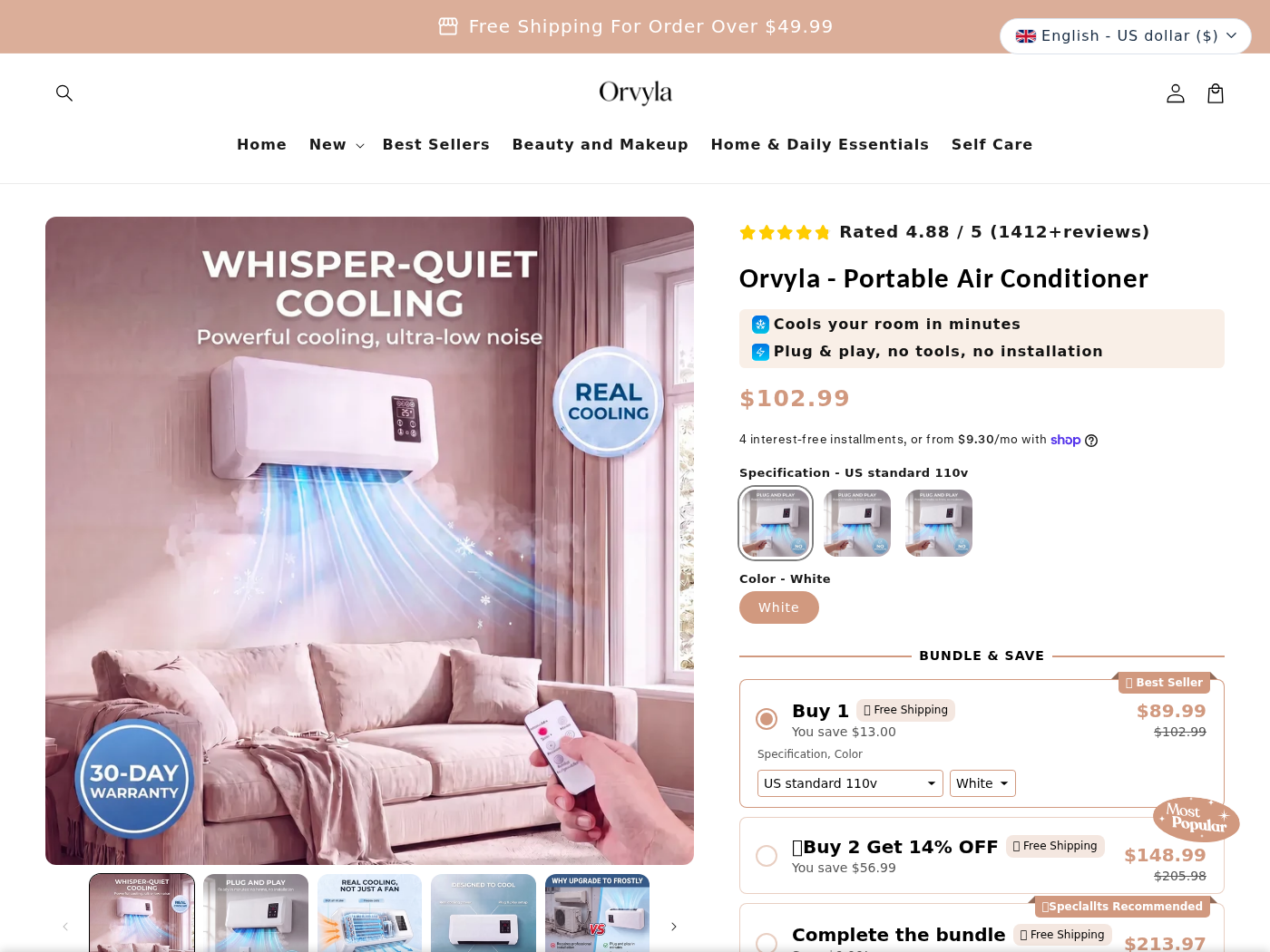
Orvyla's current portable air conditioner page presents a compact tabletop unit with prominent buy buttons, a selected $89.99 package, and claims of real cooling without installation. Another promotional version has described 12,000 BTU, cooling to 16°C in 10 seconds, operation at 24 dB, and coverage up to 550 square feet.
Those specifications would be remarkable for the pictured size and setup. A genuine room air conditioner collects heat indoors and rejects it outside. Portable units typically use one or more exhaust ducts, while window and split systems place the hot side beyond the room.
A small water-based cooler can make moving air feel cooler close to the device, especially in dry conditions. It does not become a compressor air conditioner merely because the page uses AC language, a snowflake graphic, or an invented BTU number.
Overview
The ad blurs three different appliances
Fans move room air. Evaporative coolers use water evaporation to lower the temperature of a local air stream while adding humidity. Air conditioners use a refrigeration cycle and reject collected heat elsewhere. The pictured device is often closer to the first two categories than the third.
This distinction is central, not technical trivia. If the hot side of an air conditioner remains inside a sealed room, its electrical energy ultimately adds heat. A claim of powerful whole-room cooling with no hose, outdoor unit, or other heat-rejection path needs extraordinary evidence.
The specifications contradict the physical design
Claims such as 12,000 BTU, 550-square-foot coverage, 16°C air in 10 seconds, 24 dB, no installation, no drainage, and low energy use are stacked together because each answers a buyer objection. Together, they describe a machine very different from the compact device shown.
The US Department of Energy's portable air conditioner test procedure explicitly accounts for exhaust duct heat transfer. ENERGY STAR room-air guidance also emphasizes correct sizing and installation. A tabletop device should not be compared with rated room equipment unless independently tested under a recognized procedure.
The store adds billing and return concerns
Orvyla lists a 30-day warranty and uses a residential Iowa contact address. Its shipping policy says orders may be fulfilled from the USA, Asia, the UK, or Australia and cannot be canceled once placed.
Customer reviews on Trustpilot were overwhelmingly negative at the time of review, although those reports are user allegations rather than independently verified facts.
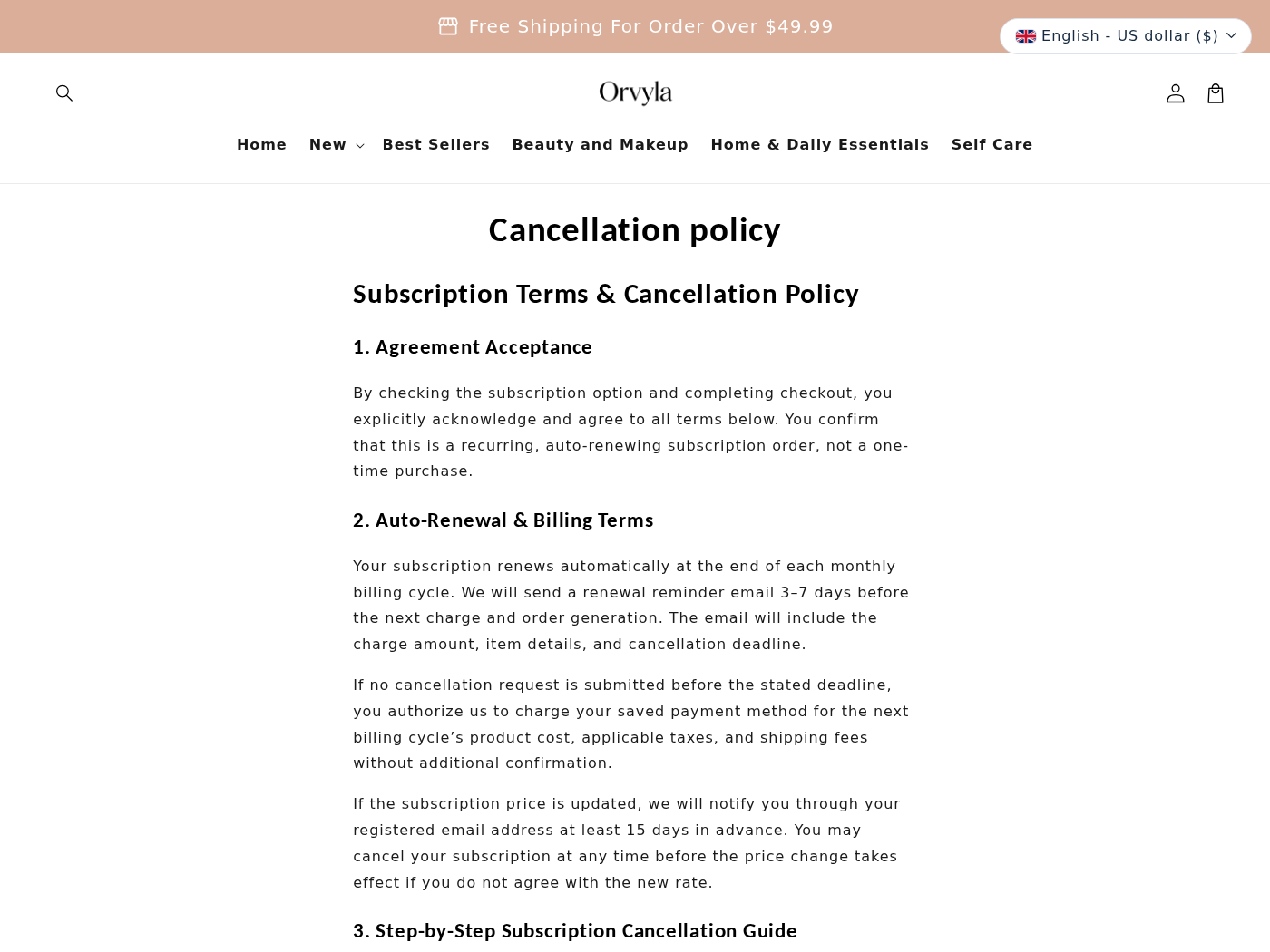
Orvyla also publishes a subscription policy describing monthly auto-renewal when a subscription option is selected. The captured product selection did not by itself prove that every AC order enrolls a subscription, so buyers must inspect the exact checkbox, order summary, confirmation, and future statement rather than assuming either outcome.
- A heat-wave ad promises compressor-level cooling from a tiny tabletop device.
- The page uses AC, BTU, and room-size language while omitting a credible heat exhaust path.
- The offer combines aggressive discounts, high review claims, and urgent purchase buttons.
- The seller's policies allow international fulfillment and restrict cancellation after purchase.
- Separate recurring-payment terms make the final checkout especially important.
The Simple Physics the Advertisement Avoids
Cooling is the removal of heat, not merely the feeling of air moving across skin. A fan improves evaporation from the body but does not lower the total heat in a closed room. Its motor adds a small amount of heat.
An evaporative cooler can lower the temperature of air passing through a wet pad, but the water vapor remains in the room. Performance depends heavily on humidity and ventilation. In a humid room, the cooling effect may be small while discomfort from moisture increases.
A refrigeration air conditioner absorbs heat at an indoor coil and releases it at a hotter outdoor coil. Window units place that coil outside. Portable units route hot air through an exhaust hose. Split systems connect indoor and outdoor sections. The heat needs somewhere else to go.
That is why a small vent-free device can blow pleasantly over a desk but cannot honestly inherit the performance claims of a full room AC. The comparison should use measured cooling capacity, input power, test conditions, room size, humidity, and noise, not a dramatic thermometer graphic.
A seller that truly achieved 12,000 BTU from the pictured format could provide a recognized laboratory report, model number, electrical rating, refrigerant details, and safety certification. Marketing adjectives are not substitutes for those documents.
What Orvyla's Product and Policy Pages Show
The product page displays a compact device, a large discount, a 4.88/5 rating from more than 1,400 claimed reviews, and a 30-day warranty. It says the product provides real cooling and works without complicated installation. These claims should be evaluated against the actual device received and its rated label.
Separate promotional material has attached extremely strong specifications to the same concept, including 12,000 BTU, a 550-square-foot range, and rapid temperature drops. A consumer should ask for the official model documentation because those figures are inconsistent with the visible size and absence of an exhaust hose.
The contact page lists 987 Tulip Tree Lane, West Des Moines, Iowa. Real-estate sources identify the property as a single-family home. That does not prove misconduct, but it does not support the image of a large appliance maker or repair center either.
The shipping policy allows fulfillment from multiple regions, including Asia, and says orders cannot be canceled after placement. If a lightweight cooler arrives from a different country than expected, returning it may be slower and more expensive than the ad suggests.
The subscription policy describes monthly automatic renewal when a subscription option is chosen and says a renewal reminder should be sent 3 to 7 days before billing. One email link in the policy points to the placeholder support@yourstore.com, a template error that raises questions about how carefully the terms were configured.
How the Vent-Free Portable AC Scam Works
Step 1: Extreme weather creates urgency
Ads intensify during heat waves, when buyers need relief quickly and local air conditioners may be sold out. The message promises a solution that ships to the door, uses little electricity, and avoids landlord or window restrictions.
Countdowns and low-stock warnings make technical verification feel like a luxury. The viewer is pushed to buy before asking how heat leaves the room.
Step 2: A visual effect simulates powerful cooling
The video may show frost, vapor, an instantly falling thermometer, or people pulling blankets around themselves. Some clips reuse footage from different appliances, add digital effects, or frame a small cool-air stream as whole-room performance.
Condensation or mist is not proof of refrigeration. Ask to see the complete device, exhaust path, rated label, and power draw in one continuous test.
Step 3: Technical numbers make the promise sound measured
BTU, square footage, temperature, noise, and energy savings are presented together, often without a test standard or model report. Precise numbers feel objective even when the seller offers no evidence for them.
Check whether the device's input power could plausibly support the stated capacity and whether a recognized certification database contains the exact model. A generic USB or low-watt adapter is a strong clue that the unit is a personal cooler, not a room AC.
Step 4: A one-product page manufactures consensus
The landing page repeats star ratings, customer photographs, testimonials, and recent-order pop-ups. Visitors may see thousands of satisfied customers without dates, verified purchase records, or an independent review trail matching the claim.
The store controls what appears on its own page. Independent complaints can be useful context, but they also must be read critically. Look for repeated details about what arrived, billing, tracking, and refund handling.
Step 5: Bundle and option design increases the charge
The order selector may emphasize two or more units for different rooms. Shipping protection, warranties, or a recurring option can appear near the main choice, so the customer must review every selected line.
The existence of a subscription policy does not prove every checkout is recurring. The correct test is whether a subscription checkbox or interval is selected and disclosed immediately beside the final price.
Step 6: The parcel reveals a fan or evaporative cooler
Customers may receive a lightweight device with a water reservoir, wick, fan, lights, or mist function. It can create a cool sensation at close range while failing to reduce the temperature of a whole room as advertised.
Document the model label, power rating, packaging, manual, and a simple room test. Do not block ventilation openings or add ice if the manual forbids it. Electrical products and water require extra care.
Step 7: Cancellation and returns become difficult
A no-cancellation rule can prevent an immediate correction after the buyer notices the wrong quantity. Support may require videos, photographs, tracking, or shipping to a location provided only after approval.
If the product materially differs from the advertisement, state that clearly in writing. Preserve the exact capacity and room-size promises rather than saying only that you disliked the device.
Company, Address, and Fulfillment Checks
The listed home is not an appliance factory
Orvyla's contact address is publicly described as a residence. A home-based seller can be lawful, but the address does not demonstrate engineering, testing, inventory, repairs, or the global service operation implied by thousands of reviews.
Ask for the legal entity behind the brand, its registration, and the manufacturer or importer printed on the device. If the parcel and card statement introduce new names, add them to your records.
Template errors weaken support promises
The subscription page's support@yourstore.com link looks like an unedited store template. A billing policy should identify a working support address with no ambiguity, especially when it describes automatic renewals.
Test the published phone and email before ordering. Ask for written confirmation of the exact model, final total, recurring status, ship-from country, and return destination.
Fulfillment location changes the refund math
The policy allows stock to ship from Asia and other regions. International fulfillment is not automatically deceptive, but it can produce longer delivery times, customs issues, split packages, and expensive tracked returns.
A guarantee that requires overseas postage may recover little after shipping costs. Obtain the return location and conditions before paying, not after opening the box.
Unknown electrical manufacturing can be dangerous
A cooling device combines electricity, a fan, and sometimes water. Buyers need a real model label, voltage and current ratings, safety instructions, manufacturer or importer identity, and certification appropriate to the market.
Stop using a unit that becomes unusually hot, smells of melting plastic, leaks near electrical parts, sparks, or has a damaged adapter. Do not leave an unknown device running unattended or while sleeping merely because the advertisement calls it safe.
How to Evaluate a Portable Cooling Claim
Begin with the category. If the device has no compressor, refrigerant system, outdoor section, or exhaust hose, treat it as a fan or evaporative cooler unless independent testing proves otherwise. The seller's use of the letters AC is not a test result.
Next compare scale. A 12,000 BTU room appliance has substantial heat exchangers, airflow, power demand, and heat rejection. A tiny tabletop housing powered like a household gadget does not hide that equipment through clever design.
Then examine the business. A residential address, broad international fulfillment, template policy mistakes, no-cancellation language, and a weak independent complaint pattern do not establish product performance. They increase the cost of being wrong.
Finally, buy cooling equipment by room size and verified capacity from a retailer with clear returns and safety support. If installation constraints rule out a conventional unit, consider a fan, shading, ventilation, or an honestly labeled evaporative cooler without pretending it is whole-room refrigeration.
Warning Signs to Watch For
- A tiny device claims 12,000 BTU or whole-room coverage without a heat exhaust path.
- The page promises rapid cooling, near-silent operation, low power, and no installation at once.
- Frost, mist, or a digital thermometer replaces a continuous room test.
- The model number and independent test report are missing.
- The contact address is a residence rather than a disclosed appliance business.
- The seller can ship from several regions and refuses cancellation after ordering.
- Subscription terms exist, but the checkout selection is unclear.
- A support link still contains a generic store placeholder.
The decisive question is where the heat goes. If the page cannot answer that clearly while promising full air-conditioner performance, do not let the discount or temperature animation answer for it.
What to Do if You Have Fallen Victim to This Scam
- Save the ad, order page, and receipt. Take screenshots of the vent-free portable AC advertisement, the page that made the promise, every price shown at checkout, the confirmation email, and the package label. Save the page address and the date. These records help your bank understand what was represented before the seller changes or removes the funnel.
- Check the exact amount and merchant name. Compare the final card charge with the total you knowingly approved. Write down the merchant descriptor exactly as it appears, because it may not match the brand in the advertisement. Check pending and posted transactions for extra bundles, add-ons, foreign fees, or a second charge you did not expect.
- Contact the seller in writing. Ask the appliance seller shown on your confirmation to cancel any unshipped order, recurring plan, or future renewal and request a refund under the policy that applied on the purchase date. Email is better than relying only on a call because it creates a timestamped record. Keep the full conversation, case number, and any return authorization.
- Do not mail a return to an unverified address. A package sent to the wrong warehouse may be rejected and the seller may claim it was never received. Ask for the authorized return location in writing, use tracked shipping, photograph the contents and label, and retain the delivery record. Follow the stated deadline while also documenting any delay caused by support.
- Call your card issuer if the charge is wrong. Explain whether the problem is an unauthorized charge, an amount different from the checkout, goods not delivered, goods materially different from the advertisement, or a canceled renewal that continued. Ask about the dispute deadline and whether the issuer should block future charges from the same merchant descriptor.
- Watch for follow-up billing. Review statements for several months. A canceled card does not always cancel an underlying agreement, so send a written cancellation as well and ask the issuer how recurring payment updates are handled. Report every unfamiliar charge promptly instead of waiting for several renewals to accumulate.
- Secure accounts if you reused a password. Change any reused password, beginning with your email and payment accounts, and enable multi-factor authentication. If you downloaded a file, browser extension, or remote-support tool during the purchase, remove it and run a full scan with Malwarebytes. A normal product checkout should not require remote access to your device.
- Reduce exposure to the same advertising network. Report the ad to the social platform and use AdGuard to reduce malicious advertising, trackers, pop-ups, and repeat redirects. An ad blocker is not a substitute for judgment, but it can remove part of the infrastructure that repeatedly pushes deceptive advertorials to the same audience.
- Report the campaign. File a report with the FTC at ReportFraud.ftc.gov and with your state attorney general or national consumer-protection authority. Include the ad account, website, merchant descriptor, support details, amounts, and dates. Reports are more useful when they describe the path from the first ad to the final charge.
Frequently Asked Questions
Can a vent-free portable device cool an entire room?
A small fan or evaporative cooler may improve comfort nearby, especially in dry air, but that is different from refrigerating a room. A real air conditioner must reject heat outside the cooled space. Without a credible exhaust path or outdoor component, compressor-level whole-room claims require evidence the seller usually does not provide.
What is the difference between an evaporative cooler and an AC?
An evaporative cooler passes air through water and can lower the local air-stream temperature while adding humidity. An AC uses refrigerant to absorb indoor heat and release it elsewhere. Evaporative performance falls as humidity rises, while an air conditioner also removes moisture from indoor air.
Does the Orvyla product definitely create a subscription?
The store publishes subscription terms for options that are selected, but the captured AC product page does not prove that every order is automatically recurring. Check the exact checkout for words such as subscribe, monthly, recurring, or auto-renew, then save the receipt.
Never infer either a one-time purchase or a subscription from the product page alone.
Are the Trustpilot complaints proof that every order fails?
No. Online reviews are individual reports, and Trustpilot states that it does not fact-check every claim. A low score and repeated allegations about nonworking products, different items, or refund trouble are risk signals to investigate, not proof of every transaction. The technical contradictions and policy details stand independently.
How do I test what arrived?
Photograph the sealed box, model label, adapter, manual, and device. Measure room temperature and humidity away from the direct air stream before and after a reasonable period with doors and windows controlled. A cool reading directly in mist or airflow does not prove that the room was cooled.
What should I buy instead?
Choose a properly sized room air conditioner with a verifiable capacity rating, model documentation, appropriate safety certification, and a heat-rejection setup suitable for the room. If you only need personal airflow, buy an honestly labeled fan or evaporative cooler from a retailer with straightforward returns.
The Bottom Line
The vent-free portable AC scam sells the feeling of cold air while avoiding the central fact of air conditioning: heat must leave the room. Impressive BTU numbers and frosty videos cannot replace a hose, outdoor unit, recognized test, or credible model documentation.
Treat the seller's business trail as part of the product. Verify the capacity, checkout options, support, address, shipping origin, and return cost before paying. A modest fan sold honestly can be useful. A tiny fan sold as an instant whole-room AC is a very different purchase.

Join the discussion
0 commentsShare your experience or ask a question about this article.
Discussion
Start the conversation
Have a question or something useful to share? Add the first comment.