

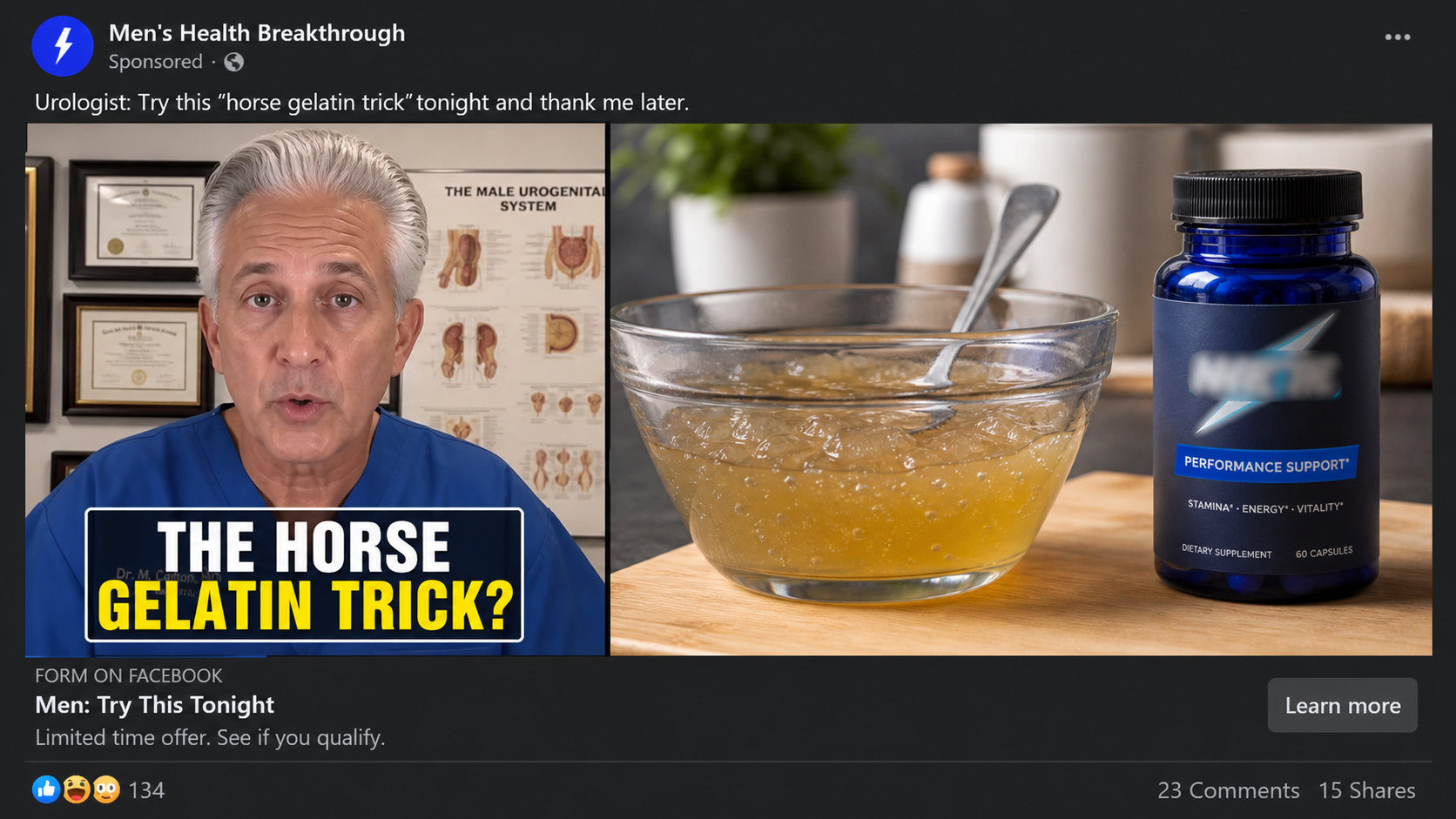
A famous doctor appears to reveal that a cheap spoonful of “horse gelatin” can restore male performance almost overnight. The clip sounds candid, the explanation feels medical, and the advertisement suggests men have been kept in the dark for years.
The embarrassment surrounding sexual health makes this pitch unusually effective. It also makes people less likely to ask a doctor, compare evidence, or report a bad purchase. The Dr. Samadi horse gelatin trick scam exploits that silence to sell a rotating supplement through fake AI advertising.
Overview
A real urologist’s identity is used to sell an unverified trick
Dr. David B. Samadi is a real urologist whose public profile makes his name valuable in a men’s health campaign. Deceptive ads can copy that authority without obtaining his approval. A synthetic voice, altered lip movement, or chopped interview can make invented advice feel authentic.
The campaign claims that Samadi recommends a horse gelatin recipe for erectile dysfunction, testosterone, prostate health, or stamina. The exact promise can change between ads. What remains consistent is the impression that a recognized specialist personally discovered or endorses the solution.
We found no reliable evidence that Dr. Samadi endorsed the supplement funnel reviewed. An image on a landing page is not consent, and an AI-generated video is not a medical consultation. Endorsements must be verified through the doctor’s official website or verified channels.
“Horse gelatin” is designed to be strange enough to earn a click
Ordinary advice rarely stops someone mid-scroll. “Horse gelatin trick” does. The phrase is unusual, slightly shocking, and specific enough to sound like a hidden discovery. It creates an information gap that the viewer wants to close.
The presentation may suggest that gelatin rebuilds blood vessels, restores nitric oxide, repairs pelvic tissue, or revives hormones. Real biological terms can appear beside invented mechanisms. The ad rarely provides a credible human trial showing that the claimed recipe produces the promised result.
Gelatin is a food ingredient, not a proven universal treatment for erectile dysfunction. Sexual performance problems can involve cardiovascular disease, diabetes, medication effects, hormones, nerve damage, stress, sleep, or relationship factors. One internet ritual cannot diagnose all of them.
The promised recipe ends at a supplement checkout
The viewer is told to keep watching for the exact gelatin type, amount, or timing. Later, the narrator explains that grocery-store gelatin is contaminated, too weak, or missing a special activator. The simple recipe becomes a proprietary capsule blend.
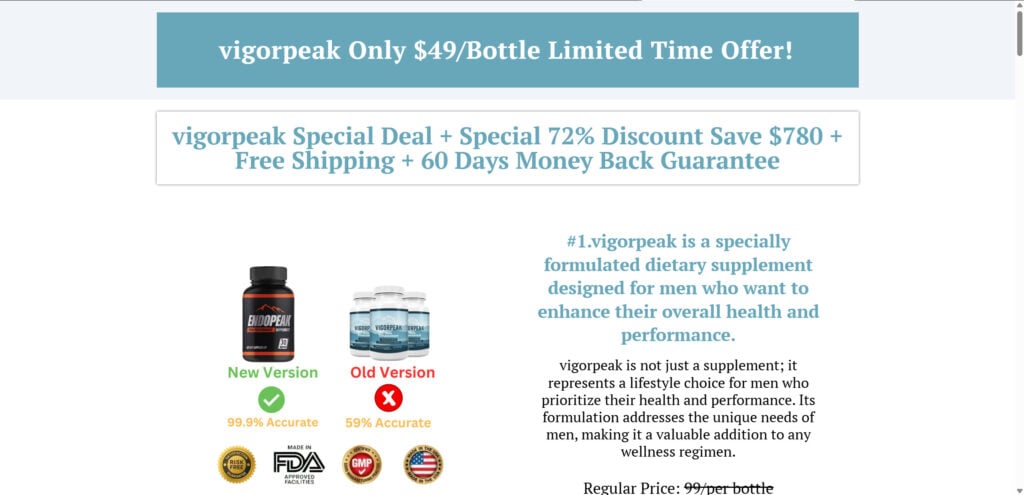
In one version we reviewed, the funnel promotes VigorPeak. Its page uses familiar direct-response elements, including a low per-bottle figure, a large percentage discount, multiple packages, and a money-back guarantee. Those elements do not validate the AI endorsement or medical claims.
VigorPeak can be replaced by a new brand as soon as advertising accounts, domains, or customer sentiment deteriorate. The durable asset is the horse gelatin story, which can continue sending traffic to whatever bottle is available.
Why This Male Performance Pitch Is Dangerous
It discourages a medical evaluation that could matter
Erectile dysfunction can be an early warning of blood-vessel or metabolic problems. A person may need a cardiovascular risk review, medication adjustment, hormone assessment, or other medical care. A miracle ad treats the symptom as a private failure that can be fixed secretly.
That framing can delay help. It also creates risk when someone combines an unknown supplement with nitrates, blood-pressure medicine, anticoagulants, or other treatments without professional advice.
Fast prescription-like claims are a major red flag
The FDA repeatedly warns that products marketed for rapid sexual enhancement may contain hidden drug ingredients. This is a category-wide warning, not proof that VigorPeak contains sildenafil or another undeclared substance. No such conclusion should be made without laboratory testing of the exact product and batch.
The warning still matters. If a “natural” product claims an immediate effect comparable to prescription medicine, buyers should question how that effect is supposedly produced and whether independent testing exists.
Shame and secrecy weaken normal consumer defenses
The ad may say the solution is discreet, does not require a doctor, and can restore confidence before a partner notices a problem. This encourages a private purchase made quickly, sometimes late at night, without discussing the ingredients or company with anyone.
Scammers benefit when buyers are reluctant to complain. A consumer who would dispute an ordinary household purchase may stay silent about a sexual enhancement charge because explaining it feels uncomfortable.
Testimonials create a result the seller has not proved
Sales pages commonly feature men reporting stronger erections, greater stamina, restored marriages, and dramatic confidence within days. Photographs may be stock images or AI-generated, and names may not identify verifiable customers.
Even a genuine testimonial cannot establish typical results or rule out other causes. Evidence should concern the exact finished formula, ingredient doses, safety, and interactions, not a dramatic quotation placed beside an order button.
How the Scam Works
Step 1: A provocative social ad targets a private fear
The first creative refers indirectly to bedroom performance, masculinity, or what happens “after 40.” It may avoid explicit words to pass advertising filters while still making the message unmistakable.
The horse gelatin phrase supplies curiosity. Viewers click because they expect a simple instruction, not because they have decided to buy a supplement.
Step 2: AI places the claim in Dr. Samadi’s mouth
The video may clone a voice, modify a real interview, or use a fabricated scene with the doctor’s photograph. Subtitles often carry the most aggressive claim, so the ad remains persuasive even when the audio sounds unnatural.
Some deepfakes contain odd blinking, stiff facial movement, or mismatched cadence. Others are difficult to identify visually. Independent source verification is therefore essential.
Step 3: A fake interview or news page takes over
After the click, a television-style advertorial claims that the revelation surprised a host, angered drug companies, or was removed from mainstream media. The layout borrows credibility from news without providing the accountability of journalism.
Try the menus and search the supposed publisher’s real site. Decorative links, a constantly fresh publication date, and a domain unrelated to the logo expose many copies.
Step 4: The script invents a universal cause
The presentation says performance problems come from one clogged pathway, missing nutrient, parasite, or age-related toxin. That simplification makes one product appear suitable for everyone.
Real sexual health is more complex. A proper assessment considers physical, psychological, medication, and relationship factors. An anonymous video cannot safely rule those in or out.
Step 5: The horse gelatin recipe turns into VigorPeak or another bottle
The promised household method becomes impractical just as the product appears. VigorPeak is presented as the pure, measured, or clinically designed version of the trick, although the preceding story has not proved the formula’s effectiveness.
Our VigorPeak supplement investigation examines that product-specific page. A future version may promote a different name while using the same fabricated Dr. Samadi narrative.
Step 6: A low per-bottle number masks the bundle total
The biggest package usually receives the most prominent badge and lowest unit price. A large crossed-out amount and savings percentage make it feel like a rare opportunity.
Calculate the total yourself. A displayed $49 price can mean $49 multiplied by several bottles. Confirm shipping, tax, and every optional item before entering payment information.
Step 7: Upsells and recurring terms can hide in the purchase flow
After the initial selection, the buyer may see “one-time” upgrades, complementary products, or additional packages. Mobile layouts can make the decline link easy to miss.
Not every order creates an automatic refill. Still, this industry commonly uses continuity offers, so search the checkout and terms for “subscription,” “autoship,” “monthly,” “membership,” “rebill,” and “next shipment.”
Step 8: The seller becomes harder to identify after the charge
The receipt may display a merchant name unrelated to VigorPeak. Support could be shared across brands, and a return address may lead only to a fulfillment warehouse. These layers make the real responsible entity difficult to pin down.
Document everything immediately. If the seller does not resolve an unauthorized quantity, recurring charge, or deceptive transaction, contact the payment provider within its dispute window.
Company, Address, and Fulfillment Checks
Find the company behind the card descriptor
The product label is marketing. The accountable entity should appear consistently in the terms, privacy notice, checkout, invoice, and bank statement. If five different names appear, ask how they relate before ordering.
Search the legal entity in business records and complaint databases. A brand launched last month should not be presented as a decades-old medical authority without evidence.
Expose mailbox and warehouse addresses
A returns address can belong to a fulfillment contractor handling dozens of offers. It may also be a virtual mailbox, residence, or unrelated business. That address does not identify a manufacturer or headquarters by itself.
Use maps and public records, then call the location when appropriate. Never mail a return until the seller confirms the destination and authorization requirements in writing.
Call support before trusting the guarantee
Ask the agent to name the product, legal seller, total package price, automatic refill status, refund deadline, and return procedure. Unanswered calls, full voicemail, generic scripts, or a representative who cannot identify the brand are strong reasons to leave.
Test email too. A guarantee backed by an address that never replies is not meaningful protection.
Unknown origin and hidden ingredients can carry real health risks
Some supplements are mass-produced through domestic or overseas contract facilities, including factories in China. We have not confirmed that origin for the exact VigorPeak bottle shown, so it should not be stated as fact. The correct question is whether the seller supplies traceable manufacturing and batch-specific testing.
Check the complete label, lot, expiration, warnings, and ingredient quantities. Claims such as “all natural” or “FDA registered facility” do not prove FDA approval, freedom from contaminants, or absence of undeclared pharmaceutical ingredients.
What to Do If You Fell Victim
- Save the ad and transaction trail. Capture the video, fake interview, product page, bundle, checkout total, receipt, terms, and card descriptor. Preserve URLs and dates before the campaign rotates.
- Read the order confirmation carefully. Check bottle count, shipping, upsells, subscription wording, and the merchant name. Compare the promised total with the posted charge.
- Cancel all future billing in writing. Tell the seller that you revoke authorization for any subscription, autoship, or continuity plan. Request a cancellation number and written confirmation.
- Contact the bank without embarrassment. Card teams handle sensitive purchases routinely. Explain what you authorized and what differed. Ask about charge disputes, future merchant blocks, and relevant deadlines.
- Follow the return policy with proof. Obtain required authorization, photograph sealed products, ship with tracking, and retain delivery confirmation. Do not rely on verbal promises alone.
- Secure the device if the page behaved suspiciously. Run a scan with Malwarebytes after downloads, extension prompts, fake alerts, or unusual redirects. AdGuard can help block deceptive ad chains during future browsing.
- Protect your health. Stop using the product and seek help for chest pain, fainting, severe headache, vision changes, allergic symptoms, or a prolonged erection. Ask a pharmacist to check the full ingredient list against prescriptions.
- Report impersonation and deceptive sales. Report the ad to the platform, file a complaint at ReportFraud.ftc.gov, and submit suspected supplement safety issues through FDA reporting channels. Include the lot and photographs when available.
Keep the story and the bottle separate when reporting the campaign. The same fabricated doctor clip may later promote a different label, while the original product page disappears and leaves buyers searching under the wrong name.
Frequently Asked Questions
Did Dr. David Samadi endorse the horse gelatin trick?
We found no reliable evidence that he endorsed the campaign reviewed. A cloned voice, altered video, or photograph in an advertorial is not authorization. Check his official channels for any genuine recommendation.
Does horse gelatin treat erectile dysfunction?
There is no reliable clinical evidence that a horse gelatin ritual universally treats erectile dysfunction. The condition has many possible causes and deserves an individualized medical assessment.
Does VigorPeak contain hidden sildenafil?
We cannot make that claim without a laboratory result for the exact product and batch. The FDA’s broader warnings show why rapid prescription-like claims in “natural” sexual enhancement products deserve caution.
Is VigorPeak always sold by subscription?
Do not assume that every order has recurring billing, and do not assume that none do. Read the live checkout, confirmation, and terms for autoship, continuity, membership, and next-shipment language.
Why do scammers use an embarrassing health problem?
Privacy and shame reduce consultation and reporting. A buyer may act quickly, avoid asking family or a doctor, and hesitate to dispute a charge. Those reactions make the audience easier to pressure.
What is the safest first step for persistent performance problems?
Speak with a qualified clinician. The symptom can relate to cardiovascular, metabolic, hormonal, neurological, medication, or psychological factors, and effective options depend on the cause.
The Bottom Line
The Dr. Samadi horse gelatin trick scam uses AI impersonation and an unusual home-remedy hook to disguise a direct-response supplement sale. VigorPeak is one rotating product associated with the story, not proof that the endorsement or promised mechanism is real.
Verify the original speaker, company, formula, total, and billing terms independently. Sexual health deserves evidence and confidential medical care, not pressure from an anonymous countdown page.

Join the discussion
0 commentsShare your experience or ask a question about this article.
Discussion
Start the conversation
Have a question or something useful to share? Add the first comment.