

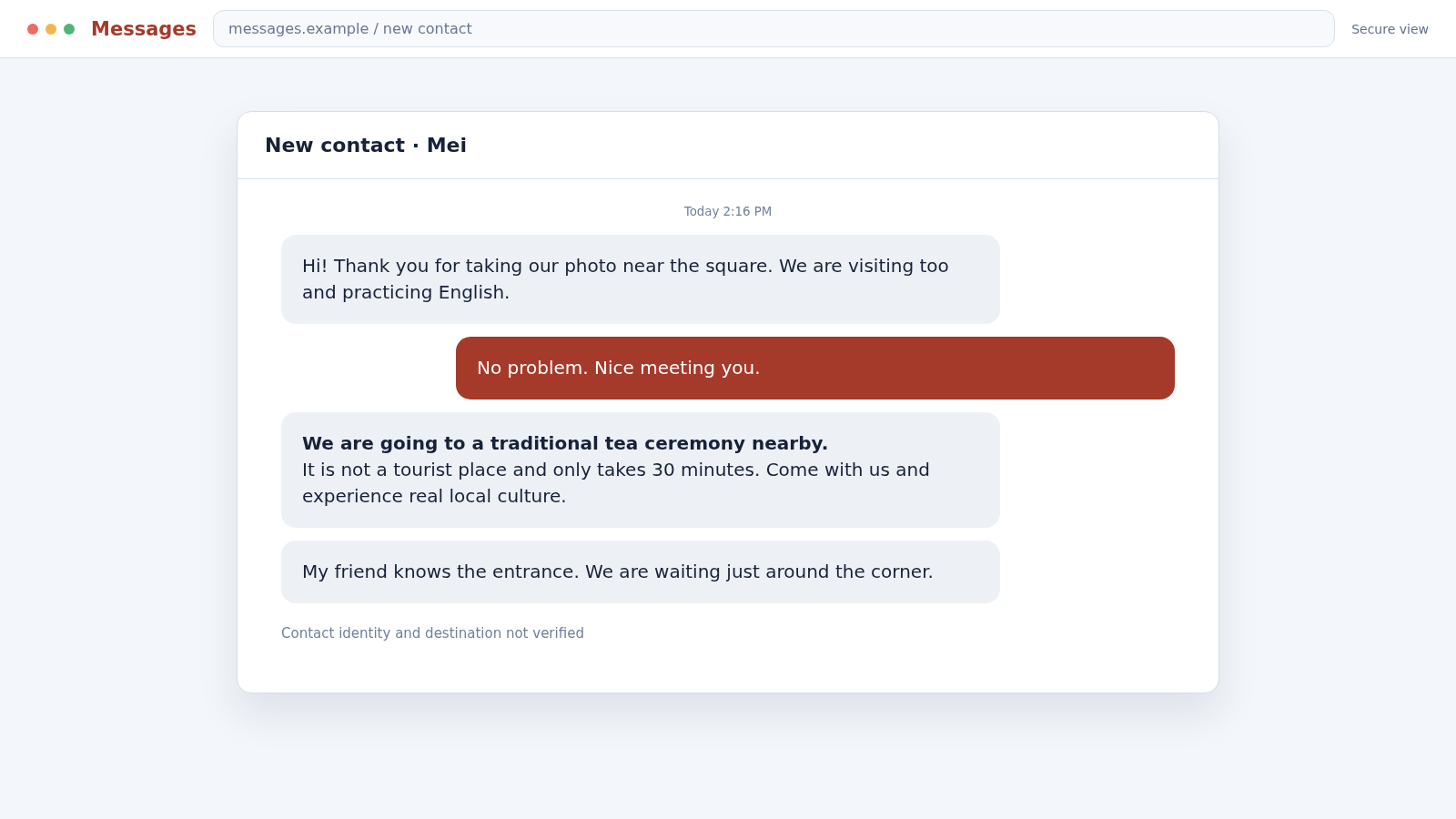
A friendly stranger near a landmark asks for a photo, starts an easy conversation, and suggests one authentic stop nearby. Nothing about the invitation feels like a hard sell.
That relaxed beginning is what makes the China tea house scam so effective. The real pressure arrives only after the visitor is inside.
Overview
A cultural invitation leads to a venue chosen by the stranger
The China tea house scam targets visitors in busy tourist areas.
Friendly people introduce themselves as students, travelers, or locals hoping to practice English, then invite the target to a tea tasting, café, bar, art show, or cultural ceremony.
The invitation feels spontaneous, but the destination is usually part of the arrangement.
Once drinks or snacks are served, staff present a grossly inflated bill and apply pressure until the visitor pays.
The trap depends on politeness and uncertainty
Travelers may hesitate to ask about price because they do not want to offend a new acquaintance or appear unfamiliar with local customs.
The people running the scheme treat that hesitation as consent to order more.
When the bill appears, language differences and fear of making a scene make resistance difficult.
The friendly companions may vanish, pretend to be surprised, or claim the guest agreed to split the cost.
The same setup appears under several different invitations
The story changes, but the controlled destination and hidden price remain consistent:
- A traditional tea ceremony or rare-tea tasting
- An opportunity to help students practice English
- A drink at a nearby bar, café, or karaoke room
- A private art exhibition run by supposed students
- A massage or wellness service at a recommended venue
- A friendly date who insists on one particular location
Official travel advisories from the UK and Canada warn about this exact approach. Friendly strangers may invite tourists to tea, drinks, massage, or another establishment.
An exorbitant bill and possible threats follow.
Why the Invitation Feels Safer Than It Is
The approach often happens in an open, crowded area.
A request to take a photo or practice English feels harmless, and a conversation can continue for several minutes before money is mentioned.
The person may share personal stories, ask thoughtful questions, and appear as unfamiliar with the city as the visitor. Presenting as another traveler reduces the appearance of a sales approach.
There is also a natural reluctance to distrust hospitality in a new country.
Most encounters with local people are harmless, so the scam succeeds by hiding inside a normal and positive part of travel.
The useful distinction is not whether a stranger is friendly.
It is whether that stranger quickly tries to control where you go, what you order, and how little pricing information you receive.
The suggested venue is described as close, traditional, and unknown to ordinary tourists. That framing turns the target’s lack of local knowledge into a reason to trust the stranger’s choice.
Once the visitor agrees to walk, each small decision makes the next one easier.
Entering the building, taking a seat, accepting the first cup, and allowing another order can feel like ordinary courtesy until the cost is revealed.
Warning Signs Before You Enter the Venue
- A stranger singles out foreign visitors near a major attraction.
- The conversation quickly turns to English practice or cultural exchange.
- The person insists on a specific tea house, bar, or gallery.
- Your suggestion of a different public venue is rejected.
- The destination is down a side street, upstairs, or poorly marked.
- No menu or complete price list is visible before service begins.
- Staff start serving several items without confirming each order.
- Your new companions communicate with staff as if they know them.
- The server wants to keep your card or take it away from the table.
- Doors, hallways, or staff positions make leaving feel difficult.
None of these signs means every friendly person or tea house is dishonest. The risk comes from the pattern: unsolicited approach, controlled destination, missing prices, and pressure.
How the China Tea House Scam Works
Step 1: Approachers watch for visitors who seem unfamiliar
The group works near areas where tourists pause, check maps, take photos, or walk alone. A person who appears relaxed, curious, and without a local guide is an attractive target.
The first contact is deliberately ordinary. Asking for a photo, directions, or a quick language exchange avoids the defensive reaction that a direct sales pitch would create.
Step 2: A warm conversation creates quick trust
The stranger asks where the visitor is from, how long they are staying, and what they hope to see.
They may introduce a friend and tell a believable story about being students from another city.
This stage also reveals whether the visitor is alone, has local contacts, and is willing to spend. The group can end the approach quietly if the target seems cautious.
Step 3: The cultural invitation is made casually
Tea is presented as the natural next step rather than a commercial transaction.
The stranger might say a ceremony is happening nearby or that a favorite local spot offers an experience guidebooks miss.
The invitation often includes social reassurance: the companions are going anyway, everyone can share, and the venue is only a few minutes away.
Step 4: The group controls the route and the venue
The target is led to a specific establishment.
It may have a sign and normal-looking reception, or it may occupy an upstairs room that offers little visibility from the street.
Staff recognize the approachers and begin service smoothly. Familiar coordination can be mistaken for ordinary local hospitality when it is actually the mechanism of the scheme.
Step 5: Items arrive without clear prices or informed consent
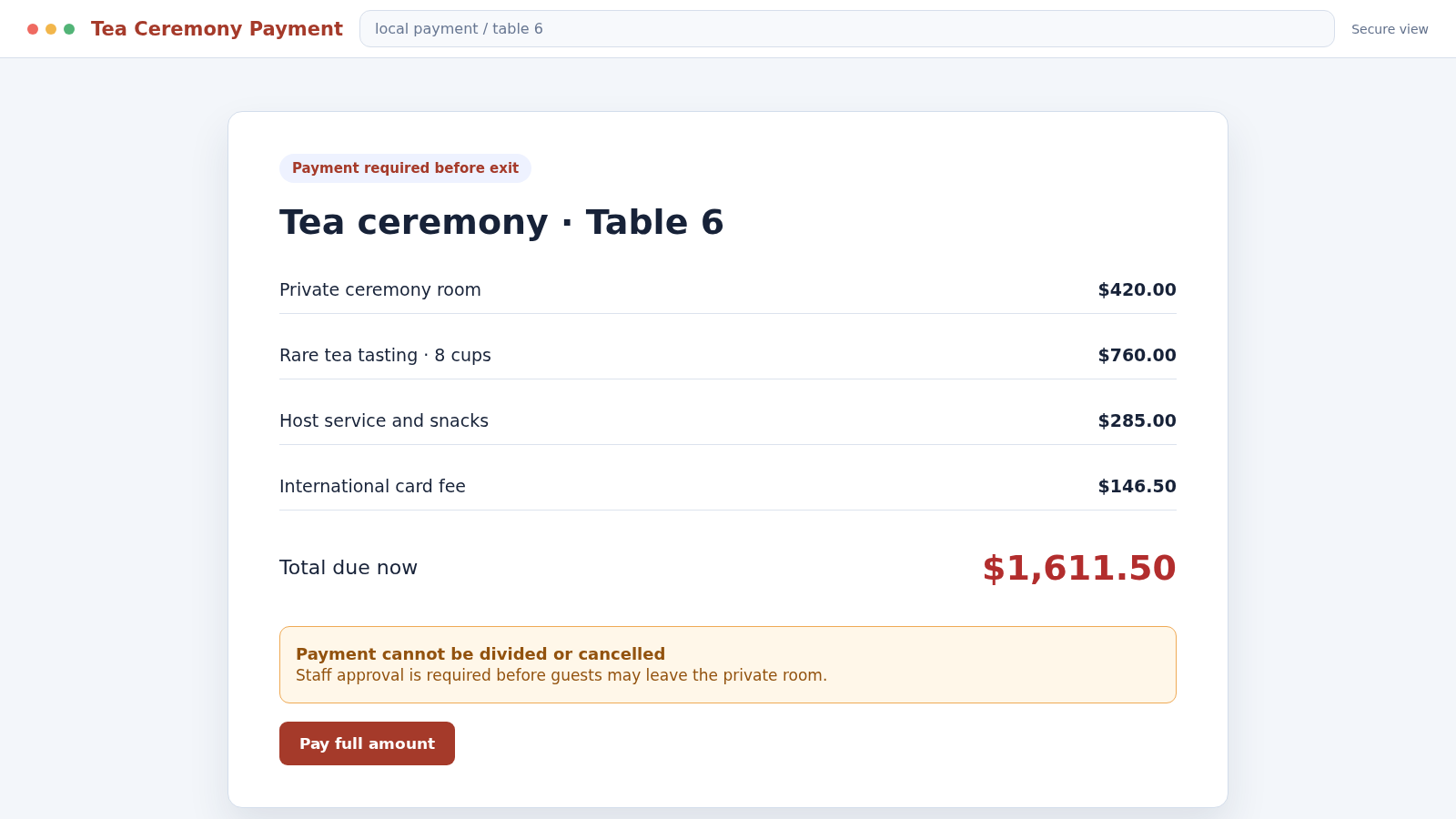
A menu may be missing, written only in unfamiliar terms, or shown briefly without explaining that every cup, pot, snack, room, or service has a separate charge.
The host orders on behalf of the group.
Several teas can be poured in small samples, making the quantity seem trivial. Premium labels and ceremonial language are later used to justify a bill far beyond an ordinary tasting.
Step 6: The companions change roles when the bill arrives
The friendly strangers may suddenly leave, claim they have no money, or argue that the tourist agreed to pay. Some pretend to contribute while secretly receiving their payment back later.
The social atmosphere turns transactional. Staff insist that every served item was accepted and that the total is fixed.
Step 7: Pressure and isolation force payment
The visitor may be told that police will be called, a passport will be reported, or leaving would constitute theft.
Staff can stand near the exit, raise their voices, or imply physical consequences.
The goal is to make paying feel safer than challenging the bill. Some victims are accompanied to an ATM or asked to try several cards until a transaction succeeds.
Step 8: Additional charges and card fraud can follow
A dishonest terminal may show one amount while a larger amount is processed, or the card can be charged more than once.
A copied card number may support later unauthorized transactions.
After the victim leaves, the approachers return to the tourist area. The venue can repeat the same process while each target assumes the encounter was spontaneous.
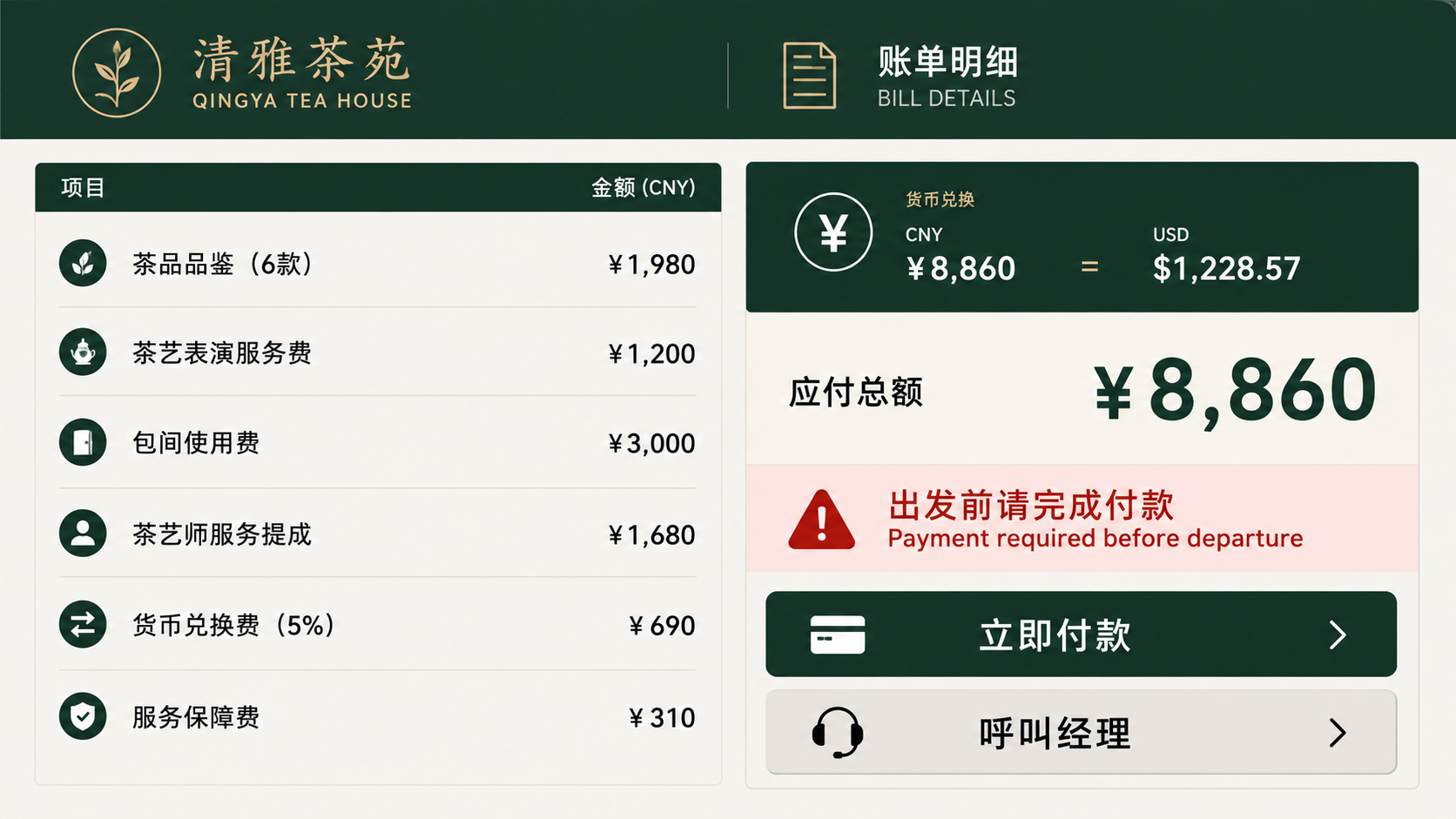
The bill screen turns a friendly invitation into a financial confrontation. Itemized ceremony fees, commissions, and conversion charges may appear only after service.
Company, Address, and Fulfillment Checks
Choose the venue yourself and save its exact address
Research a tea house through a trusted map, hotel, guide, or established travel source before visiting. Save the name and address in both English and the local language when possible.
A venue selected independently is easier to verify and share with someone else. Do not let a stranger substitute an unlisted room at the last moment.
Read a complete menu before ordering
Ask for the price of each person, tasting, pot, room, snack, service fee, and deposit. If the answer is unclear or keeps changing, leave before anything is served.
Do not rely on the host’s statement that it will be cheap. The business charging the card should confirm the total directly and in writing.
Keep payment under your control
Do not allow a card to be taken into another room. Read the amount on the terminal, select the correct currency option, cover the PIN, and keep the receipt.
Use transaction notifications and a conservative travel limit. If the displayed total differs from the agreed price, do not approve it merely to keep the conversation pleasant.
Confirm what was ordered and delivered
Ask staff to list every item before service begins. Reject unrequested refills, extra tastings, gifts, and performances that are presented without a price.
A real cultural experience can explain its package clearly. Confusion is not an unavoidable part of travel; in this scam, confusion is how the bill is manufactured.
What to Do While You Are Still Inside
Personal safety comes first. Stay calm, avoid physical confrontation, and do not make sudden movements if staff are blocking the exit or behaving aggressively.
State clearly that the prices were not disclosed and request an itemized bill. Do not sign an admission that you knowingly ordered high-priced services you did not understand.
If it is safe, contact local police and share the exact address. In China, the police emergency number is 110.
A hotel, embassy, consulate, or trusted local contact may also help with communication after you reach safety.
Do not surrender a passport as collateral. If physical safety requires payment, keep the receipt and document the scene once you can do so without escalating the situation.
How to Enjoy a Genuine Tea Experience Safely
Book through a reputable hotel, known tour operator, established venue, or recommendation you researched before the approach. Read recent reviews for unexplained bills and coercive sales.
Confirm the package price, duration, included teas, snacks, room charges, and cancellation conditions. Take a photo of the menu if local rules allow.
Tell a companion where you are going and avoid isolated venues when traveling alone. A genuine host will not object to a guest knowing the address and total price.
The safest rule is simple: do not follow a stranger who approaches near a tourist site to a business that stranger selected. You can be polite without accepting the invitation.
What to Do if You Have Fallen Victim to This Scam
- Get to a safe public place. Do not return alone to argue with the venue or approachers. Ask hotel staff, police, or a trusted local contact for help.
- Write down the location immediately. Record the business name, floor, street, nearby landmarks, time, and route. Details fade quickly and may be needed for a police or card report.
- Preserve the receipt and payment evidence. Save terminal slips, bank notifications, messages, photos, and an itemized bill. Do not edit original screenshots.
- Contact local police. Report coercion, confinement, threats, or fraudulent billing. Ask for a report number and a copy or proof of the complaint.
- Call the card issuer promptly. Explain that prices were concealed and payment was obtained under pressure. Ask about blocking the card, disputing the transaction, and monitoring for duplicates.
- Change a card PIN if it may have been observed. Follow the issuer’s instructions and review cash withdrawals or purchases made after the incident.
- Notify your travel insurer. Check deadlines and required evidence. Some claims require a police report, receipts, and proof that the bank was contacted quickly.
- Tell the hotel, guide, or tour operator. Local professionals may recognize the venue and help communicate with authorities. Their knowledge does not replace an official report.
- Secure accounts used on public Wi-Fi or a shared device. Change exposed passwords and review sessions. If you downloaded an unknown file or app, run a full Malwarebytes scan.
-
Block deceptive travel links.
AdGuard can help block many phishing pages and malicious ads encountered while researching bookings or responding to follow-up messages. - Contact your embassy or consulate if needed. Consular staff can explain local reporting options and provide lists of local resources, especially when documents or personal safety are involved.
- Reject refund agents who contact you. Anyone promising guaranteed recovery for an upfront payment may be targeting victims again. Work through the bank, insurer, police, and verified legal channels.
Frequently Asked Questions
Are tea ceremonies in China scams?
No. Tea culture and legitimate tea houses are real. The scam is the coordinated stranger invitation, hidden pricing, inflated bill, and coercion, not the cultural experience itself.
Where does the China tea house scam happen?
Official travel advisories warn about it in popular tourist areas, including locations in Beijing and Shanghai. Similar bar, massage, and art-gallery versions can appear elsewhere.
What should I say to the person inviting me?
A brief “No, thank you” while continuing toward your planned destination is enough. Do not debate the offer or follow the person merely to avoid seeming rude.
Should I pay if staff block the exit?
Prioritize immediate safety and avoid a physical confrontation. Try to contact police, request an itemized bill, and document the payment. If you pay under pressure, report it promptly afterward.
Can my bank reverse an inflated tea house charge?
A reversal is not guaranteed. Contact the issuer quickly and provide the receipt, police report, hidden-price explanation, duplicate charges, and evidence of coercion or a mismatched terminal amount.
How can I book a real tea tasting?
Choose and research the venue yourself, confirm the full price in advance, and book through a reputable provider. Do not let an unsolicited street contact control the destination.
The Bottom Line
The China tea house scam begins with friendliness because an obvious threat would never get the visitor through the door.
The hidden price and pressure only appear after the target has been isolated inside a cooperating venue.
Enjoy local culture on your own terms. Choose the business independently, confirm every price before service, and leave when a stranger insists on one specific venue.

Join the discussion
0 commentsShare your experience or ask a question about this article.
Discussion
Start the conversation
Have a question or something useful to share? Add the first comment.