

A message from a 236 number looks close enough to home to deserve a reply. It may mention a delivery, unpaid road fee, bank alert, job offer, or simply ask whether you are still free for dinner.
The 236 Area Code scam is not one campaign and the number itself is not proof of fraud. The danger comes from the familiar-looking caller ID and the story that follows.
Overview
236 is a legitimate British Columbia area code
Area code 236 is part of Canada’s telephone system and serves British Columbia as a province-wide overlay. Real residents, businesses, schools, clinics, and public agencies can use numbers beginning with it.
Receiving a call from 236 does not mean the person is a scammer. It also does not prove the caller is in British Columbia, because displayed numbers can be spoofed and internet calling services can issue numbers without a local physical presence.
Local familiarity is the first layer of persuasion
People are more likely to answer a number that resembles their own community or a nearby province. Fraudsters take advantage of that reflex when sending bank alerts, delivery texts, government threats, investment introductions, and wrong-number messages.
The area code is only the costume. A safe decision depends on what the caller asks you to do, whether the claim can be independently confirmed, and where any link or payment actually leads.
Several different scams can share the same caller ID
A 236 Area Code scam may be a short phishing attempt or the beginning of a relationship that lasts for weeks. Common versions include:
- Wrong-number texts that develop into investment fraud
- Fake parcel and unpaid toll notices with phishing links
- Bank security alerts requesting login details or an OTP
- CRA, police, court, or immigration impersonation calls
- Family emergency messages demanding a quick transfer
- Remote job and task offers that require a deposit
- One-ring calls intended to trigger a curious callback
- Robocalls selling questionable services or collecting leads
No honest caller should object when you pause and verify through an official channel. Urgency, secrecy, and irreversible payment methods matter much more than the digits at the top of the screen.
Why Caller ID Cannot Prove Who Is Calling
Caller ID was designed to display routing information, not to act as a verified identity card. Some telephone systems allow the calling number to be set or altered, and criminals abuse that flexibility to display a local business, bank, police station, or ordinary household number.
The innocent subscriber whose number appears may know nothing about the calls. Returning the call can reach a confused person rather than the fraud operation because the displayed number was never the scammer’s real line.
Text messages can also come from disposable or internet-based numbers that look local. A number being able to receive replies does not show that its user lives in the service area.
Do not rely on the caller knowing your name, address, bank, or relatives. Data brokers, public records, social profiles, breached accounts, and earlier scams can provide enough personal information to make a cold call sound targeted.
The strongest verification is a separate contact that you initiate. Close the message, find the organization through its official website or a statement you already trust, and call or sign in through that known route.
How the 236 Area Code Scam Works
Step 1: A local-looking call or text gets attention
The campaign begins with caller ID showing 236 and a seven-digit number. For someone in British Columbia or nearby, it feels more relevant than an unfamiliar international call.
The first contact may be deliberately vague. A missed call, “Are you busy?”, or “Your package needs attention” invites the recipient to supply context by replying.
Step 2: The scammer tests whether the line is active
A reply confirms that a person reads the messages. The response may also reveal language, time zone, temperament, and willingness to continue a conversation.
In a robocall campaign, answering can route the number to a live agent. In a wrong-number scheme, a friendly apology becomes an excuse to keep chatting.
Step 3: A believable identity is introduced
The sender may claim to be a courier, bank employee, CRA officer, recruiter, police investigator, business owner, or accidental texter. Logos and familiar local references help the identity feel ordinary.
Scammers often avoid immediately asking for money. They first create a reason for the recipient to trust the next link, call, or conversation.
Step 4: Urgency or friendliness weakens verification
Transactional scams use a deadline: the parcel will be returned, the card will be locked, or legal action begins today. Relationship scams use warmth, compliments, and steady daily messages instead.
Both methods reduce the chance of independent checking. One rushes the victim; the other makes verification feel rude after trust has formed.
Step 5: The conversation moves to a controlled channel
A phishing text leads to a website controlled by the sender. A longer conversation may move to WhatsApp, Telegram, or another encrypted service where accounts are easy to replace.
The new channel can hide the original number and make platform reporting more difficult. It also lets the criminal share files, investment dashboards, QR codes, and voice messages.
Step 6: Information or money is requested
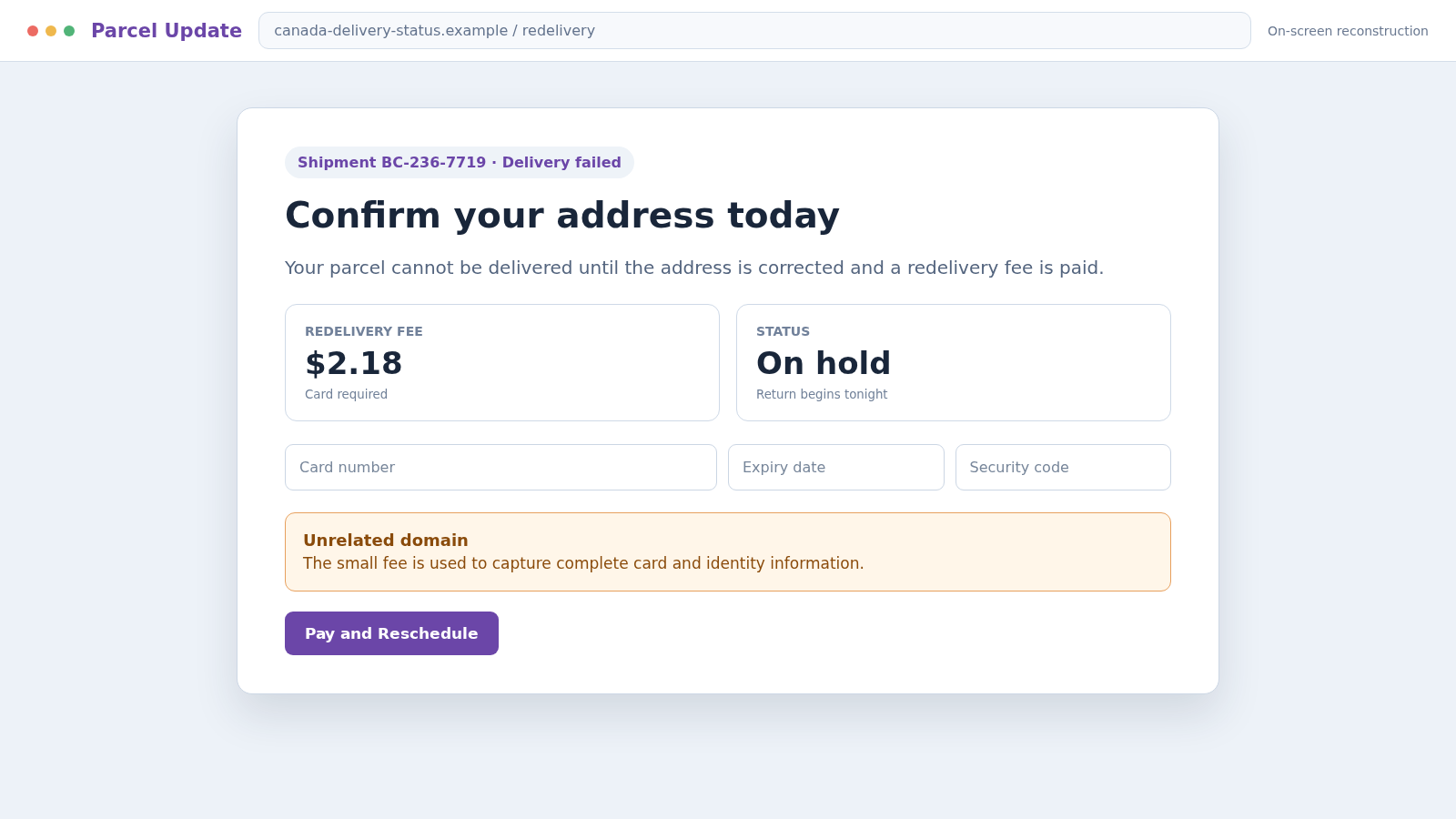
A delivery page asks for a small redelivery fee and captures card details. A bank alert requests credentials and an OTP. A government caller demands gift cards, cryptocurrency, or a transfer.
In a wrong-number investment scheme, the victim is shown supposed profits and encouraged to deposit into a trading platform. The displayed balance is controlled by the scammer and may not represent real assets.
Step 7: A small success leads to a larger demand
A tiny card charge verifies that payment information works. A small investment may appear to earn a quick return. A first withdrawal might even be allowed to build confidence.
The next request is larger. Shipping insurance, account tax, security verification, or a premium investment opportunity is introduced after the victim has already committed.
Step 8: The number disappears and follow-up scams begin
Once challenged, the caller blocks the victim or abandons the number. Another account may then claim to be a bank investigator, refund service, or recovery expert.
Information entered on the first page can make the second approach more specific. A scammer who knows the delivery story and card issuer can sound like someone responding to the incident.
Common 236 Scam Stories and Their Real Warning Signs
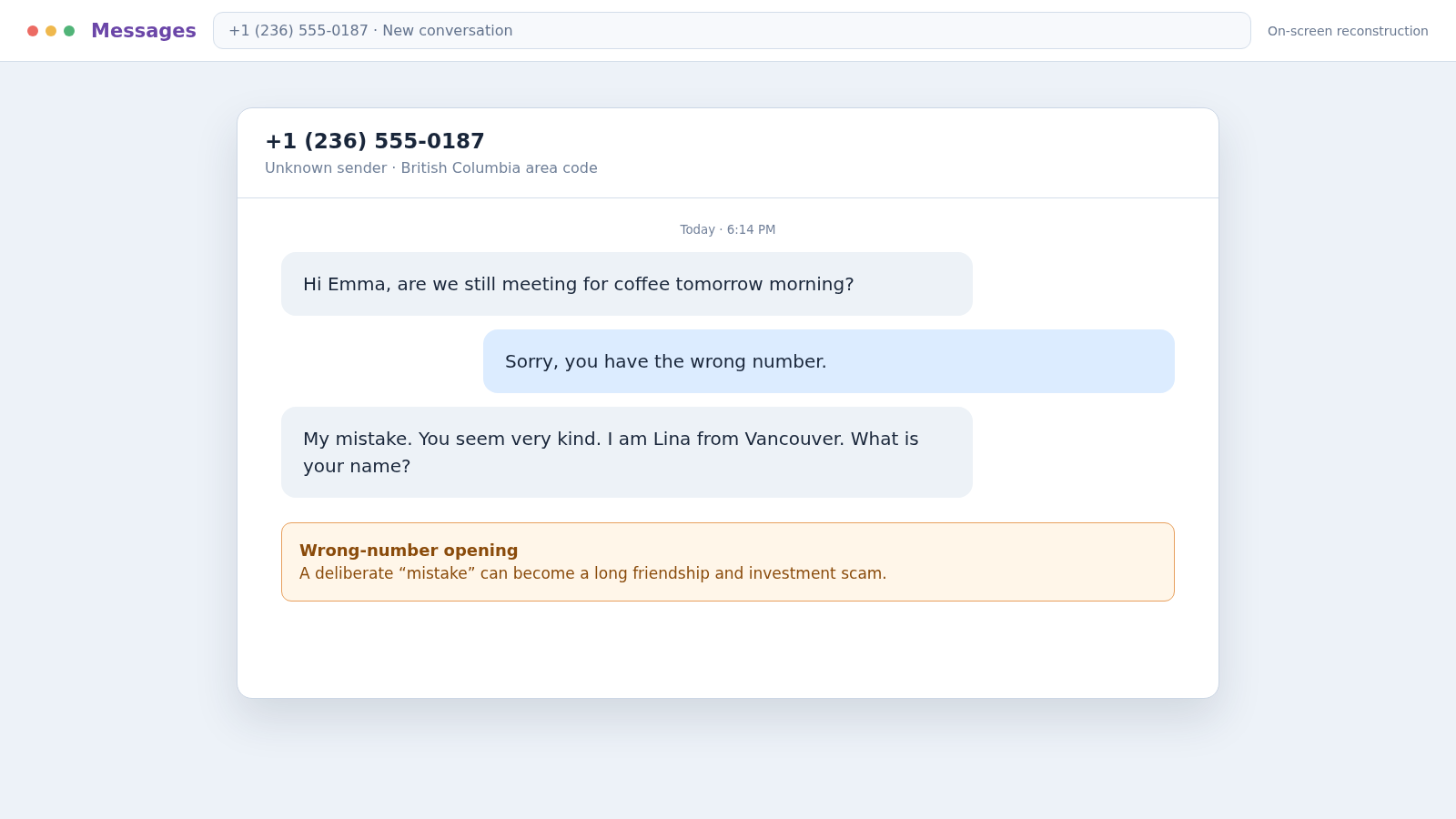
The wrong-number conversation
A stranger asks for someone else, apologizes, then continues chatting. Over days, the sender shares lifestyle photographs, business stories, and investment results before introducing cryptocurrency or a private trading platform.
A genuine wrong number ends when the mistake is explained. Persistent friendship with an unknown person, especially one that turns toward money, is a classic social-engineering path.
The delivery or toll text
The message claims a parcel cannot be delivered or a small road fee remains unpaid. A short deadline and low amount encourage the recipient to enter card details without examining the domain.
Open the courier or road authority’s official app or website independently. A real account will show the notice without requiring the link in the text.
The bank fraud alert
A text or call describes a transaction and offers a fast cancellation route. The supposed agent asks for a password, one-time code, remote access, or a transfer to protect funds.
Call the number printed on the card or sign in through the banking app already installed. A real fraud team does not need the full online banking password or a transfer into a stranger’s account.
The government or police threat
The caller alleges unpaid taxes, an arrest warrant, immigration trouble, or a missed court appearance. Immediate payment is demanded through gift cards, crypto, wire, or a payment app.
Government processes do not disappear because a person buys gift cards during a surprise call. End the conversation and contact the agency through its official public directory.
The family emergency
A voice says a child or grandchild has been injured, arrested, or kidnapped. Artificially generated or stolen audio may imitate someone familiar, while a second caller poses as a lawyer or officer.
Call the relative using a saved number and contact another family member. A private family password can help when a caller tries to turn panic into immediate payment.
Should You Call an Unknown 236 Number Back?
A legitimate caller may leave a useful voicemail identifying the organization, purpose, and a way to verify the contact. Silence, a one-ring call, or a vague demand gives you no reason to return the call.
Area code 236 is within the North American Numbering Plan, so it is not automatically an overseas premium-rate destination. Charges depend on your telephone plan, the actual routing, and any service reached after connection.
The larger risk is entering a live scam conversation. A callback confirms interest and gives the operator another opportunity to create urgency, request information, or direct you to a fraudulent payment.
If the voicemail claims to represent a bank, courier, government office, clinic, or employer, locate that organization’s number yourself. Do not use the callback number merely because it appears in a local area code.
Company, Address, and Fulfillment Checks
Identify the legal organization behind the claim
Ask for a full company or agency name, department, reference number, and physical address. Then locate the organization through a trusted directory rather than using details supplied by the caller.
Call a number you obtained independently
Use the number printed on a bank card, official statement, government domain, or prior contract. Ask whether the specific transaction, parcel, case, or employee exists.
Inspect the destination behind every link
Read the registered domain carefully. A brand name placed before or after an unrelated domain does not make the page part of the real company.
Confirm the promised service or delivery in the real account
Open the official app or type the website address yourself. Genuine orders, account alerts, bills, and appointments should have a record that does not depend on the suspicious message.
How to Handle Suspicious Calls and Texts Safely
Let unknown calls go to voicemail. A real caller with a legitimate purpose can leave details, while a robocall often disconnects or provides only a pressure-filled callback number.
Do not reply merely to ask who is there. If the message claims to know you, require the sender to identify the relationship without feeding it names or facts.
Never share an OTP, password, PIN, card security code, or screen. A person who initiated contact cannot prove identity by asking you to surrender the very control protecting the account.
Forward spam texts to 7726 when supported by your carrier, then block the number. Reporting helps carriers identify patterns, although criminals can rotate or spoof numbers quickly.
Enable transaction alerts, account login notifications, and call filtering. These controls do not replace verification, but they reduce the time between an unauthorized action and your response.
What to Do if You Have Fallen Victim to This Scam
- End communication immediately. Stop replying, leave the messaging group, and block every account. Do not send a final payment to release funds or prove that you are honest.
- Contact the financial provider. Report card details, transfers, gift cards, or payment-app transactions through an official channel. Ask about blocking, replacement, recall, and dispute options.
- Secure exposed accounts. Change compromised passwords from a trusted device, begin with email, end unfamiliar sessions, and enable strong multifactor authentication.
- Protect identity information. If identity documents or an SSN were shared, use IdentityTheft.gov to build a recovery plan and consider credit freezes.
- Remove suspicious software. Uninstall remote-access apps and unknown profiles, then scan the device with Malwarebytes for credential stealers and unwanted programs.
- Revoke browser permissions. Remove notification access, extensions, and saved passwords associated with the fraudulent site. AdGuard may help block reported phishing and redirect domains going forward.
- Save evidence. Keep screenshots, complete numbers, voicemails, domains, messages, receipts, beneficiary details, and the timeline. Do not rely only on a contact name that can change.
- Report the incident. Notify the Canadian Anti-Fraud Centre when appropriate, the impersonated organization, your carrier, local police for serious losses, and ReportFraud.ftc.gov if the scheme affected you in the US.
- Warn contacts. Tell relatives if the criminal accessed an account or learned family details. Ask them to verify unexpected money requests through a different channel.
- Expect follow-up attempts. Refund agents and fake investigators may contact you using details from the original scam. Do not pay anyone who promises guaranteed recovery.
Frequently Asked Questions
Is every call from area code 236 a scam?
No. It is a real British Columbia area code used by legitimate people and organizations. Evaluate the request and verify the caller rather than blocking an entire region.
Where is area code 236 located?
It is a province-wide overlay serving British Columbia, Canada. A displayed 236 number still does not prove that the caller is physically located there.
Can scammers spoof a 236 number?
Yes. Caller ID can be manipulated, and internet telephone services can issue numbers remotely. The number shown on the screen is not reliable identity evidence.
Does replying STOP make the scam end?
For a clearly fraudulent message, blocking and carrier reporting are safer than engaging. Reserve STOP replies for legitimate marketing senders you recognize, because a scammer does not follow opt-out rules.
What if the caller knew my address and bank?
Personal information can come from breaches, public records, or data brokers. Contact the bank through the number on your card and do not disclose any additional details to the caller.
Can I recover a payment sent after a 236 scam call?
Recovery depends on the method and timing. Contact the bank, card issuer, gift-card company, crypto platform, or payment app immediately and provide complete transaction evidence.
The Bottom Line
The 236 Area Code scam uses a familiar-looking Canadian number to make many different stories feel local. The digits may be spoofed, remotely issued, or attached to an ordinary number that criminals will abandon.
Do not judge a call by its area code. Judge the request, refuse urgency and secrecy, and contact the claimed organization through a route you already trust before clicking, sharing a code, or sending money.

Join the discussion
0 commentsShare your experience or ask a question about this article.
Discussion
Start the conversation
Have a question or something useful to share? Add the first comment.