

The email does not begin with a lottery, emergency, or obvious promise of easy cash. It sounds like a restrained introduction from a financial consultant who wants to discuss funding for a serious project.
The Michael Williams Lotus scam uses that professional tone to invite business plans and sensitive records into an unverified relationship. The risk grows quietly after the first reply.

Overview
An unsolicited consultant offers access to international lenders
The reported email identifies the sender as “Michael Williams,” a Senior Financial Consultant at “Lotus Consults.” It claims the organization connects selected clients with lenders that provide low-interest financing for personal, business, or project needs.
The recipient is invited to submit a business plan and executive summary to michael.williams@lotusconsults.org. The message uses flattering language about high-caliber clients and funded realities, but offers little verifiable information about the actual firm or lender.
The first request may be information rather than money
The Michael Williams Lotus scam is dangerous because the opening email can seem like harmless networking. A business plan may reveal names, addresses, forecasts, customer information, banking relationships, intellectual property, and the amount of funding a target needs.
Once the recipient responds, the sender can ask for identity documents, company registration files, bank statements, tax records, or a fee supposedly required to move the application forward.
A polished signature is not proof of a financial business
A title such as Senior Financial Consultant carries no automatic verification. Neither does a custom email domain, a professional signature, or a description of a worldwide lending network.
The warning signs in the reported solicitation include:
- The recipient did not request funding from this person or firm.
- The message is broad enough to fit many businesses and projects.
- No named lender, licensing record, office, or transaction history is established.
- The sender asks for valuable commercial information before basic verification.
- The domain in the address must be researched independently, not trusted because it looks corporate.
- A later request for processing, insurance, tax, compliance, or release fees would fit an advance-fee pattern.
A genuine adviser should welcome reasonable due diligence. Anyone who pressures a recipient to send documents before the firm can be verified is reversing the order of a safe business relationship.
What the Reported Funding Email Says
The subject line refers to exploring funding opportunities for the recipient’s project. The sender introduces himself as a senior consultant and says his firm specializes in connecting carefully selected clients with lenders around the world.
The offer avoids a specific loan amount or guaranteed approval. That restraint can make it sound more credible than a message promising instant financing to everyone.
The email asks the recipient to share a business plan and executive summary so the supposed consultant can determine whether the proposal aligns with a network of investors. It does not first identify a regulated lender, explain underwriting criteria, or provide formal disclosures.
This is an important distinction. A real financing discussion includes mutual verification. The applicant evaluates the firm while the firm evaluates the applicant.
In a scam, evaluation flows in one direction. The recipient supplies increasingly sensitive information while the supposed consultant remains a name, title, domain, and story.
Why Business Owners Can Be Vulnerable to This Pitch
Funding is often difficult, slow, and personal. A small company may be trying to cover inventory, payroll, equipment, expansion, or a temporary cash shortage when the email arrives.
The sender does not need to promise impossible riches. Offering a lower interest rate, flexible lender, or introduction to private capital can be enough to start a conversation.
Flattery also lowers resistance. Calling the recipient’s project high-caliber suggests that someone has already noticed its potential, even when the message contains no detail showing that the project was actually researched.
A scammer can then mirror the target’s own language. Information from a website, pitch deck, or reply helps the next email sound specific and informed.
Confidentiality can make the target less likely to seek advice. The sender may describe the funding source as private, invite-only, or available through a discreet family office.
None of those labels proves fraud by itself. The concern is the combination of cold outreach, unverifiable credentials, one-sided disclosure, and a financial request that appears before independent checks are complete.
What the Sender May Request After You Reply
Commercial plans and internal financial information
A business plan can disclose revenue, expenses, financing needs, suppliers, customers, growth plans, and competitive weaknesses. Criminals can use those details for tailored fraud or sell them to other operators.
Identity and company records
The supposed compliance process may request passports, driver’s licenses, tax numbers, corporate filings, utility bills, or beneficial-owner information. Those records can support identity theft and fraudulent account applications.
Bank statements and payment instructions
A fake underwriter may ask for bank statements to prove cash flow, then use the account and transaction information for impersonation. Instructions for an incoming loan can also be used to introduce altered wire details.
An advance fee with a professional label
The charge may be called due diligence, insurance, legal review, notarization, tax clearance, anti-money-laundering verification, or a lender commitment fee. The label changes, but the target must pay before receiving the promised financing.
The FTC’s guidance on advance-fee loans warns that a promise of credit tied to an upfront processing or insurance payment is a classic scam pattern.
How the Michael Williams Lotus Scam Works
Step 1: A broad funding offer reaches a business contact
The sender may collect addresses from company websites, professional directories, public filings, networking platforms, or purchased lists. The email does not need to know whether the recipient is actively seeking capital.
Its wording is flexible enough to fit a startup, property project, established company, or personal financing request.
Step 2: A senior title and private network create authority
The signature presents an impressive role and a consultancy name. References to vetted lenders, international investors, and competitive rates make the sender sound connected.
No credential should be accepted from the signature alone. The person, firm, and regulated activity must be checked through sources outside the email.
Step 3: The recipient is asked to reveal the project
The first reply may contain only an executive summary, but it tells the sender what the target wants, how much funding is needed, and which details will make a follow-up convincing.
The criminal can now write a tailored response that appears to reflect a real review.
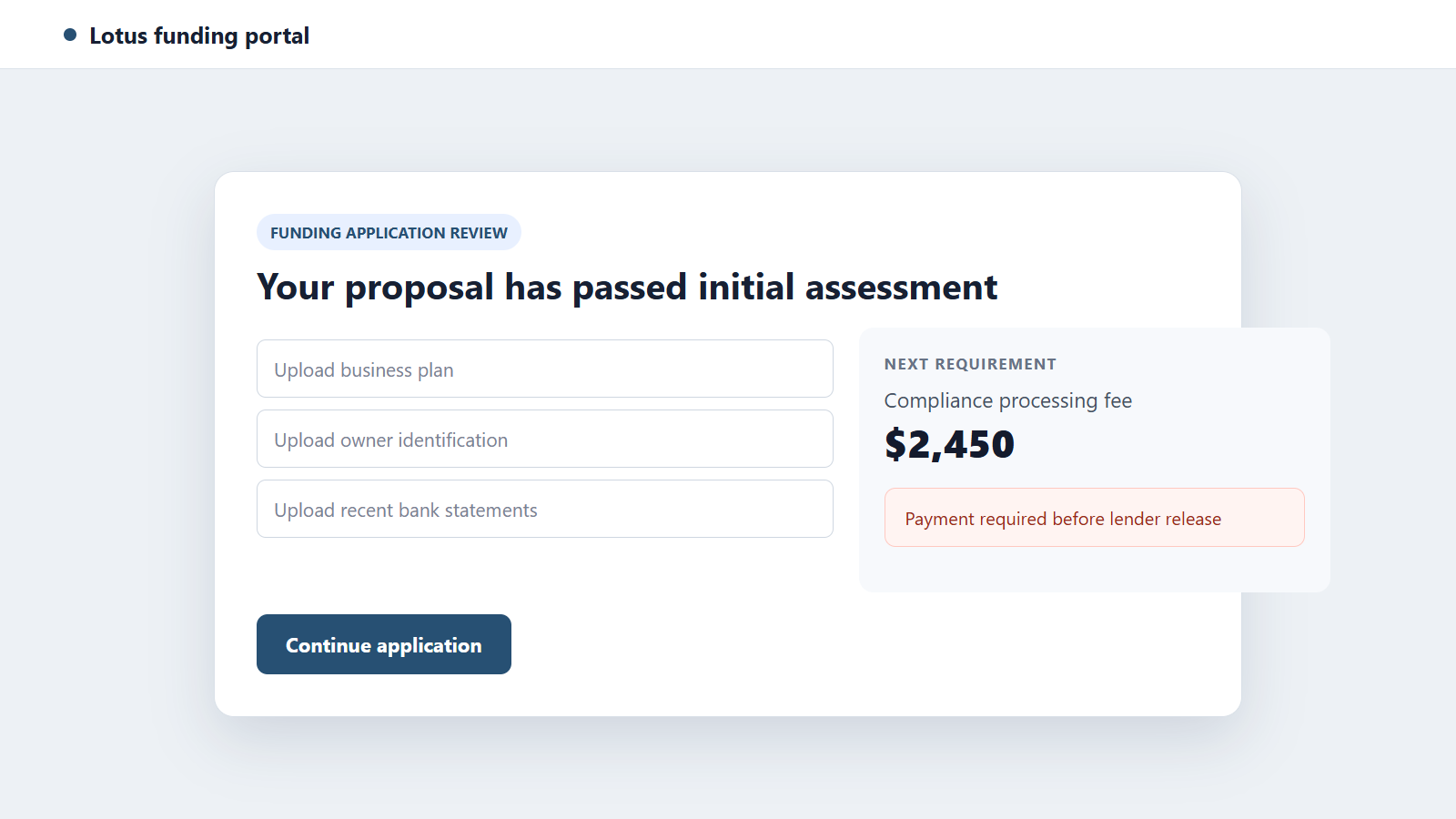
Step 4: A favorable assessment arrives quickly
The supposed consultant says the project fits an investor’s mandate or has passed an initial assessment. The approval may praise the plan while avoiding questions a real underwriter would ask.
A letter of intent, term sheet, lender profile, or account portal can be fabricated to give the process weight.
Step 5: Due diligence collects sensitive records
The applicant receives a checklist for identification, ownership, tax, banking, and financial documents. Each request is framed as a normal compliance requirement.
Real lenders do perform due diligence, which is why the firm must be verified before documents are uploaded or emailed.
Step 6: A fee appears before the financing can close
The recipient is told that insurance, legal certification, document processing, or a cross-border clearance must be paid first. The fee may look small beside the promised loan.
Payment may be directed to an individual, unrelated company, cryptocurrency address, or bank account in a different jurisdiction.
Step 7: New obstacles follow each payment
After the first fee, another department discovers a tax, compliance hold, currency conversion, or release requirement. The promised funds remain visible in documents or a portal but never reach an account the victim controls.
Previous payment creates pressure to continue because walking away means admitting the earlier money may be gone.
Step 8: The operation disappears or becomes a recovery scam
When the victim stops paying, messages may end and the portal may vanish. Another person can later claim to be a lawyer, regulator, investigator, or asset-recovery specialist.
That second approach may use the documents already collected and demand a new fee to release or recover the nonexistent financing.
Company, Address, and Fulfillment Checks
The person must have a verifiable professional history
Search the full name with the claimed firm, location, licenses, and employment history. A common name can produce unrelated results, so matching only the name proves nothing.
For securities-related services in the U.S., FINRA BrokerCheck can help verify registration and professional background. Other lending or advisory activity may require different federal or state checks.
The company must exist beyond its own website and domain
Find the legal entity name, registration number, owners, filing history, regulator, and official contact details. Compare those records with the email rather than using information supplied by the sender.
A custom domain and a digital certificate only show that someone registered a domain and encrypted the connection.
The address must connect to a real operating business
Verify the full office address through corporate and regulatory records. A residential property, mail drop, virtual office, shared suite, or address copied from another company requires further investigation.
Call a separately sourced number for the building or registered firm if the address is central to the claim.
The funding process must identify who delivers the money
Ask for the lender’s legal name, licensing jurisdiction, underwriting terms, full fee schedule, disbursement method, and account ownership. A vague network of investors is not a contracting party.
Review documents with an independent lawyer or financial professional before paying or signing. Do not use an adviser introduced by the person making the offer.
Questions to Ask Before Sending a Business Plan
- How did the sender identify this project, and what specific information did they review?
- What is the firm’s exact legal name, registration number, regulator, and physical office?
- Which lender would provide the funds, and where is that lender authorized to operate?
- Can the representative be reached through a telephone number found independently?
- Why are confidential documents required before mutual verification and a nondisclosure agreement?
- Will any fee be paid before funds are delivered, and who receives it?
- Does the payment account belong to the verified contracting company?
- Can an independent professional review the agreement without pressure or secrecy?
A legitimate opportunity does not become illegitimate because you slow down. If the offer collapses when you ask ordinary due-diligence questions, that result is useful.
How to Handle an Unsolicited Funding Email Safely
Do not reply with a pitch deck simply to see what happens. A response confirms that the address is monitored and gives the sender material for a more convincing approach.
Search the domain registration history, company records, licensing databases, address, telephone number, and distinctive sentences from the email. Conduct each search independently.
If the name resembles a real company, contact that company through its verified website and ask whether the person and offer are genuine. Do not forward confidential documents during that inquiry.
Remove sensitive details from any material shared during early, verified discussions. Customer lists, personal identity records, bank account numbers, signatures, and unpublished intellectual property do not belong in a cold-email response.
Keep colleagues involved. A second reader who is not emotionally invested in obtaining the funding may notice inconsistencies that the intended recipient overlooks.
What to Do if You Have Fallen Victim to This Scam
- Stop all contact and payments. Do not send a final fee to release, insure, refund, or recover the supposed financing. Preserve the conversation before blocking the sender.
- Contact the payment provider immediately. Ask the bank, card issuer, wire service, or cryptocurrency platform what recall, freeze, dispute, or tracing options remain available.
- Protect exposed company accounts. Change passwords for email, banking, accounting, cloud storage, and document platforms. Revoke unknown sessions and strengthen authentication.
- Tell the real organization being impersonated. Use independently verified contact details. The legitimate business may help confirm the fraud and warn other targets.
- Assess every document that was shared. List the identity, tax, banking, customer, employee, signature, and intellectual-property data exposed. Notify affected people when required.
- Warn the finance team. Criminals can reuse invoices, signatures, and payment patterns for business-email compromise. Require verbal verification of new bank details through a known number.
- Check devices for unwanted software. Run a full scan with Malwarebytes if an attachment, remote meeting tool, browser extension, or unknown application was opened or installed.
- Block malicious follow-up pages. AdGuard can reduce exposure to known phishing and advertising domains, but it cannot retrieve a payment or protect documents already sent.
- Report the fraud. File a report with the FTC, local police, relevant financial regulator, and any platform or hosting provider used by the operation. Include complete headers, domains, accounts, and receipts.
- Expect recovery impersonators. Treat unsolicited lawyers, investigators, or fund-recovery agents as unverified. Do not pay another fee or provide additional identity documents.
Frequently Asked Questions
Is Lotus Consults a verified lender?
The reported email does not establish a verified lender or regulated funding relationship. Confirm the exact legal entity, jurisdiction, licenses, and lender independently before sharing information.
Is michael.williams@lotusconsults.org a safe address?
A custom-domain address is not proof of legitimacy. The unsolicited message using that address has been reported as fraudulent, so do not reply or send documents.
Why would a scammer want my business plan?
It can reveal financing needs, owners, revenue, partners, customers, intellectual property, and language that supports more targeted fraud.
Do legitimate lenders ever charge fees?
Some real applications involve disclosed costs, but a guaranteed loan conditioned on an upfront processing or insurance payment is a major warning. Verify the lender and terms first.
Can a professional-looking term sheet be fake?
Yes. Logos, signatures, account portals, and legal wording can be copied or fabricated. Confirm every party and account outside the supplied documents.
What if I replied but sent no documents?
Stop responding, mark the message as spam, and watch for more tailored contact. The immediate risk is lower if no credentials, records, software, or payments were exchanged.
The Bottom Line
The Michael Williams Lotus scam uses the language of private finance to make cold outreach feel selective and professional. Its first objective may be information that supports a larger fraud.
Verify the person, legal company, regulator, lender, address, and payment route before sending a business plan. A real funding opportunity can withstand independent checks and careful review.

Join the discussion
0 commentsShare your experience or ask a question about this article.
Discussion
Start the conversation
Have a question or something useful to share? Add the first comment.