

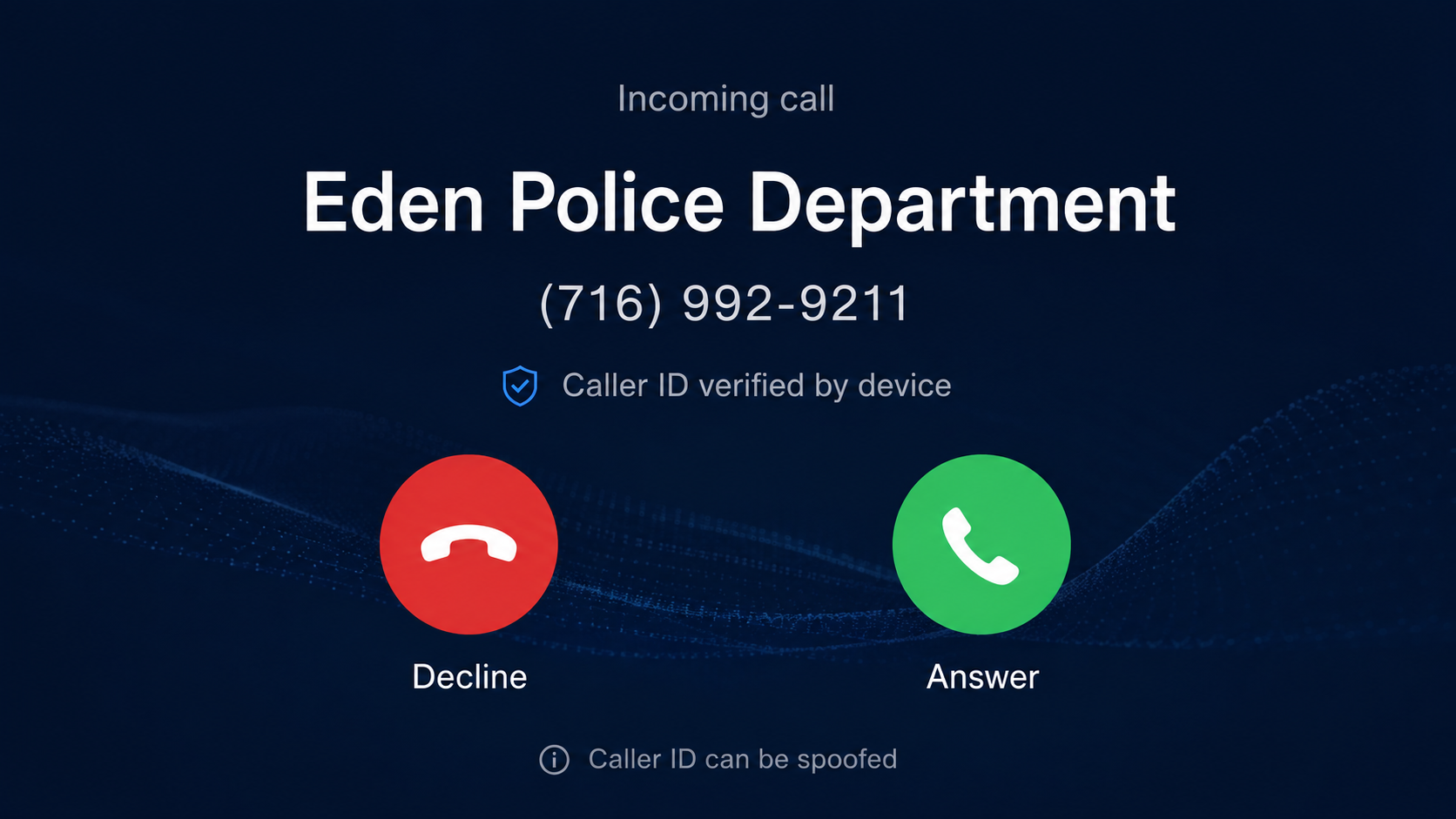
The number on the screen appears to belong to a police department. The caller knows your name, speaks with authority, and says a warrant will be issued unless the matter is handled before the call ends.
The 716-992-9211 police scam call exploits a real-looking local identity to make an invented emergency feel official. The caller ID is the first piece of evidence victims see, and it may be the least trustworthy.
Overview
What callers using 716-992-9211 may claim
Reports describe callers who make the screen display the Eden Police Department’s public number. The person may claim there is an arrest warrant, missed court obligation, unpaid fine, suspicious package, or criminal case connected to the recipient.
The caller offers a way to stop immediate action, usually by paying, confirming personal information, or staying on the line while following instructions. The story is designed to make independent verification feel dangerous.
Why the caller ID can look genuine
Caller ID spoofing lets criminals make a chosen name or number appear on a recipient’s screen. The FTC repeatedly warns that scammers can imitate local law enforcement and display a real department number.
The number itself can belong to a legitimate organization while the call is fraudulent. A screen showing 716-992-9211 therefore does not mean the call actually originated from the Eden Police Department.
What the scammer wants
The immediate goal may be money through gift cards, cryptocurrency, a payment app, cash, or wire transfer. Those routes are favored because they can move quickly and are difficult to reverse.
Some callers first collect a Social Security number, birth date, bank details, or account codes. Others ask the victim to install a remote-access application or visit a payment page, creating additional routes to identity theft.
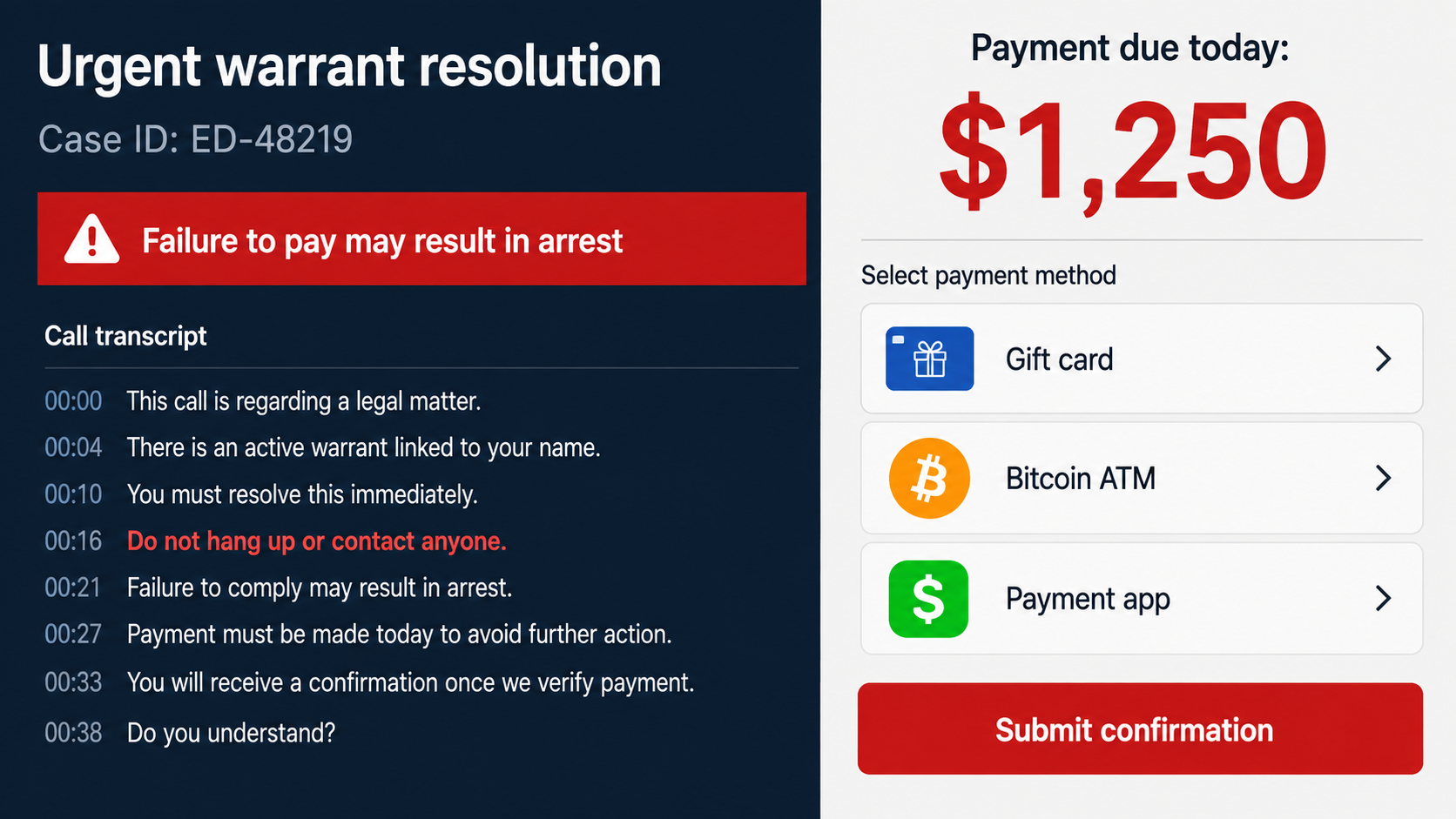
- The caller threatens arrest if you hang up or contact anyone.
- Caller ID shows a real law-enforcement name or public number.
- You are told to pay immediately to cancel a warrant or fine.
- The requested method is a gift card, Bitcoin ATM, payment app, cash, or wire.
- The caller demands secrecy from relatives, bank staff, or local police.
- You are asked to read back a code or provide sensitive identity details.
How the 716-992-9211 Police Scam Call Works
Step 1: The scammer prepares a believable local identity
The caller chooses a real department name and a public telephone number. Spoofing technology inserts that information into the caller ID data sent toward the recipient.
A criminal may also use names of real officers found online. Public addresses, court information, social profiles, and breached records can supply personal details that make the conversation sound researched.
None of that establishes where the call originated. Caller ID was built to display information, not to serve as proof of an officer’s identity.
Step 2: A frightening accusation removes time to think
The caller says you missed jury duty, ignored a court notice, owe a fine, or are linked to a package containing drugs, money, or weapons. The accusation is chosen to produce fear before questions begin.
A case number, badge number, supervisor name, or legal phrase may be offered. These details are easy to invent and can make a scripted call sound procedural.
The supposed deadline is immediate. If you hang up, the caller says officers will arrive, the warrant will activate, or the opportunity to resolve the case will disappear.
Step 3: The caller isolates the target
Victims may be told not to speak with family, legal counsel, police, or bank staff because the matter is confidential. The scammer might remain on the line while the victim drives to a store or payment location.
Isolation prevents a calmer person from challenging the story. It also stops the victim from calling the real department through a separately verified number.
A legitimate investigation does not depend on keeping you trapped in one unsolicited call. A demand for secrecy is evidence of control, not official procedure.
Step 4: Payment is framed as the only escape
The caller demands a “bond,” “citation,” “processing fee,” or “refundable security payment.” The label changes, but the promise is the same: pay now and avoid arrest.
Gift card numbers can be read aloud. Bitcoin can be sent through an ATM. Payment apps and wires move funds without a police counter, court clerk, or written order.
The FTC states that real law-enforcement officers do not call and insist on these payment methods as a way to avoid a crime. That request is a decisive scam indicator.
Step 5: The scammer guides the transaction
The criminal may tell the victim what to say if a cashier or bank employee asks questions. They can claim that honest warnings are part of an internal investigation or that disclosure will violate a court order.
At a Bitcoin ATM, the caller provides a wallet address or QR code. With gift cards, they demand the card numbers and PINs, which can be redeemed without holding the physical cards.
If a payment fails, the caller may split the amount into smaller transactions or move to another method. Continued instructions show that the objective is transferring money, not resolving a legal process.
Step 6: The demands continue after the first payment
Paying rarely ends the call. A new fee may appear for taxes, warrant cancellation, identity verification, or a second jurisdiction. The initial payment tells the criminal that fear is working.
Personal information collected during the conversation can fuel later identity theft. The victim may receive follow-up calls from fake investigators, banks, or recovery agents who already know details of the loss.
Once the target resists, the caller may become abusive or disconnect abruptly. The real department’s number has been misused, leaving both the victim and the legitimate agency to handle the confusion.
Company, Address, and Fulfillment Checks
Treat an incoming number as a label, not proof
A familiar area code, department name, or exact public number can be spoofed. Do not authenticate a caller using information supplied by the same call.
The FTC’s local law-enforcement impersonation warning says even a real officer name, real number, or knowledge of your address does not make the caller genuine.
End the call before verifying
Hang up without pressing a number or following transfer instructions. Wait a moment, then use the department’s official website or a trusted directory to locate its non-emergency contact.
Start a completely new call. Do not redial from recent calls, use a callback number provided in voicemail, or accept a transfer offered by the suspicious caller.
Ask the real agency about the claim
Explain that someone used the department’s displayed number and describe the accusation, payment method, case number, and caller name. The legitimate agency can confirm whether the story matches any real contact.
Do not use 911 merely to verify a financial demand unless there is an immediate safety emergency. Use the published non-emergency route for ordinary impersonation reports.
Check how real obligations are fulfilled
Courts and police departments use documented processes. They do not erase arrest warrants because someone reads gift card numbers, sends cryptocurrency, or transfers money to a personal payment account.
A real fine or court matter can be verified with the appropriate clerk or agency outside an unsolicited call. Written records and official payment channels should exist independently of the caller’s instructions.
What to Do During a Suspicious Police Call
The fastest protection is to break the caller’s control. You do not need to win an argument, prove innocence, or convince the person that you recognize the scam.
- Do not confirm your name, address, Social Security number, or account details.
- Do not read a verification code or install a remote-access application.
- Do not promise payment or travel to a store while remaining on the line.
- Write down the displayed number, time, claims, payment instructions, and callback details.
- Hang up and contact the agency through a number found independently.
- Tell a trusted person what happened before making any financial decision.
- Report spoofing and impersonation even when no money was lost.
If the caller knows private information, that can feel alarming. Data exposure is common, and knowing a detail is not the same as having lawful authority over you.
Callers may add realistic background sounds, hold music, radio chatter, or transfers to a supposed supervisor. These effects are part of the performance and do not connect the caller to a station.
A badge number or case identifier should also be treated as an unverified claim. Write it down, then let the real agency check it after you have ended the incoming call.
If the caller says a family member is in custody, contact that person directly and verify through a known local number. Do not allow the caller to choose every route of communication.
Bank and retail employees sometimes recognize unusual payment patterns. A scammer who orders you to lie to them is trying to disable another layer of protection.
Take threats seriously enough to verify, but not so literally that you surrender control. Ending the call does not create a warrant, increase a lawful fine, or block your right to contact counsel.
Community warnings can reduce future losses. Sharing the spoofed-number pattern without publishing a victim’s private data helps others understand why a familiar caller ID is not sufficient proof.
What to Do if You Have Fallen Victim to This Scam
- Stop every pending payment. End the call and contact the bank, card issuer, wire service, payment app, gift card company, or cryptocurrency exchange immediately. Ask whether the transfer can be frozen or recalled.
- Preserve the evidence. Save call logs, voicemails, screenshots, receipts, wallet addresses, payment usernames, card numbers, QR codes, and the caller’s claimed identity. Do not edit the originals.
- Report the impersonation locally. Contact the real department through its independently published non-emergency number. Explain that its identity and possibly its number were spoofed.
- Notify federal authorities. File the incident at ReportFraud.ftc.gov. Significant online or financial crime can also be reported through IC3.gov.
- Secure exposed accounts. Change passwords from a safe device, end unknown sessions, and enable multifactor authentication. Contact any institution whose security code was shared.
- Protect your identity. If you disclosed a Social Security number, identification image, or banking profile, use IdentityTheft.gov to build a recovery plan.
- Remove remote access. Disconnect the device if a caller controlled it. Uninstall remote tools, update the system, and run a complete Malwarebytes scan before using sensitive accounts again.
- Block malicious pages. AdGuard can help prevent connections to known phishing and tracking domains. It does not recover cryptocurrency, gift cards, or payment-app transfers already sent.
- Tell close contacts. Warn family members because criminals may reuse your information in an emergency or impersonation story aimed at them.
- Reject recovery callers. Anyone unexpectedly promising to recover the money for an upfront fee may be running a second scam. Work only with the original payment provider and verified authorities.
Frequently Asked Questions
Does 716-992-9211 belong to a real police department?
The number has been publicly associated with the Eden Police Department. That does not authenticate an incoming call because criminals can make a real number appear on caller ID.
Use independently published contact information to call the department yourself. The call you initiate is the point where verification begins.
Can caller ID really copy an exact police number?
Yes. Spoofing can display a chosen number or organization name. The person calling may be located elsewhere and have no connection to the identity on the screen.
Treat caller ID as a convenience feature. It should never override suspicious behavior or a demand for immediate secret payment.
Will police call about a warrant?
Procedures vary, but real law enforcement does not demand gift cards, cryptocurrency, payment-app transfers, or cash to prevent arrest during an unsolicited call.
If you are worried about a legitimate matter, end the call and contact the department or court independently. You do not lose that option by hanging up.
What if the caller knew my address or part of my Social Security number?
Scammers can obtain personal details from public records, marketing databases, stolen mail, previous scams, and breached data. Knowledge creates credibility but not authority.
Do not confirm the rest. If sensitive identity data was disclosed, monitor credit and follow the appropriate recovery steps.
Can gift card or cryptocurrency payments be reversed?
Recovery is difficult, but contacting the provider quickly is still worthwhile. Keep receipts and transaction identifiers, and ask about fraud procedures before assuming nothing can be done.
Never pay an outside recovery service that guarantees a refund. Guaranteed recovery paired with an upfront fee is a familiar follow-up trap.
Should I call the displayed number back?
Do not rely on the recent-call entry. Find the agency’s official contact information through an independent source and dial it manually.
Tell the real department that its number may have been spoofed. That helps the agency warn residents and document the campaign.
The Bottom Line
The 716-992-9211 police scam call borrows the credibility of a real-looking department number and combines it with arrest threats, secrecy, and irreversible payment methods.
Caller ID cannot prove who is speaking. Hang up, find the official non-emergency number independently, and verify the story outside the call that created the fear.
If money or information was shared, move quickly across payment recovery, account security, identity protection, and official reporting. Do not let embarrassment give the impersonator more time.

Join the discussion
0 commentsShare your experience or ask a question about this article.
Discussion
Start the conversation
Have a question or something useful to share? Add the first comment.