

An unexpected recruiter says a company needs help with simple online optimization work. The pay is unusually generous, the schedule is flexible, and the first tasks seem almost too easy to count as work.
The offer may be called a cron job, product boosting, app optimization, or data submission. Whatever label appears, the real test comes when the platform says you must pay before you can collect what you supposedly earned.
Overview
What the cron job task scam promises
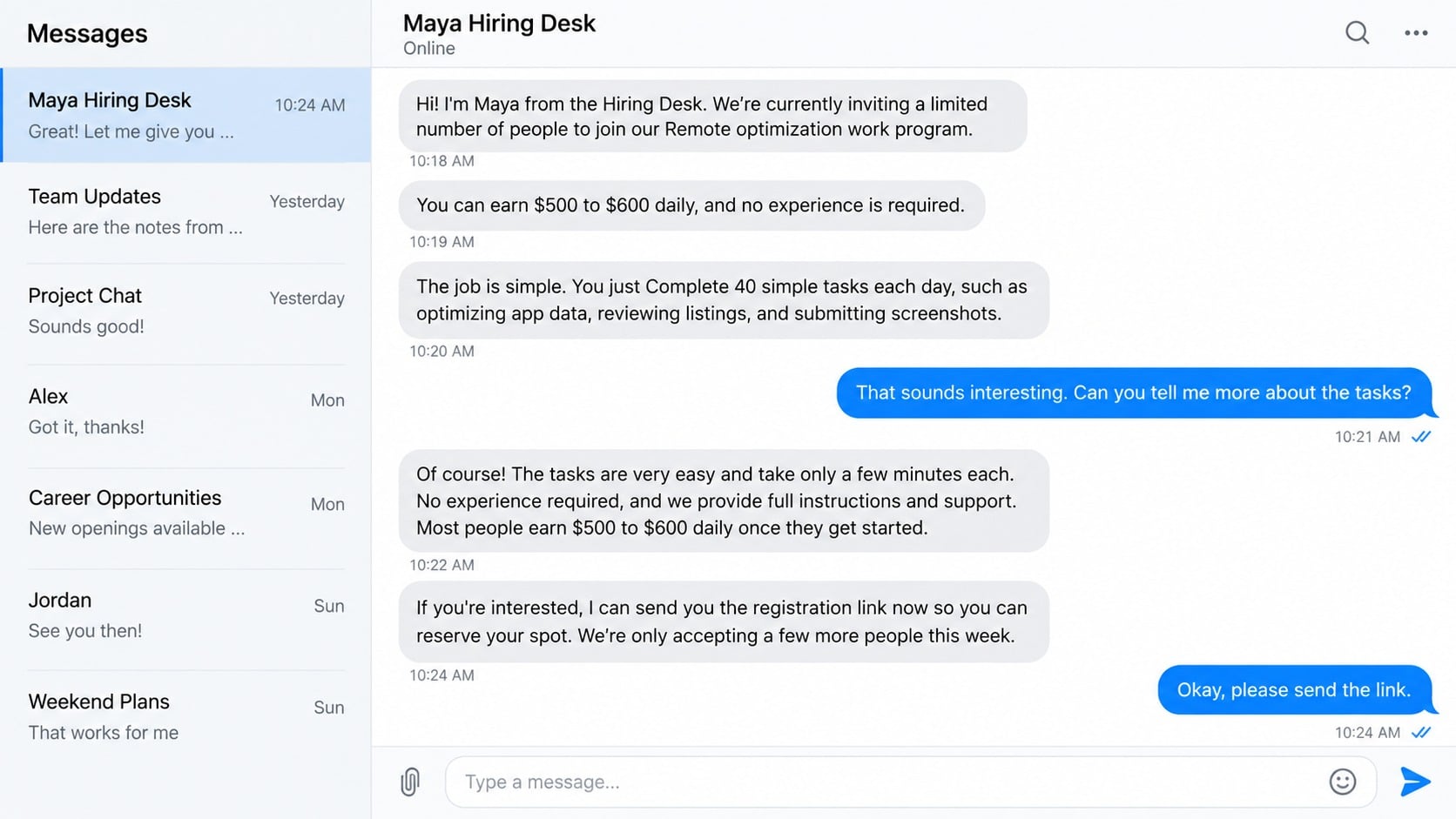
The pitch describes remote work that anyone can perform from home. Tasks may involve clicking through products, rating items, submitting app data, confirming orders, or pressing an optimization button a fixed number of times.
Some recruiters misuse the technical phrase cron job to make the opportunity sound connected to automated computing. A real cron job is a scheduled command on Unix-like systems. It is not a category of paid consumer work that requires deposits to release wages.
Where the money trap appears
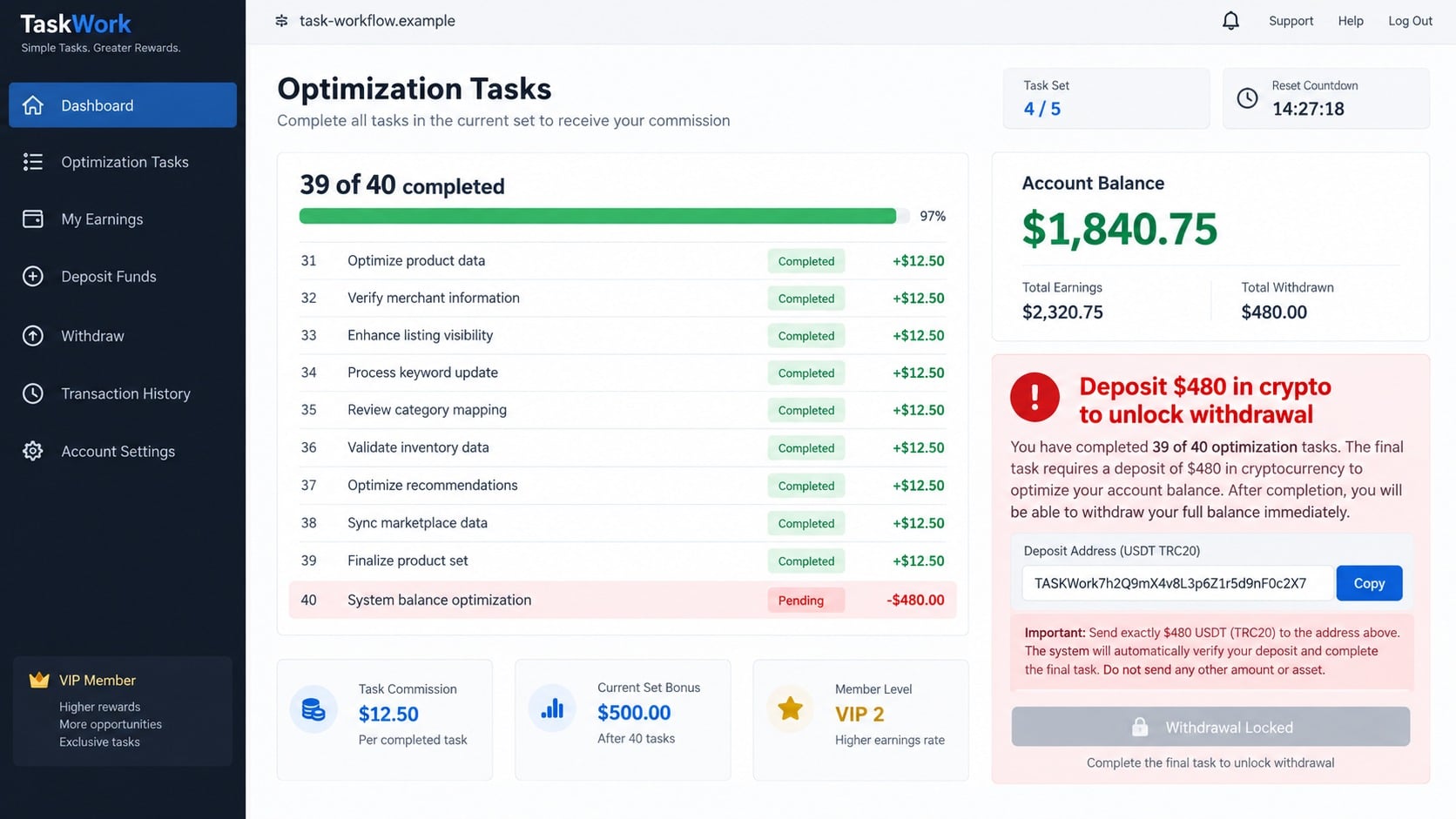
The platform displays commissions after each click, but the balance exists only inside a website or app controlled by the operators. Near the end of a task set, the account receives a negative balance, premium order, or combination task that supposedly must be funded.
Victims are told to send cryptocurrency or another hard-to-reverse payment. One deposit leads to another: tax, verification, credit score repair, account upgrade, or withdrawal fee. The growing on-screen balance is used to justify sending more real money.
Fast warning signs
Legitimate employers do not make workers finance routine tasks. Treat the offer as a scam if several of these details appear:
- The first contact arrives unexpectedly through text, WhatsApp, Telegram, or social media.
- The recruiter promises $500 or more each day for repetitive clicks.
- No interview, skills check, tax paperwork, or verifiable employment agreement is required.
- You must complete a daily set, often 30 or 40 tasks, in a specific order.
- A surprise negative balance can be cleared only by depositing your own money.
- Payment must be sent in cryptocurrency to a wallet supplied in chat.
- Support says a withdrawal is pending but demands another fee first.
Why the Word “Cron” Does Not Make the Job Technical or Legitimate
In computing, cron is a tool administrators use to run scheduled commands. A server might use it for backups, reports, maintenance, or other recurring processes. The person configuring it is paid for technical work; they do not repeatedly click product cards and add funds to unlock a commission.
Scammers borrow unfamiliar terminology because it discourages questions. A new worker may assume that negative balances, task combinations, or pre-funded orders are normal features of a specialized industry.
The label is not always used. The same structure appears under names such as app optimization, product boosting, merchant data, hotel review work, order grabbing, or digital marketing. Focus on the payment mechanics, not the job title.
If the worker’s own deposit is essential to the business model, the activity is not ordinary employment. The displayed task and commission are props designed to move money from the recruit to the operator.
How the Cron Job Task Scam Works
Step 1: A recruiter sends an unexpected invitation
The first message is deliberately broad. It may ask whether you want remote work, mention a job board where your details were supposedly found, or claim that a recruiter referred you. The sender usually avoids a precise role description until you reply.
Conversation quickly moves to a private messaging service. The recruiter may use a pleasant profile name, professional vocabulary, and patient responses. None of those details verifies an employer or establishes that the person is who they claim to be.
Step 2: The offer combines tiny tasks with exceptional pay
The work is described as helping products rank better, improving app visibility, or generating sales data. A task requires little more than pressing a button. Pay can be advertised as $500, $600, or more per day despite no experience being necessary.
The mismatch is the warning. Businesses do not ordinarily pay professional-level daily rates for anonymous clicking that produces no independently verifiable result. High earnings make the later deposit seem small by comparison.
Step 3: Training creates trust and a visible balance
The recruit receives login credentials or a registration link for a polished dashboard. A trainer may demonstrate the process using a shared account, explain commissions, and guide the first set of tasks in real time.
The website adds small amounts to a balance after each action. Some schemes allow a modest first withdrawal or the trainer sends a small payment. The FTC warns that task scams may pay $5 to $20 initially to make the operation appear genuine.
Step 4: A special task pushes the account below zero
After progress has been established, a combination task, premium product, lucky order, or system allocation suddenly exceeds the available account balance. The dashboard now says the task cannot be completed until the deficit is covered.
Support presents the event as fortunate because it supposedly carries a larger commission. The recruit is told the deposit is temporary and will be returned with earnings after the remaining tasks are finished.
Step 5: Real money is exchanged for a fake account balance
The victim buys cryptocurrency through a legitimate exchange and sends it to the wallet supplied by the platform. The dashboard then changes numbers, creating the impression that the deposit reached a work account and became part of a recoverable balance.
In reality, a blockchain transfer sends funds to a wallet controlled by someone else. The figure displayed on the task site is not a bank deposit, wage account, or protected investment. The operator can change it to any amount without holding funds for the victim.
Step 6: New barriers appear at the withdrawal stage
When the worker asks to withdraw, support invents a problem. The account may need a higher membership tier, a completed task set, a repaired credit score, a tax payment, a security deposit, or identity verification.
Each payment is framed as the final one. If the victim hesitates, the recruiter points to the large balance, warns that previous deposits will be lost, or offers to contribute a small portion. This pressure exploits the natural desire to recover money already sent.
Step 7: Communication ends or turns into recovery fraud
Once the victim stops paying, access may be blocked and contacts disappear. In other cases, support remains responsive because another payment may still be possible. A functioning chat window is not proof that funds are available.
Later, a supposed investigator or recovery specialist may claim that the cryptocurrency has been located. An upfront recovery, legal, or wallet activation fee begins a second scam aimed at the same victim.
Why the Fake Dashboard Feels Convincing
The platform uses familiar financial elements: transaction histories, progress bars, support chat, VIP levels, pending withdrawals, and precise balances. These details create a sense that the account is governed by software rather than by a person who can edit the records.
Repetition also changes perception. After completing dozens of harmless clicks, the recruit has invested time and learned a routine. The unexpected negative task then feels like a problem inside a legitimate process instead of the purpose of the process.
Group chats can add false social proof. Other members celebrate withdrawals, post deposit screenshots, or reassure newcomers. Those accounts may be operated by the same group or use recycled images that do not demonstrate any independent payment.
A small initial payout is especially persuasive. It proves only that an operator was willing to spend a little to build trust. It does not convert future deposits into wages or make the displayed balance withdrawable.
Company, Address, and Fulfillment Checks
Verify the employer outside the conversation
Search for the company’s official website and contact its human resources department using details you find independently. Ask whether the named recruiter, job title, and vacancy exist. Do not use a phone number or email address supplied only in the chat.
A real company name can be impersonated. Registration records and a professional website establish that a business exists, but not that the person messaging you represents it.
Inspect the platform’s address and history
Look closely at the registered domain, not a brand name printed on the dashboard. Recently registered addresses, hidden ownership, copied policies, broken social links, and support that exists only through messaging apps all increase the risk.
HTTPS protects data in transit but does not verify the business model. A task site can have a padlock and still be designed solely to collect deposits.
Demand ordinary employment documentation
Legitimate employment includes a defined role, pay terms, employer identity, interview process, and applicable payroll or contractor paperwork. An anonymous dashboard and a few chat messages are not a substitute for an agreement you can verify.
Ask how the tasks create value and why a worker must fund them. Evasive explanations about liquidity, merchant orders, or platform rules do not make personal deposits normal.
Follow the money to its real destination
Wages flow from employer to worker. In this scam, money flows from the worker to a crypto address, payment app account, or intermediary. That reversal is more important than any certificate, office address, or testimonial displayed by the platform.
Cryptocurrency wallet addresses do not identify an employer to the sender and transfers are difficult to reverse. Never borrow, use credit, or ask relatives for money to satisfy a platform balance.
How to Evaluate a Remote Job Offer Before You Register
Search the exact recruiter message in quotation marks. Reused wording can reveal reports tied to different company names. Check the vacancy on the employer’s own careers page and compare the sender’s email domain with the official domain.
Ask for a video interview through the employer’s normal process, a written description, and a clear explanation of compensation. Refusal does not always prove fraud, but a recruiter who can discuss deposits for hours should be able to verify a real role.
Never provide a password, one-time code, identity document, bank login, or cryptocurrency wallet recovery phrase during recruitment. Employers may need identity and tax information after a real offer, but it should be handled through a verified, appropriate channel.
The FTC’s broader job scam guidance recommends researching the employer and never paying for the promise of a job. That rule remains reliable even when the platform uses unfamiliar technical language.
What to Do if You Have Fallen Victim to This Scam
- Pause every transfer and leave the task chat. Do not send a final deposit, tax, or withdrawal charge. Screenshots of a growing balance do not make earlier funds recoverable, and another payment usually increases the loss.
- Preserve the full record. Save chats, usernames, phone numbers, email headers, website addresses, wallet addresses, transaction hashes, receipts, and dashboard screenshots. Export conversations before an account or message can be deleted.
- Contact the payment provider immediately. Tell the exchange, bank, card issuer, or payment app that the transfer was connected to fraud. Cryptocurrency transactions are difficult to reverse, but providers may flag accounts, retain evidence, or advise on the next step.
- Secure your accounts from a trusted device. Change any reused passwords, sign out other sessions, and enable multifactor authentication. If you revealed a one-time code or email login, protect the email account first because it can reset many other accounts.
- Scan devices used with the platform. If you installed an app, browser extension, profile, or remote-access tool, disconnect the device and run a full security scan. A second-opinion scan with Malwarebytes can help identify malicious or unwanted software.
- Remove unwanted browsing permissions. Revoke notification access for the task site and delete suspicious extensions. AdGuard can reduce malicious advertising and redirect exposure after cleanup, but it cannot recover funds or make a fraudulent platform safe.
- Report the scheme. File a report with the relevant national fraud authority and local police when appropriate. In the US, reports can be submitted at ReportFraud.ftc.gov. Include transaction hashes and wallet addresses.
- Expect recovery approaches. Do not pay a stranger who guarantees blockchain tracing, asset release, or a refund. Share evidence with law enforcement and verified providers, not with unsolicited recovery accounts.
Frequently Asked Questions
Is a cron job a real technical term?
Yes. It refers to a scheduled command or process on Unix-like systems. That legitimate term does not validate a clicking job, and real cron administration does not require workers to deposit cryptocurrency to receive pay.
Why did the platform let me withdraw a small amount?
A small payment can be a trust-building expense. It encourages a larger deposit and gives the victim a personal success story, but it does not prove that the later dashboard balance is backed by real funds.
Can I complete the final task without paying?
The platform may say no because the deposit is the objective of the scheme. Even if support changes the displayed requirements, it controls the dashboard and can create another barrier after any payment.
Can a crypto exchange reverse my transfer?
Completed blockchain transfers generally cannot be canceled like card payments. Contact the exchange quickly anyway. It may identify a destination account on its service, preserve records, or respond to a lawful investigation.
Is the job safe if it uses a famous company name?
No. Scammers impersonate real brands and employees. Confirm the opening through the company’s official careers page and contact the company using information obtained independently.
Should I pay a recovery service?
Be extremely cautious. Guaranteed recovery and advance-fee demands are strong warning signs. Fraud victims are frequently targeted again by people claiming special access to wallets, investigators, or legal processes.
The Bottom Line
The cron job task scam dresses an advance-fee scheme in the language of remote work and technology. The tasks, commissions, and account balance are designed to make a personal deposit feel like a temporary business requirement.
No legitimate employer requires cryptocurrency to unlock wages. Stop when money is requested, verify the employer outside the chat, and treat every new withdrawal fee as a reason to preserve evidence and report the operation, not as a path to recovery.








