

Before depositing money at Soafax.com, focus on the conditions for getting money back out. A visible balance, a promotional code or a convincing game screen does not establish that a withdrawal will be paid. The important questions concern the operator, the rules and what happens when you request your own money.
This guide explains common fake-casino and advance-fee patterns to check when assessing Soafax.com. The examples are warning signs to investigate, not claims that a particular promotion, customer complaint or withdrawal demand has been verified for this domain. Keep your decision tied to what you can actually establish.
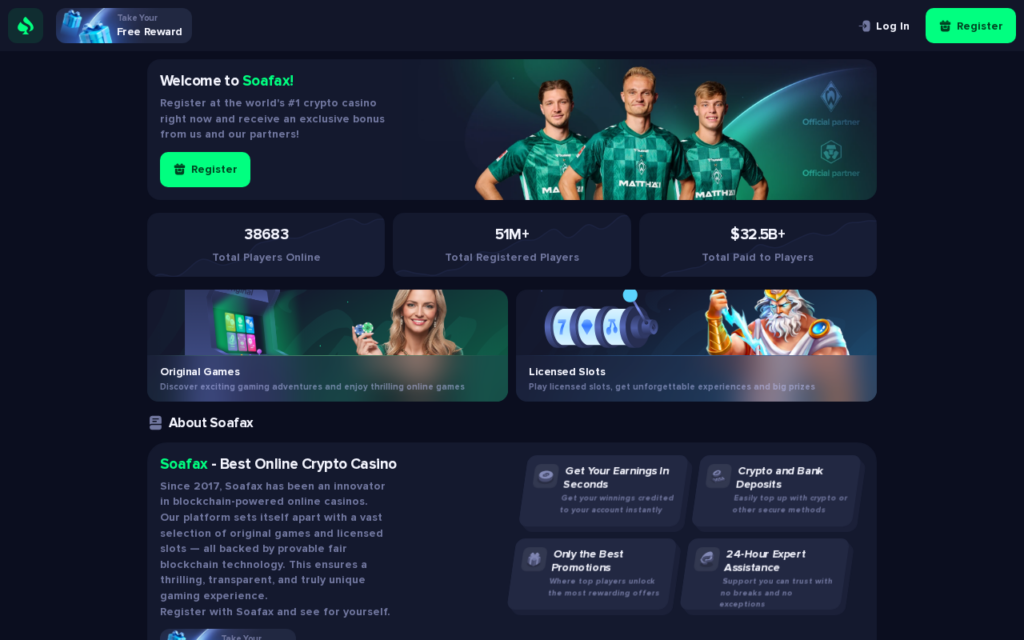
Overview
Check the exact website and who is responsible
Identify the exact hostname before opening an account. A link in a message, a social advertisement and a search result may lead to different addresses with similar names. Record the address shown in the browser and check whether the business you intended to visit uses that address through an independently located channel.
Look for a legal operator name and a clear explanation of who provides the service. If the site claims a gambling license, verify the claim with the named authority rather than relying on a badge or a link supplied by the casino alone. Check whether any record actually covers the operator and domain in question.
Read the withdrawal rules before a deposit
Read the withdrawal conditions before considering a deposit. Look for minimum amounts, identity checks, processing times, bonus restrictions and any charges. A headline saying withdrawals are easy is less useful than a policy that explains the relevant conditions clearly enough for you to understand their consequences.
A lack of accessible information is a reason to pause, especially if the website is asking for an irreversible payment. It does not become safer simply because its design looks professional or because other pages repeat its name. You do not have to send money to resolve basic uncertainty about an operator.
Distinguish an account display from money you control
When checking Soafax.com, organize what you find around the decisions that affect your money. A polished presentation or a risk label cannot answer these questions on its own.
- Can you independently verify the operator and any claimed license?
- Are the deposit, bonus and withdrawal conditions understandable before payment?
- Does a request to receive money introduce a new payment or access demand?
How a Fake Crypto Casino Scam Can Work
Step 1: A promotion presents a reward as easy money
A common trap begins with an attractive reward: a promotional balance, a prize, a referral payment or a special code. The offer can make the next step feel like collecting money already won, rather than deciding whether to entrust money to an unfamiliar website.
Step 2: An on-screen balance makes the reward feel real
The account may then display a balance that appears available for withdrawal. That number is controlled by the service presenting it. It is not the same as money arriving in a wallet or bank account you control, and an animation or transaction list cannot independently prove that customers are receiving payouts.
Step 3: Withdrawal is tied to another payment
The critical change occurs if collecting that apparent balance requires another payment. The demand might be described as activation, verification, a deposit threshold or a charge needed to release funds. Examine the substance of the request instead of accepting the label given to it.
Step 4: New conditions encourage further transfers
If further demands appear after a payment, stop and reassess. Paying one charge does not establish that the next promise will be honored. A sequence of new conditions can keep someone focused on rescuing the money already sent, even as the amount at risk grows.
Check the Operator, Address and Account Support
A casino brand should identify the responsible operator
Compare the legal name in the terms with any license record and the entity receiving account payments. Different service providers can have legitimate roles, but the relationship should be explained. A brand name alone does not identify who is responsible for your account.
An address should have an explained role
A registered office, a mailing service and an operating location are different things. Check what the operator claims the address represents. A shared address is not enough to prove shared ownership with another casino or transfer another site’s complaints to this domain.
Support should explain the withdrawal condition
Ask for the exact rule that applies to your request and where it was disclosed before payment. Preserve the reply and the relevant terms. A support account’s confident wording does not independently establish the legal or technical necessity of a new fee.
The payment destination should match the stated process
Compare an instruction received in chat with the deposit information shown in your account. If they differ, stop and verify through an independently located official channel. Do not send a test transfer to settle an inconsistency in the recipient or payment purpose.
Read bonuses as conditions, not as cash
Before accepting a bonus, determine what it actually represents. It might be promotional credit rather than withdrawable money. Read any wagering requirement, expiry, game restriction or limit on winnings. If the terms are missing or unclear, do not assume the most favorable interpretation applies.
Be especially careful when a promotion presents a large amount as already belonging to you. Ask what action would be required to receive it and whether the promise can be verified independently. An amount displayed in an account should not pressure you into sending a smaller real payment to unlock it.
Do not treat a countdown, a limited invitation or a personalized message as evidence of legitimacy. Those features can encourage quick decisions. Take time to read the conditions outside the promotional page and compare them with what the advertisement or message promised.
A legitimate promotion can still be unsuitable for you, and a complicated bonus can carry risks even without fraud. The useful distinction is whether the terms are transparent, consistent and connected to an identifiable operator. If you cannot understand the obligation, you can decline the offer without making a test deposit.
Check celebrity and brand claims independently
If a casino promotion invokes a well-known person, company or media outlet, verify the connection through that person’s or organization’s independently located channels. A photograph, interview clip, logo or quotation placed on a sales page is not enough to establish endorsement or ownership.
Consider whether the promotional material identifies an original source that can be checked. A short video excerpt may omit context, and an image can be reused in a different setting. Avoid assuming that realistic presentation proves when or why the material was created.
If the named person or organization has no clear connection to the offer outside the advertiser’s own pages, keep that uncertainty in your decision. You do not need to decide exactly how a clip was produced before declining to send money on the strength of an unverified endorsement.
The same principle applies to partnership logos, security seals and awards. Ask what each symbol actually establishes and whether the issuing organization confirms it. A collection of badges may make a page feel familiar while leaving the central question of responsibility unanswered.
What a game screen and activity feed can tell you
A working game interface can show that the website runs software, but it cannot by itself establish fair results, secure custody of funds or reliable withdrawals. Keep those questions separate. A smooth animation is a different kind of evidence from a verifiable payment received outside the platform.
Activity feeds, recent-win panels and player counters should be treated as information supplied by the operator unless there is an independent way to verify them. Repeated numbers or familiar-looking accounts may deserve closer inspection, but avoid claiming that a specific feed is fabricated without supporting evidence.
Similarly, a shared design can suggest that websites use common software or assets. It does not automatically establish common ownership or identical conduct. Connections between domains need specific supporting details, particularly before transferring a complaint about one service to another.
If Soafax.com displays technical claims about randomness or fairness, look for documentation you can assess independently. A phrase such as “provably fair” is a claim to examine, not a substitute for understanding the mechanism and the separate conditions governing deposits and withdrawals.
Recognize a payment demand that deserves an immediate pause
Pause if a withdrawal request leads to instructions to send more cryptocurrency to a newly supplied address. Ask why the charge cannot be handled through an already disclosed process and compare the demand with the terms available before you deposited. Save the original and the new instructions.
Be cautious about a demand framed as a tax or official fee when it comes only from an unfamiliar support account. Verify any claimed obligation with the appropriate independent institution. Do not accept a support message as proof that an authority requires payment to that particular wallet.
Identity verification and an additional transfer of money are different actions. A service may request information for an account check, but describing a payment as “verification” does not explain why it is necessary or prove that it will unlock funds. Ask for a clear, checkable explanation before taking another step.
Never disclose a wallet’s recovery phrase or private key to someone who says it is needed for a withdrawal, a refund or an account review. Do not approve unfamiliar transactions or install remote-access software under pressure. Stop the conversation if the proposed solution requires access you do not understand.
Look for evidence about this exact domain
When researching Soafax.com, distinguish the exact website from other casinos with similar names. A report should identify the relevant hostname, transaction or communication clearly enough to establish the connection. Similar branding alone is not sufficient to assign another site’s history to this one.
Look for a clear account of what happened: when a payment was made, what withdrawal was requested, what condition changed and how support responded. Specific records can help you evaluate a complaint. Broad accusations or repeated promotional praise without transaction details may be less informative.
A transaction shown on a public ledger can establish that a transfer occurred, but it does not automatically prove the purpose claimed for it. Check which address sent funds, which received them and whether the purported recipient controls the receiving address. Avoid treating an unrelated transaction as proof of a customer payout.
If independent information is limited, keep the conclusion limited too. An absence of complaints is not a promise of safety, particularly when the operator’s history is difficult to establish. Choosing not to use an uncertain service does not require you to prove every possible concern first.
What to Do if You Have Fallen Victim to This Scam
If your interaction with Soafax.com has led to a payment or account problem, work through the steps that apply to what actually happened. You do not need to solve every uncertainty at once.
-
Start by preserving the account and payment records you already have. Save the exact domain, your account identifier, deposit addresses, transaction hashes, amounts and timestamps. Capture the withdrawal page and any explanation of a refusal or additional requirement while the information remains available.
-
Keep the original messages from support and the promotion that led you to the site. Record whether the terms you relied on differ from the instructions you received later. A chronological account is easier for another person to assess than a collection of screenshots without dates or context.
-
If someone asks for another payment to release the balance, do not send it simply to test whether the promise is real. Contact the exchange, wallet service or payment provider involved through its official support channel and explain the circumstances. Ask what steps are possible for the particular transaction.
-
Be precise about what you are requesting. A provider may be able to review account security or record a report even when a transfer cannot be reversed. Do not interpret a support ticket or an acknowledgment as a promise that funds will be recovered.
-
If you shared account credentials, change reused passwords through the official services concerned and review active sessions. If you exposed a recovery phrase or approved a suspicious wallet transaction, obtain guidance from the wallet provider about securing the assets still under your control.
-
Avoid experimenting with unfamiliar wallet commands or recovery websites while distressed. Instructions that you do not understand can create another loss. Use support channels you locate independently, and do not follow a new contact’s link merely because that person appears to know details of the original incident.
-
If you downloaded a file or installed software during the interaction, run a device scan with Malwarebytes and review unfamiliar browser extensions. A scan can help identify malicious software; it cannot resolve an order dispute or recover a cryptocurrency transfer.
-
If repeated ads or redirects keep bringing you back to suspicious offers, consider AdGuard to reduce advertising and block listed harmful destinations. No blocker recognizes every new page, so keep checking the seller or operator independently before sending money.
Reporting and the risk of recovery offers
A useful report distinguishes observed events from suspicions. State what the website promised, what you paid, what you requested and what response followed. Include supporting records without publishing your passwords, recovery phrase, private keys or unrelated personal information.
You can report a misleading advertisement to the platform where you encountered it and ask the relevant provider how to report an abusive account or wallet address. Where appropriate, use the official fraud-reporting or law-enforcement channels available in your location.
Keep copies of reference numbers and the material you submitted. If you later receive a message claiming to come from the organization handling your report, verify it through that organization’s established channel before sharing more documents or following payment instructions.
Be wary of guaranteed recovery in exchange for an upfront fee. Knowledge of your loss does not prove that a person has the authority or ability to retrieve the money. A demand for a deposit, tax or release fee can repeat the same pressure that caused the original problem.
Frequently Asked Questions
Does a small successful withdrawal prove the casino is reliable?
It establishes only that the particular withdrawal occurred. It does not guarantee later access to a larger balance or validate every promotional claim. Do not increase the amount at risk solely because one early transaction succeeded.
Does a secure connection make the casino safe?
It protects the connection to the website. It does not establish the operator’s honesty, licensing, financial position or willingness to honor withdrawals. Those are separate questions that require different evidence.
Should I deposit a small amount to investigate?
You are not required to pay an uncertain operator to assess it. Start with the identity, terms and independent records. A test payment can expose information and create pressure to send more without resolving the underlying questions.
What if support says a fee is the final requirement?
Compare that statement with the original terms and any earlier promises. Ask for information that can be verified independently. A confident assurance does not establish that another payment will lead to a withdrawal.
Does a license badge establish that this domain is covered?
No. Check the named regulator’s own record and compare the operator and domain details. A genuine license held by a different entity does not establish authorization for the website you are considering. Keep any unresolved mismatch in your decision.
Can an unsolicited recovery service guarantee a refund?
A promise of recovery is not evidence that the service controls the funds or can reverse the transfer. Verify the organization independently and avoid paying an upfront release fee. Never provide a private key or recovery phrase to support a recovery claim.
The Bottom Line
Do not deposit while you cannot verify the operator or understand the withdrawal conditions. If an apparent prize or balance requires a fresh payment before you can receive it, pause and investigate independently. Keep conclusions about Soafax.com connected to the evidence for this exact domain, rather than borrowing claims from another website.
If you have already encountered a problem, prioritize records, account security and official support channels. Avoid further transfers made only to rescue a displayed balance. Common scam patterns can help you recognize a risky request, but the most useful account of your case remains the specific promise, transaction and response you can document.








