

A caller who knows your mobile provider and offers a dramatic loyalty discount can sound like the person you hoped would ring. The plan is familiar, the savings are specific, and the conversation begins like ordinary customer service.
The danger appears in the details that follow. A supposed retention offer may be the opening move in an account takeover, identity theft, or device-ordering scheme that leaves the real subscriber with the bill.
Overview
What is the TELUS loyalty discount scam?
The TELUS loyalty discount scam is an impersonation campaign in which callers claim a subscriber qualifies for a steep reduction on wireless, internet, or television service. Offers described by targets commonly promise savings of 30% to 40% for a long fixed period.
The approach may be described as a loyalty department, priority customer program, promotional team, or retention offer. The caller can use TELUS branding and telecom language while having no authorization from the company.
TELUS representatives have publicly confirmed that at least one widely reported two-year loyalty discount pitch was fraudulent. The fake offer is designed to keep the subscriber talking until the caller obtains account information, identity details, or security codes.
Why the call feels believable
Telecom customers are accustomed to plan changes, contract renewals, and retention deals. A discount is therefore less surprising than an unexpected lottery win, especially when monthly bills have recently increased.
Caller ID may display a Canadian number or a name connected to the provider. That label can be spoofed, and a local area code says nothing reliable about where the call originated.
Some callers know the target’s name, provider, or rough monthly cost. That information can come from a breach, marketing database, discarded bill, previous phishing response, or a simple guess aimed at a large carrier’s customer base.
Warning signs in a supposed loyalty offer
A genuine promotion should survive independent verification. End the call and contact TELUS through the number on your bill or the official My TELUS account whenever any of these signs appear:
- The discount is unusually large and available only if you act during the call.
- The representative asks for your account password, PIN, or one-time verification code.
- You must visit a link sent by text rather than sign in through the official app.
- The caller wants a driver’s licence, Social Insurance Number, or credit card before explaining the written terms.
- A new device is ordered even though you requested only a plan discount.
- You are told to return a wrongly delivered device using a label supplied by the caller.
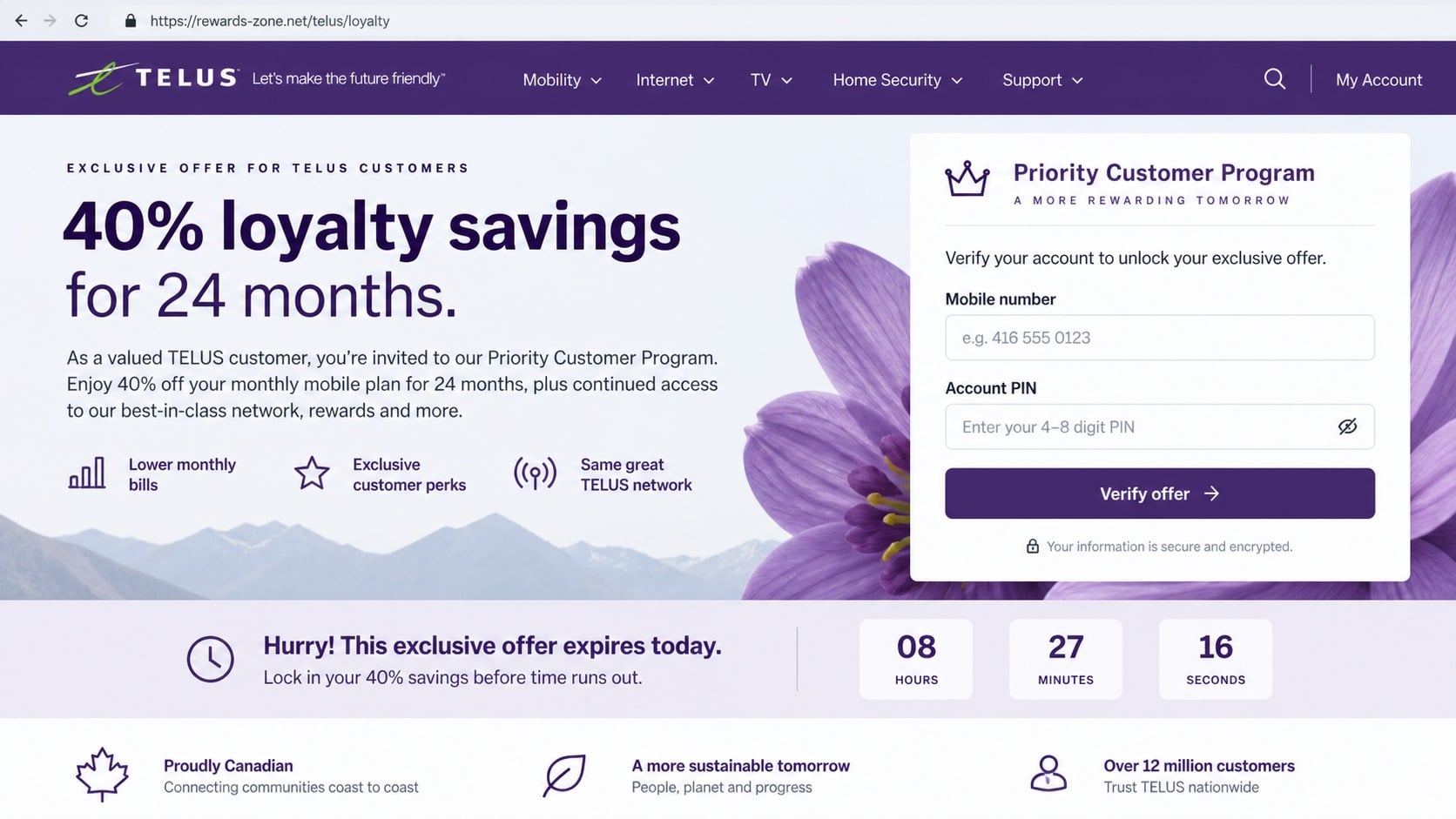
- The website address contains extra words such as rewards, loyalty, secure, or verify.
- The agent becomes hostile or evasive when you say you will call TELUS yourself.
The Canadian Anti-Fraud Centre’s service scam guidance describes this telecom pattern: an unexpected discount or upgrade leads to requests for account data, codes, and identity documents, sometimes followed by a fraudulently ordered device.
How the TELUS Loyalty Discount Scam Works
Step 1: The scammer calls a broad list of Canadian numbers
The campaign can start with automated dialing or a purchased contact list. Because the caller claims to represent a major provider, enough recipients will be actual subscribers for the guess to sound informed.
The incoming number may look local or resemble a corporate support line. Modern internet calling systems let criminals alter caller ID, so the displayed number should never be used as proof of employment.
A missed call may be followed by a voicemail or text inviting the customer to claim a loyalty rate. Responding confirms that the number is active and gives the operation another chance to make contact.
Step 2: A friendly agent presents an exclusive reward
The representative often begins with broad account language instead of sensitive questions. They may ask whether service is satisfactory, mention rising costs, and say the loyalty team can reduce the bill for 24 months.
A large discount is framed as recognition for being a long-term customer. That story lowers suspicion because the target feels selected rather than pressured.
The agent may quote a new monthly amount and include extra data, faster internet, or a device upgrade. Details make the offer feel negotiated, even when the same script is read to every person.
Step 3: Routine account verification becomes data collection
Once the customer agrees in principle, the caller says the offer must be attached to the account. They may ask for the account number, postal code, date of birth, email address, or existing plan details.
Then the requests become more sensitive. A password, account PIN, payment card, government identification, or Social Insurance Number can provide what the criminal needs to impersonate the subscriber.
The caller may claim they cannot see information already held by TELUS because they work in a special promotions unit. That explanation reverses the burden: the customer is asked to prove identity to an unverified stranger.
Step 4: A real security code is triggered and intercepted
With basic account details, the criminal may attempt a password reset or contact the real provider while pretending to be the subscriber. TELUS then sends a legitimate one-time code to the customer’s telephone or email.
The fake agent asks the customer to read that code aloud, describing it as discount confirmation. In reality, the code may authorize a password reset, login, SIM change, or order.
A genuine verification message often says not to share the code. Read the entire message before doing anything, and remember that an employee should not need you to disclose a code generated for your own authentication.
Step 5: The account is changed or used to order equipment
Once inside, the scammer can change contact information, add a line, select a costly device, or redirect delivery. The victim may initially see nothing except a genuine provider notification that looks connected to the promised offer.
In another version, equipment is shipped to the customer’s real address. The caller then apologizes for sending the wrong model and provides a return label controlled by the criminal.
The customer believes they are returning property to TELUS, but the parcel goes elsewhere. The account remains responsible for the financed device while the fraudster receives something that can be resold.
Step 6: A fake portal captures additional information
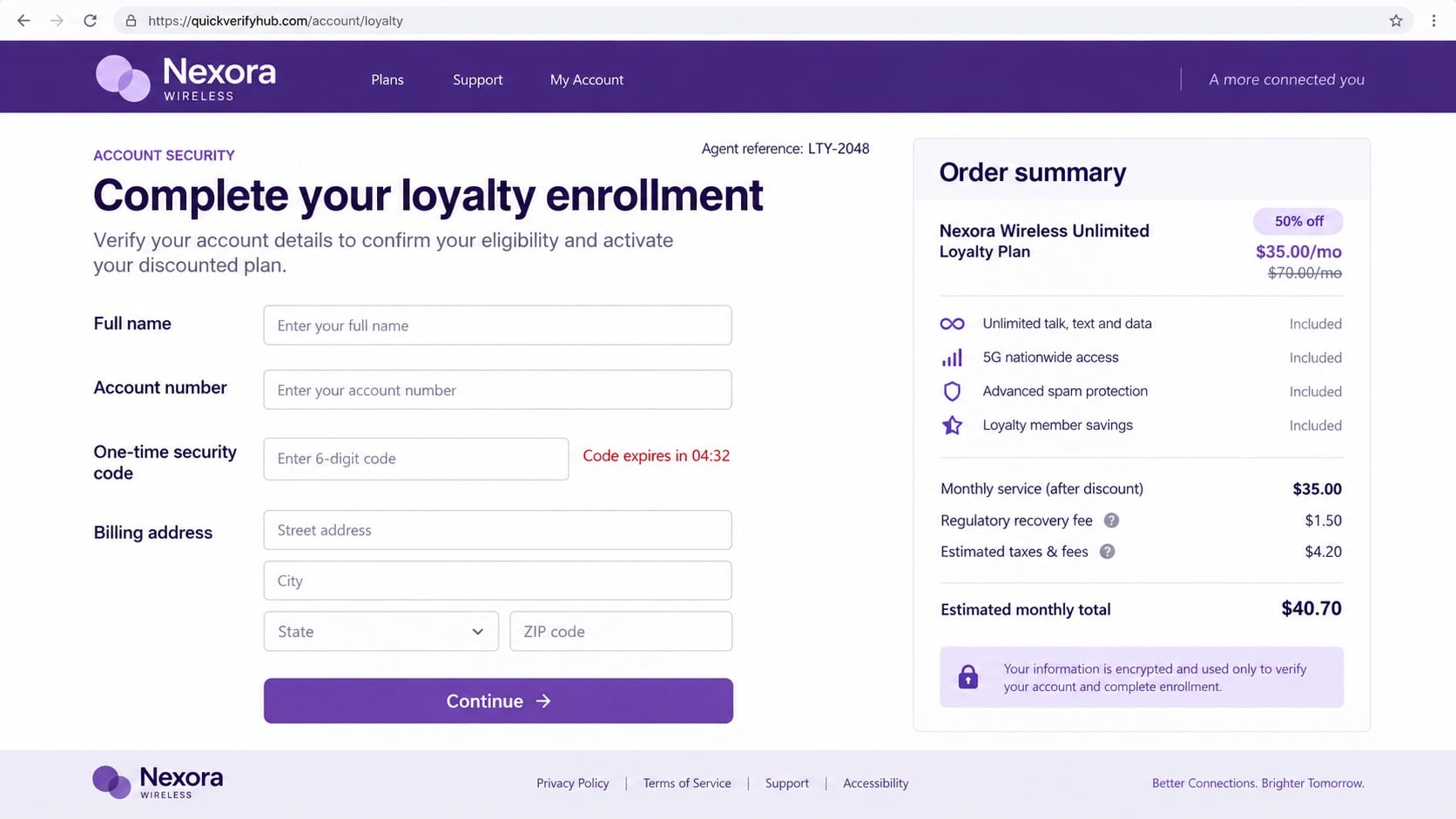
The caller may send a page decorated with purple branding, plan comparisons, security icons, and a My Account button. The address can contain the provider’s name without belonging to its official domain.
Forms may request login credentials, billing data, address, and the newest one-time code. Submitting the form sends the information to the operator, even if the page later displays an error.
Some pages forward the victim to the legitimate TELUS website afterward. That redirect can make the earlier form feel genuine and delay recognition that the credentials were captured.
Step 7: The promised savings never appear
The fake representative may promise that billing changes take one or two cycles. That delay gives the criminal time to finish orders, alter the account, or move a telephone number to another SIM.
The victim eventually finds no approved discount, unfamiliar financing, new lines, or lost access. By then, the calling number and promotional domain may already be abandoned.
Follow-up criminals can pose as fraud investigators and claim they will reverse the damage. If they ask for another code, payment, or remote access, the recovery call is simply a second attempt.
What the Scammer Can Do With Your TELUS Details
An account number and address help a caller pass weak identity checks. Combined with a date of birth, PIN, or password, the data can support account takeover and unauthorized purchases.
A stolen one-time code is especially dangerous because it can complete an action already in progress. The code may validate a reset, new login, number transfer, or order that the victim never sees on the caller’s screen.
If criminals take control of a mobile number, they may receive text codes for banking, email, social media, and cryptocurrency accounts. This is why sudden loss of cellular service requires immediate attention.
Identity documents can be reused far beyond the telecom account. They may support new credit applications, synthetic identities, rental fraud, or targeted messages that quote enough true information to sound official.
Card details can be tested with small transactions before larger purchases appear. Monitor every account involved, not just the monthly TELUS bill.
Company, Address, and Fulfillment Checks
Verify the department through a channel you control
Do not ask the incoming caller to prove the offer by transferring you to a supervisor. Everyone on that call can be part of the same operation.
Hang up, open the official My TELUS app or type telus.com yourself, and use the support route shown there. You can also call the number printed on a recent bill.
Ask whether the exact promotion exists and whether any order, password reset, or contact change is pending. A legitimate offer can be documented again through the verified account.
Check the website address character by character
The important part of a web address appears immediately before the first single slash. Words such as telus-loyalty or telus-rewards in another domain do not make the page part of TELUS.
Search ads and text links can obscure the destination. Type the official address manually rather than editing a suspicious URL or trusting a branded search result.
A padlock indicates encrypted traffic, not company ownership. Fraudulent websites can obtain encryption certificates and display convincing security language.
Confirm every order and delivery inside the real account
If the caller promises new equipment, verify the model, financing, shipping address, and order number through authenticated support. Do this before a package arrives.
Never use a return label supplied through an unexpected call or text. Ask verified TELUS support to generate the label, then compare the return address and tracking record.
Keep the shipping receipt and photograph identifying labels before handoff. A package return is complete only when the official account shows the equipment received and the financing removed.
Review the written price rather than the spoken promise
A caller can promise 40% savings without explaining taxes, device financing, activation costs, term length, or cancellation consequences. Ask for the complete service agreement inside the official account.
Check the regular rate, promotional rate, start date, end date, included services, and balance due today. If the written offer differs from the call, do not authorize it.
Be cautious when an agent says written terms appear only after you share a code. Consent should follow clear information, not precede it.
How to Handle an Unexpected TELUS Promotion Safely
You do not need to decide while an unknown caller waits. Say you will contact the provider directly, end the conversation, and avoid answering any callback from the same campaign.
- Do not disclose a password, PIN, payment card, or one-time security code.
- Do not click a loyalty link sent during the call.
- Open My TELUS independently and review recent account activity.
- Ask official support to confirm the promotion and agent notes.
- Enable strong multifactor authentication and a unique account password.
- Place a port protection measure or account passcode where available.
- Save the incoming number and message, but remember that caller ID may be spoofed.
TELUS provides a security reporting page on its official website for suspicious calls, texts, websites, and messages. Reporting the domain and wording helps the company identify active impersonation campaigns.
General awareness guidance is also available through the company’s cybersecurity awareness centre. Reach those pages by typing telus.com yourself, not by following a link supplied by the caller.
What to Do if You Have Fallen Victim to This Scam
- Call TELUS through a verified number now. Tell the fraud team what you shared and ask them to lock the account, reverse unauthorized changes, cancel orders, and review recent logins. Request a case number and written confirmation.
- Change the My TELUS password and PIN. Use a clean device, choose credentials not used elsewhere, sign out other sessions, and replace recovery information the criminal may have altered. Do not approve unexpected prompts during the process.
- Act immediately if mobile service stopped. Sudden loss of service may indicate a SIM swap or number transfer. Tell the provider to restore the number, add port protection, and document when control was lost.
- Secure email and financial accounts. Start with the email address tied to TELUS, then change passwords for banking and any service that sends codes by text. Replace SMS authentication with an authenticator app where possible.
- Contact the card issuer or bank. Report unauthorized payments, request a replacement card when needed, and ask how to dispute equipment or subscription charges. Never send money to a supposed investigator who calls unexpectedly.
- Protect your identity. If you disclosed a Social Insurance Number or identification document, contact both Canadian credit bureaus about fraud alerts and monitor reports for unfamiliar inquiries or accounts.
- Report the campaign. Submit details to TELUS and the Canadian Anti-Fraud Centre. Include the claimed department, number, domain, messages, dates, and any delivery label without publishing sensitive account data.
- Scan any device that installed software. If the caller persuaded you to download a support application, disconnect it from sensitive services and run a full scan with Malwarebytes. Remove unrecognized browser extensions and remote-access tools.
- Block the malicious route. Use carrier spam controls and consider AdGuard to reduce access to known phishing and advertising domains. This helps with repeat attempts, but it cannot undo a shared code or stolen identity data.
Frequently Asked Questions
Does TELUS offer real loyalty discounts?
Providers may offer genuine retention promotions, but that does not validate an unexpected caller’s proposal. Confirm the exact rate inside My TELUS or with support reached from the official website.
Can the caller ID show TELUS during a scam?
Yes. Caller ID names and numbers can be spoofed. Treat the display as unverified until you end the call and contact the company through a route you selected.
Why did the scammer know I am a TELUS customer?
The information may come from marketing data, a breach, a previous form, or a broad guess. Knowing the provider does not prove access to the account or employment by TELUS.
Should I read a TELUS security code to an employee?
Do not share a code from an unexpected interaction. Read the message around the code, end the call, and ask verified support what action generated it.
What if a device arrives after the fake offer?
Keep the package secure and contact TELUS independently. Use only a return process created inside the legitimate case, and retain tracking evidence until the account is corrected.
Can blocking one number stop the loyalty calls?
Blocking helps with one displayed number, but operators can rotate or spoof new ones. Provider-level filtering and refusing to engage are more useful against a continuing campaign.
The Bottom Line
The TELUS loyalty discount scam borrows the language of retention teams to turn an attractive rate into an account takeover opportunity. The largest warnings are secrecy, urgency, requests for security codes, and equipment orders that do not match what you requested.
No legitimate discount is too fragile to verify through the real account. End the incoming call, contact TELUS yourself, and approve changes only after the complete offer and order appear in a trusted channel.








