

The message says something valuable is waiting for you. A payment, a prize, or an approved opportunity seems close enough to begin planning around it.
Then there’s one small condition. An advance-fee scam often sounds almost finished, which makes the next request much easier to justify to yourself.
Overview
The promised benefit is used to collect a smaller payment
An advance-fee scam asks you to pay in anticipation of something more valuable. The benefit may be a prize, inheritance, credit offer, contract, or supposed reimbursement.
The deception is not simply that money changes hands before a service. It is the false promise that your payment will unlock a benefit.
The FTC’s advance-fee loan guidance describes one version: promised credit that supposedly requires payment before you can receive it.
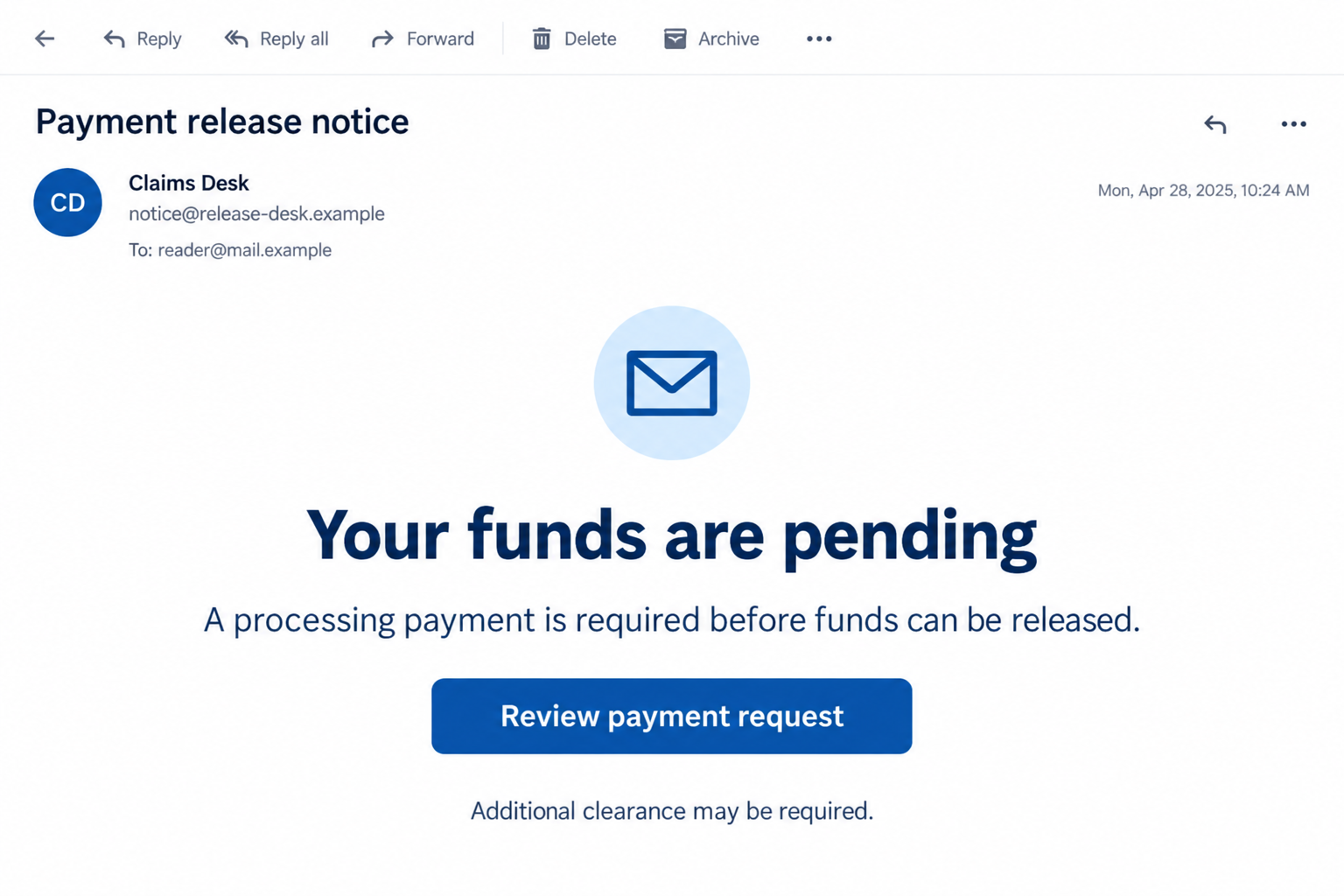
The email illustration is a fictional release-fee example. It does not identify an actual sender, bank, pending payment, or amount owed.
The fee’s name changes more easily than the underlying demand
Processing, clearance, insurance, registration, delivery, and verification can all sound like ordinary administrative expenses. A plausible label doesn’t establish a genuine obligation.
A sender may present each charge as the final step. When one payment is followed by another obstacle, the promised benefit keeps moving beyond reach.
You might receive documents, a reference number, or an impressive account balance along the way. Those items need confirmation outside the person collecting money.
Don’t decide by comparing the small fee with the large promised reward. First establish whether there is a real benefit and a legitimate process.
Legitimate costs require context, not a blanket accusation
Real professionals, businesses, and lenders can have lawful upfront expenses. A genuine application fee or paid service is not automatically an advance-fee scam.
The concern becomes sharper when these features appear together:
- An unexpected or guaranteed benefit with no independently verified basis.
- A payment demanded before the promised money can be released.
- Changing explanations for additional fees after earlier payments.
- Pressure to avoid normal checks or outside advice.
- An unfamiliar recipient who doesn’t match the claimed organization.
- Insistence on gift card codes, cryptocurrency, or another difficult-to-recover transfer.
You can refuse a suspicious release demand without accusing every business that collects a deposit. The promise, recipient, and agreed service must be examined together.
Recognize the Pattern Across Different Promises
A prize becomes a bill
A notice announces winnings, then requests money for processing, delivery, or purported taxes. The excitement makes the added charge seem like a minor inconvenience.
The FTC warns against paying a sender to receive a prize. A real sweepstakes does not require a release payment to the caller.
This is different from understanding legitimate tax responsibilities through an appropriate official process. Don’t send a stranger money because they label their demand a tax.
If you don’t remember entering the competition, check that first. A logo or certificate does not explain why you were selected.
Guaranteed credit becomes a required advance payment
A supposed lender promises approval regardless of your circumstances. Only afterward do you learn that a processing or insurance payment must unlock the loan.
FTC loan guidance distinguishes real application costs from false guarantees. Paying a fee cannot, by itself, establish that a loan is genuine.
Check the provider and its registration through the appropriate regulator where it operates. Don’t use contact details supplied solely by the person requesting payment.
An application you genuinely made can still attract impostors. Matching your financial need is not the same as being the lender you contacted.
An inheritance or refund requires release money
A stranger may say an estate, payment fund, or compensation award has your name on it. The request can look like a windfall or welcome reimbursement.
Ask what independently establishes your entitlement and who administers it. A privately supplied letter does not verify the institution or the relationship.
If an estate or compensation case is real, consult the actual professional or agency through a separately verified route. Don’t let the sender control every check.
A refund that requires you to buy gift cards first is not a normal return of money. Stop before making the proposed transfer.
How the Advance-Fee Scam Works
Step 1: The offer fits something you want or worry about
The approach can arrive by email, message, telephone, or an advertisement. It presents a benefit that seems unusually valuable compared with the effort required.
For someone dealing with bills, a promised loan offers relief. For someone who recently lost money, a supposed reimbursement can feel like a second chance.
You may be asked to confirm interest before any charge is mentioned. That first answer creates a conversation and an opportunity to tailor the story.
Read the offer without planning around the outcome. A possible benefit is not money available to spend, and a stranger’s assurance is not approval.
Don’t volunteer sensitive details to help the sender locate your payment. An unverified entitlement should not require your bank login or full identity record.
If the offer claims to come from an organization you know, find that organization’s own contact route before continuing.
Step 2: Apparent proof makes the benefit feel established
The sender supplies an approval letter, balance display, official-looking notice, or case reference. Each item can make the next request feel more reasonable.
A document proves only what can be independently confirmed about it. A signature, seal, or reference printed on a page can be copied or invented.
You may also be introduced to another supposed official. If that contact comes from the same sender, it isn’t an independent check.
Separate the claimed institution from the communication channel. A familiar name in an email doesn’t establish who owns the address or operates the website.
Ask whether you can verify the reference without using their link, telephone number, or messenger account. Refusal to allow that check is important.
Don’t upload identity documents as a test. Sending more information won’t authenticate the person receiving it.
Step 3: One administrative obstacle requires your money
Only after the benefit seems close does a fee appear. It is presented as necessary to clear a hold, finish registration, or approve release.
For a fictional example, imagine being asked to pay $50 to obtain a claimed $5,000 payment. The larger number makes the smaller request seem tolerable.
But you are risking the $50 on an unverified promise. The claimed $5,000 does not become more real because the fee is relatively small.
Ask what service the fee actually purchases and why that service is needed. Then check the explanation independently, not through another person the sender introduces.
A deadline can narrow your attention to payment logistics. Before worrying about which app to use, establish whether you should be paying at all.
Don’t borrow from someone else to meet a release demand. That can turn an unconfirmed windfall into a real debt.
Step 4: Paying creates another reason to stay involved
After a transfer, you wait for the promised benefit. Instead, another charge may appear, with a new explanation for why release still cannot happen.
You may feel that quitting now wastes the first payment. The sender benefits when recovering that earlier amount becomes a reason to send more.
Look back at the first promise. If yesterday’s final charge has become today’s new charge, stop treating each payment as a separate little problem.
Keep track of the total sent, not just the latest request. Several individually manageable payments can create a serious loss before you notice the pattern.
A promise to deduct future fees from the benefit should also be checked. The sender’s willingness to negotiate does not establish a genuine payout.
Stop at the first unverified release demand. If you already paid, use the actual transaction record to seek help instead of negotiating another condition.
Step 5: The promise disappears or becomes a recovery pitch
The contact may stop replying, the site may become unavailable, or the conversation may continue with a supposed supervisor. None confirms that payment is forthcoming.
A different account can later offer to trace the loss or return your money for a fee. Knowledge of the first incident does not authenticate that offer.
Keep recovery inside the organizations you independently contact. A legitimate payment provider should not be replaced by a stranger’s private instructions.
You don’t need to obtain a confession before reporting the request. The offer, fee demands, and transaction history are enough to explain your concern.
Also review what information accompanied the payments. A financial loss and disclosure of a password or identity document need separate protective actions.
Check the Demand Before You Check the Payment App
Name the service you would actually receive
A genuine professional fee should correspond to understandable work, terms, and an identified provider. It should not merely purchase confidence in a guaranteed windfall.
Ask whether the charge was disclosed before you committed. An invented obstacle introduced after apparent approval deserves a fresh review.
Paying for an actual consultation differs from paying a stranger to unlock millions. Don’t let similar words blur those different transactions.
If you cannot describe the service without repeating the sender’s promised reward, pause. You may be paying for the promise rather than anything independently established.
Follow the recipient, not just the logo
Compare the organization making the offer with the name receiving payment. Ask about unexplained individuals, unrelated businesses, or changing destinations.
Some legitimate services use payment processors. That is not inherently suspicious, but the provider should explain the relationship and the transaction should remain traceable.
Don’t assume a payment application’s availability means it approved the underlying offer. The app moves money; it doesn’t authenticate every recipient’s story.
Keep checks outside the sender’s network. A friend, regulator, or independently reached professional may notice contradictions you missed while focusing on the expected benefit.
What to Do if You Have Fallen Victim to This Scam
-
Stop the fee sequence. Don’t send another amount for clearance, release, cancellation, or a supposed refund of the earlier transfer.
Save the latest demand and decline further financial instructions. You do not owe the sender a negotiation about how much more you can afford.
If threats follow, preserve them and seek appropriate local assistance. A frightening message is not proof the sender has the authority it claims.
-
Identify every payment already made. List the date, amount, method, recipient, and transaction reference. Include separate charges even when they seemed small.
Keep receipts and screenshots alongside the message requesting each payment. That connects the money sent with the promise used to obtain it.
Don’t publish bank details or full identity documents when asking others for help. Share sensitive records only through appropriate official channels.
-
Contact the relevant payment provider immediately. Tell the bank, card issuer, transfer service, or platform what was promised and why you now believe it was deceptive.
Ask whether a pending transfer can be stopped and what dispute or recall route applies. Recovery depends on the method and circumstances.
FTC recovery advice helps identify the right contact. Don’t assume reporting a transaction automatically reverses it.
-
Protect credentials actually disclosed. If a form collected your password, replace it through the real account and review sessions and recovery details.
Check other accounts using that same password. A payment-provider dispute doesn’t secure a separate email or banking login.
Receiving an offer without supplying information does not establish an account compromise. Match the protective steps to what you shared.
-
Address identity information separately. Note whether you supplied a government identifier, identity document, date of birth, or enough information for impersonation.
For U.S. identity misuse, IdentityTheft.gov provides a recovery plan. Follow the guidance appropriate to actual misuse or exposed information.
A fictional prize certificate isn’t evidence someone opened credit in your name. Monitor relevant records without assuming every possible consequence occurred.
-
Inspect software only when the encounter involved it. If you installed a supposed payment tool or allowed remote control, stop sensitive activity until the device is checked.
Malwarebytes can assist with unwanted-software detection after that exposure. AdGuard may reduce malicious-ad encounters, but neither cancels a transfer or validates a promised inheritance.
Don’t buy emergency cleanup from the person demanding release fees. Get technical help through a developer or service you independently trust.
-
Report the approach and the payment request. In the U.S., ReportFraud.ftc.gov accepts fraud reports. Elsewhere, use your official local reporting route.
Report the account or listing to the platform where contact began. Include the false promise and fee demand rather than only calling the sender suspicious.
Keep case references and a short timeline. Different organizations may handle the payment, identity exposure, and fraudulent account separately.
-
Make the next financial decision independently. If you still need credit or genuine assistance, return to verified providers instead of the person who promised the payout.
Ask a trusted person to review any follow-up recovery offer. Embarrassment can make a second private promise more tempting, not more reliable.
You can accept the loss needs attention without accepting another fee. The next useful action is contacting a real provider, not funding a new excuse.
Frequently Asked Questions
Is every upfront fee an advance-fee scam?
No. Legitimate application expenses or professional services can cost money. The warning concerns a deceptive promise that paying unlocks an unverified benefit.
Why can’t the sender deduct the fee from the payout?
Ask that question, but don’t treat a reassuring answer as proof. Independently establish the benefit, administrator, fee, and payment route before considering any transaction.
Does a certificate or approval letter make the offer genuine?
No. Confirm the document through the claimed institution’s independent contact route. Printed seals, signatures, and reference numbers can be copied or invented.
What if I already received a small payment?
A small transfer doesn’t validate a later release demand. Evaluate the new request independently rather than risking more money to preserve earlier confidence.
Should I pay one final charge to recover previous fees?
No. Take the transaction records to the real payment provider. Another privately demanded payment can extend the loss instead of recovering it.
Can a recovery company guarantee my money will return?
Don’t trust unsolicited guaranteed-return promises requiring advance payment. Work through independently verified providers and reporting agencies, and keep expectations realistic.
The Bottom Line
Don’t send money to release an unverified prize, loan, or windfall. A large promised benefit doesn’t justify a smaller real loss.
If money has already gone out, stop the fee sequence and contact the payment provider. Preserve the requests and secure any information disclosed along the way.

Join the discussion
0 commentsShare your experience or ask a question about this article.
Discussion
Start the conversation
Have a question or something useful to share? Add the first comment.