

A whiskey calendar looks like an easy holiday gift: a familiar distillery, a festive countdown, and something new for the bourbon fan each day.
Before putting that offer in your cart, take a closer look at the product name. The Buffalo Trace advent calendar scam relies on a very convincing assumption.
Overview
The distillery says this calendar is not an authorized product
Buffalo Trace Distillery’s official scam warning says it has never produced, sold, or authorized an advent calendar or a 250th-anniversary bottle.
That directly contradicts offers presenting the calendar as an official Buffalo Trace release. The familiar name is being used to give an unauthorized product credibility.
The brand itself is legitimate. The warning concerns the misleading calendar offer, not genuine Buffalo Trace whiskey or every independent seller of bourbon.
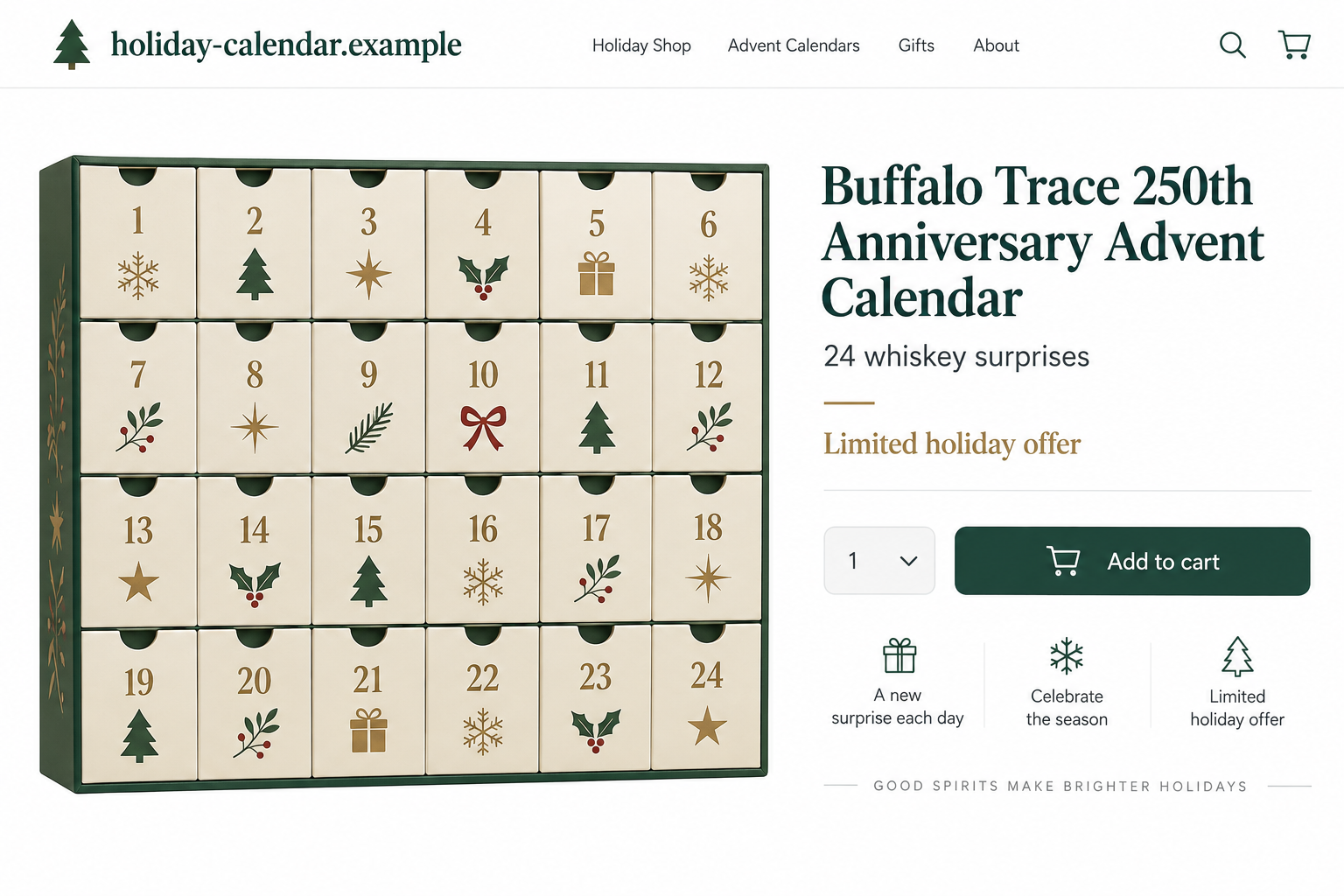
The storefront illustration shows the promotional idea using fictional shop details. It is not a capture of a particular seller or proof of an actual checkout.
The anniversary story makes the gift feel collectible
Holiday presentation and anniversary language can make a calendar seem like a special release worth buying before it disappears.
The advertised name may suggest miniature whiskey bottles, an exclusive assortment, or an official commemorative gift. Read what is actually promised instead of supplying those details yourself.
A decorative calendar, empty box, or ornament set is not automatically fraudulent when described accurately. Misrepresenting such an item as an official whiskey selection is different.
Don’t rely on a changing storefront’s claims to settle that difference. The distillery’s denial of authorization is the central fact to check first.
A normal-looking order process does not authenticate the gift
An unfamiliar site can display a cart, shipping page, support address, and tracking field while selling a misleading product.
Before paying, separate these questions:
- Does Buffalo Trace actually authorize the advertised calendar?
- Does the listing promise whiskey, decorations, or an empty container?
- Who takes the payment and appears on the receipt?
- What total price, quantity, shipping, and return terms apply?
- Can you reach the seller through verifiable, published contact details?
- Does the payment method provide a meaningful dispute route?
You were looking for a gift from a distillery you know. Its own warning gives you a reason to leave this calendar out of the cart.
What the Official Warning Does and Doesn’t Tell You
An unauthorized calendar is not a rare official release
The distillery’s warning is stronger than a calendar simply being absent from one shop page. It expressly states that no such advent calendar was authorized.
A seller cannot overcome that statement with a purported anniversary certificate or a logo copied onto packaging. Those are additional claims, not independent confirmation.
The same warning discusses false anniversary bottles. Keep the calendar and bottle offers separate when checking an order, because they are different advertised items.
If a page claims the product was recently approved, verify that through the distillery itself before considering it. Don’t accept the seller’s explanation for the contradiction.
The warning doesn’t prove every order has the same outcome
Some misleading offers may lead to no delivery; others may involve an item unlike the gift expected. The result depends on the actual order.
Don’t assume every parcel contains ornaments, every bottle is empty, or every buyer faces recurring billing. Those facts need evidence from the particular transaction.
Likewise, this warning doesn’t establish an active price or universal discount. Preserve what your own listing displayed, including fine print and selected quantity.
The buying decision can still be clear: don’t order a calendar promoted as an official Buffalo Trace product when the distillery says it never authorized one.
How the Buffalo Trace Advent Calendar Scam Works
Step 1: A seasonal offer borrows the distillery’s reputation
The promotion combines a known whiskey name with a holiday countdown. For someone choosing a gift, the idea feels more specific than a generic discount advertisement.
You may recognize the name and stop looking for the seller’s identity. That is the assumption the misleading promotion needs you to make.
A storefront appearing in an advertisement or search result doesn’t establish a connection to the distillery. Visibility and authorization are separate questions.
Start with the exact advertised product name. If it is the supposed Buffalo Trace anniversary advent calendar, check the brand’s warning before following the offer further.
Don’t treat holiday urgency as evidence of authenticity. A seasonal countdown is easy to display even when the underlying product claim is false.
Step 2: Product presentation fills in the promise
The calendar layout encourages you to imagine opening small doors and finding whiskey. Product wording may reinforce that expectation with references to selections or surprises.
Look for an explicit contents description. A picture of a calendar does not establish bottle size, alcohol content, number of bottles, or official manufacture.
Check whether decorative items or empty containers are disclosed elsewhere on the page. A buried qualification can materially change what the headline appears to offer.
Do not dismiss that difference as a small detail. A gift purchased for drinking is not interchangeable with a decorative object.
Reviews and customer images on the same storefront require caution. Their presence does not independently confirm what would arrive from your selected listing.
You don’t need to prove how the promotional image was made. The unsupported official-product claim is enough to stop the purchase.
Step 3: A familiar cart turns interest into an order
The next page can look like any ordinary online shop. Quantity selection, delivery fields, and a payment button make the purchase feel routine.
That familiar sequence can shift attention from legitimacy to logistics. You start checking arrival dates and gift quantities instead of whether the calendar exists as advertised.
Pause before submitting payment information. An encrypted connection protects data in transit; it does not certify the seller’s relationship with Buffalo Trace.
Save the contents promise and seller identity before making any dispute. A later page change may remove wording that influenced your decision.
If you already entered an address but haven’t paid, don’t continue simply because most of the form is complete. Filling fields is not a commitment to finish.
Also check whether an account password was requested. Reusing an important password at an unfamiliar shop creates a separate risk beyond the gift order.
Step 4: The receipt reveals who actually took the payment
After payment, you may receive a confirmation from a shop or payment name unrelated to the distillery. That record helps identify the transaction you need to address.
A different payment descriptor isn’t conclusive fraud by itself; legitimate processors and trading names exist. But an unexplained mismatch needs attention.
Compare the listing, receipt, transaction, and published terms. Don’t assume an email mentioning Buffalo Trace means the distillery processed the order.
If support supplies a tracking number, confirm what the carrier actually reports. Tracking does not establish that the parcel contains the item promised.
Keep dates and records together. A clear order timeline is more useful in a dispute than a general claim that every calendar seller is dishonest.
Step 5: Non-delivery or different contents become a dispute
The problem becomes concrete if the promised gift doesn’t arrive or the delivered item differs from the listing. Record the actual issue carefully.
Open and photograph packaging when safe, keeping labels and order references. Describe the contents accurately without guessing where they were manufactured.
Don’t consume an unfamiliar substance merely to test whether it is whiskey. A complaint about product identity doesn’t require taking that risk.
If the seller offers a partial refund or requests return shipping, compare the proposal with the advertised terms and your payment provider’s dispute requirements.
You should not pay an unexpected private release fee to obtain the original order. Verify any claimed carrier charge directly through the actual carrier.
Stop repeating the order at another unfamiliar store selling the same supposedly official calendar. A new domain does not fix the product’s missing authorization.
Who Is Selling the Calendar?
The Buffalo Trace name doesn’t identify the merchant
The legitimate distillery and the calendar storefront are not automatically the same business. The warning says the product was never authorized.
Find the legal or trading name in the terms and receipt. Compare it with the party collecting payment and answering your support request.
If no seller identity is available, preserve that absence as part of the record. Don’t invent a company name to fill the gap.
You can report the misleading brand use to Buffalo Trace through its independently reached official contact route. That does not make it responsible for the seller’s refund.
A shipping address isn’t proof of manufacture
A parcel label may identify a depot, intermediary, or return location. It doesn’t necessarily establish headquarters, ownership, or who made the contents.
Don’t infer counterfeit production from a country name alone. The strongest verified problem is the false authorization claim attached to the advertised calendar.
Likewise, a copied distillery address on a website is not confirmation that orders originate there. Check the actual merchant records.
If a return destination is supplied, save it and ask the payment provider what documentation is needed before spending more on shipping.
Support should answer the item and refund questions
Ask in writing what was sold, whether it contains whiskey, and how to cancel or return the particular order. Keep the reply and promised dates.
Send the order reference and ask a clear question about the promised contents. Keep the message and reply so the issue doesn’t disappear into vague assurances.
If support doesn’t respond, note your attempts without assuming every other buyer had the same experience. Your own records are enough to explain your dispute.
Don’t let repeated assurances push you past applicable dispute deadlines. Ask the card issuer or payment service which date matters for your transaction.
The contents need a traceable description
A genuine gift listing should tell you what arrives. Product identity, contents, seller, and any alcohol-related requirements should be understandable before payment.
An anniversary phrase cannot replace those details. Neither can a picture suggest official whiskey while the delivered parcel contains something materially different.
Unknown contents should not be assumed safe to drink. If someone becomes unwell after consumption, seek appropriate medical assistance and preserve packaging information.
This guide does not establish contamination in a particular parcel. The practical advice is to avoid consuming something whose identity you cannot establish.
What to Do if You Have Fallen Victim to This Scam
-
Save the original product promise. Keep the listing URL, advertisement, contents description, price, selected quantity, seller details, and order confirmation.
Capture changes or qualifications that affect what you expected. A calendar advertised as whiskey and a decorative calendar are different purchases.
Keep private payment details out of public warnings. Supply sensitive records only through the relevant provider’s secure dispute process.
-
Request cancellation or a remedy in writing. Identify the order and explain the misleading authorization or contents claim clearly.
Ask for confirmation, the proposed amount, and the expected date. Don’t supply passwords or additional identity documents just to request a refund.
A cancellation request is not proof the payment was reversed. Check the actual transaction through your bank or payment account.
-
Contact the payment provider promptly. Describe non-delivery, misdescription, or unauthorized charges according to what actually occurred.
Ask about the applicable dispute route, deadline, and evidence. An order you approved under misleading claims should be described honestly.
FTC payment-recovery guidance explains payment-specific next steps. A refund or chargeback outcome cannot be guaranteed.
-
Preserve a delivered parcel. Photograph packaging, shipping labels, and contents. Retain the item while asking what the seller or payment provider requires.
Don’t throw away evidence just because the gift is disappointing. Avoid sending it to an unverified destination before understanding the dispute instructions.
Do not drink unknown contents to demonstrate a problem. Product identification and photographs may explain the mismatch without consumption.
-
Check the card and account exposure. Review charges and tell your issuer if card information may have been compromised.
If you reused a password at the shop, replace it wherever that reuse creates risk. Review unexpected account notices through genuine settings.
An order email alone doesn’t mean your email account was entered. Focus on credentials supplied and any actual unauthorized activity.
-
Investigate software only if the shopping journey involved it. A tracking extension, download, or remote-support request is separate from an ordinary checkout.
Malwarebytes can help check unwanted software after that exposure. AdGuard may reduce malicious-ad contact, but neither authenticates whiskey or refunds an order.
Use genuine developer sources for security tools. Don’t install a refund app supplied by the seller you are disputing.
-
Report the misleading offer. Use the advertisement platform’s reporting tools and provide the exact product claim and destination.
For U.S. financial fraud, submit relevant details through ReportFraud.ftc.gov. You can also use appropriate local consumer-protection channels.
If you notify the real distillery, use its official contact page. Keep the merchant complaint separate from your payment-provider dispute.
-
Watch for follow-up fees and false recovery offers. Don’t pay another supposed agent to trace a parcel or unlock a refund.
Continue through your existing case reference and independently verified contacts. Save promises without treating them as completed refunds.
Choose a different, verifiable gift rather than buying the same unauthorized calendar again. The brand’s warning applies to the product claim, not just one domain.
Frequently Asked Questions
Is the Buffalo Trace advent calendar official?
No. The distillery says it has never produced, sold, or authorized an advent calendar. A seller’s claim of official status contradicts that warning.
Is Buffalo Trace Distillery itself a scam?
No. This warning concerns unauthorized offers using its name. Genuine distillery products and verified sellers are separate from the misleading calendar promotion.
What if the calendar is described as decorations?
An accurately described decorative item is different from a supposed official whiskey calendar. Read the exact contents claim and don’t assume it contains alcohol.
Does a tracking number prove I will receive whiskey?
No. Carrier tracking can describe a shipment, not authenticate its contents or brand authorization. Compare the actual delivered item with the saved listing.
Can I get a refund after receiving the wrong item?
Ask the seller and payment provider about the applicable remedy and deadlines. Preserve evidence of the mismatch; recovery depends on the transaction and process.
Does this mean all bourbon advent calendars are fake?
No. The specific warning concerns unauthorized Buffalo Trace products. Other offerings require their own checks of seller identity, contents, authorization, and purchase terms.
The Bottom Line
Don’t buy the Buffalo Trace advent calendar scam offer as an official distillery gift. Buffalo Trace explicitly says it never authorized that product.
If you’ve already ordered, preserve the listing and request a remedy. Contact the payment provider promptly, and don’t consume contents you cannot identify.

Join the discussion
0 commentsShare your experience or ask a question about this article.
Discussion
Start the conversation
Have a question or something useful to share? Add the first comment.