

The text says a traffic fine is still unpaid. You start wondering about a recent trip, a misplaced notice, or something another driver forgot to mention.
A Utah DMV text scam turns that uncertainty into a decision about money. Before trying to clear the alleged problem, check which organization is actually asking.
Overview
An alleged traffic fine is being used to solicit information and payment
Fraudulent texts borrow the Utah DMV name and threaten consequences over an unpaid traffic fine. Their payment destination is not established by the government-like wording.
The Iron County Sheriff’s official alert reproduces a message using that approach and identifies it as a scam.
The example threatens registration and license consequences, adds a service fee, and presents a suspicious link as an official way to resolve the issue.
Those are claims made by the fraudulent message. They are not a description of penalties you should accept as applicable to your own record.
Utah’s motor vehicle and driver license agencies have different roles
The Utah DMV website explains that the Motor Vehicle Division and Driver License Division are separate agencies. Its own services include vehicle titles and registration.
Driver license questions are directed to the Driver License Division. A text using DMV as a catchall for every driving issue should not choose your payment route.
Likewise, an actual court citation belongs with the appropriate court process. Identify the real matter before deciding where any legitimate response should go.
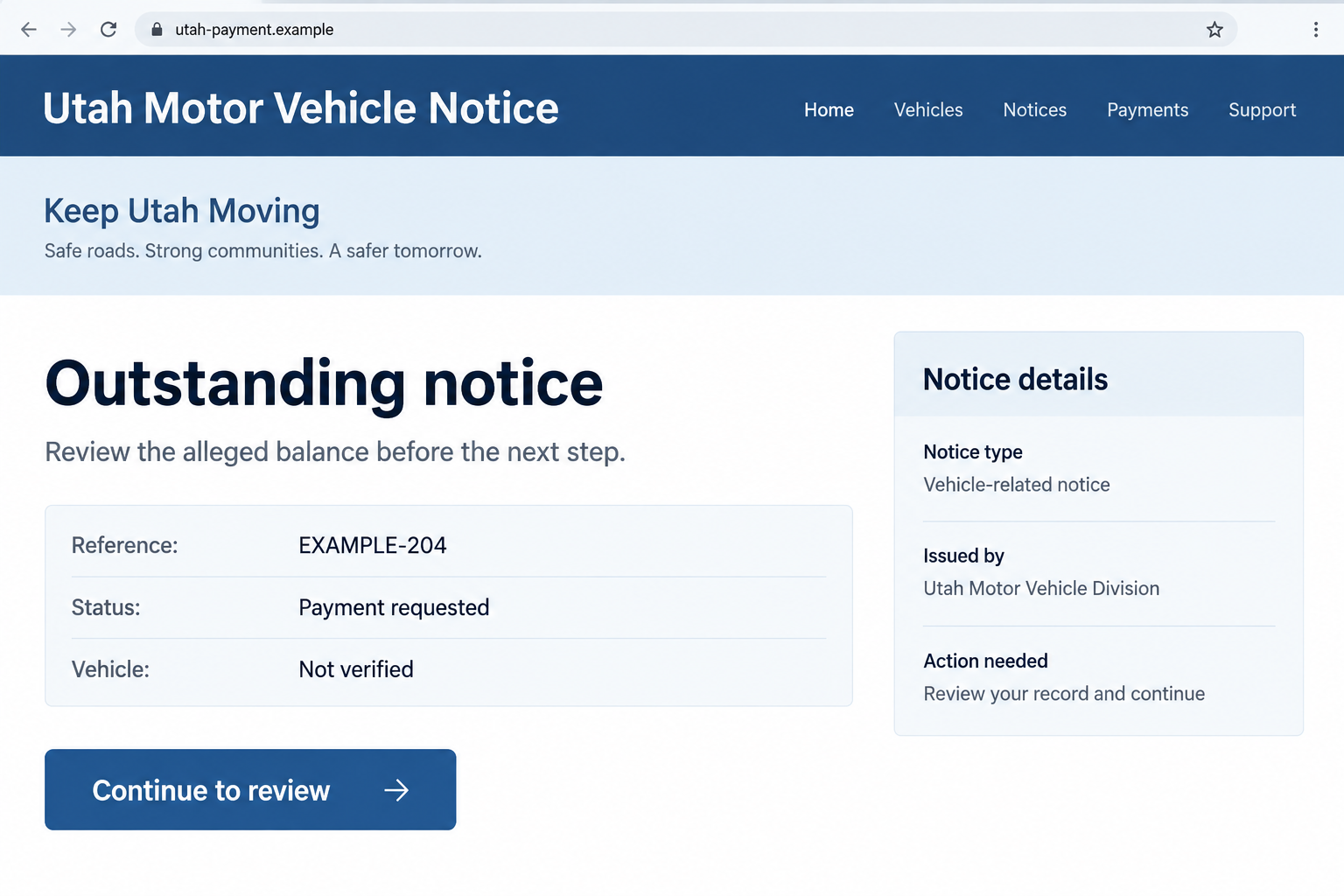
The pictured webpage is a fictional illustration. Its example domain, unverified vehicle field, and reference do not represent a tested malicious site or a real driver’s record.
The message tries to make verification feel less attractive than paying
Be wary of a demand that:
- Announces an unpaid fine without a record you can independently identify.
- Threatens several serious consequences on a compressed schedule.
- Uses formal-sounding regulations to discourage questions.
- Calls its own unfamiliar payment website official.
- Asks you to reply or continue before checking with a genuine office.
You do not need to prove the sender’s identity by submitting your information. A separate contact with the real organization is the safer way to investigate.
Read the Threat Without Accepting Its Assumptions
A long list of consequences can conceal a very vague allegation
The message may be detailed about what will happen next while saying little about what supposedly happened first. That imbalance is worth noticing.
You can be told about suspension, fees, and credit consequences without receiving a citation you recognize. The volume of threats does not supply the missing record.
Write down the actual allegation in a sentence. Which violation, issued by whom, is the sender asking you to settle?
If that remains unclear, do not fill in the gap from your own driving history. Ask the appropriate authority through an independently obtained contact.
The service fee in the warning is not a verified cost
The sheriff’s published example includes a threatened 35% service fee. That figure belongs to the fraudulent notice and should not be mistaken for a real quote.
It makes the alleged balance sound as though it will grow if you hesitate. The intended reaction is to pay before considering who receives the card details.
You do not need to calculate whether the invented surcharge is affordable. First establish whether there is a genuine obligation and a legitimate collector.
Other versions may use different wording or numbers. A message does not become authentic because it omits one detail from a public scam example.
An official-looking web address still needs a real connection to the agency
State words can be placed inside an unrelated domain or page path. Recognizing Utah somewhere in the link does not mean the state controls the destination.
Nor does a copied header establish a link to an actual government record. Both the text and the page can be parts of the same imitation.
Use the DMV’s independently opened website to choose its services. Do not search for the suspicious domain in hopes that a matching logo will settle the question.
If a message points toward a real-looking court, verify that court separately. A court name printed inside a payment demand is not an independent endorsement.
How the Utah DMV Text Scam Works
Step 1: A pending-enforcement label gives an unfamiliar message authority
The sender claims a traffic fine has been detected or remains unpaid. The notice sounds as though an automated government system has already reviewed the matter.
You may assume that a database exists behind the claim. In reality, the text has not demonstrated access to any genuine record about you.
Check whether the allegation corresponds to original paperwork or a known event. Do not confirm your identity to an unknown sender just to make the notice more specific.
A real concern can be investigated without using the message. The choice is not between immediate payment and ignoring every possible driving issue.
Step 2: Formal references make the deadline sound legally settled
The sheriff’s example includes a regulation-style reference and a sequence of threatened consequences. Their role in the scam is to make questions feel pointless.
You should not infer that the cited wording creates an enforceable obligation. A formal reference needs a genuine source and a connection to an actual case.
Do not argue with the sender over legal numbering. Contact the responsible office or obtain qualified advice if real paperwork raises a genuine legal concern.
Save the message and tell the reporting agency what it claimed. You don’t need to agree with its legal wording to explain what happened.
Step 3: The payment shortcut shifts attention away from the allegation
After presenting consequences, the text offers a link to resolve everything. That shortcut encourages you to think about finishing a payment rather than verifying a collector.
A page may show a reference, notice status, or service menu. Those features are easy to display without being connected to the real DMV.
The sheriff’s alert also reproduces a reply instruction. Do not respond merely to make the message or its link work.
If you have already opened a page, stop before providing details. Close it and use an independently reached government service for the relevant question.
Do not trust a different device to make the same unverified destination legitimate. The problem is the recipient of the information, not only the screen displaying it.
Step 4: A supposed fine becomes a disclosure of payment or identity information
The fraudulent route may request a card, personal information, or another verification step. Treat each actual disclosure as something to address separately.
You can lose control of information even when the site does not complete the payment. A blank page or error provides no reliable assurance about submitted fields.
Do not keep entering variations of a password or trying additional cards. That can expand the exposure without settling a real ticket.
If a bank sends a code or approval request, read its purpose. Do not let the unfamiliar page explain away a transaction you did not intend.
Step 5: Follow-up contact can keep the invented obligation alive
Another message may say the payment needs completion, a receipt needs confirmation, or the penalty can be canceled for a fee.
Details from the earlier exchange can make a second contact feel informed. They do not establish that the new person represents the state or your bank.
Stop new instructions and work through your genuine providers. Keep separate records for the financial exposure and the question of whether any real citation exists.
A purported refund should not require another secret or transfer to an unfamiliar recipient. Return to the bank contact you established independently.
Choose the Right Utah Office for the Actual Question
For vehicle registration or titles, begin with the Motor Vehicle Division
The state DMV homepage is an established starting point for vehicle transactions. Use its service links rather than a payment address introduced by an unsolicited text.
Explain the issue in ordinary terms: registration status, a title question, or a suspicious contact. You do not need to accept the sender’s category for the allegation.
If sensitive identification is needed, follow the real office’s secure instructions. Do not email documents to an address found only on the questionable page.
For license questions, follow the state’s Driver License Division route
The DMV homepage directs driver license, Real ID, driving record, learner permit, and CDL questions to the separate Driver License Division.
That distinction can save you from relying on a single fake portal promising to repair everything. Ask the actual office about the specific concern.
Keep any genuine answer or required next action. Do not assume that blocking a scam text resolves an unrelated real restriction or missed notice.
For a citation, verify the issuing authority and court independently
Use original citation paperwork when you have it. Confirm the correct contact through an official source, especially if the unsolicited message supplies different payment details.
A reference from the text should not replace the genuine case information. Describe the discrepancy rather than entering your identity into a website to see what appears.
If you cannot determine the right office, ask the genuine agency for direction. A careful referral is more useful than accepting an instant clearance from a stranger.
Keep the check practical and limited
You don’t need to trace the website’s owner yourself. Start by protecting anything you shared and asking the real office about your record.
Save existing evidence without following the link again. A screenshot of the original message and your own timeline are often more useful than another risky visit.
When helping a relative, ask what they actually shared. A calm question about an entered code can reveal an exposure that a general warning about spam misses.
What to Do if You Have Fallen Victim to This Scam
-
End the false payment process immediately. Leave the page and stop replying. Do not send anything else to prevent the threatened enforcement.
Record which fields you completed and whether a payment or bank approval occurred. Keep receipts, but do not treat them as government confirmation.
Distinguish reading the text from providing information. The fact that a message arrived does not mean a bank account or driving record was accessed.
-
Speak to your card issuer or bank about the financial exposure. Use a known contact and explain the impersonated traffic demand.
Ask about protecting the payment method, reviewing transactions, and disputing or stopping any relevant charge. Include unsuccessful attempts if you entered card details.
The FTC’s scam-response guidance recommends contacting the payment provider promptly. Recovery depends on the payment and circumstances.
-
Check whether a genuine driving issue needs action. Use Motor Vehicle Division services, the Driver License Division, or the appropriate court according to the actual question.
Explain the suspicious notice and verify the relevant record through their process. Keep any independently obtained instructions.
Do not ignore real paperwork after identifying the scam. A fraudulent collector and a legitimate obligation can be separate matters.
-
Address identity information with the appropriate issuer. Tell the real agency if you submitted a driver credential or identification image.
For a Social Security number or other serious identity exposure, use IdentityTheft.gov to identify relevant protective steps.
Watch for unfamiliar records and save follow-up reports. Do not send more identification to the original sender to cancel the earlier disclosure.
-
Replace passwords disclosed through the site. Go to each genuine service yourself and use a unique replacement instead of a slightly altered reused password.
Review security settings and recovery information where applicable. If someone obtained a code or approval, explain that separately to the affected provider.
Tell authorized account users what happened. They may otherwise mistake the next message for a continuation of normal business.
-
Get trusted help for installed software or granted access. Do not keep an unknown support connection open while seeking advice from the same sender.
Malwarebytes can help inspect malicious software from a download. It cannot confirm a citation’s validity or remove a payment from your financial record.
AdGuard may reduce risky ads and web destinations. It does not authenticate government notices or replace the agency and bank steps.
-
Report the impersonation and preserve the account of what happened. Mark the text as spam or use supported carrier reporting, including 7726 where available.
File a factual report through ReportFraud.ftc.gov. Include the claimed agency, request, destination, and loss without exposing secret credentials.
Retain provider references privately. A public fraud report does not replace the transaction dispute or a real court response.
-
Be ready for another deadline or recovery promise. The next sender may claim your earlier payment is frozen or needs a final charge.
Decline the new shortcut and return to verified contacts. Details of your previous conversation do not turn an unsolicited caller into an official investigator.
Tell anyone sharing responsibility for your vehicle paperwork about the incident. Agree to check future demands outside the message before money or documents are supplied.
Frequently Asked Questions
Is the Utah DMV text about a pending traffic fine a known scam?
Yes. The Iron County Sheriff’s alert documents a DMV impersonation text using unpaid-fine and suspension threats. Verify any real matter through official channels.
Does the threatened 35% fee establish what I owe?
No. That figure appears in the fraudulent example. It is not a verified charge for your case or a reason to pay the linked site.
Are Utah DMV and the Driver License Division the same office?
No. The state DMV explicitly distinguishes the agencies and directs driver license questions to the Driver License Division.
Should I reply to resend or activate the notice?
No. Do not follow the suspicious message’s reply instruction. Choose the appropriate service from a government website you reach independently.
What if I have a real ticket too?
Use its original paperwork and the genuine issuing authority or court. The existence of a real citation does not authenticate an unrelated text.
Can I wait for a charge before reporting entered card details?
Tell the issuer promptly what you disclosed. It can advise on protection even if the page failed or no unfamiliar transaction is visible yet.
The Bottom Line
Do not pay through a Utah DMV text scam or let its threatened deadline choose your next website. Verify the actual issue with the correct agency.
If you already supplied information, stop further contact and involve the relevant bank or identity provider. Keep the real driving record and the fraudulent demand separate during recovery.

Join the discussion
0 commentsShare your experience or ask a question about this article.
Community experiences
Did this happen to you?
Your experience could help someone recognize the same scam. Submit a private report for our team to review.
I experienced this tooReports are reviewed before publication. Sharing publicly is always your choice.
Discussion
Start the conversation
Have a question or something useful to share? Add the first comment.