

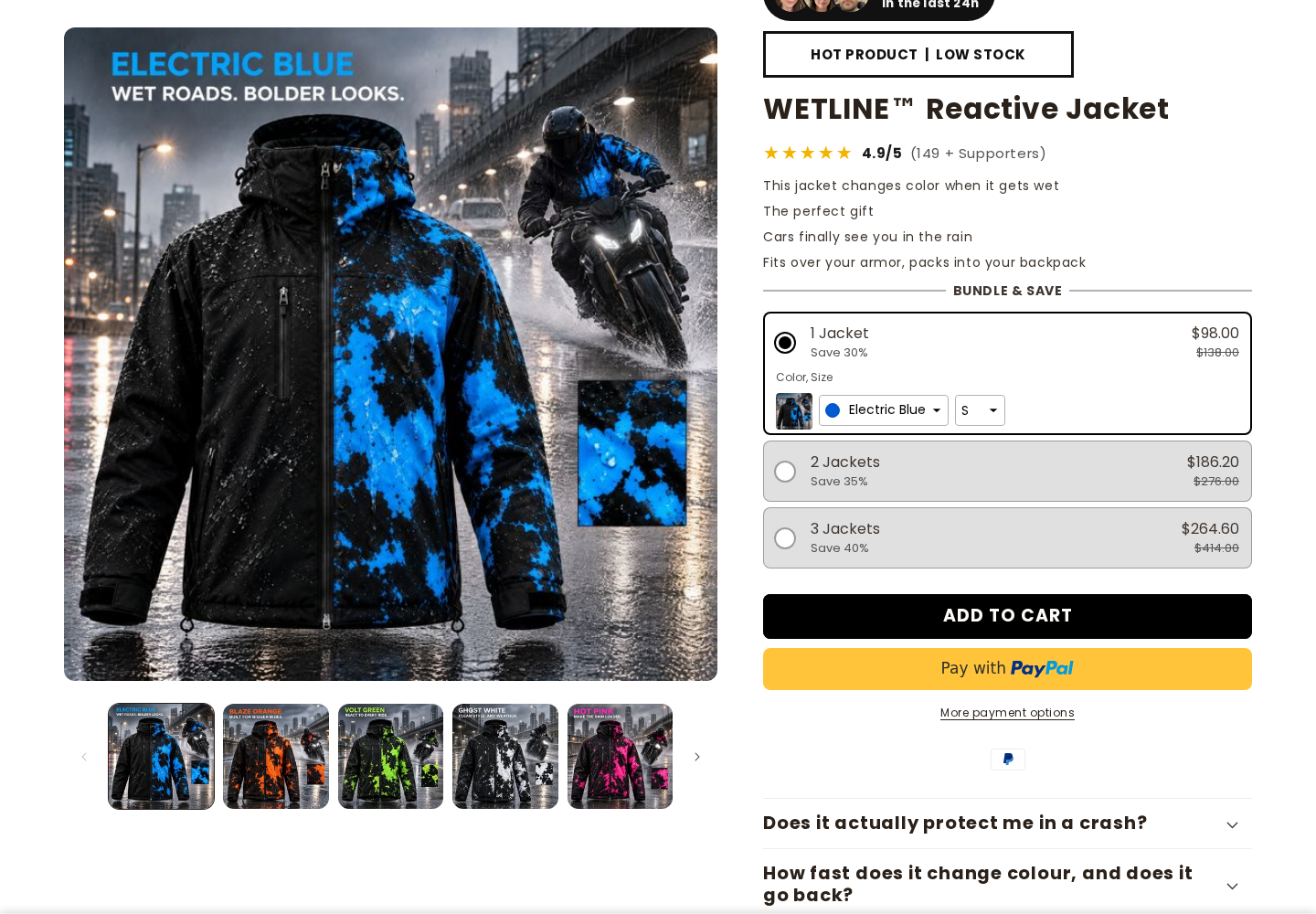
A black jacket turns electric blue as rain hits it. On a small screen, that is the kind of transformation that makes you stop scrolling.
Wetline builds its appeal around that moment. Before ordering, it is worth looking at the jacket, the riding claims, and the business beyond the picture.
Overview
Wetline is sold as a water-reactive outer layer
The Wetline offer examined here is on wandoraa.com. Its product page promotes a jacket that changes appearance when wet, with a strong motorcycle-riding theme.
The captured US offer shows an Electric Blue selection and a $98 single-jacket price. Larger packs are offered alongside it.
That identifies the particular offer being discussed. Another seller using the Wetline name should not automatically inherit either its promises or its problems.
The product description does not line up cleanly
The selected image advertises a blue effect, but the explanation describes a hot-pink base. Several customer stories also discuss a pink transformation.
Different color variants could explain part of that difference. The page still needs to explain which description belongs to the exact jacket you are ordering.
The practical concerns extend beyond color:
- Visibility claims are not the same as documented safety performance.
- The store explicitly says the jacket does not provide crash protection.
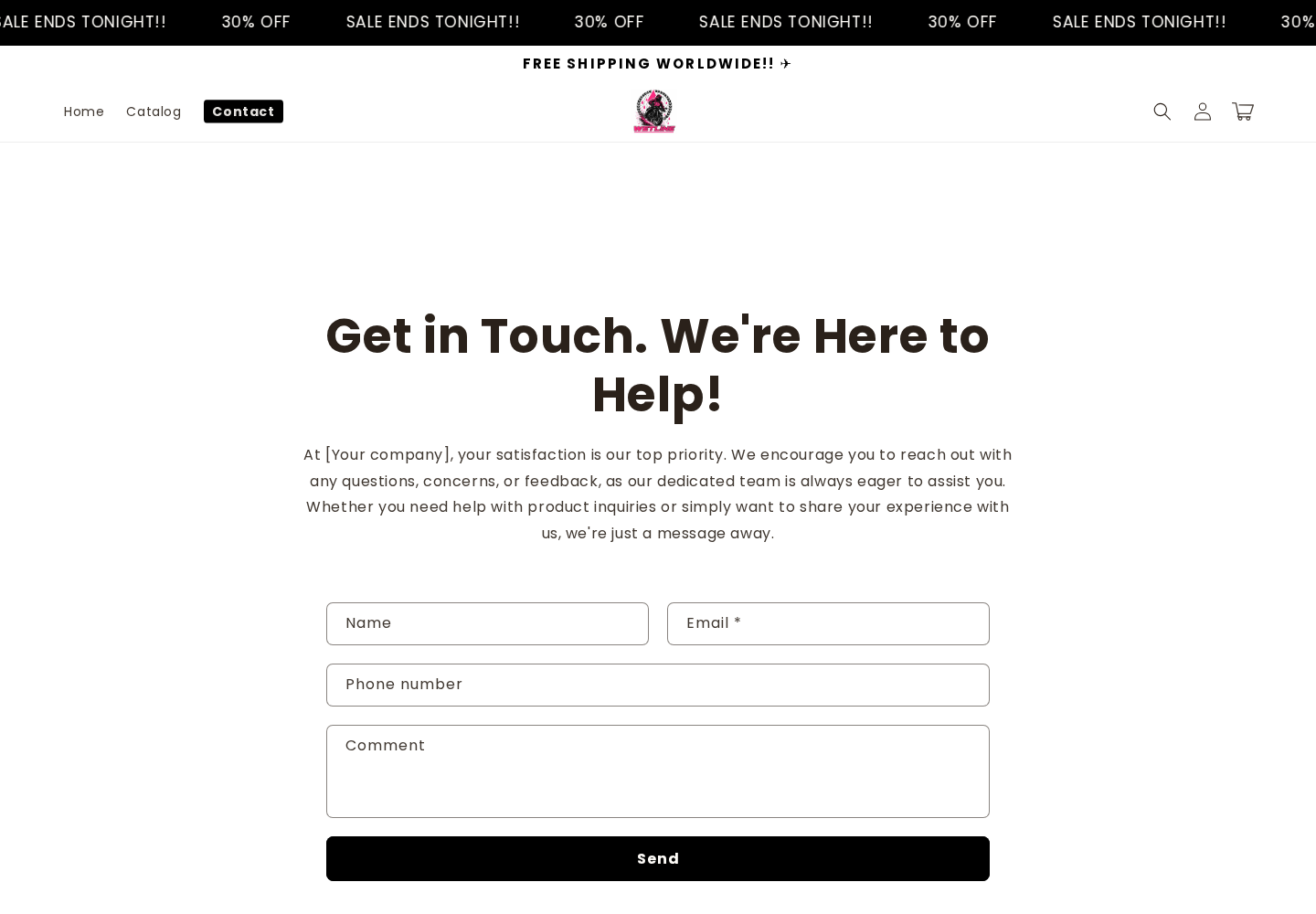
- The public contact page retains an unfinished company-name placeholder.
- The reviewed pages do not clearly identify an approved return destination.
- A bundle discount increases the commitment before the first jacket is assessed.
The recommendation is to skip this offer
Do not buy Wetline through this offer while the product description and seller information remain this unclear. A dramatic transformation is not enough to justify the purchase.
This is not proof that reactive fabric is impossible or that every customer receives nothing. The documented weaknesses already make the offer unsuitable to recommend.
The Color-Change Effect Does Not Answer the Important Questions
The appeal is easy to understand: a dark jacket becomes strikingly bright when the weather changes. That could be fun as a novelty feature.
However, color, fit, water resistance, durability, and visibility are different characteristics. A successful demonstration of one does not establish the others.
Blue in the selection, pink in the explanation
Someone choosing Electric Blue should be able to find matching instructions and a clear description of the delivered item. A general account of a pink base does not settle that.
This does not prove that the blue variant cannot exist. It shows that the sales page is asking buyers to bridge an avoidable information gap.
Ask for a continuous video of the exact selected color, beginning dry and ending after it dries again. That is more useful than another promotional collage.
A dramatic picture is not a fabric test
The sales artwork shows an unusually polished jacket and riding scene. Its appearance alone cannot establish whether it is a photograph, composite, render, or AI-generated image.
Buyers need actual product views regardless of the method used to make the advertisement. Look for fabric close-ups, seams, labels, fastenings, and the inside of the garment.
A clear demonstration also needs ordinary lighting. A saturated color effect on an edited background tells you little about a wet jacket on a gray road.
No Wetline jacket was ordered or physically tested for this article. There are no measured waterproofing, wash-cycle, abrasion, or visibility results behind this review.
Ask what remains after regular wear
A novelty coating is only useful if it survives the care the garment requires. Ask for washing instructions and details of any effect-related warranty.
If the effect weakens, would that count as a defect? If the label requires special care, would normal machine washing invalidate the seller’s promise?
These questions should have written answers before purchase. They are particularly relevant when the advertised transformation, rather than ordinary jacket construction, is the main reason to buy.
The Motorcycle Safety Message Needs Clear Limits
The seller acknowledges that it is not protective armor
Wetline’s crash-protection FAQ answers no and describes the garment as a rain layer used with an armored jacket. That limitation should be taken seriously.
The FAQ explicitly limits the jacket’s role to an extra layer. Treat that limitation as seriously as the more prominent riding imagery when choosing your equipment.
Do not replace established protective equipment with a novelty shell. Check that any additional layer fits without obstructing movement or interfering with the equipment underneath.
Being brightly colored is not a guarantee that drivers see you
The advertising connects the color effect with being noticed in rain. That is a persuasive message for riders who already worry about inattentive drivers.
But visibility depends on conditions, contrast, lighting, positioning, and the material’s properties. A vivid product image does not measure performance from another driver’s viewpoint.
NHTSA’s rider guidance recommends bright clothing and reflective material as part of being more visible. It does not endorse Wetline or validate this jacket’s effect.
A wet color change also should not be confused with retroreflective performance at night. Ask what the garment actually does rather than relying on the atmosphere of the advertisement.
A rain-shell claim is not a winter-sports specification
Anyone considering the jacket for skiing, snowboarding, or prolonged cold exposure needs separate information about warmth, breathability, weather resistance, and fit.
If an advertisement showed skiing, check that its promises match the actual product page. This offer’s rain-layer description does not establish winter performance or suitability for freezing conditions.
Choose equipment for the activity first. A color-changing effect can be an extra, but it cannot supply missing information about the conditions the garment is meant to handle.
How the Wetline Sales Funnel Works
Step 1: The transformation earns attention
The offer leads with a strong visual contrast between a black jacket and a brightly colored wet surface. You can understand the appeal without reading the specifications.
That speed is also the risk. You may already be choosing a color before asking which material, construction, or test supports the performance claims.
Separate the two decisions: whether the idea looks interesting and whether the merchant has described a product worth ordering.
Step 2: Rider stories create a sense of real-world reassurance
The product page includes customer-style stories about commutes, rain, and reactions from other people. They make the jacket feel established in everyday use.
Those accounts appear on the sales page, where the merchant controls presentation. They are not a substitute for a clearly identifiable independent test.
Look for practical details: which variant arrived, how sizing worked, whether it leaked, and what happened after washing. Generic excitement does not answer those questions.
Step 3: The page encourages an immediate and potentially larger order
The store displays sale and low-stock messaging. Its captured bundle panel offers two jackets for $186.20 and three for $264.60.
The single-jacket option is selected in that capture. There is no evidence here that the retailer secretly changes a one-jacket order into a larger shipment after payment.
Still, buying several units before seeing one magnifies a sizing or quality problem. A lower average price does not remove the risk attached to the total.
Step 4: The buyer has to find the business behind the presentation
The strongest reassurance would be a clearly named operator, usable support details, and a return process. The public contact page does not provide that level of clarity.
It presents a generic form beneath text that still uses a company-name placeholder. That is not a minor detail when you are deciding who will handle a complaint.
Resolve the seller and remedy before payment. A payment button can be operational even when the after-sales arrangements remain poorly explained.
Wetline Seller Identity and Returns
The product name and storefront name need an accountable operator
The site uses Wandora in page titles and Wetline in the product branding. Buyers still need the legal seller, not just two names on a storefront.
The reviewed product, catalog, and contact pages did not clearly establish that entity. The contact introduction instead contains the unreplaced phrase [Your company].
A buyer should not have to infer corporate identity from a logo. Ask for the registered seller name and check it against the merchant shown at payment.
The dispatch and return destinations need to be clear
The pages examined did not give a clearly identifiable dispatch warehouse or approved return address. That leaves a practical question about where a parcel would go.
Do not assume local shipping or a nearby return is available. Ask for those arrangements before entering payment details.
For an existing purchase, keep the shipping label, customs information where present, and tracking history. Those documents can establish facts that promotional copy cannot.
A form is not evidence of tested customer service
The contact page offers fields for a name, email, telephone number, and comment. No message was submitted, so there is no basis for claiming an unanswered support test.
The unfinished introduction is enough to flag a quality-control problem. It gives buyers less confidence that the business details received the same attention as the sales artwork.
Before ordering, obtain a written explanation of how refunds are requested and processed. If the merchant cannot provide one, leave the offer.
The garment needs more than a branded picture
Ask for the actual fiber label, care instructions, manufacturer or responsible supplier, size measurements, and applicable performance information. These identify the item you would receive.
A seller can source an ordinary garment from another manufacturer without committing fraud. What matters is whether the delivered item matches the claims and has traceable responsibility.
If a particular protective or visibility standard is claimed, request the documentation for that exact model. Do not assume an attractive riding photograph establishes any certification.
What to Do If You Ordered a Wetline Jacket
-
Capture your exact order now. Keep the selected color, size, quantity, full price, confirmation, and sales-page address.
Save the color description as well as the picture. If your confirmation says blue while the product explanation discusses pink, include both in any question to support.
-
Request clarification before dispatch. Ask which company is fulfilling the order and what the selected garment should look like when dry and wet.
If the answers do not match your expectations, request cancellation promptly. Get the outcome in writing rather than relying on a disappearing chat.
-
Inspect the delivered jacket before relying on it. Check the label, measurements, seams, fastenings, and correspondence with the advertised model.
Photograph differences before removing labels or washing it. Do not test an unfamiliar garment by riding in dangerous weather to see whether its safety claim holds.
-
Keep existing protective equipment. Treat the seller’s no-crash-protection statement as a genuine limitation, not fine print you can disregard.
If you intended to use it for a technical activity, choose equipment with suitable documented performance instead of assuming the effect supplies protection.
-
Ask for the specific return procedure. State the order number, delivery date, and whether the issue is incorrect goods, a defect, or a change of mind.
Request the authorized destination, postage responsibility, refund amount, and deadline. Do not ship it to an unconfirmed address found in a comment.
-
Escalate an unresolved transaction through your payment service. Provide the receipt, product evidence, messages, and tracking details.
Ask which dispute process and time limit apply. A payment-service logo on the store does not mean the provider has already endorsed the jacket or guaranteed reimbursement.
How to Recognize a More Useful Jacket Demonstration
A strong demonstration keeps the same garment in view throughout. You should be able to see the selected color, ordinary water application, and the return to its dry appearance.
For rainwear, ask separate questions about seams, closures, material, and expected use. One splash over the outside does not demonstrate performance over a long wet journey.
A credible sizing explanation shows measurements rather than relying only on small, medium, or large. If layering over another jacket, compare garment measurements with your existing equipment.
After-sales clarity also belongs in the comparison. A less spectacular product with a named retailer and understandable returns may be the much better purchase.
You do not have to prove fraud before declining a jacket. Unclear product information and unfinished seller details are enough to choose a more dependable offer.
Frequently Asked Questions
Is the Wetline reactive jacket a confirmed scam?
A color-changing jacket is not inherently fake. This offer’s inconsistent description and unfinished seller details are the problem, and good reasons to pass.
Does the Wetline jacket turn blue or pink?
The captured selection says Electric Blue, while other page text describes a pink base. Ask the merchant for matching evidence of the variant attached to your order.
Can Wetline replace an armored motorcycle jacket?
No. The seller explicitly says it does not protect you in a crash and describes it as an additional rain layer.
Does the color change prove that it is high-visibility safety clothing?
No. A visible effect does not establish performance under different lighting or road conditions. Look for relevant documentation rather than treating promotional imagery as a safety test.
Are the jacket pictures definitely AI-generated?
Their polished appearance is not conclusive proof of origin. The useful requirement is clear, verifiable footage and photographs of the actual product.
What is the first step if my jacket does not match?
Photograph the item and labels, save the order description, and request a remedy promptly. Keep the garment unmodified while return instructions are being resolved.
The Bottom Line
Do not buy Wetline through this offer. The striking color effect does not compensate for mismatched product wording and unfinished business information.
If you already ordered, confirm the exact variant and seller, preserve the purchase record, and pursue cancellation or a documented return if the offer does not match your expectations.

Join the discussion
0 commentsShare your experience or ask a question about this article.
Discussion
Start the conversation
Have a question or something useful to share? Add the first comment.