

A missed call from Washington, DC can feel harder to ignore than an ordinary unknown number, especially when the voicemail mentions a government case.
Before returning that 202 call, separate what your phone actually tells you from what the person behind the message wants you to believe.
Overview
The 202 prefix is real, but it is not an identity check
202 area code scam calls exploit a legitimate Washington, DC telephone prefix. The code itself is not fraudulent, and ordinary residents and organizations use it.
The problem begins when a caller treats that familiar location as proof of authority. A display reading Washington does not establish government employment or physical location.
Someone may genuinely own the number they use, or they may have falsified the displayed number. You cannot distinguish those possibilities from the prefix alone.
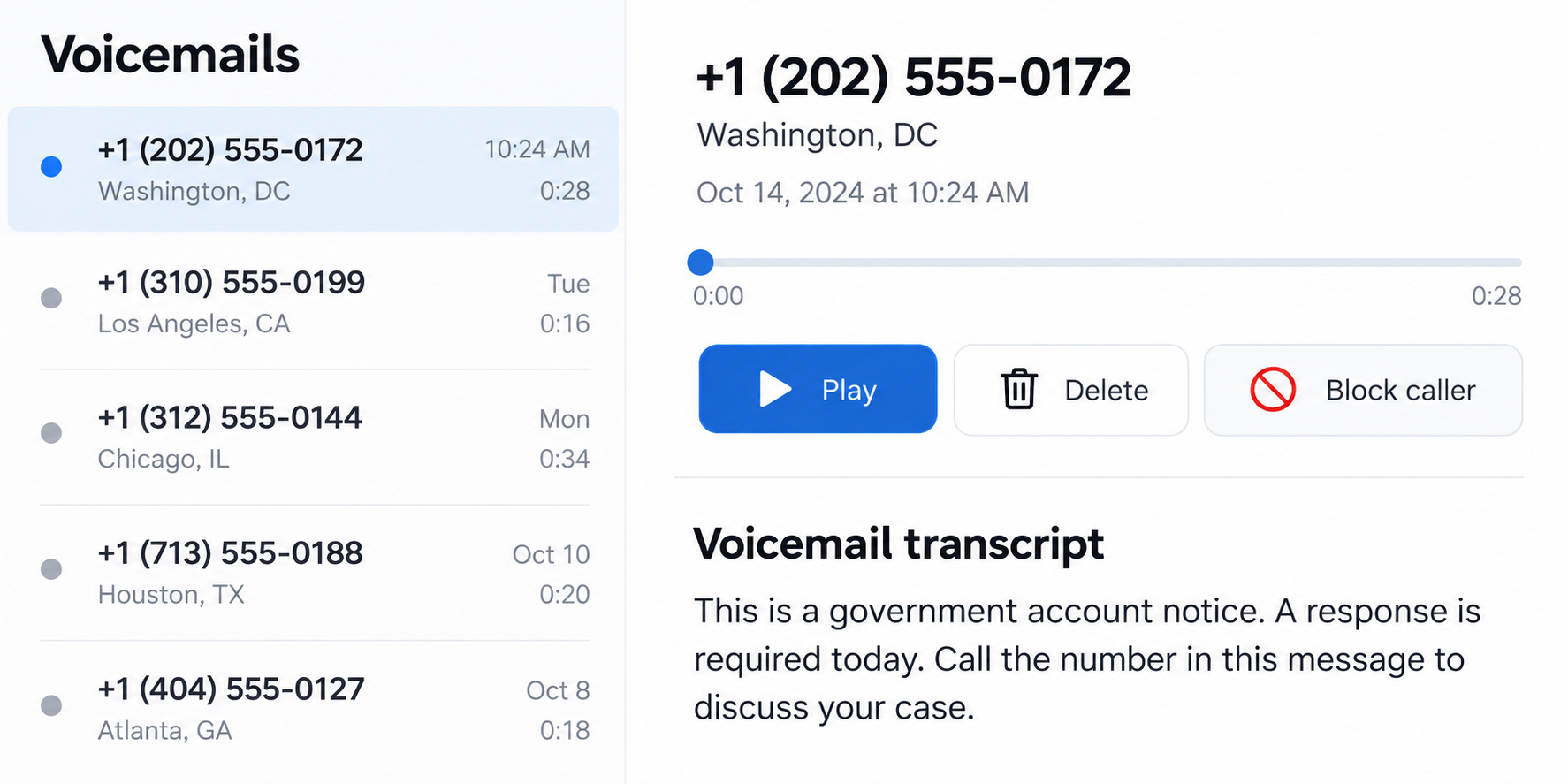
The voicemail image is a fictional illustration using reserved example numbers. Its transcript and date are not a recording or timeline of an individual complaint.
The real warning is what the caller wants next
A government impostor may mention unpaid taxes, suspended benefits, a legal problem, or an account that supposedly needs immediate attention.
Those stories differ, but the dangerous turning point is usually a request to pay, disclose sensitive information, or follow instructions without independent verification.
- A threat supposedly disappears if you pay during the call.
- The caller asks for a password, security code, or complete financial details.
- You must move savings into an account described as protected or supervised.
- You are told not to contact your bank, relatives, or the real agency.
Check the claim without continuing the conversation
You do not need to prove who called before hanging up. An unexplained demand for money is enough reason to stop and verify elsewhere.
Use contact information you find independently on the agency’s official website. For a bank claim, use your established banking app or card.
A genuine matter can then be checked through the responsible organization, rather than through a stranger whose only credential is a telephone display.
Why a Washington Number Can Feel So Convincing
The location does some of the caller’s work before a word is spoken. Washington brings federal agencies to mind, making an official-sounding message seem plausible.
Washington on the display cannot turn a caller discussing your taxes into an IRS employee. The location is part of the impression, not a credential.
Caller ID spoofing means altering the number or name shown to the recipient. The FTC explains this impersonation tactic.
It also explains why searching a displayed number can be misleading. You might find a real office whose number somebody else borrowed for the display.
In that situation, the directory listing identifies the real office. It does not establish that your incoming call came from that office.
The opposite can happen too: an unfamiliar number has no useful search results. That absence neither proves fraud nor makes the requested payment safe.
Listen for a verifiable claim, not a convincing accent or polished delivery. Neither a professional voice nor awkward grammar reliably settles the caller’s identity.
How the 202 Area Code Call Scam Works
Step 1: An unfamiliar number introduces an official-sounding problem
The first contact can be a live call, a recorded message, or a voicemail. Sometimes the message reveals very little beyond a supposed case number.
That vagueness creates a question you feel obliged to answer. You may wonder whether an old tax issue, application, or benefit payment has gone wrong.
Other versions name an agency immediately and announce a serious consequence. The goal is to make checking the message feel more urgent than checking its source.
A missed call alone does not establish this scam. Look at the accompanying demand and avoid assuming that every unfamiliar 202 caller has criminal intentions.
If you were expecting a legitimate call, use the appointment or contact details you already have. Do not let an unrelated voicemail replace them.
Step 2: The caller turns public details into apparent authority
A caller may know your name, address, or employer. Hearing accurate information can make the rest of the conversation feel authenticated.
But knowing a detail and having authority over your account are different things. Public information can be repeated by someone who has no legitimate connection.
An employee number, case reference, or supervisor’s name serves a similar purpose. It sounds checkable, even when the caller never allows a separate check.
You can note the claimed agency and reference without confirming additional information. There is no need to supply missing birth dates or account digits to help.
Do not search for the claimed agent while staying on the line. End the conversation first so you can assess the information without live pressure.
Step 3: A deadline makes ordinary verification seem dangerous
The supposed problem becomes something that must be settled now. You might be warned about arrest, a blocked benefit, or a rapidly increasing penalty.
The caller may insist that hanging up counts as refusing to cooperate. That instruction is meant to keep control of your next decision.
A real deadline should be checked through a real channel. A stranger’s insistence does not turn an unexplained demand into an enforceable obligation.
The FTC’s government impersonation guidance describes threats and unusual payment demands as central warning signs.
Be especially concerned if you are told to keep the matter secret. Preventing a second opinion benefits the person directing the payment, not you.
Step 4: They ask for money, security codes, or account information
The caller eventually needs more than your attention. They may request a transfer, gift card codes, login details, or information useful for identity theft.
A payment might be described as a temporary deposit rather than a fine. A transfer might supposedly protect your money while an investigation continues.
Changing the label does not change the action. Money leaving your account remains a payment, even when the caller promises to return it shortly.
Likewise, reading out a security code can approve something you did not intend. Read the actual message yourself instead of accepting the caller’s explanation.
If another person’s instructions conflict with your bank’s warning, stop. Do not let them coach you through dismissing the very alert designed to protect you.
Step 5: Further instructions follow the first concession
After you comply once, the caller may introduce another obstacle. A fee was insufficient, a transfer failed, or a different department supposedly needs verification.
The next demand depends on the story being used. There is no single script or criminal group identified by the 202 prefix.
What matters is recognizing when the original concern has become a chain of unexplained requests. A completed payment is not a reason to continue paying.
The same applies after you provide information. Stop further disclosure and protect the account involved rather than trying to satisfy the caller into leaving you alone.
Three Misconceptions That Can Send You in the Wrong Direction
A 202 number is not automatically an international premium line
202 is a domestic Washington, DC area code within the North American numbering system. It is not, by itself, an international premium-rate designation.
That does not make returning an unknown call sensible. It means you should identify the actual risk instead of assuming a special surcharge from these digits.
Your provider determines applicable calling charges under your plan. If your bill contains an unexplained charge, ask the provider to identify the destination and billing basis.
The person whose number appears may be another victim
Do not post accusations against a number’s listed owner solely because it appeared during a suspicious call. Spoofing can implicate an unrelated person or office.
Reports are more useful when they distinguish the displayed number from a separate callback number, payment destination, and words actually spoken.
Answering is not the same as handing over account access
Picking up an ordinary call does not, by itself, reveal your banking password or authorize a transfer. The important question is what happened afterward.
Separate an upsetting conversation from an actual disclosure. That distinction helps you take useful protective steps without treating every call as a complete device compromise.
Screening Calls Without Cutting Off Legitimate Contact
If you regularly deal with Washington offices, blocking the whole 202 prefix can create problems of its own. A narrower screening routine is more practical.
Let an unfamiliar caller leave a message, then compare the claim with appointments, applications, or correspondence you already recognize. Avoid returning a number purely from curiosity.
Keep established contact details for organizations you use. When a new message contradicts existing instructions, resolve the difference through that established route before making changes.
Your provider may offer blocking or call labeling. The FTC’s blocking guidance explains the options and warns that legitimate calls can sometimes be filtered too.
A spam label is useful context, not an identity verdict. Similarly, the absence of a warning does not certify that a caller’s payment request is legitimate.
Registration with the National Do Not Call Registry is not a guarantee against fraud. Criminal callers do not become trustworthy because they ignore that list.
Ask your carrier how to review blocked calls and adjust settings if necessary. The aim is fewer interruptions without losing a reliable way to handle real messages.
What to Do if You Have Fallen Victim to This Scam
-
End the call and write down what happened.
Keep the voicemail, call log, and any accompanying messages. Record the claimed agency, requested amount, payment method, and any callback number supplied.
Make a short timeline while details are fresh. Separate what you actually did from what the caller asked you to do but you declined.
Do not contact the caller to obtain better evidence. Preserving what you already have is safer than reopening the conversation.
-
Check the supposed problem through the real organization.
Find the agency yourself rather than following the caller’s website or transfer instructions. Explain the allegation and ask which department can check it.
If the story concerned your bank, use its normal secure contact route. Ask whether there is an actual restriction, transaction, or notice requiring attention.
A fake call does not erase an unrelated real obligation. Handle any genuine issue separately after confirming it through the proper organization.
-
Contact the payment provider immediately if money moved.
Explain that a caller impersonated an official and describe exactly how you authorized or lost the funds. Ask about stopping, recalling, or disputing the payment.
Provide transaction references, recipient details, timestamps, and receipts. For gift cards, retain the cards and contact the issuing brand promptly.
Ask for a claim number and any follow-up deadline. Recovery depends on the payment and circumstances; neither a police report nor a promise guarantees reimbursement.
-
Secure whatever information you actually exposed.
If you shared account credentials, change them through the legitimate service and review account access. Replace reused passwords on other affected accounts.
Tell the institution if you disclosed an authentication code or approved a login. A password change alone may not address an already authorized action.
For exposed identity documents or Social Security information, use IdentityTheft.gov to identify the appropriate recovery steps for your circumstances.
-
Report the impersonation with useful distinctions.
Submit a report through ReportFraud.ftc.gov. Include both the displayed number and any different number the message asked you to call.
Share the actual payment destination privately with your bank or investigators. Do not publish full account numbers, identity documents, or your personal contact details.
Use your carrier’s blocking or spam-reporting controls afterward. Blocking one displayed number may reduce that contact, but it cannot prevent every spoofed call.
-
Give yourself a simple plan for follow-up calls.
A second caller might claim to be investigating the first. Do not accept that explanation as proof, even if they know details you previously shared.
Tell a trusted person what happened and agree on an independent verification routine. Having someone available can make the next urgent demand easier to resist.
Reject any unexpected offer that requires another payment to recover the earlier loss. Continue through your existing provider claim instead.
Frequently Asked Questions
Where is the 202 area code located?
202 serves Washington, DC. It is a legitimate telephone area code, but the number displayed during a call does not establish where the caller is located.
Should I block every 202 number?
No. Legitimate people use those numbers too. Screen unfamiliar calls and independently verify unexpected official claims instead of treating the entire prefix as fraudulent.
Does calling back automatically create a large international charge?
Not because the displayed code is 202. Charges depend on the actual call and your plan. Do not return suspicious calls simply to test them.
What if the number matches a real federal office?
That match does not authenticate the incoming call. End it and contact the office through a number you independently obtain from its official website.
Can the caller arrest me for hanging up?
A caller’s threat does not prove a warrant or legal authority. Verify the underlying allegation independently, and obtain qualified legal help for an actual legal matter.
Do I need to reset everything if I only answered?
Usually, an answered call alone does not justify that response. Review whether you shared information, authorized anything, installed software, or sent money, then address that exposure.
The Bottom Line
202 area code scam calls borrow Washington’s credibility, not legitimate authority. Do not pay or disclose sensitive information because a telephone display looks official.
End the contact and verify the claim independently. If you already paid or shared access, contact the affected institution now and preserve the evidence.

Join the discussion
0 commentsShare your experience or ask a question about this article.
Community experiences
Did this happen to you?
Your experience could help someone recognize the same scam. Submit a private report for our team to review.
I experienced this tooReports are reviewed before publication. Sharing publicly is always your choice.
Discussion
Start the conversation
Have a question or something useful to share? Add the first comment.