

On Hubbycarts.com, a famous store’s gift card is up for grabs, and it’s a big one. All it asks is a few quick steps. On a budget, it feels lucky.
You get a shiny button and very little explanation. That gap matters, because clicking through puts you in a deal quite unlike the one the page shows.
Overview
What Hubbycarts.com says is waiting for you
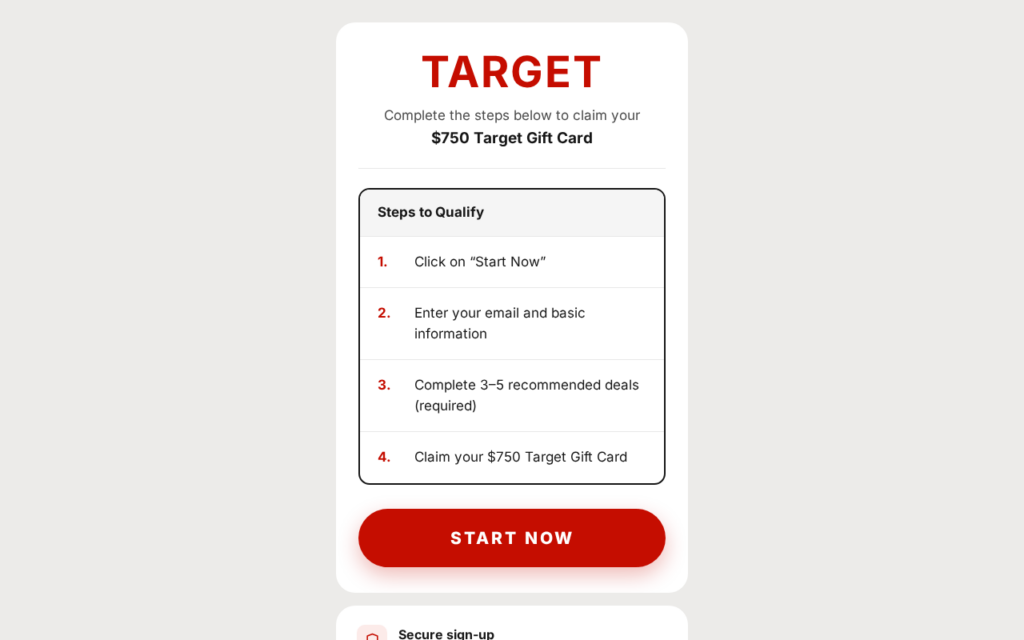
Hubbycarts.com leads with a big gift card headline and a claim button. Similar pages usually add a well-known retailer’s logo and numbered steps ending in “claim your card.”
On pages like this, the ask sounds tiny at every step: your email, a few questions, a few “recommended deals.” Those deals only take shape once you’re inside.
The store’s name, but not the store’s offer
The page names a retailer, but that retailer isn’t running the offer, didn’t approve it and won’t be sending the card. The name is borrowed trust the site couldn’t earn.
The claim button doesn’t lead to the retailer. It opens a tracking link from an affiliate network, and the domain hosting the offer isn’t the retailer’s website either.
A closer look at the “steps”
The card is bait, and the funnel behind it is built to generate leads. Buttons like this one typically lead to:
- Affiliate tracking that turns every sign-up into a payout for the operator.
- Forms that capture your contact details (email, phone number and address) plus your date of birth.
- Sponsored deals to complete, from paid trials and subscriptions to app installs and credit applications.
- Terms that keep moving, so there is always one more deal between you and the card.
- No identified company accountable for delivering the reward.
The page can promise anything it likes. Hubbycarts.com is still a gift card scam, so keep your details private, pass on its deals and don’t hold out for a card.
What We Found on Hubbycarts.com
Here’s what stands out about Hubbycarts.com:
- The page’s title reads "Claim your $750 Target Gift Card".
- Its claim button opens a tracking link on giftclick.org, an affiliate network domain, not the website of the store it names.
How the Hubbycarts.com Gift Card Scam Works
All reward funnels like Hubbycarts.com read from one script. The store name, the amount and the domain are the only details that differ from page to page.
Step 1: A message says you made the cut
A text message, an email or a social media ad is how most visitors arrive. It says you’ve been “selected” to claim a famous store’s reward or to test products.
On its own, an unknown website couldn’t win your trust. Attach a famous store’s name and a reward big enough to stop your scrolling, and suddenly it can.
Your first name, or a purchase you made recently, turns up in some messages and makes them feel personal. An earlier data leak can be the source, not the store.
Step 2: The landing page keeps the steps looking short
A bright claim button and a few numbered steps are usually front and center on pages like Hubbycarts.com. “Complete a few deals” makes the job sound short and clearly finite.
You’ll find countdown timers on many of these pages, plus “only a few cards left” banners and counters of people who “already claimed.” There’s no way to check those numbers.
Step 3: The claim button leads into an affiliate network
Neither “Claim” nor “Start now” sends you to the store. Both pass you along a tracking link that captures the offer you clicked and the operator’s affiliate ID.
Nothing is wrong with affiliate links as technology. Their role here is the giveaway: you’re being sold as a lead from the first click, not rewarded as a winner.
Step 4: Your personal information turns into the product
The first request is your email. Later pages ask for your name, phone number, home address and date of birth, and a “survey” about income and shopping habits often follows.
The more you answer, the more valuable you become as a lead for marketers. Walk away halfway and those details can still fuel emails, texts and calls for months.
Look closely at each screen for boxes that are already ticked. Leave them, and one “Continue” click can share your details with dozens of “marketing partners.”
Step 5: The sponsored deals bring real costs
The card sits behind sponsored deals, and you’re told to clear them: free trials, streaming plans, insurance quotes, credit applications, or mobile games played to a set level.
Many of those deals come with strings, starting with a payment card. An uncanceled trial can turn into a full-price subscription, and a credit application can leave a hard inquiry.
Step 6: Your card never arrives
The finish line never stays put. Once you’ve done a few deals, the page asks for more, says one “didn’t track,” or marks your claim “pending review.”
For the operator, the job is already done: every sign-up has been paid for. The card was never the product, so there’s no one to ask where it went.
Red Flags of Offers Like Hubbycarts.com
Look for these signs, which appear on almost every reward funnel. The first one settles it all by itself.
“Deals” stand between you and the card
Stores don’t make you start paid trials or apply for credit to win their own gift cards. “Complete a few deals” is what an affiliate funnel says.
Almost no effort, a huge promised reward
Stores hold giveaways, but filling out a form won’t get you a card worth hundreds from one. That generous figure is part of the lure.
The address bar tells a different story
A big store’s name inside a strange address means an advertiser is using the brand. The store isn’t behind it. Check the address bar before you read further.
The claim button takes you somewhere else
Hover your mouse over the claim button on a computer and the true link shows up. On these pages, it isn’t the retailer at all. It’s a tracking domain.
Nobody signs their name to this offer
Nobody will send the card, and nobody will answer for it: the page lists no company, address or support contact. A tiny “not affiliated” footer line doesn’t fix that.
An unexpected text or email
That text or email from an unknown sender, the one saying you’ve “won” or been “selected,” isn’t proof of a prize. It’s the opening of the funnel.
Running timers and dwindling card counts
Speed is what these tools are after, because speed stops you from checking. A real store offer would look the same a day later.
Why the Store’s Name Isn’t Proof
A famous store name does the persuading, which is why scammers borrow it. Gift cards from Costco, Target, Walmart and Amazon show up often, yet any trusted brand works.
Large retailers regularly warn shoppers about fake surveys and reward messages using their name. They also ask people not to enter details through a link they weren’t expecting.
In 2013, operators of “free gift card” text campaigns that pushed people into paid offers were sued by the US Federal Trade Commission. The script has hardly changed since.
The rule is simple: the store’s own website has the final word. If the offer isn’t there, it isn’t the store’s offer, whatever the headline says.
What a Real Store Promotion Looks Like
Genuine gift card offers from real retailers are out there. Compare one with a fake and the differences become easy to see. Here’s what the real thing looks like.
- It’s announced where the store speaks for itself: its own website, app or verified social accounts.
- It publishes official rules naming the organizing company, the prize and the end date.
- It doesn’t make you sign up for trials, download apps or apply for credit to qualify.
- If it’s a receipt survey, the address is printed on your receipt. If it’s a loyalty reward, you’ll find it in your store account or app.
- If you win, you hear about it through the account or channel you used to enter, not from a random text.
Treat the gift card as bait if the offer fails even one of these. A real promotion shows its conditions instead of hiding them behind a “claim” button.
What the “Deals” Can Cost You
There’s no card at the end, only the real costs of chasing it. The usual ones are:
- Charges that keep coming. Miss the cancellation window, and free trials and discounted plans renew at full price.
- Credit inquiries. Your credit file can pick up hard inquiries from the loan and credit card applications tucked among the offers.
- Unwanted calls and email. Once you hand over your email, phone number and address, they go to marketing partners you didn’t choose.
- The next scam. Lists of people who replied to a “you won” offer are valuable to other scammers. Expect phishing and fake delivery texts to follow.
- Unwanted apps. Games and apps added to your phone to “unlock” the reward can keep watching you or filling your screen with ads once you stop playing.
- Lost time. All those hours of surveys, games and offers go toward a reward that was never on its way.
Nothing about the card is real, yet the costs certainly are. The operator earns from every sign-up, and the bills land on the visitor.
Same Funnel, New Domain
Hubbycarts.com isn’t a one-off. It’s one of many look-alike reward pages that cost little to set up, often on website builders, and usually vanish within days of a report.
The same affiliate ID often turns up in the claim links across several domains, which points to a single operator running many pages at once.
Line the pages up and the shared fingerprints are hard to miss:
- A gift card headline that pairs a well-known store with a large amount
- Three or four step-by-step instructions that finish on “claim your card”
- The requirement to “complete a few deals” first
- A claim button whose real destination is an affiliate tracking link
- Timers or counters nobody can verify
Once you recognize the pattern, the store and the amount are just details. The funnel is the same one, moved to a new address.
How to Check a Gift Card Offer Before You Click
A real promotion holds up to a two-minute check. A reward funnel falls apart.
- Go straight to the store’s official app or website without touching the link, and search for the offer there.
- Hold your cursor over the claim button on a computer, but don’t click. A tracking domain rather than the store’s address is the answer you need.
- Look up the site’s name alongside “scam” or “review.” Often a new funnel has no history at all, and that silence is a warning on its own.
- Search the fine print for “participation requirements,” “deals” or “offers.” Even one of them means the card comes with strings attached.
When even one check comes up short, walk away and close the page. It doesn’t deserve your email address, and it definitely doesn’t deserve your card details.
What to Do If You Have Fallen Victim to This Scam
The trial periods are your window. If you entered details or started deals through Hubbycarts.com, act now, and most of the damage can be limited before they end.
- Cancel every trial and subscription. Work through each deal you started, one by one, and cancel before its trial ends. Keep every confirmation you get.
- Check your statements. Don’t recognize a small test charge or a recurring payment? Dispute it with your bank or card issuer.
- Replace any exposed card. Ask your bank for a new card number if you typed card details into any page in this funnel.
- Monitor your credit. A loan or credit card application filled out during the offer is worth following up on: scan your credit report for accounts and inquiries you didn’t start.
- Treat follow-ups as scams. That goes for every text and email about “your reward” or “a problem with your claim.” Don’t tap or click the links inside.
- Tidy up your device. Revoke notification permissions these pages got from you. Installed anything? Scan with Malwarebytes Free. AdGuard blocks many ads leading to these pages.
- Retire any shared password. If the account you created on the site uses a password that protects other accounts too, change it everywhere else it appears.
- Sort, unsubscribe and block. If you recognize the company, unsubscribe. If you don’t, mark it as spam. Block numbers that begin calling or texting you.
- Speak up. Tell the real retailer its name was used. Then report the ad or message and file at ReportFraud.ftc.gov in the US, or your national fraud service elsewhere.
Can’t get a charge or subscription canceled? Your bank or card issuer can usually dispute it for you. Don’t wait, since most issuers only allow a few months to file.
Frequently Asked Questions
Is the Hubbycarts.com gift card real?
No. The only thing Hubbycarts.com delivers is an affiliate funnel that takes your details and pushes paid deals. It’s a gift card scam, and no card is sent.
Is Hubbycarts.com connected to the store it names?
It isn’t. The offer takes the store’s name, often with its logo, purely to look legitimate. Any real promotion from that retailer would be posted on its own website.
How does Hubbycarts.com make money?
Short answer: affiliate commissions. An email address, a survey answer, a completed deal: advertisers pay for every one of them, and the operator keeps a slice of each.
I completed some deals. Will I get the gift card?
No. You can ignore those “pending” reward messages. What matters now: start no new deals, cancel your existing trials and subscriptions, and check your statements.
Why do I keep seeing the same offer on new websites?
Speed and cost explain it. Reports catch these pages fast, rebuilding them costs little, and the operators keep relocating the same funnel to new domains with new store names.
What should I do if I get one of these offers by text?
Don’t open the link. Send the text on to 7726 (SPAM), which works in the US and the UK and helps your carrier block copycat messages, and then delete it.
The Bottom Line
Strip away the famous store’s name and the big gift card, and Hubbycarts.com is a paid affiliate funnel. The deals make the money. The card exists only to hook you.
Don’t give the site your details, and don’t start any deals. A free gift card that requires you to complete offers is your cue to close the page.
Did you already take part? Head off the renewals by canceling every trial, check your statements carefully, and read any reward message as the next scam in line.

Join the discussion
0 commentsShare your experience or ask a question about this article.
Discussion
Start the conversation
Have a question or something useful to share? Add the first comment.