

The caller sounds as though they’re doing you a favor. There’s a Walmart order you don’t recognize, and they say they’ve caught it just in time.
You’re asked to stay on the line while they sort things out. That is when a reassuring fraud alert can become surprisingly hard to question.
Overview
The warning borrows Walmart’s name
The Walmart fraud prevention call scam uses a supposed suspicious purchase to start a conversation about your account, payment card, or identity.
The impersonator presents themselves as the person preventing fraud, not causing it. That makes their next request sound like part of the solution.
Walmart’s own fraud warnings describe vishing: deceptive calls that impersonate trusted organizations to obtain confidential information.
The request matters more than the caller’s performance
A polished greeting doesn’t verify employment. Neither does a familiar caller ID, a reference number, or knowing information about you.
- Don’t reveal an account code to cancel a purchase you haven’t independently verified.
- Don’t move money because the caller describes it as protection or verification.
- Don’t install remote-access software to let an unexpected caller inspect your accounts.
- Check Walmart records and payment records through routes you choose yourself.
This isn’t a claim that every Walmart-related call is fraudulent. It is a warning about an unsolicited caller using an alleged purchase to control your actions.
What is known about the example
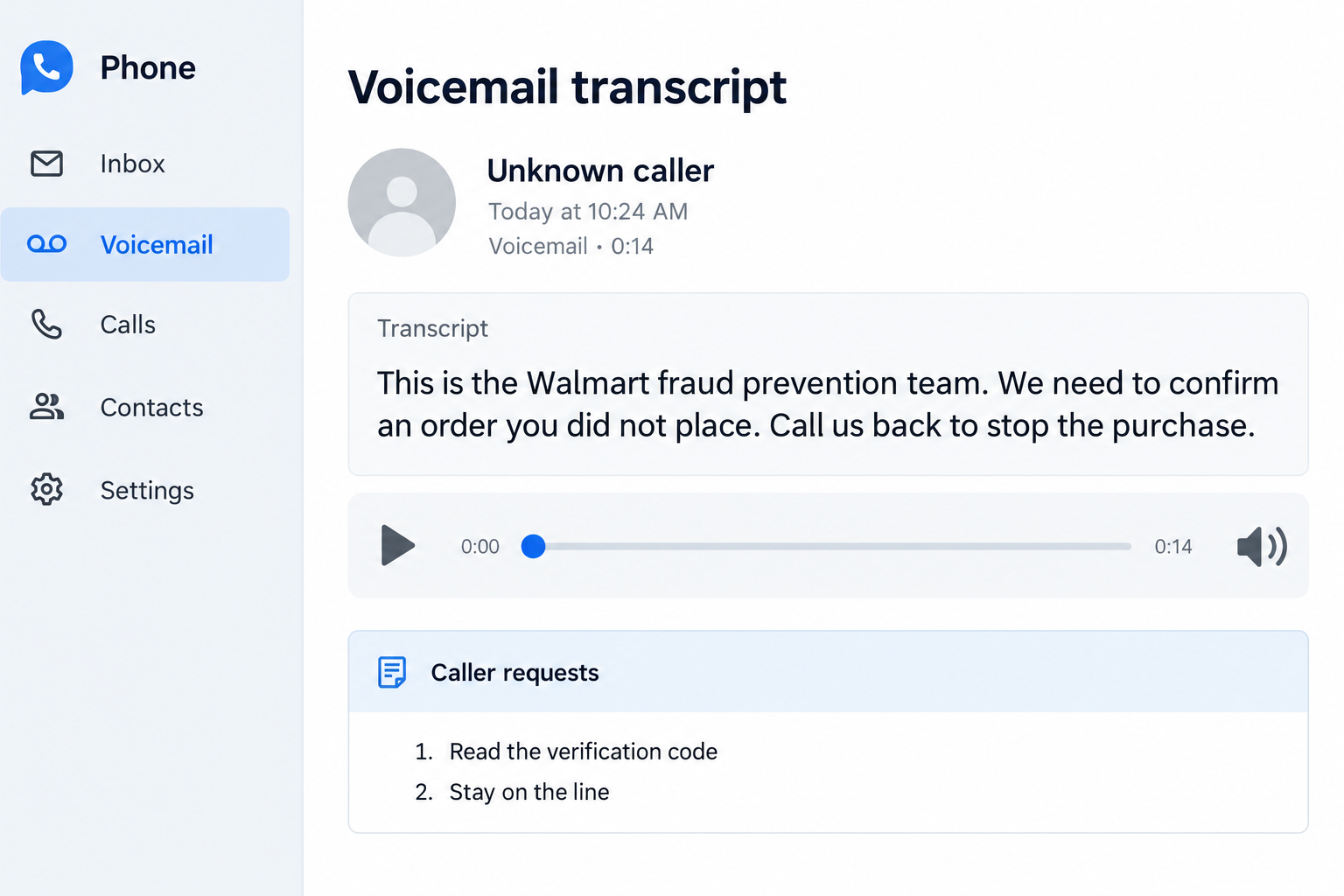
The lead image is an invented voicemail illustration, not a recording or transcript from a real customer. Its wording demonstrates the pressure point.
Different calls can branch into password theft, code requests, payment instructions, or remote access. Not every recipient encounters every branch.
There is no need to establish whether the voice is artificial. Treat the identity as unverified and independently check the claimed order.
The Fake Purchase Gets You Solving the Wrong Problem
You are invited to cancel before checking
A purchase you didn’t authorize naturally raises two questions: did somebody use your account, and did somebody use your card?
The caller offers an immediate answer to both. They say they can stop the transaction if you follow a few instructions.
That shifts attention away from evidence. You’re thinking about reversing a charge before seeing whether the charge exists.
A voicemail may encourage the same reaction by asking you to call back urgently. Returning that number keeps you inside the sender’s chosen channel.
A retailer record and a card record tell different stories
An order in your Walmart account deserves attention. So does an unfamiliar card transaction, even when you cannot find a matching order there.
A stolen card could be used through a different account or channel. Conversely, a caller can invent an order without accessing your card at all.
Pending transactions and posted charges may also look different. Ask your issuer to identify an unfamiliar entry rather than relying on the caller’s explanation.
Don’t let the absence of one record settle every question. Verify the alleged order and any actual payment activity separately.
Familiar details can hide an unfamiliar request
The caller might know your name, email address, or part of an address. Those details don’t prove access to Walmart’s internal systems.
Someone can obtain personal information from many places. You don’t need to discover its source during the call.
Instead, notice what the person wants you to do with information you still control: reveal a code, approve a prompt, or authorize a transaction.
You can refuse that request now. There’s no need to explain how the caller obtained your address before deciding to keep your code private.
How the Walmart Fraud Prevention Call Scam Works
Step 1: A supposed fraud team announces an unfamiliar order
The contact may be a live call, automated introduction, or voicemail. The claimed role is usually meant to sound protective.
You are told a purchase needs confirmation, or that it will proceed unless you respond. The item and amount can vary.
The story works without a real order. Its purpose is to make you feel that ignoring the call would allow a preventable loss.
Resist answering account questions while frightened. End the call and check the business through its official app or website.
Step 2: The caller keeps the investigation on their terms
After you deny making the purchase, the caller may treat that denial as confirmation that an urgent security process is necessary.
They can offer an internal transfer, provide a case number, or introduce another supposed department. None independently verifies the participants.
A transfer arranged by the original caller is still part of the same interaction. It isn’t equivalent to calling a number you obtained separately.
Pressure to remain connected is especially important. It reduces your opportunity to compare the story with real account records or another person’s advice.
You can investigate after hanging up. A legitimate issue doesn’t require you to trust the first person who mentioned it.
Step 3: Verification becomes a request for account access
A caller may ask for a password, PIN, or one-time code, describing it as a way to confirm you are the cardholder or account owner.
Read any notification privately. A message about signing in, resetting access, or approving a payment isn’t simply a cancellation receipt.
The code may concern a different service from the one named in the call. Don’t assume the retailer’s name explains every notification arriving during it.
Even when you initiated a genuine support call, follow the service’s stated verification process. Never override a message warning against sharing its code.
For an unsolicited caller, the simpler choice is to supply nothing and start fresh through a trusted contact route.
Step 4: Some versions ask you to operate the device for them
Another possible branch involves a link, download, screen-sharing session, or remote-control tool. The caller frames it as a fraud investigation.
That can expose information unrelated to Walmart, including banking screens, email messages, saved documents, or codes arriving elsewhere.
A legitimate remote-access product doesn’t make the person directing its use legitimate. The context and permissions matter.
Don’t open banking accounts while an unknown caller can see or control the screen. Stop the session before doing financial checks.
Installing nothing and simply answering a call doesn’t prove your device is infected. Device cleanup should match the actual exposure.
Step 5: A protective action may become a real payment
The caller may say an account must be secured by moving money, buying gift cards, or completing a verification transaction.
Those actions can turn an invented purchase into an actual loss. Calling a transfer temporary doesn’t prevent the recipient from receiving it.
Gift-card numbers and PINs matter because they can allow someone else to use the balance. A photograph can expose them just as effectively.
Refuse instructions to buy cards or send funds to cancel the supposed order. Contact your issuer if a real unauthorized transaction exists.
Don’t make a small test payment to establish trust. Completing one transaction doesn’t authenticate the caller or guarantee that the next demand will stop.
Step 6: The story continues when you hesitate or report a problem
If you question the process, the caller may introduce another supposed authority, increase the urgency, or claim your previous action was incomplete.
After a payment, another contact might promise a refund or recovery. That promise can be used to request another fee or code.
Preserve the existing evidence rather than continuing the conversation to obtain a confession. Your payment provider needs transaction details, not the caller’s permission.
Don’t assume a new name or number means a separate trustworthy organization has joined the case. Independently verify every new approach.
Check the Purchase Without Calling the Impersonator
Open Walmart yourself
Use the Walmart app you already have or enter the official website address yourself. Inspect the orders and account details available there.
If you need assistance, reach customer service from that official environment. Don’t use a sponsored search ad simply because it appears above other results.
Ask about the claimed order without volunteering passwords or full payment credentials. A reference number supplied by the caller remains unverified until the real service confirms it.
Look for unfamiliar shipping destinations or account changes as well as purchases. Save relevant records if something is wrong.
Reach the issuer independently
For actual card activity, use the number on your card or the support route in your banking app. Don’t accept the caller’s proposed bank transfer.
Explain whether you authorized a transaction because of deception or saw a transaction you never authorized. Accurate details help the provider assess the case.
Ask about protecting the card, disputing the transaction, and monitoring related activity. Available measures depend on the payment method and circumstances.
A promised refund from the caller isn’t a reason to postpone reporting. The FTC recommends contacting the payment company about possible recovery.
Don’t use caller ID as an employee directory
Walmart’s security guidance warns about deceptive calls and spoofed caller information. A familiar display doesn’t prove who placed the call.
The number displayed, the number in a voicemail, and the number in a later text may all differ. Save them as evidence, not as verified contacts.
Likewise, an unfamiliar accent or an unusually smooth voice doesn’t establish fraud. Judge the request and independently verify the business.
What to Do if You Have Fallen Victim to This Scam
-
Disconnect from the caller. Stop any remote session, close the supplied page, and don’t approve another prompt while collecting your thoughts.
Note the sequence: call, link, code, account access, payment. This is more useful than trying to remember every word of the conversation.
Save voicemail and messages without calling back. Keep any receipts and transaction identifiers privately.
-
Contact the provider holding the affected money. Use your card issuer, bank, transfer service, or gift-card issuer’s independently verified support route.
Describe the deception and ask what reversal, dispute, freeze, or replacement options are available. Don’t assume any particular option is guaranteed.
If gift-card details were exposed, retain the card and purchase receipt. Report promptly even when the balance appears to have been used.
-
Change exposed account credentials. Protect whichever account the code or password concerned, not just the retailer named by the caller.
Review signed-in devices, recovery details, and unfamiliar activity. Replace reused passwords on other services where the same secret would work.
If email access was exposed, secure that inbox too. It may receive reset links for several other accounts.
-
Check the Walmart account through real support. Review unfamiliar orders, delivery addresses, and changes that occurred during the incident.
Ask the actual service about stopping an unauthorized order where possible. Separately pursue the payment issue with the issuer.
Keep confirmation details from those genuine contacts. A caller’s claim that everything has been canceled isn’t equivalent to a retailer or bank record.
-
Inspect software only where relevant. If you installed a tool, remove its access and review extensions, downloads, and notification permissions.
Consider Malwarebytes for a security scan after risky software exposure. AdGuard can help reduce malicious advertising encounters, not undo payments or account theft.
Seek trusted technical help if remote control continues. Use a separate trusted device for urgent financial or password changes when the affected device remains uncertain.
-
Address identity information that was disclosed. If you supplied sensitive identifiers or identity documents, use IdentityTheft.gov for a recovery plan suited to the exposure.
Review financial alerts and tell providers about unfamiliar changes. Don’t post identity documents or complete card details in public complaint threads.
Sharing only your name isn’t the same as revealing a Social Security number. Give yourself an accurate list before choosing additional measures.
-
Report and refuse paid recovery offers. Preserve the impersonation evidence and report the incident at ReportFraud.ftc.gov.
Provide actual losses and transaction records rather than estimates based on what the caller claimed. You can report an attempt even without losing money.
Don’t pay an unsolicited investigator who guarantees recovery. Someone asking for another transfer to release your refund may be continuing the same deception.
Frequently Asked Questions
Does Walmart ever contact customers about orders?
Legitimate customer contact can occur. The issue is whether this caller is genuine. Independently contact Walmart rather than treating every call as authentic or automatically fraudulent.
What if the caller knows my name and address?
Those details don’t establish employment or authority. Don’t disclose codes or payment information to confirm information the caller already appears to know.
Can answering the call steal money by itself?
Answering alone doesn’t establish a financial loss. Focus on whether you shared information, approved access, installed software, or authorized a payment.
Should I press a number to cancel the alleged purchase?
Don’t rely on the call’s cancellation path. Hang up, check real account records, and obtain customer support from the official service.
Why does the code mention my bank instead of Walmart?
It may concern a banking action the caller wants approved. Read the purpose privately and contact the bank independently without sharing the code.
What if there really is an unauthorized Walmart charge?
Report it to your issuer and contact Walmart through official support. A real transaction doesn’t authenticate the unexpected person who called about it.
The Bottom Line
End an unsolicited Walmart fraud prevention call before supplying codes, access, or money. Check the alleged order and any real card activity through independently chosen channels.
If you’ve already followed instructions, contact the affected provider promptly and secure exposed accounts. Don’t let a promised cancellation delay steps that can limit further harm.

Join the discussion
0 commentsShare your experience or ask a question about this article.
Discussion
Start the conversation
Have a question or something useful to share? Add the first comment.