

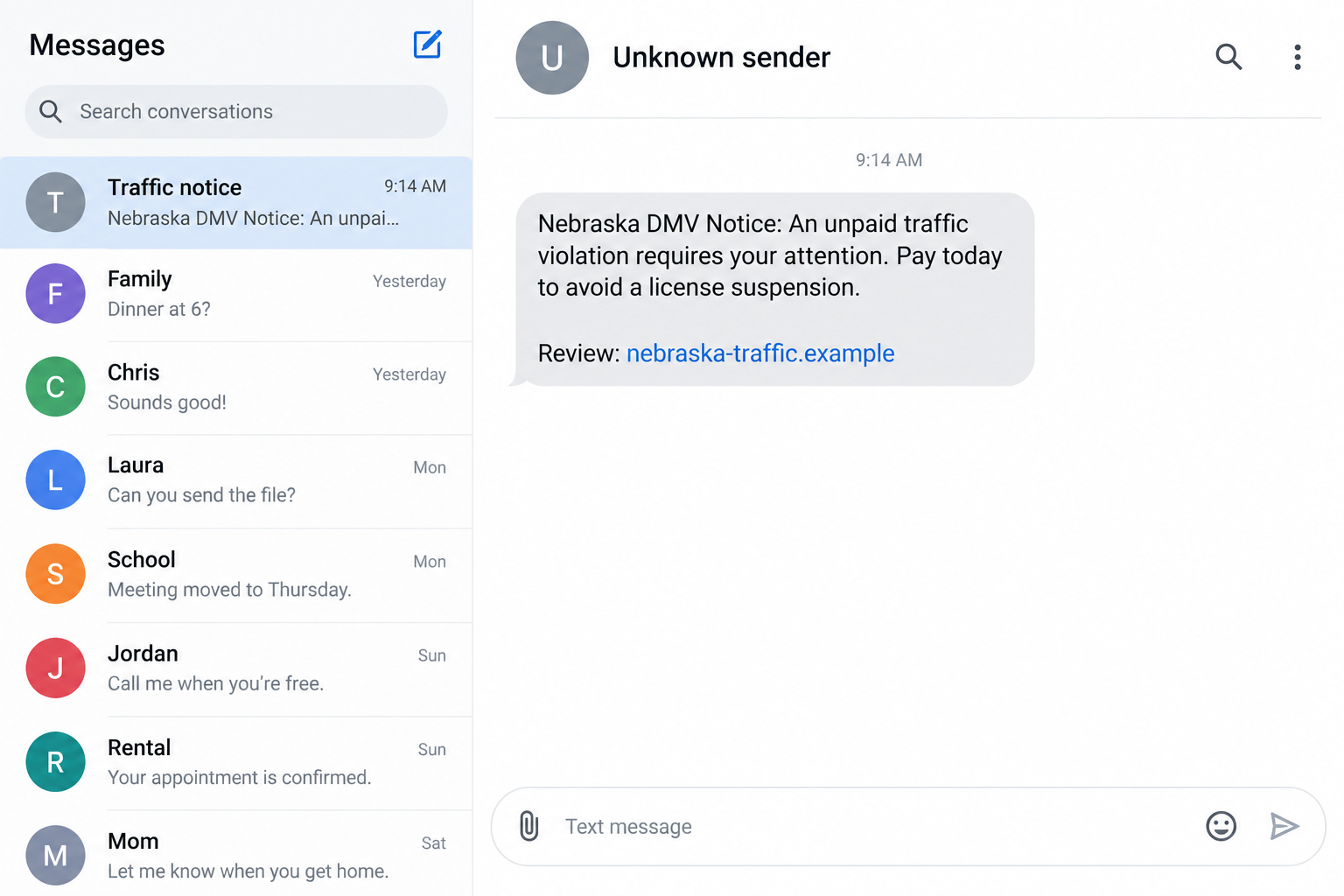
A text says an unpaid Nebraska traffic violation could put your license at risk. The deadline is close, and the message offers a quick way to settle it.
It’s the sort of interruption that can follow you through the day. Before paying, work out whether the sender has shown you an actual obligation.
Overview
A threatening notice is not a driving record
The Nebraska DMV scam text impersonates a motor vehicle authority and uses an alleged fine, violation, or similar problem to push recipients toward a payment link.
Its leverage is your dependence on driving. A short message turns a vague allegation into a problem that seems to require immediate attention.
Official Nebraska warnings distinguish fraudulent payment demands from legitimate government communications. The real agencies are being impersonated; they aren’t operating the scam.
Two official warnings explain the distinction
The DMV’s customer scam warning addresses texts demanding money or promising refunds. It also explains that voluntary opt-in messages can be genuine.
A separate Nebraska Judicial Branch warning covers fraudulent traffic-violation texts and emails seeking payment or personal information.
- Don’t confuse an unexpected payment link with a verified case.
- Check the actual office responsible for the claimed problem.
- Keep genuine ticket deadlines separate from the text’s invented urgency.
- Contact your card issuer if payment information was exposed.
What this guide’s image represents
The notice pictured above is a fictional interface illustration. Its example address isn’t a live payment destination or evidence of a specific recipient’s message.
Actual wording, dates, amounts, and websites can change. The useful question is whether you can confirm the allegation without following the sender’s route.
Don’t pay through the unsolicited notice. If you have a real concern about your license or a ticket, investigate it independently.
Nebraska Agencies Can Send Some Legitimate Texts
Opting into messages doesn’t authorize every payment request
It’s tempting to use one simple rule: government agencies never text. Nebraska’s own guidance makes that rule too broad.
The DMV says it may send messages when customers voluntarily opt in. Its warning specifically distinguishes those communications from demands for money or refund promises.
The Judicial Branch also notes that courts can text when people have given permission and supplied their contact information.
That doesn’t authenticate a new text just because you previously dealt with the state. Enrollment in one service isn’t permission to trust every sender.
Check whether the message fits a transaction you initiated, then confirm through the agency’s independently accessed service when payment or sensitive information is involved.
The DMV warning also covers promised refunds. An apparent offer to return money can lead to the same request for card or personal information.
Don’t enter payment details to collect an unexpected refund. Ask the real agency about an identifiable transaction before treating a refund promise as money owed to you.
A real ticket and a license problem are not identical
A traffic citation belongs to a particular case and issuing jurisdiction. A driver’s license inquiry concerns your driving record or current status.
The two can be related, but a text listing both doesn’t prove that either record exists. Don’t let combined terminology replace basic verification.
If you already have a ticket, use its independently verified court details to check the case. Avoid substituting the unsolicited text’s contact information.
If your concern is license status, start with the Nebraska DMV’s official services. Ask which office handles anything you cannot identify confidently.
Ask whether the record matches you and the alleged incident. Finding a genuine government page doesn’t answer whether this particular demand belongs to you.
A warning’s age matters less than whether you understand it
The DMV warning was published in 2021. It isn’t evidence of a newly announced enforcement rule or a new charge against you.
The Judicial Branch’s May 2026 warning independently describes traffic-payment impersonation. Together, they explain both the deception and the legitimate communication exceptions.
Neither warning determines your personal legal position. Use the responsible office to resolve a genuine case rather than relying on a scam article for case advice.
How the Nebraska DMV Scam Text Works
Step 1: A local agency name makes an unexpected message feel relevant
The text names Nebraska and borrows official-sounding language about traffic violations, outstanding balances, or driver records.
That local detail can make the message harder to dismiss than generic spam. You may begin searching your memory for a missed notice.
A recent move, a family member using the vehicle, or an upcoming renewal can supply an innocent explanation in your mind.
Those circumstances don’t validate the sender. They simply make the allegation feel plausible enough to investigate.
Investigate from a fresh starting point. You don’t need to open the supplied link to take the possibility of a real issue seriously.
Step 2: A deadline turns uncertainty into a payment decision
The sender may threaten license suspension, extra charges, or further action if the supposed balance remains unpaid.
The pressure encourages you to treat the deadline as established fact. First, however, there must be a genuine record and an actual responsible authority.
A formal-looking reference, citation number, or legal phrase doesn’t establish those things. Treat them as information to check, not instructions to obey.
Don’t assume that ignoring the scam means ignoring a real ticket. You can reject the payment link while checking any genuine paperwork separately.
That separation removes the sender’s strongest advantage: making independent verification feel like a dangerous delay.
Step 3: The link supplies a convenient route to a false resolution
A message may offer one button or address that appears to resolve everything. The destination can imitate official colors, labels, and payment instructions.
Visual familiarity isn’t proof of authority. A copied government heading cannot connect the page to your actual driving record.
The browser’s encrypted-connection indicator also doesn’t establish government ownership. It concerns the connection, not whether the demand is legitimate.
Some destinations disappear or stop working after an alert circulates. A broken page doesn’t mean the message was harmless when it arrived.
You don’t need to test the form. Use the real agency’s website independently and find its current services from there.
Step 4: Resolving the alleged fine becomes disclosing valuable information
An imitation payment flow may request card details, billing information, identifying data, or account credentials. The specific fields differ between versions.
The visible amount isn’t necessarily the full risk. Exposed card information can require attention even if no successful payment receipt appears.
Likewise, submitting a page that later shows an error doesn’t prove the information was rejected. Record what you typed and contact the relevant provider.
If a later prompt asks for a bank code, stop. Read the genuine bank message privately to understand which action it concerns.
Don’t keep trying another card or code because the page claims the first attempt failed. That can widen the exposure.
Step 5: The information can support another convincing approach
After a response, a follow-up caller or message may refer to the supposed fine, payment, or refund.
Information you already supplied can make that approach sound informed. It still doesn’t establish the identity or authority of the new contact.
A demand for another payment to correct the first is another reason to stop. Contact your provider using your own trusted route.
Possible follow-up misuse isn’t proof that it happened to every recipient. Watch actual account activity rather than treating every later message as connected.
Preserve enough records to recognize the original story without continually reopening the suspect site.
Verify the Problem Without Letting the Sender Direct You
Identify what the message is actually alleging
Before searching, write down whether it claims a ticket, license issue, registration problem, refund, or toll balance. Different allegations may require different offices.
A message that bundles several together can create confusion about where to check. Start with the concrete record it says exists.
For a court matter, use the Nebraska Judicial Branch’s official guidance to locate the appropriate court or payment route.
For a DMV service, begin at the official Nebraska DMV website. Follow its current links instead of guessing a payment address from the text.
Prepare for a useful conversation with the real office
Have genuine paperwork, prior receipts, and the date of the alleged incident available. Use only information needed for the official inquiry.
Ask whether there is a matching record, which office owns it, and what the legitimate response options are.
Don’t ask the unknown sender to confirm those details for you. Another elaborate explanation isn’t independent verification.
If the office cannot locate a record, explain any genuine paperwork you have. A missing online result alone shouldn’t decide a separate, known legal obligation.
Handle shared vehicles without passing the link around
When relatives share a vehicle, ask whether anyone received actual paperwork. Forwarding the payment link can expose several people to the same lure.
For a work vehicle, involve the person responsible for fleet records or traffic notices. Don’t pay personally just to make an unfamiliar message disappear.
Compare the alleged vehicle and incident with records you already control. A matching name or plate, if present, still doesn’t authenticate the payment destination.
Keep the verification conversation factual. You are checking a notice, not asking a family member or employer to admit wrongdoing.
What to Do if You Have Fallen Victim to This Scam
-
Stop interacting and save a private copy. Capture the text, sender information, visible website, and any payment confirmation without revisiting the suspicious form.
Record when the interaction happened and what information you entered. Don’t post card numbers, identity details, or usable account codes publicly.
If the message only arrived and you did nothing, reporting and deleting it may be sufficient. Exposure depends on what happened afterward.
-
Call the issuer about exposed card details. Use the number on your card or your banking app, not the text’s proposed fraud department.
Explain whether a payment occurred and whether the full card details were entered. Ask about replacement, protection, and disputed-transaction options.
Report even a small payment. The form may have exposed information beyond the amount shown, and a reversal isn’t guaranteed.
-
Protect any account credentials you supplied. Change the affected password through the genuine service and review unfamiliar sessions or contact changes.
Replace the same password on other accounts if you reused it. Don’t confuse changing a password with replacing an exposed payment card.
For a disclosed bank code or approval, tell the bank what the prompt said. Its purpose helps identify the actual account action.
-
Get identity-specific help where necessary. Sensitive identity details or document images warrant a different response from simply receiving spam.
Use IdentityTheft.gov for a plan based on the information involved. Follow up with the relevant issuer if a driver’s license document was exposed.
Watch for unfamiliar account activity without assuming identity theft has already occurred. Keep real notices and case details together.
-
Review risky downloads and browser permissions. If you installed anything or granted notifications, inspect those changes and remove permissions you don’t recognize.
Malwarebytes can assist with potentially unwanted software checks. AdGuard may reduce malicious ad exposure; neither protects a card number you’ve already disclosed.
Opening a message isn’t an infection diagnosis. Keep financial and account recovery ahead of unrelated software purchases.
-
Confirm real obligations with the responsible Nebraska office. Check a genuine ticket or license concern independently, even after identifying the text as fraudulent.
Ask how to handle the actual record and retain the office’s instructions. Don’t pay a second time merely because the impersonator claims the first payment failed.
A scam report doesn’t automatically close a legitimate court matter. Keep the two records separate so an important real deadline isn’t lost.
-
Report the attempt and expect cautious follow-up. Use the reporting guidance in Nebraska’s official warning and report financial deception at ReportFraud.ftc.gov.
The FTC’s practical recovery guide also explains whom to contact for different payment methods.
Ignore unsolicited offers to recover money for an advance fee. A person referencing the incident isn’t automatically part of your bank’s investigation.
Frequently Asked Questions
Does the Nebraska DMV send legitimate texts?
It can send messages to customers who voluntarily opted in. That doesn’t authenticate unsolicited money demands or texts promising refunds.
Can a Nebraska court contact me by text?
The Judicial Branch says courts may text people who gave permission and contact details. Independently verify any unexpected payment demand with the responsible court.
Does the deadline in the text suspend my license?
The text doesn’t establish your actual status. Check through official DMV services, and separately address any genuine court paperwork you already have.
What if the payment page looked exactly like a state website?
A copied layout doesn’t verify ownership or a debt. Leave it and navigate to the official agency yourself before entering information.
Should I reply STOP to the suspicious sender?
Don’t reply to an unverified demand. Manage any genuine messaging enrollment through the official service rather than treating the unknown text as its control panel.
Do I need a new card if no charge appeared?
Tell your issuer if you entered card details, even without a visible charge. Let it assess replacement and monitoring rather than relying on the form’s result.
The Bottom Line
Reject the Nebraska DMV scam text’s payment route. Confirm a genuine license issue or ticket through the correct official service, without trusting the sender’s deadline.
If you entered financial details, contact the issuer now. Preserve the message and handle any real Nebraska obligation separately from the fraudulent demand.

Join the discussion
0 commentsShare your experience or ask a question about this article.
Discussion
Start the conversation
Have a question or something useful to share? Add the first comment.