

The woman on screen says she understands the frustration: another diet, another disappointment, and clothes that no longer feel comfortable.
Then Dr. Emily Walters promises a pink tea trick. Before trusting that inviting little phrase, follow where the presentation wants to take you.
Overview
The advertised doctor is the story’s central trust signal
The Dr. Emily Walters pink tea presentation describes a former pharmaceutical researcher offering a supposedly remarkable weight-loss discovery.
Her advertised career, research role, and connection to the claimed results have not been independently authenticated. A persuasive introduction is not a medical credential.
This warning concerns that specific promotional identity. It is not an accusation against every healthcare professional with the same or a similar name.
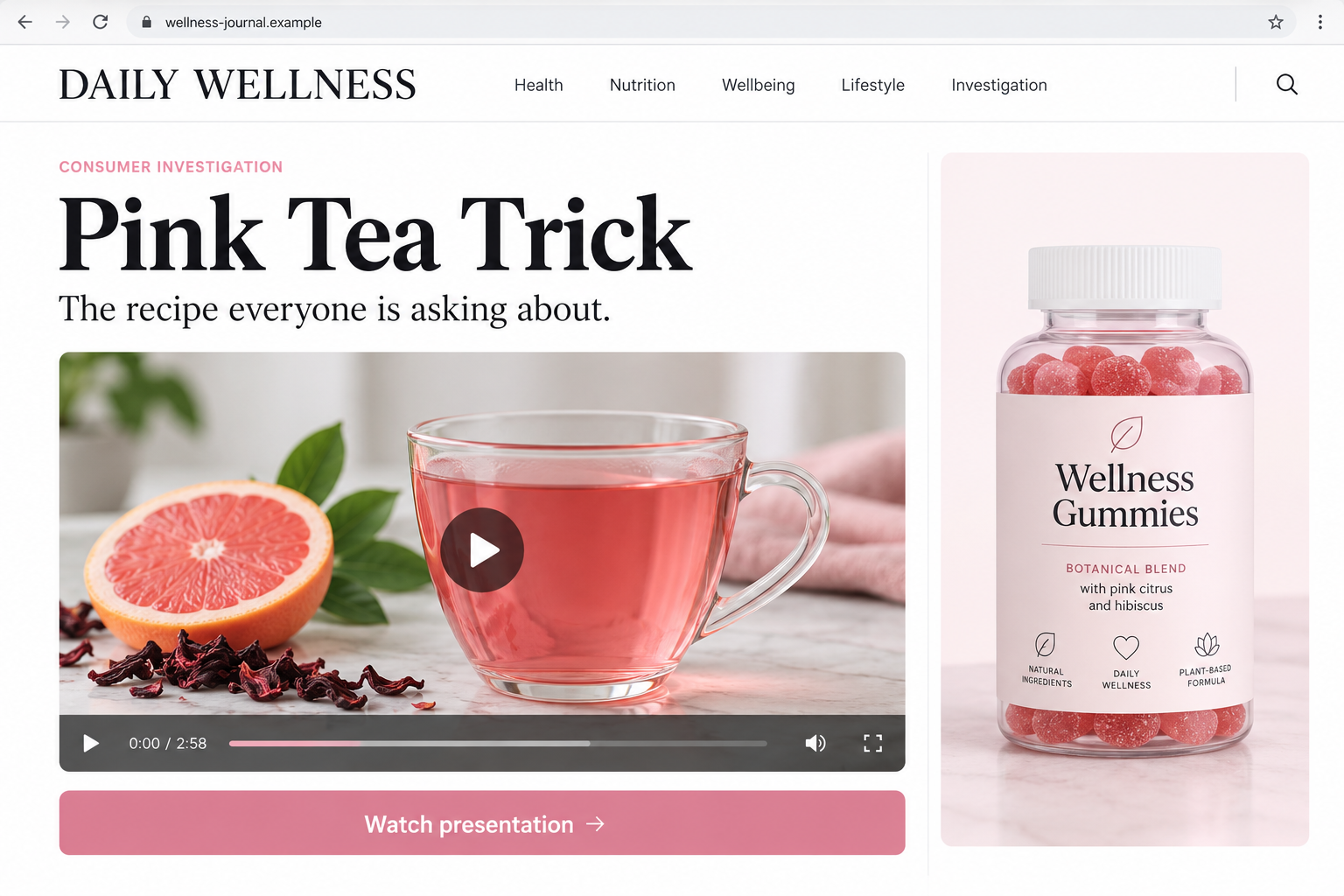
The lead image illustrates the sales-page format using a fictional domain and generic packaging. It is not an original advertisement or a real checkout.
A promised drink becomes an order for gummies
The recorded campaign offers a pink-citrus recipe, then promotes TrimLab Gummies. The audience is attracted by a kitchen idea and led toward a packaged supplement.
The narrative compares the supposed method with prescription injections and promises striking weight changes without the usual effort.
That combination deserves a clear answer: do not order through this presentation. Its unverified authority and unsupported treatment comparisons do not justify the purchase.
Whether a bottle is delivered is a separate question from whether the advertised doctor, recipe, and expected results are genuine.
The warning should stay attached to the documented offer
The available campaign recording preserves specific claims. A current original merchant checkout was not available for an order-by-order billing assessment.
- The spokesperson claims experience developing weight-loss medication.
- The pitch repeatedly promises a pink tea or pink-lemon answer.
- The commercial outcome is a gummy supplement, not an established prescription alternative.
- The recorded product page uses an FDA-approval claim that supplements cannot borrow.
Automatic refills, manufacturing origin, and actual refund handling are not established by that recording. They must not be invented to strengthen an already justified warning.
Why This Story Feels More Personal Than an Ordinary Advertisement
The pitch does not begin with an ingredient panel. It begins with how disappointing previous attempts at weight loss can feel.
That makes the speaker sound like someone offering understanding rather than selling a product. The proposed solution arrives after the emotional connection.
The narrator’s claimed pharmaceutical background then adds an insider role. She supposedly knows the system and can explain what ordinary patients have been missing.
Those two roles work together: sympathetic friend and knowledgeable researcher. A viewer may become comfortable with the person before checking the promise.
But understanding a reader’s frustration is not evidence that a treatment works. Medical decisions need more than the feeling of finally being heard.
You can reject the sales claim without dismissing your own difficulties. Struggling with weight is not a reason to trust an unverifiable commercial biography.
What the Prescription Comparisons Leave Out
The presentation uses the familiarity of Ozempic, Wegovy, and Mounjaro to make its alternative sound both powerful and accessible.
Calling a drink natural does not establish that it acts like a regulated medicine. The proposed effects, dose, and safety profile need their own evidence.
The pitch goes further, claiming an advantage over these medicines and portraying the method as broadly safe. Neither conclusion follows from a pink ingredient.
A genuine comparison would identify the exact formula, treatment groups, follow-up period, and outcomes. Testimonials cannot supply those missing details.
The NIDDK explains prescription weight-management treatment as individualized care, not a decision based on a social-media recipe.
People may have different medical histories, other medicines, and treatment goals. A single presentation cannot assess all of those circumstances.
Do not replace a prescribed medicine or change its dose to try the advertised trick. Bring questions about alternatives to the clinician managing your care.
How the Dr. Emily Walters Pink Tea Pitch Works
Step 1: A relatable opening earns a few more minutes
The campaign speaks to someone who feels they have already tried everything. It offers a fresh explanation rather than another lecture about willpower.
The promise is deliberately easy to picture: a colored drink, familiar ingredients, and a small daily habit. It sounds less intimidating than another treatment plan.
At this stage, the practical question is simple. Is the advertisement offering a recipe, a medical service, or a supplement?
When that answer is delayed, notice the delay. You should not need to finish an extended presentation to learn what somebody intends to sell.
Step 2: Dramatic outcomes make waiting feel worthwhile
The narrative describes substantial weight losses over short periods and introduces success stories with first names such as Sarah and Chelsea.
The viewer is encouraged to imagine a similar transformation. But isolated stories do not show what a typical customer can expect.
Results may depend on other treatment, changes in eating, starting weight, or facts never mentioned. A sales testimonial does not control for those differences.
Nor can smooth skin or unusual lip movements alone prove how a video was produced. The claims can be assessed without a speculative AI diagnosis.
Step 3: The speaker introduces an insider’s credentials
Dr. Emily Walters is presented as someone who spent years working on pharmaceutical weight-loss products and then pursued natural ingredients.
The implied message is that she knows something drug companies would rather keep quiet. That story can make missing independent confirmation feel intentional.
Yet a commercial narrator’s employment history needs a verifiable source. The presentation’s confidence is not a replacement for an accountable professional record.
Do not contact an unrelated doctor merely because a search returns a similar name. The relevant question is who authorized this specific advertisement.
Step 4: A suppression story discourages outside checking
The speaker warns that the presentation could disappear and describes pressure from interests threatened by the discovery.
That turns a pause for research into an apparent risk of missing out. The viewer may feel that checking could cost them the opportunity.
A claim of suppression does not demonstrate a discovery. It also does not explain why reliable treatment evidence cannot be provided before payment.
Take the time anyway. A health product does not become more effective because its sales video predicts that someone will remove it.
Step 5: The promised ingredients give way to gummies
The commercial destination is TrimLab Gummies, presented with wellness or blood-sugar wording on the bottle while the narrative focuses on losing weight.
That mismatch matters. A package description is not a clinical demonstration of the more dramatic claims made in the presentation.
Check exactly what the bottle contains, how much of each ingredient is provided, and what evidence concerns that finished formulation.
A mention of a plant compound does not reveal its dose in a gummy. Neither does it establish the effect of combining it with other ingredients.
Step 6: A reassuring checkout asks for the commitment
The purchase route reaches a Cartpanda-hosted payment stage and displays review scores, package choices, and a money-back promise.
A checkout platform can provide payment infrastructure without endorsing every claim made by its merchants or their advertisers.
The old recording does not establish today’s price, selected quantity, or recurring-payment terms. Do not substitute assumptions for your own order summary.
If a checkout cannot plainly identify the seller and total commitment, close it. Reassuring icons are not a reason to supply card details.
The FDA Claim Is Not a Minor Detail
The recorded product page describes the supplement as FDA approved. That is a consequential claim because it suggests regulatory scrutiny of the product’s promised effects.
The FDA says supplements are not approved to treat or prevent disease. The claim cannot be used as a shortcut to effectiveness.
Manufacturing standards and facility registration are separate matters. They do not authorize an advertiser to say a supplement performs like a prescription injection.
Likewise, familiar media references must be backed by a real report about the exact product. A television name placed near an order button proves nothing.
This is why the buying recommendation can be firm without claiming every possible allegation is established. The advertising already asks readers to trust more than it proves.
A Real Recipe Would Answer Different Questions
An ordinary recipe gives you ingredients, quantities, preparation instructions, and a clear idea of the finished drink. You can decide whether you want it.
A medical claim requires much more. The presentation would need to explain how the proposed preparation was tested and what benefit was measured.
The pink-tea story blurs those categories. It uses a familiar drink to suggest accessibility, then invokes drug-like effects when describing the expected outcome.
Neither category is satisfied by repeatedly promising that the explanation is coming. Waiting longer does not create the missing evidence.
Consider the comparison with gummies. If the commercial formula differs from the advertised drink, evidence about one cannot simply be transferred to the other.
Even a named ingredient needs a quantity and preparation method. A substance’s presence in a plant does not reveal its dose in a product.
And a successful before-and-after story cannot establish that the ingredient caused the change. Other treatments and behaviors may have been involved.
These are not technical objections reserved for scientists. They determine whether the offer actually answers the question that brought you to the page.
You wanted a useful, understandable way to improve your health. An unresolved chain of claims is not that answer, however appealing the drink looks.
Enjoying tea is one decision. Spending money because it is portrayed as a powerful medication alternative is another, and that second claim has not earned trust.
Do Not Let a Moving Product Name Hide the Story
A similar pitch can be attached to a different bottle later. The essential questions remain the advertised doctor, discovery, evidence, and purchase conditions.
That does not establish that every pink-tea advertisement has the same owner. Similar language can be copied by affiliates or unrelated sellers.
It does explain why searching only the bottle name can miss the problem. Search the doctor’s name and recipe phrase as well.
Compare what the ad promises with what the label and checkout actually say. The gap is often more useful than the brand’s newest spelling.
Our separate TrimLab coverage addresses the supplement. Here, the focus is the Walters authority story and how it turns recipe interest into purchasing.
What to Do If You Bought After Watching the Presentation
-
Collect the order information before chasing another advertisement. Save the receipt, payment descriptor, quantity, shipping confirmation, and any support messages.
If the selling page is still available, preserve its guarantee and recurring-payment wording. Keep the full address, not just the product name.
-
Ask the seller to stop an unwanted order promptly. Explain whether you are requesting cancellation before dispatch or a refund after delivery.
Use a contact attached to your transaction. The historic campaign’s email address should not be treated as a verified current support channel.
-
Get return conditions in writing. Ask whether opened bottles are accepted, where the parcel goes, and what postage or deductions apply.
Photograph the goods and keep a tracked shipping receipt if returning them. Do not send a parcel to a guessed overseas address.
-
Check for additional purchases or renewals. Compare each payment with an itemized receipt rather than assuming every charge represents a refill.
For an unwanted recurring payment, request cancellation and confirmation. Tell your payment provider if charges continue or authorization is disputed.
-
Escalate an unresolved transaction through the provider. Describe what was promised, what you received, and the steps taken to resolve it.
Ask about applicable deadlines. Keep the distinction between misleading advertising, non-delivery, an incorrect quantity, and an unrecognized charge clear.
-
Discuss use of the gummies with a professional. Show the complete ingredient label, especially if you take medication or have an existing condition.
Report the deceptive promotion to the platform with its exact claims. Refuse follow-up offers requiring another payment to recover the first one.
Frequently Asked Questions
Is Dr. Emily Walters the verified creator of a weight-loss discovery?
The identity and career presented in this campaign have not been authenticated. That is not a claim that no legitimate professional anywhere shares the name.
What is the pink tea trick supposed to be?
The advertisement describes a pink-citrus routine while leading viewers toward gummies. It does not establish a clinically proven homemade alternative to prescription treatment.
Are the Sarah and Chelsea testimonials reliable medical evidence?
No. The recorded stories do not provide the independently verifiable treatment details needed to establish typical results, safety, or a comparison with medication.
Does this investigation prove that TrimLab uses automatic refills?
No current checkout was verified. Buyers should inspect their actual receipt and recurring-payment agreement, then dispute charges that were not authorized.
Why is the lead image an illustration?
A suitable original sales-page capture was unavailable. The image uses fictional details to explain the format and is not evidence of a real charge or testimonial.
Should I try the advertised method before seeking care?
Do not delay appropriate care for this pitch. Discuss weight-management options and any supplement ingredients with a clinician who can consider your circumstances.
The Bottom Line
Do not buy through the Dr. Emily Walters pink tea presentation. Its expert story, prescription comparisons, and approval claim are not a trustworthy basis for treatment.
If you ordered, keep the transaction evidence and request cancellation or a refund now. Make your next health decision with an accountable professional, not a disappearing-video warning.

Join the discussion
0 commentsShare your experience or ask a question about this article.
Discussion
Start the conversation
Have a question or something useful to share? Add the first comment.