

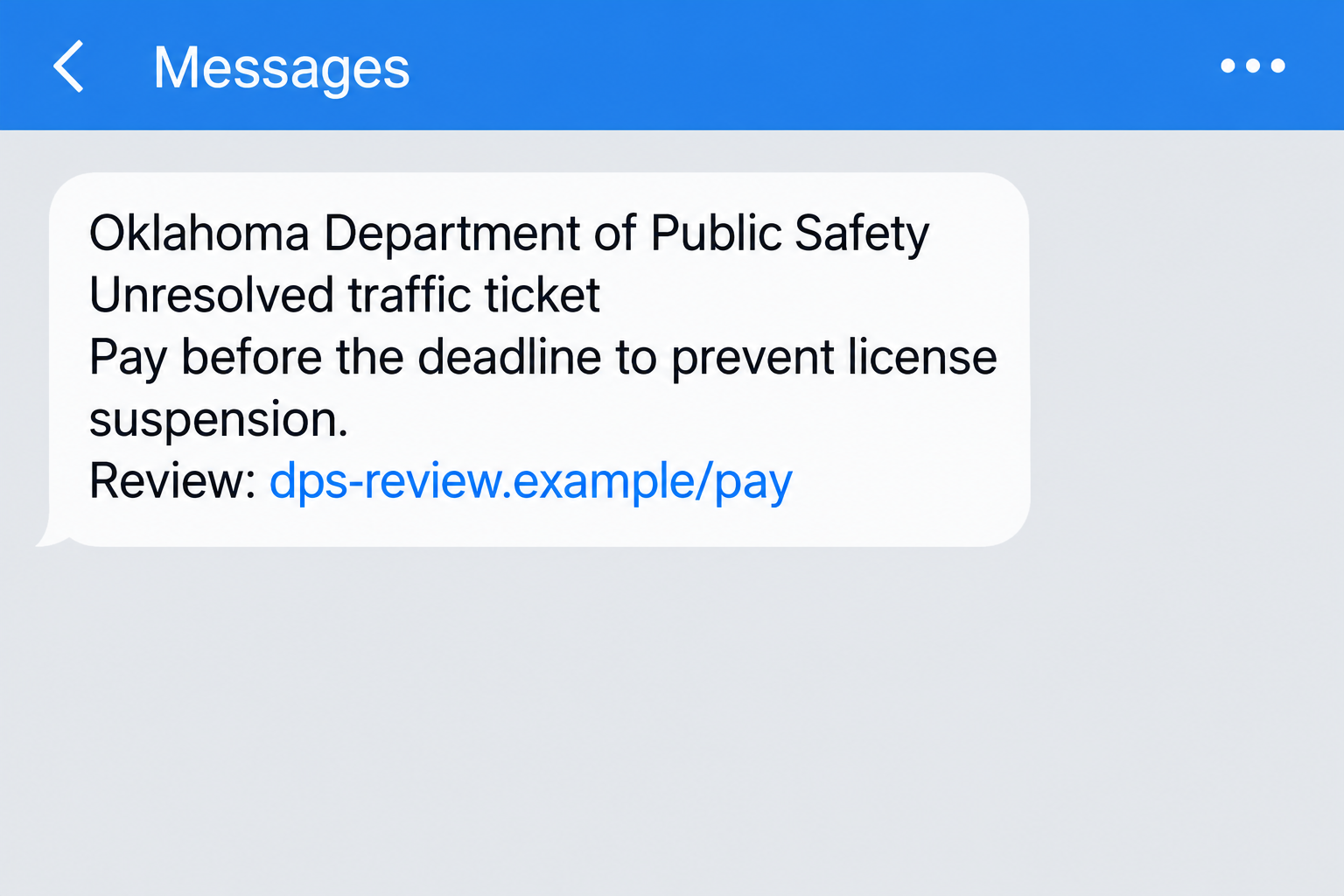
An Oklahoma DPS text says a traffic ticket could cost you your license. There’s a link to resolve it, apparently before the situation becomes more serious.
If you need your car tomorrow, that warning is hard to dismiss. The important detail is which office supposedly wants your money.
Overview
DPS and highway patrol names make a false collection demand sound official
The Oklahoma DPS text scam claims an unresolved ticket requires immediate payment. The alleged penalty is often a restriction on your ability to drive.
Oklahoma’s Attorney General has warned specifically about this demand using DPS or Oklahoma Highway Patrol identities.
The warning explains that those agencies do not collect traffic-violation payments. An actual fine must be checked with the responsible court clerk, not an unknown texter.
Service Oklahoma has issued its own warning
Oklahoma’s services can be confusing to navigate, especially when old paperwork mentions DPS. That confusion does not make the incoming link a useful shortcut.
Service Oklahoma’s contact page warns about messages impersonating government agencies, alleging toll or traffic debts, and threatening legal action or suspension.
The image above is a fictional example of that approach. It contains no actual case information and cannot take a payment.
Three different questions need three different checks
A ticket, license restriction, and turnpike charge are not interchangeable. The organization handling one may not be the organization that handles another.
- A real citation needs the correct court and case.
- A licensing concern needs the state’s official driver-service process.
- A genuine toll bill belongs with its actual operator.
- A suspicious financial transaction needs your bank or payment provider.
Reject the text’s payment route while checking whichever real issue concerns you. You don’t have to accept its instructions to take your own records seriously.
Why the Agency Mix-Up Matters
Stopping a driver is not the same as collecting a court fine
Someone may recognize Highway Patrol from the road and assume a message bearing that name must know about a traffic ticket.
The scam takes that familiar connection and adds an unsupported payment instruction. Recognizing an agency does not tell you whether it sent the text or should receive money.
Read the request literally. Does it identify a court and an incident you can verify, or simply claim that a government database shows a balance?
A reference number can make an allegation look organized. It only becomes useful when the responsible office can connect it to the right person and actual matter.
Real licensing services still exist online
Do not turn this warning into a rule that every online Oklahoma service is fake. Service Oklahoma publishes genuine services and contact information.
Its suspension and reinstatement information explains that actual restrictions can require specific compliance steps.
That is why an independent check matters. A real issue may need more than payment, while an impostor’s page may offer a convenient but meaningless clearance.
Reach any online process through the agency’s own navigation. A service appearing on your phone is not inherently suspicious; an unverified collection link is the problem.
How the Oklahoma DPS Text Scam Works
Step 1: A vague ticket is presented as an established debt
The sender announces an unresolved traffic violation. The message may not give enough detail for you to recognize where or when it supposedly happened.
That gap creates a reason to open the link. You might think you are only reviewing the evidence, rather than beginning a payment.
Keep your own uncertainty separate from the sender’s confidence. Not remembering every journey does not make an undocumented debt more credible.
Step 2: A borrowed agency identity supplies the pressure
DPS, highway patrol, DMV, or another government-sounding heading makes the text appear connected to your legal ability to drive.
In the documented Oklahoma warning, the demanded traffic payment is not being collected by the agencies whose names are invoked. That mismatch is important.
Do not repair the message in your head by assuming one office must collect for another. Ask the genuine organization what it handles.
An official-looking logo or a matching contact name cannot answer that question. Both can be copied into a message or its landing page.
Step 3: Suspension makes an instant payment feel reasonable
The claimed deadline turns a questionable balance into a practical worry. You may be tempted to pay first and investigate later to protect tomorrow’s plans.
Paying first hands a stranger your details before you’ve checked the ticket. You would then depend on that same stranger to explain whether it worked.
A genuine restriction should be addressed through the official process. A text threatening one cannot establish that process merely by providing a payment button.
Step 4: The link becomes a supposed identity or violation check
The destination may ask for a name, vehicle information, or card details. A form labeled “verification” is still collecting whatever you enter.
Be cautious about a page that requires financial information before identifying the alleged court or ticket. You should not have to buy access to an explanation.
A web address containing DPS or Oklahoma is not sufficient authentication. Open the state’s known website separately instead of guessing which letters in the link are safe.
If a QR code appears, treat it as another link. Its square pattern does not certify a court, government office, or payment processor.
Step 5: The recipient is pushed to finish the transaction
Once you have spent time entering details, another small request can feel like the final hurdle. That can make it harder to leave an increasingly doubtful page.
An error followed by a demand for another card is a reason to stop. So is an instruction to obtain gift cards or send an unfamiliar transfer.
Do not provide a banking code just because the page calls it account verification. Check the bank’s own message to understand the action being authorized.
No legitimate explanation should depend on keeping you away from your financial provider. Contact that provider using your established route whenever a transaction looks wrong.
Step 6: The promised license fix never establishes an official result
A payment receipt from the website does not show that an Oklahoma court received money or that a real licensing requirement was satisfied.
Likewise, the scammer’s final message cannot certify that your record is clear. Obtain answers from the office responsible for the actual record.
The exact exposure varies by page and response. These warnings do not establish that merely receiving an SMS installs malware or that every destination asks identical questions.
Check the Ticket, License, and Toll Separately
For a ticket, establish the court before discussing payment
Use genuine citation paperwork if you have it. Identify the issuing jurisdiction and independently locate the court clerk’s published details.
Ask how to verify the case and whether the alleged balance belongs to you. Explain if the message does not identify a usable court or citation reference.
Municipal and other court matters can have different processes. Do not assume that a stranger’s all-purpose payment portal covers every Oklahoma ticket.
For a license concern, begin with Service Oklahoma
The official contact page points readers to service.ok.gov for genuine services. Use its published navigation to locate licensing information or ask for help.
Describe your concern without treating the text as a reliable record. If you have existing suspension paperwork, compare its requirements with the agency’s confirmed instructions.
Actual reinstatement can involve more than a fee. Do not accept a promise that one unexplained payment instantly removes every restriction.
If a genuine service links an outside scheduling or assistance platform, follow that official route. An unfamiliar platform name alone does not prove fraud.
For a toll claim, find the actual account owner
Oklahoma has real turnpike billing. A toll story is not false merely because the road charge is unfamiliar or you expected to receive something by mail.
Use a known account, prior genuine statement, or independently located operator website. Compare the vehicle and trip without entering them into the DPS-branded text page.
If several people use the same vehicle, ask about travel separately. A plausible trip still does not authorize an unrelated sender to collect money.
Do Not Confuse a Real Virtual Service With a Text Demand
Service Oklahoma’s reinstatement page includes a genuine virtual-visit option. A remote service can therefore be legitimate when reached through the state’s own published process.
The important difference is who arranged the interaction and what record it concerns. An unsolicited caller cannot borrow that genuine option to authenticate a separate payment demand.
If the text offers an instant appointment or reinstatement shortcut, leave that offer behind. Find the service in the official navigation and check its actual requirements.
Do not assume every court matter belongs to a county-level office. Use the jurisdiction on genuine paperwork to find the appropriate clerk, including municipal services where relevant.
What to Do if You Have Fallen Victim to This Scam
-
Leave the payment route and keep a private record. Save the text, visible URL, sender details, and any confirmation you already received.
Note whether you only opened a page or submitted information. Do not make a test payment, scan the code again, or continue chatting for more evidence.
-
Call the provider responsible for the exposed funds. Explain that a message impersonating Oklahoma’s traffic or driver-service authorities led to the transaction.
Ask about blocking compromised payment details, reviewing pending charges, and available recall or dispute procedures. A transfer and a card purchase may require different responses.
Keep the transaction identifiers and the provider’s response. Do not rely on an unsolicited refund offer while waiting for a formal decision.
-
Change any password entered on the suspicious page. Use the authentic account website and check its recovery settings for changes you did not request.
Address other accounts using that same password. Tell the affected service if you disclosed a one-time code, rather than assuming the password change fixes everything.
If sensitive identity data was involved, use IdentityTheft.gov for a recovery plan based on that exposure.
-
Ask the real state service or court about the underlying claim. Use independently found contacts, not the sender’s alleged support desk.
Find out whether a genuine citation or restriction needs action. Keep its instructions separate from the financial-provider investigation into the fraudulent payment.
If you need advice about an actual case, consult a qualified lawyer. Deleting the scam does not answer deadlines in genuine court paperwork.
-
Review device changes if the sender requested them. Downloads, installed applications, and newly granted permissions deserve attention when they actually occurred.
Do not install another supposed government helper or pay a caller to clean your record. Seek assistance through a trusted device-support route.
If you only read the message, do not assume a full device reset is necessary. Concentrate on preserving evidence, reporting, and removing the lure.
-
Report the demand and block further contact. Use your carrier’s spam controls or 7726 where supported, after saving useful details.
File a fraud report at ReportFraud.ftc.gov. For losses or serious identity exposure, also consider local law enforcement and IC3.
Beware of a second person claiming the first payment must be corrected. A familiar case description does not authenticate a new caller or message.
A Simple Way to Keep the Offices Straight
Make a short note with three headings: citation, driving privileges, and toll account. Put each verified document under the heading it actually concerns.
This helps when a text combines several threats. You can see which part has supporting paperwork and which exists only in the sender’s story.
Record the official office you contacted and what it confirmed. Do not put passwords, complete payment-card details, or banking codes in that note.
For a business vehicle, involve the person who manages the relevant account. Avoid using a company card simply to remove a frightening alert quickly.
If you are helping a relative, let them keep control of their accounts. You can locate official contacts together without collecting their private login information.
Frequently Asked Questions
Does Oklahoma DPS collect these traffic-ticket payments by text?
No. The Attorney General’s warning identifies DPS and OHP impersonation and directs traffic-fine questions toward the responsible court clerk.
Is Service Oklahoma the same thing as the suspicious sender?
No. It is a genuine state service with its own warning about these messages. Reach it through its published official route, outside the text.
Can a real license restriction require reinstatement steps?
Yes. Actual restrictions can require compliance through official procedures. That does not make a stranger’s instant-payment offer legitimate.
What if I recently used an Oklahoma turnpike?
Check that trip through the real toll account. Travel can explain a genuine bill, but it does not establish the authority of a DPS-branded collection message.
Should I ask the sender for proof of the ticket?
Use the court’s independently published contact details instead. A document supplied by the same unverified sender does not provide an independent check.
Is a confirmation number proof that I paid the court?
Not when it came from the suspicious destination. Keep it for your financial provider, then check actual court records through the clerk.
The Bottom Line
Do not pay the Oklahoma DPS text scam. Its borrowed agency identity does not turn an unsolicited traffic demand into a genuine collection process.
Check the appropriate court, licensing service, or toll operator directly. After financial disclosure, protect the affected payment method while you verify any real obligation.

Join the discussion
0 commentsShare your experience or ask a question about this article.
Discussion
Start the conversation
Have a question or something useful to share? Add the first comment.