

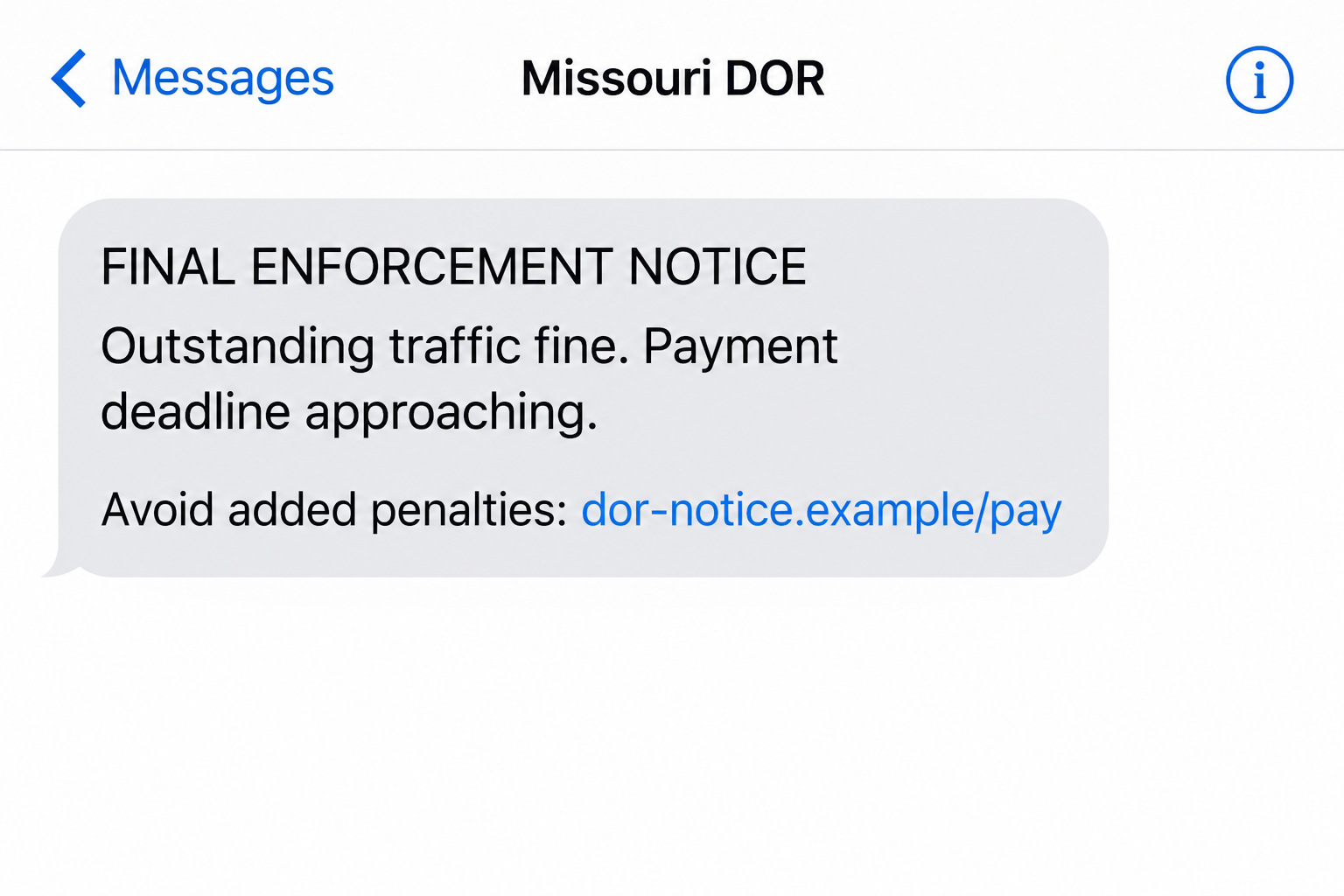
A Missouri DMV text calls itself a final enforcement notice. It says an unpaid traffic fine is about to create a much bigger problem.
You might be tempted to clear the balance and get on with your day. First, check whether the office named in that message actually collects it.
Overview
The demand misuses the Department of Revenue’s identity
The Missouri DMV text scam often invokes the Department of Revenue, or DOR. It claims a traffic balance needs immediate attention to prevent penalties.
The department’s current scam alerts identify unsolicited messages seeking payment or sensitive information. They also explain that DOR does not collect traffic-violation fines.
A department can have genuine responsibilities involving driver records without being the payee for a supposed ticket. The scam relies on that distinction becoming blurred.
The warning can include several frightening consequences
Missouri’s alerts describe threatened suspension, prosecution, credit harm, and insurance-related claims. These are statements made by fraudulent messages, not verified consequences for the recipient.
The department has also described imitation government pages and links containing DOR. A recognizable name in an address does not identify who controls the destination.
The image here illustrates the payment lure with fictional content. It is not an original notice or evidence that a particular person owes a fine.
A real ticket and a fake collection message can coexist
Do not use the text to decide either that you owe money or that your actual records are clear. Make the relevant check independently.
- Ask the responsible court about a specific citation.
- Use official DOR services for a genuine driver-record question.
- Keep court payments separate from licensing compliance requirements.
- Protect financial information submitted to an unverified destination.
The aim is to reject the impersonator without overlooking a real obligation. That is safer than paying first or ignoring every driving-related document afterward.
Why the Revenue Department Name Feels Credible
You may already associate the office with your vehicle
People do not usually carry a mental map of every government payment process. A familiar department name can make a traffic demand seem plausible enough.
The message takes advantage of that uncertainty. It suggests that the same office holding a driving record must also collect whatever balance the sender describes.
Read the alleged obligation carefully. A tax, traffic fine, registration matter, and reinstatement requirement are different issues, even when the wording blends them together.
You do not have to resolve those distinctions on your own. Use the genuine agency or court to establish who handles the matter before discussing payment.
A list of penalties can overwhelm the original question
When several consequences appear together, you may focus on the worst one. The sender no longer needs to explain the ticket in much detail.
An insurance increase or credit threat can make a small payment feel like a bargain. That calculation assumes the sender has authority it has not established.
You don’t have to calculate an insurance increase while staring at the text. Find out who sent it and whether the ticket exists first.
Even a lawful consequence in another situation would not validate this sender. A statement about what government can do is not proof of what happened to you.
How the Missouri DMV Text Scam Works
Step 1: An official-sounding final notice introduces an alleged debt
The opening may suggest that earlier chances to respond have passed. You are invited to treat the balance as overdue rather than examine its origin.
A person who recently moved or lost track of mail may supply an explanation for the missing notices. That explanation comes from their worry, not the message’s evidence.
Do not tell the sender about an old ticket simply to see whether it matches. Let the responsible court identify an actual record independently.
Keep the exact wording already available. A changing description during a text conversation can make the supposed debt harder to separate from information you supplied.
Step 2: The message attaches legal or administrative language
A reference to an administrative code, database, or enforcement procedure can make the demand look researched. Most recipients cannot immediately evaluate those references.
Missouri’s final-enforcement-notice warning describes this official-looking approach. It also warns that fake pages can display real department leadership.
Those copied details create familiarity without establishing authorship. A name appearing on the real agency site does not authenticate another page that repeats it.
Resist checking only the easiest detail, such as whether a person or code exists. The important question remains whether the actual office recognizes your alleged case.
Step 3: A deadline makes payment seem less costly than checking
The sender may predict license trouble, prosecution, or other harm if you wait. The purpose is to make verification feel like a dangerous delay.
DOR’s alert page describes messages threatening insurance-premium increases of 50–120%. Those numbers are part of the fraudulent threat, not an official rate calculation.
If insurance costs concern you, consult your insurer through an established contact. Do not let a text’s percentage become the basis for disclosing a card.
A real deadline can be confirmed through the record’s proper owner. A stranger’s insistence that checking is impossible should not become your reason to comply.
Step 4: A lookalike link offers the supposed solution
The website may resemble a state service and use familiar words in its address. It may ask you to identify a vehicle or confirm personal details.
Do not assume those questions mean the site already has your records. The form may simply be collecting the details needed to make later contact more convincing.
A padlock does not identify the organization behind a website. It concerns the connection, which can be encrypted even when the recipient is dishonest.
Use an independently opened government page to reach genuine services. Do not experiment with the suspicious address by deleting characters until it looks more official.
Step 5: The alleged fine becomes a financial or identity exposure
Entering payment information can create risk beyond the balance displayed. The amount charged and the information disclosed are separate things to review.
A payment confirmation from the page is not a court receipt. An error screen is not proof that the information was never stored.
If another prompt asks for a different payment method or more identity documents, leave. Finishing the process is not safer than stopping an unverified transaction.
The public warnings do not identify one identical form or malicious program for every message. Base your response on the actual information or permissions you provided.
A Real Missouri Suspension Is a Different Process
The court record and driving record can be connected without being identical
Rejecting a fake text does not mean real traffic cases have no consequences. Missouri publishes information about genuine failure-to-appear and failure-to-pay matters.
Its official compliance and reinstatement guidance distinguishes court documentation from driver-record requirements. The correct steps depend on the actual issue.
Do not assume that paying an alleged balance somewhere automatically clears every restriction. Confirm the case and ask what documentation the licensing authority needs.
This is especially important if you already have authentic suspension paperwork. The scam message should not replace those instructions or become your source of legal advice.
Use the court to establish the underlying citation
The DOR guidance points readers toward Missouri court records for ticket information. Follow the official route from that guidance or contact the responsible clerk.
Ask whether the case belongs to you and which court handles it. A matching name by itself may not be enough to identify the correct record.
If you cannot find something online, ask for help rather than accepting the texter’s offer to search for a fee. Record systems can require additional context.
Keep out-of-state questions with the correct authorities
A driver can have paperwork involving another state. That possibility makes the verification more specific, not less necessary.
Use the court or agency identified on genuine records and ask your licensing state how any verified restriction should be addressed. Do not rely on the scammer’s interpretation.
If a legal deadline is approaching, seek suitable legal assistance. This article cannot determine the status or consequences of an individual traffic matter.
A Hold Is Not Necessarily the Same as a Suspension
DOR’s guidance distinguishes a driving-privilege suspension from a Lieu of Bail hold affecting license transactions. They are not interchangeable labels for one universal payment problem.
This is another reason not to accept a text’s all-purpose clearance offer. Ask which record action actually exists and what verified documentation addresses it.
Do not drive on the assumption that an impostor’s receipt restored a privilege. Obtain the actual status and requirements from the relevant official service.
What to Do if You Have Fallen Victim to This Scam
-
Document the exposure before deleting the lure. Retain the original text, visible link, displayed sender, and any receipt already on your device.
List the information entered and whether a payment was completed. Keep copies private; an unredacted screenshot can expose details to people unconnected with the incident.
Stop communicating with the sender. You do not need to obtain its permission before talking to your bank, the real department, or the court.
-
Ask your bank or issuer to address the financial risk. Describe the DOR impersonation and identify the payment method involved.
Discuss compromised details, unfamiliar activity, and options for a disputed charge or transfer recall. Do not assume every payment channel offers the same protection.
Be clear about what you approved under deception. Save case references and follow the provider’s evidence instructions without returning to the fraudulent form.
-
Recover accounts whose access information was shared. Change an exposed password through the real service and check recent sessions and recovery settings.
If the password was reused, protect the other services too. A code entered into the page may have authorized something different from what the page claimed.
Tell the relevant provider about that code and the surrounding messages. Avoid a new link offering to reverse the original verification.
-
Address identity information according to what was disclosed. Use IdentityTheft.gov when sensitive identifying information was exposed or used without permission.
Consider credit-report protections where relevant, and watch for accounts or correspondence you do not recognize. A missing immediate charge does not answer identity-exposure concerns.
If you installed an application or changed permissions, obtain appropriate technical assistance. A text alone does not justify assuming the device needs an expensive repair.
-
Confirm any genuine ticket or restriction independently. Ask the actual court and DOR about their respective records, using contacts reached through official resources.
Keep a real court payment separate from the money sent to the impostor. One cannot serve as proof that the other obligation was satisfied.
If the records identify a real issue, obtain its confirmed instructions and deadline. Do not purchase an unofficial clearance letter from the person who texted you.
-
Report the message through established channels. Use your carrier’s spam-reporting feature or forward the text to 7726 if your provider supports it.
Explain the incident at ReportFraud.ftc.gov. For significant losses or identity misuse, provide appropriate records to law enforcement or IC3.
Be cautious about an unsolicited offer to recover the money. Repeating your case details does not prove the new contact works for an investigator or bank.
What to Keep in Your Own Records
Separate the alleged traffic incident, your verified driving-status information, and the suspicious financial transaction. They may require help from different organizations.
For the message, preserve the original timestamp and visible destination. For a payment, retain the provider’s transaction reference and the amount actually recorded.
For genuine court correspondence, keep its source and confirmed deadline. Avoid storing complete banking credentials beside those documents just to make the file feel comprehensive.
If an official office gives you an answer, note which office and when. That is more useful than relying on the scammer’s latest explanation of a balance.
When helping someone else, ask them to open their financial account themselves. You can organize evidence together without taking control of their passwords or payment methods.
Frequently Asked Questions
Does Missouri DOR collect traffic-violation fines through these messages?
No. Its scam page says it does not collect those fines. Check a real citation with the court rather than the text’s payment destination.
Is the threatened insurance increase an official calculation?
No. The percentages in the warning describe a scam claim. Ask your insurer about actual policy questions instead of paying an unsolicited message.
Can a real traffic matter affect driving privileges?
Yes. Missouri has genuine court-compliance and reinstatement procedures. That is separate from a fraudulent text announcing an unverified suspension.
Does a website listing real department officials become trustworthy?
No. Official names and photographs can be copied. Reach the department independently and verify the particular record and payment process.
What if I have a ticket from another state?
Contact that court through its own published details, then ask the relevant licensing authority about any verified record issue. Do not use the texter as an intermediary.
Should I wait for fraud to appear after sharing my card?
Notify the issuer about the disclosure now. It can advise on replacement and monitoring before additional activity appears.
The Bottom Line
Do not settle a Missouri DMV text scam through its payment link. DOR identifies these unsolicited collection demands as fraud and does not collect traffic fines.
Use the actual court and official driver-record services to resolve genuine questions. If financial information went to the suspicious page, contact your provider promptly.

Join the discussion
0 commentsShare your experience or ask a question about this article.
Discussion
Start the conversation
Have a question or something useful to share? Add the first comment.