

A North Carolina DMV text says an unpaid ticket is about to trigger enforcement. The message stacks up consequences, then offers a quick way to pay.
You may not recognize the ticket, but the list makes waiting feel risky. Before letting it set your timetable, separate the warning from the record it claims exists.
Overview
An agency name is being used to collect a supposed ticket
The North Carolina DMV text scam claims an outstanding traffic violation requires payment. It threatens suspension or other penalties to make an unsolicited link appear necessary.
NCDMV’s warning identifies the payment demand as fraudulent. The agency says it does not request payment through these texts.
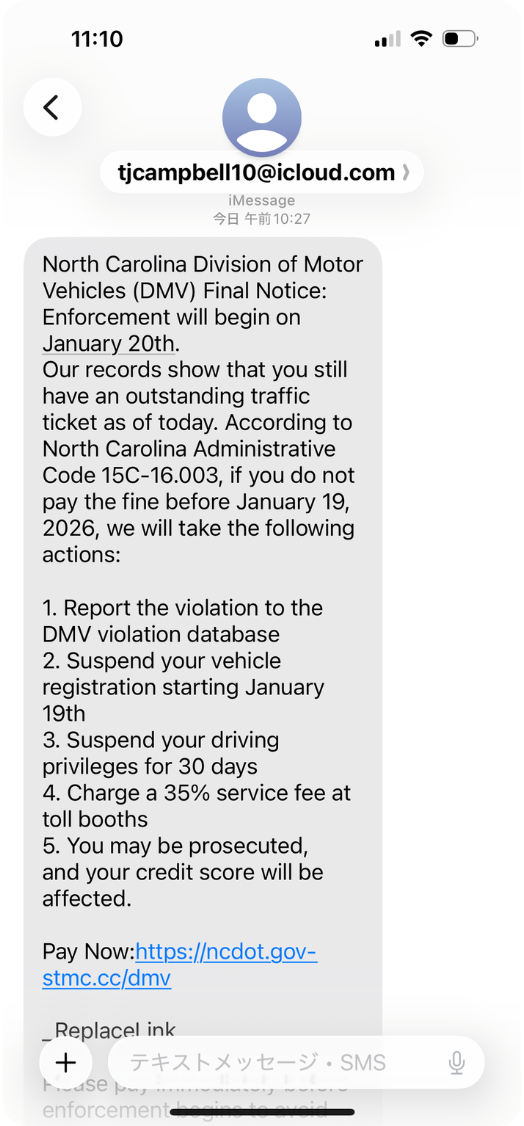
The image is a capture of the example the agency published. Its January 2026 dates belong to that example, not a current deadline for you.
The official example contains specific false threats
North Carolina’s Attorney General also explains the deception: a misleading web address, a supposed 35% toll-booth fee, and DMV credit-score threats.
Those details should not be mistaken for actual state penalties. A threatening list can borrow legal language without describing the law or your circumstances correctly.
Another message may use a different deadline or address. Changing those details does not solve the underlying problem: an unknown sender is choosing your payment route.
A DMV record, court case, and toll account are separate checks
There are genuine North Carolina services for driving records, citations, and road charges. Investigate the issue with its proper owner, outside the text.
- Reach NCDMV directly about a licensing or agency-message question.
- Use the Judicial Branch for an actual traffic case.
- Check toll invoices through the real NC Quick Pass service.
- Notify your issuer about payment details given to the suspicious site.
A fraudulent reminder does not prove that every separate obligation is imaginary. It does mean the sender’s link should not be your tool for resolving one.
What the Published Example Is Trying to Make You Believe
The countdown creates urgency before identification
The sample says enforcement will begin on a particular date. That detail makes the allegation feel scheduled, as though a process is already moving forward.
But a deadline typed into a message does not identify a valid citation. You still need to establish what happened and which real office has the record.
Receiving the message after its stated deadline does not create a new emergency. It gives you another reason to stop treating the notice as an authoritative update.
Do not ask the sender how much worse the penalties have become. That question lets the same unverified contact invent the next stage.
The number of threats matters more than their legal accuracy
The example combines registration, driving privileges, a toll-related fee, and credit harm. Most readers cannot evaluate that collection of claims while looking at a small screen.
The Attorney General specifically identifies the 35% toll-booth surcharge and claimed DMV credit-score punishment as false features of the scam.
That does not mean genuine traffic convictions cannot affect a driver’s record or insurance. It means this message’s penalty list is not a reliable guide.
You don’t have to untangle every legal phrase on that small screen. Call the real office before letting a frightening number decide what you pay.
How the North Carolina DMV Text Scam Works
Step 1: A traffic balance appears in an unsolicited message
The sender claims you still have an outstanding ticket. The word “still” can imply that previous warnings were missed, even when you never received one.
Someone who moved home or recently traveled may supply a plausible explanation. That possibility is useful to the scammer, but it is not account evidence.
Do not send your vehicle or license details back to help the sender find the alleged ticket. Begin with a real agency or court contact instead.
Step 2: The message imitates the language of a state process
A database reference or administrative-code citation makes the demand appear procedural. It suggests that the person contacting you is simply reporting an official result.
Copied government terminology is easy to put into a text. Its presence does not establish that NCDMV accessed your record or authorized this communication.
The sender may appear as a personal address or another unexpected identifier. Treat that as context, not a way to identify who actually operated the scam.
Likewise, the language used by the messaging interface does not locate the attacker. The useful facts are the payment demand and independently confirmed agency warning.
Step 3: Several penalties make one quick payment sound attractive
The message makes the alleged balance seem smaller than the consequences of delay. Paying can start to feel like buying protection for your license.
That calculation assumes the sender can apply the threatened penalties. The official alert says the demand is fraudulent, so the premise is already wrong.
Even if you have an actual citation elsewhere, verify its real deadline. An unrelated text cannot establish the payment terms of a genuine case.
Step 4: A government-looking address supplies a deceptive destination
In the published example, familiar government wording appears within a longer address controlled under a different domain. Seeing “gov” first can be enough to fool a hurried reader.
The Attorney General notes that the example’s actual domain ends in .cc. That describes the address, not proof of the operator’s nationality or location.
Do not reduce the lesson to “every .cc site is fraudulent” or “every service must end in .gov.” Legitimate government services can use outside providers.
Open the real organization’s website yourself, then follow the service it actually publishes. That is more reliable than judging an unsolicited destination by one familiar word.
Step 5: The payment process collects more than your attention
A counterfeit page can request card details or identifying information under the pretext of confirming the violation. The precise risk depends on what it obtains.
Do not treat a small displayed balance as a limit on exposure. A card number and related security details can be valuable beyond the alleged fine.
If the page reports failure, leave rather than submitting another payment method. An error does not establish that your first entry was discarded.
A receipt from the destination is not a court confirmation. Use your financial provider to investigate the transaction and the genuine office to investigate the alleged record.
Check the Right North Carolina Record
For an agency message or license question, contact NCDMV
Start from the official NCDMV website. Use its current contact and service navigation rather than an advertisement or link in the text.
Explain what the message claimed and ask which record or process would apply. Do not assume the person answering needs every sensitive detail mentioned by the sender.
If the agency identifies a genuine licensing issue, ask for the appropriate instructions. A scam warning does not establish that your actual status is unrestricted.
For a real citation, use the Judicial Branch
North Carolina’s court system publishes traffic-violation guidance explaining genuine court processes, including options that depend on the particular offense and case.
Some legitimate tickets can be handled without appearing in person. Others require a different response, so an unexpected “pay now” screen is not enough information.
Paying a genuine waivable offense can mean accepting responsibility and giving up the opportunity to contest it. Obtain suitable legal advice if you are unsure.
The point is not simply finding a genuine payment site. Confirm that the record is yours and understand the action you are choosing there.
If a search returns a similar name, ask the clerk to help distinguish the records through its established identification process.
Do not pay a different person’s case just to make the uncertainty disappear. Save the verified case reference and keep it separate from the scam text.
For a toll invoice, check NC Quick Pass independently
NC Quick Pass is a real North Carolina toll service. An unfamiliar toll allegation should be checked against the actual account or invoice.
Use its known website or your existing account route. Compare the vehicle and journey through that service rather than typing them into the DMV impersonation page.
A correct-looking travel detail does not authenticate the text. Likewise, an unrelated fraudulent message does not cancel a separate genuine road charge.
When a shared vehicle is involved, ask the account holder to check directly. Helping does not require passing passwords, card details, or live payment links between people.
What to Do if You Have Fallen Victim to This Scam
-
Stop following the message’s instructions. Save the text, displayed sender, visible destination, and any transaction confirmation already available.
Write down which actions you took and what information was disclosed. Keep the evidence without revisiting the page or asking the sender for another copy.
If you only read the notice, that is different from paying or installing something. Make that distinction clear when seeking help.
-
Tell your payment provider about exposed financial information. Use a trusted app or the contact on your card, not a refund number in a follow-up message.
Ask about card replacement, transaction review, and the available dispute or recall procedure. Describe the role of the fraudulent DMV demand accurately.
Do not wait for a promised correction from the website. Your provider can assess the risk even if no completed charge appears yet.
-
Reclaim access to accounts whose credentials were entered. Replace the affected password at the genuine service, then review sessions and recovery details.
A reused password creates separate concerns on other accounts. A one-time code can also authorize a different action from the one the fraudulent page described.
Notify the relevant service about shared codes or unexpected changes. Do not provide a second code to a caller claiming the first must be reversed.
-
Consider identity recovery when sensitive data was involved. Use IdentityTheft.gov to identify appropriate steps for an exposed identifier or identity document.
Keep monitoring for accounts or notices you do not recognize. Do not post your complete message publicly if it includes personal information.
For an application installed or permissions granted at the sender’s request, seek trusted device assistance. Merely receiving the SMS is not proof of infection.
-
Verify the underlying driving issue with its real owner. Contact NCDMV, the responsible court, or the actual toll service according to the allegation.
Ask whether any authentic deadline needs your attention. Keep the answer separate from the financial dispute, since a bank cannot decide the status of a citation.
If a real case exists, follow its confirmed process. Do not submit another payment through the scam link to try to fix both matters at once.
-
Report the text through the proper channels. The Attorney General directs recipients to its robocall and text reporting service.
Forwarding an unwanted SMS to 7726 reports it through participating carrier systems. That is not the same as directly filing a complaint with the FTC.
Use ReportFraud.ftc.gov for the federal fraud-reporting route. Preserve your references, then block and remove the lure.
Before Helping a Parent, Partner, or Coworker Pay
If someone forwards the warning, first ask whether any money or information has already been sent. That determines which protective call should come next.
Avoid starting with criticism. The list of driving consequences was designed to make a normal administrative concern feel urgent and personal.
Offer to find the real agency contact or court guidance together. A practical checking route is more reassuring than insisting the message obviously looks fake.
Do not enter your own card to finish someone else’s supposed payment. That adds another exposed account without verifying the original allegation.
If the car belongs to a business, involve the person responsible for its records. Keep the suspicious link out of shared work chats.
When warning others, share the tactic and official checking route instead of an active destination. Remove names, account details, and other private material first.
Frequently Asked Questions
Does NCDMV ask recipients to pay traffic tickets through these texts?
No. NCDMV and the Attorney General identify the unsolicited payment demands as scams. Check the underlying record through an independently reached official service.
Is the 35% toll-booth fee a real North Carolina penalty?
The Attorney General specifically identifies that threat in the fraudulent example as false. Do not treat it as an official fee schedule.
Why does the image show January dates?
It is the example published with NCDMV’s January warning. Those dates illustrate the scam’s countdown and do not create a present deadline for readers.
Does “gov” somewhere in the address make the link official?
No. Familiar wording can appear inside an unrelated domain. Reach the organization independently instead of selecting the address sent with the demand.
Can I pay every legitimate traffic ticket online?
Not necessarily. The available options depend on the actual case. Use the Judicial Branch’s guidance and ask the responsible clerk or a lawyer when needed.
Is forwarding to 7726 the same as filing an FTC report?
No. It uses carrier spam-reporting systems where supported. ReportFraud.ftc.gov is the separate FTC complaint route.
The Bottom Line
Do not follow the North Carolina DMV text scam’s payment instructions. Its urgent fine and penalty claims should not replace a real record check.
Contact NCDMV, the relevant court, or the actual toll operator independently. If the fraudulent page received financial details, protect those with your provider without waiting for another message.

Join the discussion
0 commentsShare your experience or ask a question about this article.
Discussion
Start the conversation
Have a question or something useful to share? Add the first comment.