

The page says you’ve qualified. A place is reserved, a compatibility score looks excellent, and a scientist is about to explain how ordinary people keep winning.
That’s the invitation behind the Leonard Branson Lottery AI story. Before treating it as your lucky break, look at what those reassuring details actually mean.
Overview
A lottery system sold through a scientist’s backstory
The recorded presentation introduces Dr. Leonard Branson as a former OpenAI data scientist who discovered a flaw in Powerball and Mega Millions.
He supposedly turned the discovery into repeatable wins. The video associates the method with enormous payouts and a very small number of available places.
The video tells you where Branson supposedly worked, but it doesn’t document that employment or supply the mathematical result behind the claim.
This warning concerns that advertised persona and offer. It does not accuse unrelated people named Leonard Branson or ordinary software using generic AI terminology.
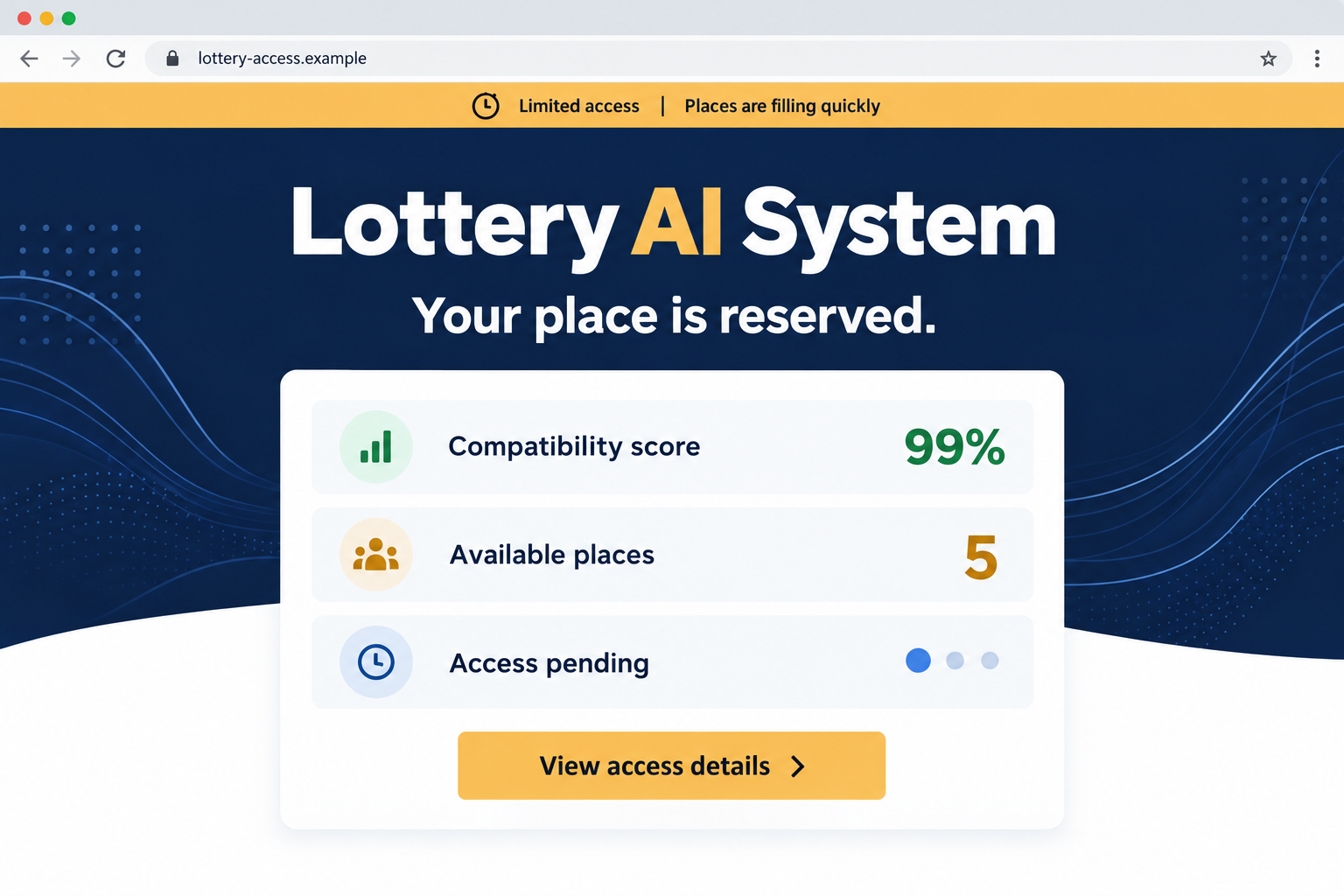
The 99% figure is a screening claim, not a winning probability
The campaign tells viewers they have 99% compatibility with its method. That sounds impressive without explaining what was measured or how it predicts a useful outcome.
Compatibility with a sales questionnaire is not the probability of winning a lottery. The two numbers should not be confused.
The fictional interface illustration highlights that distinction. It depicts the screening-and-scarcity technique, not an authentic account or a recovered copy of the original website.
- The recorded offer claims five exclusive places and warns against leaving the page.
- Its advertised former-scientist identity lacks independently authenticated supporting credentials.
- The presentation claims more than $1 billion in payouts without supplying an auditable performance record.
- The checked domain now shows a generic lost-page message rather than a usable current sales offer.
The decision should follow evidence, not qualification
Do not pay for this supposed predictive edge. A persuasive backstory, flattering screening result and countdown-style pressure do not substantiate a lottery-winning method.
The present price, merchant, refund deadline and recurring terms were not verified. Old sales claims should not be presented as today’s checkout conditions.
If you’ve paid, work from your actual receipt and statement. Don’t buy another level of access because a seller says it will make the first payment worthwhile.
What Lottery Math Says About the Promise
A number picker can generate combinations, track past draws or organize tickets. Those functions do not establish an ability to predict a future fair drawing.
Random results often contain patterns after the fact. You can find clusters, long gaps and repeated numbers without those features predicting what comes next.
Imagine tossing a fair coin and seeing several heads. That history doesn’t make the next toss “owe” you tails.
The same reasoning undermines a sales pitch built only on numbers being overdue. A pattern in past outcomes isn’t automatically a source of predictive information.
Powerball’s official questions and answers explain that every ticket has the same jackpot chance, regardless of where it is purchased.
The game’s familiar jackpot odds are 1 in 292,201,338 per play. A software compatibility score doesn’t replace those odds.
Buying more distinct combinations can increase the number of chances purchased, but it also increases spending. That isn’t evidence a prediction engine selected superior combinations.
Nor does buying a program purchase an official ticket or create a claimable prize. Those are separate transactions that a presentation can blur together.
How the Leonard Branson Lottery AI Sales Funnel Works
Step 1: Make a visitor feel specially selected
The recorded video opens by congratulating the viewer on securing one of five places. It refers to prior answers and describes the person as a suitable winner.
That changes the emotional position. Instead of asking whether the seller deserves your trust, you may start worrying about losing something you’ve apparently earned.
A qualification screen can be a marketing device. Without a defined scoring method and meaningful validation, it doesn’t establish that the opportunity is selective.
Step 2: Put a precise percentage beside a vague promise
The 99% compatibility claim gives the presentation a technical flavor. Precision can make an unexplained number seem more credible than a general compliment.
Ask what the score measures. Does it predict use of the software, customer satisfaction, winning any prize or a profitable result after costs?
The recorded pitch does not supply that connection. A percentage without a defined outcome doesn’t provide useful evidence about whether you should pay.
Be particularly careful if your memory turns “compatible” into “almost certain to win.” That stronger conclusion is not established by the displayed figure.
Step 3: Introduce the scientist who supposedly found the flaw
Branson’s claimed background supplies the next layer of authority. A former scientist from a recognizable AI organization sounds equipped to notice something others missed.
But lottery prediction would still require evidence, even if every employment claim were authentic. Credentials do not make a random process predictable.
The material doesn’t authenticate the advertised identity or identify a reproducible analysis demonstrating the supposed flaw. That gap matters more than a convincing face.
The original media files were not authenticated, so this article doesn’t declare a particular AI-generation method proved. Rejecting the unsupported offer doesn’t require that additional claim.
Step 4: Turn past success stories into an expectation of future income
The presentation says its system has produced more than $1 billion in payouts over three years. Such a large claim needs more than promotional images.
You would need attributable records, the number of participants, how much they spent and all results, including losing attempts.
A handful of selected winners would not establish profitability for a typical purchaser. Gross prizes and money left after expenses are different measures.
Retrospective demonstrations create another problem. If someone tests many rules on historical draws and shows only the best one, a convincing pattern can emerge by chance.
A credible prediction test must commit to the method before future outcomes are known. The recorded sales story doesn’t supply that kind of independent record.
Step 5: Make leaving feel more expensive than paying
The video warns that a reserved place may be given away if the viewer closes the page. The claimed exclusivity discourages comparison and reflection.
For a downloadable digital product, a five-place limit needs a meaningful explanation. The presentation doesn’t establish why serving another buyer would undermine the method.
Don’t let the threat of losing access substitute for a purchase decision. If the evidence cannot survive a pause, paying faster won’t improve it.
Step 6: Sell access while the payout remains hypothetical
The sequence ends by moving the viewer toward the product, also described as Your AI System. Similar wording doesn’t identify a single verified merchant across all websites.
There was no current usable checkout to examine on the checked domain. No payment was made, and no account balance or withdrawal was tested.
Consequently, this isn’t a claim that every buyer faces an advance withdrawal fee or a secret monthly plan. Those allegations require transaction-specific evidence.
The existing problem is sufficient: the offer asks for money before substantiating the predictive advantage being sold.
The Proof a Prediction Seller Would Need
Start with a precise promise. “Win repeatedly” might mean occasional small prizes while spending far more on losing tickets. It doesn’t necessarily mean a profit.
A useful record should show the rules used, their publication time, the selected combinations and results for every draw in a defined period.
There also needs to be a fair comparison. If the software recommends hundreds of tickets, compare its results with the same number of other eligible combinations.
Include software fees and ticket costs. Leaving those out can make an expensive losing method look successful simply because some tickets won small amounts.
Finally, the results should be independently checkable. A screenshot of a payout notification isn’t the same as a lottery record tied to a precommitted prediction.
These aren’t unrealistic demands. They’re the minimum needed to distinguish an alleged predictive advantage from selective storytelling about chance.
The commercial pitch doesn’t become stronger because someone says the discovery is secret. Secrecy prevents scrutiny; it doesn’t supply the missing validation.
A Different Website or Expert Name Doesn’t Fix the Claim
Lottery offers can appear under changing product and narrator names. The durable question is what the seller claims to predict and how that performance is established.
That doesn’t mean all similarly styled offers share an owner. Common layouts, AI language and scarcity tactics are not enough to prove a single network.
The checked lotteryaisystem.tech homepage now shows a generic Portuguese message saying there’s nothing to see. That doesn’t establish why the previous offer is unavailable.
It does mean a visitor cannot use that page to verify today’s price or return process. An older screenshot cannot fill in current commercial terms.
If you already paid, your receipt remains more relevant than the current homepage. It should identify the date, amount and business connected to the transaction.
Be cautious with search results calling themselves official support. A new page might have no relationship to the original seller.
There is also no reason to contact OpenAI for a purchase refund simply because the persona claimed previous employment there. That claim doesn’t establish a commercial role.
Keep the complaint attached to the actual seller and promise. It becomes easier to resolve when it doesn’t include accusations against unrelated organizations.
What to Do If You Paid for the Lottery AI Offer
-
Stop spending to justify the first purchase. Don’t buy more tickets, premium access or a second “activation” merely because the original system hasn’t produced results.
Treat the money already spent as a separate problem to resolve, not a reason to increase your exposure.
-
Save what was actually promised. Keep the sales video address, screening result, payment confirmation and any claims about prizes, timing or exclusivity.
Record the exact product and merchant names. A familiar institution mentioned by the narrator is not necessarily the party that accepted payment.
-
Request a written cancellation and refund. Use the support route in your receipt. Explain which promised function or representation was not substantiated or delivered.
Ask for the relevant deadline and any cancellation confirmation. Don’t accept another sales presentation as an answer to a specific billing question.
-
Review optional and recurring charges. Compare each statement entry with your authorization. Cancel any unwanted plan in a way you can document.
If a new charge appears, ask what agreement supports it. A single purchase doesn’t automatically prove a subscription, nor authorize one without terms.
-
Ask the payment provider about remedies. Supply the receipt, claim records and your attempt to resolve the issue. Explain the actual discrepancy clearly.
Deadlines and protections vary, so ask promptly. Avoid anyone who guarantees a successful chargeback in exchange for an advance payment.
-
Protect any accounts you actually exposed. If you reused a password for an account created through the offer, change it on other services where it was reused.
Never grant remote access or share verification codes for refund help. If gambling spending is becoming difficult to control, use your jurisdiction’s recognized support resources.
Frequently Asked Questions
Is Leonard Branson a verified former OpenAI scientist?
The advertised employment and identity were not authenticated by the available presentation. A photograph and self-introduction do not verify that background.
The finding applies to the sales persona, not everyone who might share the name. Even genuine credentials wouldn’t establish the claimed lottery advantage.
Does 99% compatibility mean a 99% chance of winning?
No. The number is presented as compatibility with the seller’s method. The pitch doesn’t establish a mathematical relationship between that score and a lottery outcome.
Don’t substitute a flattering screening statistic for the rules and odds of the actual game.
Can an AI analyze past lottery numbers?
Yes. Software can organize results and calculate frequencies. That capability does not demonstrate successful predictions of future fair drawings.
The crucial test would be independently recorded future performance under a fixed method, including costs and losses, not a pattern selected after results were known.
Do the claimed $1 billion payouts prove customers profit?
No auditable records were supplied for that promotional claim. Even an accurate gross-payout figure would need participation numbers, ticket spending and other costs.
A typical customer’s net outcome cannot be inferred from selected success stories or a large combined number.
Are there really only five available places?
The recorded pitch says so, but it doesn’t substantiate the capacity limit. The warning about losing access is a sales-pressure claim, not verified availability.
You should be able to examine an offer calmly without treating a disappearing place as evidence of value.
Is the current website enough to request a refund?
The checked homepage doesn’t provide the old offer or a usable current purchase process. Work from your confirmation and payment descriptor instead.
Contact the actual merchant, retain correspondence and ask your payment provider about options if the transaction isn’t resolved.
The Bottom Line
Do not pay for the Leonard Branson Lottery AI promise. The selective-access story and compatibility percentage don’t demonstrate an advantage over lottery chance.
If you’ve bought access, stop adding money, preserve the claims and seek a written remedy from the seller. Escalate a documented unresolved payment problem promptly.

Join the discussion
0 commentsShare your experience or ask a question about this article.
Discussion
Start the conversation
Have a question or something useful to share? Add the first comment.