

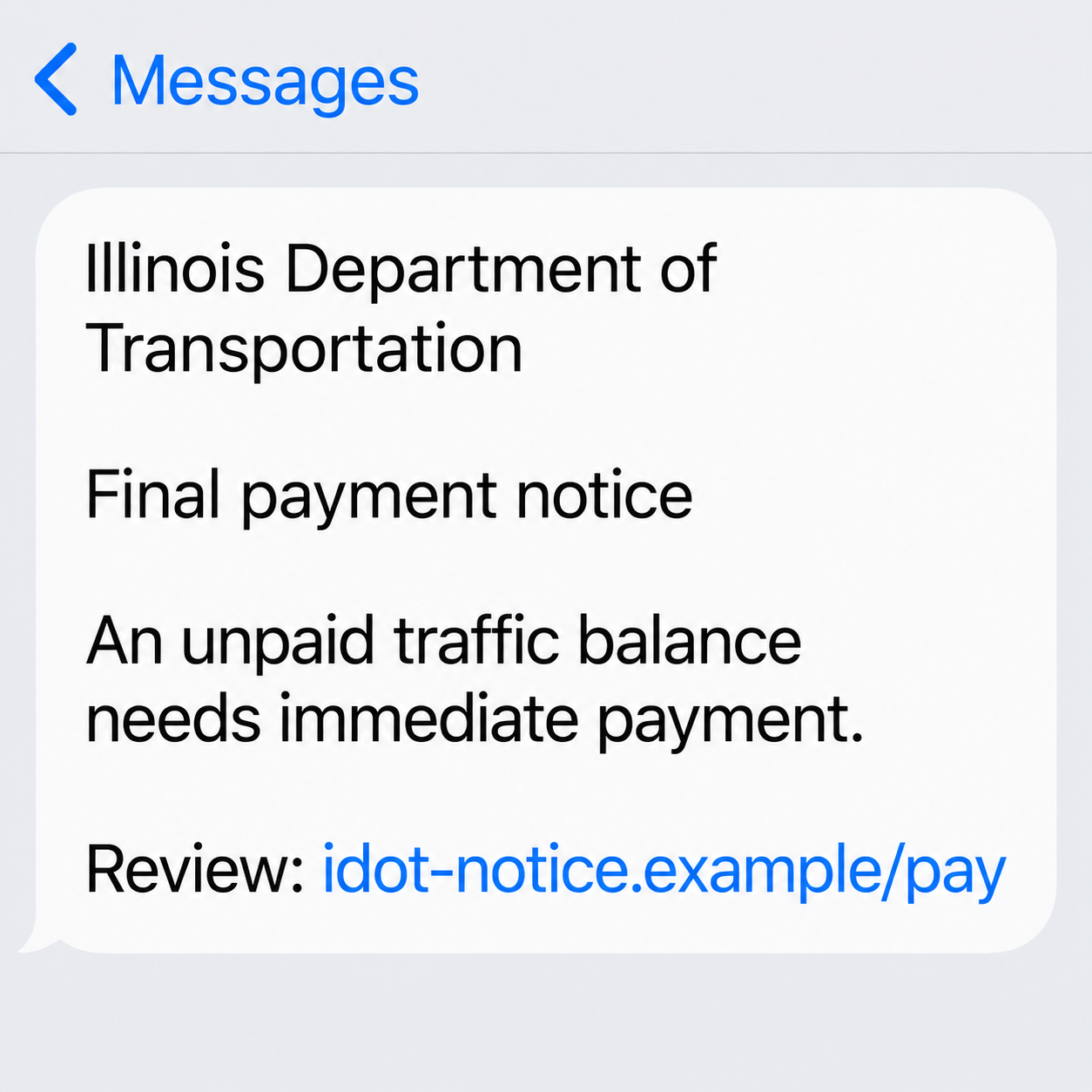
An Illinois transportation text says a traffic balance needs your attention. It offers a payment link, with consequences waiting if you leave it until later.
Perhaps you recently used a toll road or renewed your registration. Before connecting those events to this message, look closely at the office asking you to pay.
Overview
IDOT has rejected these traffic and toll collection messages
The Illinois IDOT text scam uses the Department of Transportation’s identity to demand money or personal information over an alleged driving-related balance.
IDOT’s own warning describes texts about traffic tickets, tolls, and other fines. The department says these are not legitimate messages from its office.
The illustration above is fictional. It shows the collection pretext with an example address that cannot process payments, rather than an original recipient’s message.
The message blends jobs handled by different organizations
A road agency, the Secretary of State, a toll operator, and a court do not become one collection service because a text mentions all four.
That distinction matters when the sender threatens your license while discussing a toll. You need to establish the actual record, not simply recognize a state name.
The threat can sound plausible because Illinois drivers do have genuine bills and administrative requirements. Their existence does not connect them to this unexpected sender.
You can answer the real question without entering the link
Start by separating the concern into the record you actually want to check. The correct route depends on what the message alleges.
- For driver licensing or registration, find the Secretary of State’s official service.
- For an Illinois Tollway account, use your established account route.
- For a citation, identify the court responsible for that case.
- For disclosed card details, speak directly to the issuer.
Do not pay the IDOT-branded collection text. Investigating a genuine concern separately is a useful precaution, not a reason to continue with the sender’s instructions.
Which Illinois Office Should Handle the Problem?
IDOT’s name does not explain the alleged bill
The department’s scam notice specifically includes ticket and toll-payment demands. You do not need to decide which particular threat sounds most believable before refusing that route.
If the message mentions a violation, ask yourself what incident it identifies. A department name cannot substitute for a date, location, responsible authority, or verifiable record.
Someone may recognize IDOT from highway information and assume it handles every payment connected with driving. That assumption gives the texter authority the message never established.
The Secretary of State has a different role and a separate warning
The Secretary of State provides driver and vehicle services. Its fraudulent-text guidance rejects demands involving fines, license suspensions, registration holds, and sensitive information.
Importantly, the office says it does send appointment-reminder texts. Receiving a genuine reminder does not mean a later payment demand with similar branding is authentic.
An appointment you scheduled and an unsolicited enforcement threat are different situations. Compare the purpose and your own prior activity before giving the message any trust.
The office says its reminders let customers confirm, reschedule, or cancel an appointment. They are not a demand to settle an unexplained traffic balance.
If you have an appointment that week, compare the date and location with your own booking. Do not supply those details to the unexpected sender.
A separate penalty message should not prompt you to cancel a genuine appointment in panic. Check the booking through the established service before changing your plans.
You can keep the real appointment while rejecting the fraudulent demand. The two messages do not become one official conversation merely because their timing overlaps.
If you need to check a service request, open the official website separately. Find the appointment or licensing information there instead of repurposing the suspicious link.
A Tollway balance belongs with the actual account
Illinois has legitimate toll charges. Recent travel is a reason to review the correct account, not a reason to accept an IDOT-branded demand.
Use your saved account route or independently locate the Illinois Tollway website. Compare the real vehicle and trip information through that service.
A rented car or fleet vehicle may involve another account holder. Ask that person or company to check without passing around passwords or an active payment link.
A court citation requires its own record
For an actual ticket, use reliable citation paperwork to identify the court. Locate its clerk’s contact details outside the conversation with the sender.
Ask whether the record is yours and which procedures apply. A name that resembles yours, or a courthouse address copied into a text, can leave important questions unanswered.
If you have a verified hearing or legal deadline, keep dealing with it properly. Rejecting a scam is not a substitute for responding to genuine court documents.
How the Illinois IDOT Text Scam Works
Step 1: A transportation label introduces an unexplained balance
The text arrives as an administrative problem you supposedly overlooked. It may say a fine is outstanding without explaining enough for you to recognize the event.
That leaves you searching your memory. A trip, parking stop, or recent move can supply a plausible explanation even though the sender never demonstrated a connection.
Hold on to that distinction. What you remember about your own travel is not information the texter has verified.
Step 2: Several penalties make the demand feel harder to question
The message may combine a payment deadline with registration trouble, license consequences, or legal language. The collection of threats makes one small balance feel urgent.
The Secretary of State has warned about fabricated rules and penalty dates in these messages. Their formal appearance is part of the pressure, not independent confirmation.
You do not have to calculate every threatened cost while reading the text. Establish who owns the record before considering what any genuine consequence might be.
A valid rule somewhere in Illinois would not authenticate this collection request. The actual office must still recognize the matter and its proper response.
Step 3: The link offers a shortcut around the uncertainty
A button offers to show the violation or clear the balance. You may think you’re checking the problem when you’re actually following the sender’s chosen route.
But the sender chose the destination. A page reached through that link cannot independently verify the message that sent you there.
Government wording inside an address does not resolve the problem. Read the destination cautiously without visiting it, then use an official starting point you find separately.
Do not reply to activate the link or ask for a working replacement. You already have a way to investigate legitimate records without that conversation.
Step 4: The supposed lookup becomes a request for information
A counterfeit screen can ask for vehicle details, a name, or payment information. The information enters that site’s process whether or not a charge appears afterward.
A page described as verification is still a form. Consider who receives each field, rather than assuming the label makes the disclosure harmless.
If a banking code is requested, read the bank’s own notification separately. The code may concern an action different from the one the payment screen describes.
The published agency warnings do not establish one identical technical payload for every destination. Receiving the text alone does not demonstrate malware on your device.
Step 5: An apparent outcome keeps the recipient in the false process
A confirmation screen may provide relief without resolving an actual ticket or account. Its receipt belongs to the website that issued it.
An error can be just as misleading. It does not guarantee that your card details were rejected before reaching the recipient.
Stop if the page asks for another card or a different transfer. Continuing adds exposure while the underlying bill remains unverified.
A later caller might offer to correct the transaction. Do not let knowledge of the original message replace an independent identity check.
Look Beyond the Logo and the Padlock
A copied appearance can conceal the wrong destination
A familiar agency heading makes a page recognizable, not authoritative. A state logo, contact name, or footer can be reproduced beside an unrelated form.
Even working links to genuine government information would not authenticate the payment box. Different links on one page can lead to different organizations.
The browser’s encrypted-connection indicator does not answer who should receive a fine. An encrypted connection can still deliver information to an impostor.
A real online service needs a reliable route into it
Do not conclude that paying online is always unsafe. Genuine agencies and operators offer services through their published websites and authorized providers.
Reach those services from the correct organization, not from a guess about which domain ending looks trustworthy. Check the service’s purpose as well as its address.
If you cannot identify the alleged account, ask the actual office for help. Paying an unknown form to reveal more details reverses the sensible order.
What to Do if You Have Fallen Victim to This Scam
-
End the payment attempt and record your exposure. Save the message, displayed sender, visible destination, and any receipt you already received.
Write down whether you only viewed a page, entered information, or approved a transaction. Avoid returning to the site to recreate the experience.
Keep the record private. An unredacted post in a community group can expose your details again without helping the bank investigate.
-
Speak to your issuer or transfer provider promptly. Explain that an Illinois transportation impersonation led you to an unverified collection page.
Identify the payment and ask what can be blocked, replaced, disputed, or recalled. Give an accurate account of anything you authorized under deception.
Request a reference for the conversation. Recovery depends on the transaction and provider, so do not accept a stranger’s promise of a guaranteed refund.
-
Recover access where the page collected credentials. Change the affected password through the genuine service and check recovery settings for unfamiliar changes.
Handle reused passwords on other accounts too. Tell the relevant provider if you shared an authorization code, rather than assuming a password change covers that event.
For sensitive identity information, consult IdentityTheft.gov for a recovery plan suited to the details involved.
-
Verify the driving-related allegation independently. Contact the appropriate court, Secretary of State service, or toll-account provider through its published route.
Keep any authentic obligation separate from the fraudulent transaction. The issuer can investigate money without deciding whether a court case exists.
If a genuine restriction or deadline is found, obtain its actual requirements. Do not purchase a clearance document from the person who sent the text.
-
Address device changes only if they happened. Note any application, download, or permission the sender asked you to add.
Seek trusted technical assistance for that specific change. Do not let another unsolicited contact sell you a government-approved cleanup or remote license repair.
Even if the device appears normal, continue protecting exposed payment details. A software check cannot undo the disclosure or settle a financial dispute.
-
Report the impersonation after preserving useful details. IDOT points recipients toward federal fraud-reporting channels, including IC3.
Use ReportFraud.ftc.gov and carrier reporting where appropriate. The Secretary of State separately publishes scamalert@ilsos.gov for messages impersonating its office.
After reporting, block further contact. A second sender claiming to resolve the same case should not inherit the first sender’s access to you.
When a Relative Asks You to Pay It for Them
Ask what worries them most: a license problem, an unfamiliar trip, or the money already sent. Those concerns can require different next steps.
Offer to locate the correct official service together. You can help them make the check without taking their banking password or paying with your own card.
If payment information was entered, prioritize their issuer call. An argument about whether the text looked obvious can wait.
When warning other people, describe the collection tactic and independent checking route. Leave out private details and do not circulate the active link.
Frequently Asked Questions
Is the IDOT text demanding a traffic or toll payment authentic?
No. IDOT identifies these collection messages as illegitimate. Check any real citation or account through the organization actually responsible for it.
Does every Illinois DMV text have to be fake?
No. The Secretary of State says it sends appointment reminders. That does not authenticate unsolicited threats about fines, registration holds, or license suspension.
Should I pay because I recently drove on a toll road?
Review the genuine toll account first. Recent travel can explain a real charge, but it does not authorize an unrelated text sender to collect it.
Does a government link elsewhere on the page prove the form is safe?
No. A fraudulent page can link to authentic information while sending payment details somewhere else. Start with the real organization’s own website.
What if the page said my card payment failed?
Tell the issuer what you entered. An error message does not establish that the recipient never obtained your card information.
Can deleting the text fix an actual license restriction?
No. Reject the fraudulent demand, then address any independently verified record issue through the Secretary of State or relevant court.
The Bottom Line
Do not pay the Illinois IDOT text scam. The department rejects these ticket and toll demands, and a borrowed transportation identity cannot validate their payment link.
Check the actual record through its proper office. If the form already received money or card details, contact the provider handling that exposure now.

Join the discussion
0 commentsShare your experience or ask a question about this article.
Discussion
Start the conversation
Have a question or something useful to share? Add the first comment.