

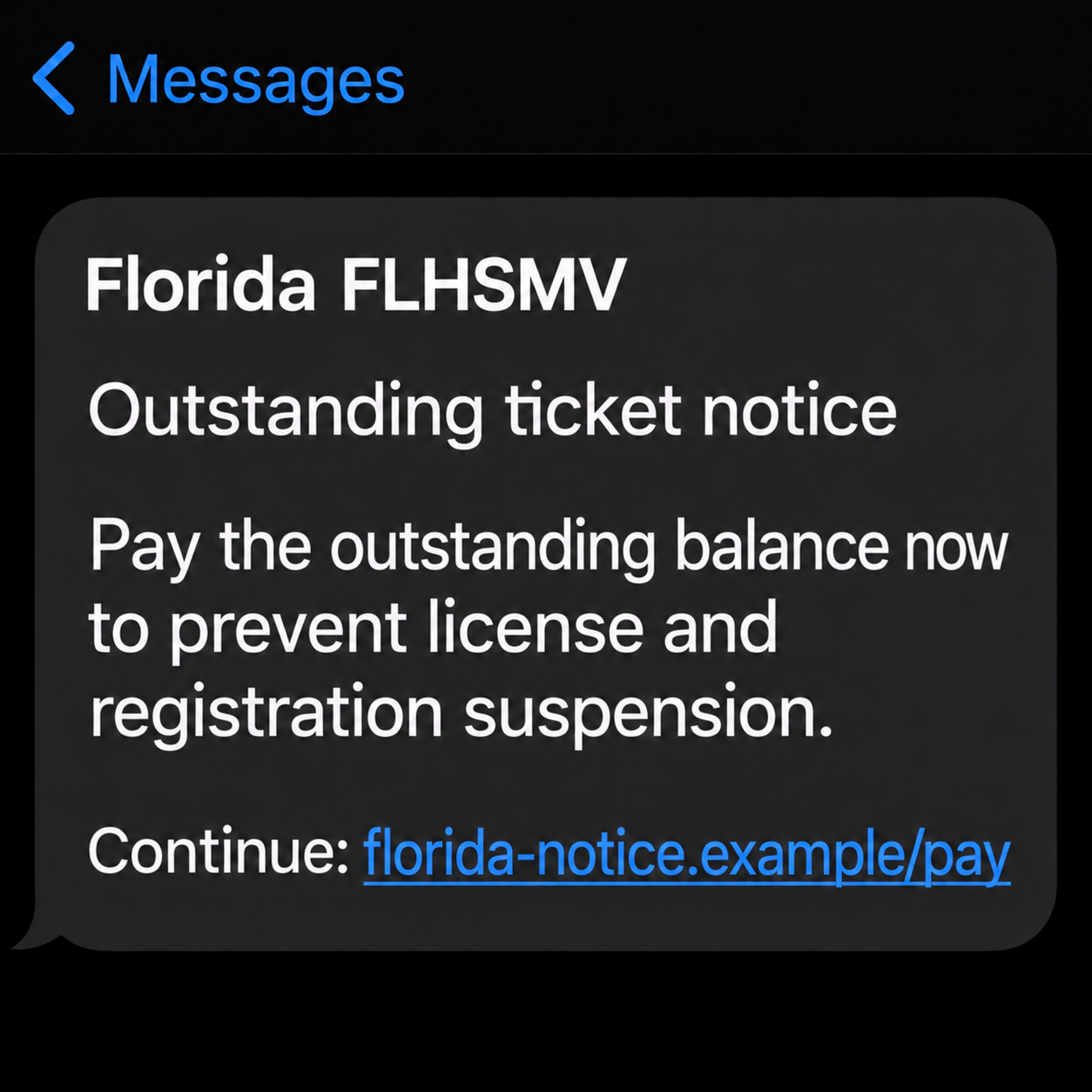
A Florida FLHSMV text says a forgotten ticket could interrupt your ability to drive. The deadline is close, and a link promises to clear things up.
You may start wondering about old mail or a recent trip. Before reaching for your card, separate that worry from what the message actually knows.
Overview
The real department is being impersonated
The Florida FLHSMV text scam alleges an unpaid ticket and pressures recipients to resolve it through a supplied website. License and registration threats give the request urgency.
Florida’s official Scam Stoppers warning describes this impersonation. It says FLHSMV does not text demands for payment or threats of suspension or arrest.
The agency name is real. The collection message is not an authorized shortcut into its services, and its payment instruction should not be followed.
A licensing threat is used to sell a quick solution
Drivers have ordinary reasons to worry about their records. A move, renewal, or unresolved citation can make a vague notice feel connected to something real.
The sender turns that uncertainty into a reason to disclose information. You may be asked to identify a vehicle, review a balance, or enter payment details.
The lead image is a fictional interface illustration. Its example destination cannot take a payment; it is not an original message from a particular victim.
The correct check depends on the actual concern
A department record, court citation, and toll invoice are different matters. Find the responsible organization independently instead of accepting the text’s combined explanation.
- Use genuine FLHSMV resources for a driver-license status question.
- Check a specific citation with the responsible Clerk of Court.
- Review road charges through the actual toll account or invoice.
- Give exposed payment information priority with your financial provider.
A real obligation deserves a proper response. Paying the sender does not establish that a court received money or that your license status changed.
Why a Familiar Florida Name Can Hide the Wrong Request
The abbreviation does not identify the sender
FLHSMV stands for Florida’s Department of Highway Safety and Motor Vehicles. Seeing those letters can make a message look connected to records you care about.
But an acronym can be copied as easily as a logo. The sender still needs to be the organization it claims to represent.
People also use DMV informally when discussing Florida services. Do not make the entire decision depend on whether the message chose that shorter label.
Instead, look at the unsolicited payment demand and verify the alleged record elsewhere. Better spelling would not turn the same deceptive instruction into an official collection process.
The registration warning adds a second worry
A message threatening both a license and vehicle registration can feel as though several systems have already agreed that you owe money.
That impression comes from the wording. It does not show that either record was checked, that a citation exists, or that an authorized office sent the text.
Do not spend your first few minutes debating which penalty sounds possible. Find the actual source of the alleged balance before allowing it to control your plans.
A local tax-collector name can also be borrowed
The Miami-Dade Tax Collector’s warning identifies fraudulent FLHSMV citation messages and says they are not affiliated with either office.
A local name may feel more convincing than a statewide heading. That familiarity should help you locate the real office, not persuade you to trust an unknown destination.
If a sender names a county where you recently drove, keep the coincidence in perspective. It is a detail to investigate through genuine records.
How the Florida FLHSMV Text Scam Works
Step 1: An overdue ticket is announced as if you already knew about it
The text presents a balance as settled fact. Its explanation may be too vague for you to recognize the original stop, location, or citation.
Words such as final or overdue can make you feel that an earlier notice was your responsibility to find. That reaction can happen before any evidence appears.
Start with the information actually supplied. Do not fill in an old journey or address change and treat your own guess as confirmation.
Step 2: The sender attaches consequences to a short deadline
The supposed balance becomes a threat to driving privileges or registration. The link appears to offer the fastest way to avoid disruption.
Florida’s official warning identifies that suspension-and-payment demand as the scam. You are not required to cooperate with its sender to check your own record.
A legal reference or formal heading can make the demand feel less negotiable. Neither supplies the missing connection to a genuine citation.
Use confirmed paperwork for actual response deadlines. A countdown introduced by an unsolicited texter should not replace instructions from the real court or department.
Step 3: A supposed record check takes you to the sender’s website
The destination can imitate a government service, with familiar colors or a form labeled violation lookup. Those features make the next action feel routine.
The text sends you to a page that repeats its own story. To check either one, leave that route and contact the real office.
A link can contain Florida or FLHSMV without belonging to the department. The useful alternative is an official service you locate without the incoming demand.
Do not experiment with variations of the suspicious address to find a working version. You can investigate legitimate driving records without repairing the scam’s route.
Step 4: Personal and payment fields turn worry into exposure
A counterfeit form may request identifying details before revealing the alleged violation. A heading that says verification does not explain who receives that information.
Financial fields create a separate concern from the amount displayed. An unfamiliar site can obtain card information even when the proposed fee looks modest.
If a code arrives from your bank, read its explanation outside the suspicious page. Do not let that page decide what the code is supposedly approving.
The exact risk depends on your response. A text on your screen, a submitted password, and an installed application are not equivalent exposures.
Step 5: The apparent result obscures the unresolved official question
A success screen can make you believe the license problem has disappeared. It is still only a statement from the website handling that transaction.
An error screen is not reassuring either. It does not establish that the recipient discarded the information or that later charges are impossible.
Do not try another card to force a receipt. Leave the process and check financial activity through the account you normally use.
A real court balance and driver-license record need separate confirmation. The suspicious site’s support conversation cannot certify either one.
Check Your Florida Record Without Buying a Clearance
Begin a licensing inquiry through FLHSMV itself
Independently locate the department’s official website and use its published license-status or contact resources. Avoid advertisements and links forwarded with the threat.
Ask about your actual status and any genuine requirements. Describe the message as an allegation rather than treating it as an official record.
Florida tax-collector guidance directs drivers toward the state’s license check. You do not need to provide a stranger with your full identity to locate that service.
If the official route does not answer the question, contact the appropriate office. An unfamiliar site’s offer to unlock the record for a fee is not the solution.
Use MyDMV Portal for the services it actually provides
Florida has a genuine MyDMV Portal for driver-license, identification, registration, and related transactions. A website being online does not make it inherently fraudulent.
Reach it through the department’s own published navigation. A familiar portal name in an incoming message is not enough to establish that message’s destination.
Use services only for records you are entitled to access. Do not test a relative’s details or someone else’s license to see whether a suspicious form works.
A genuine renewal payment and an unsolicited traffic-fine demand can look similar to a hurried reader. Confirm the service and reason before entering financial information.
Keep the underlying citation with its court
For a ticket you recognize, use its authentic paperwork to find the responsible Clerk of Court. Verify the case through that office’s official instructions.
The Clerk’s traffic-text warning explains the fraudulent collection pattern and points readers toward the proper local court resource.
Do not assume the court balance equals an unrelated licensing requirement. Ask the appropriate office what its own record shows and what action applies.
If you need legal advice about a genuine citation, obtain it from a qualified professional. The scammer’s deadline should not decide whether you contest or pay.
Separate a real toll trip from the FLHSMV message
Florida drivers can have legitimate toll accounts and invoices. Check them through established statements or the actual operator’s independently located website.
A rental company, employer, or family member may manage the relevant account. Let that account holder review it without giving the text sender more information.
Do not combine an unfamiliar toll, a possible ticket, and a licensing threat into one assumed debt. Each genuine charge needs its own verified explanation.
What to Do if You Have Fallen Victim to This Scam
-
Leave the fake collection process. Keep the original text, sender identifier, destination, and any confirmation already available without revisiting the page.
Note what you submitted and when. Distinguish a page you viewed from a transaction you approved or a credential you entered.
Do not ask the sender to remove your data first. That conversation is not a prerequisite for protecting your accounts.
-
Notify the provider handling your money. Explain that a message impersonating FLHSMV led to a suspected fraudulent payment or card disclosure.
Ask about securing exposed details and reviewing the transaction. Preserve the amount, recipient information, and reference shown in your own account.
Be clear about whether you approved the transfer under deception. Different transaction types have different recovery processes, and reimbursement is not guaranteed.
-
Replace exposed access information on the genuine service. Change any disclosed password and review recovery methods or sessions you do not recognize.
If a code was shared, tell the relevant service what happened. Check other accounts when the same password was reused.
Do not follow a new reset link from the supposed traffic office. Start account recovery through a trusted app or website instead.
-
Address identity details according to what was disclosed. A copied license image or sensitive identifier deserves a different response from merely receiving the text.
Use IdentityTheft.gov for appropriate recovery guidance. Keep evidence available for verified providers and agencies, rather than posting the complete document publicly.
Continue watching for unfamiliar account activity or correspondence. An empty card statement today does not resolve every possible use of identifying information.
-
Confirm the real status question outside the scam. Use FLHSMV for the licensing record and the appropriate clerk for the actual citation.
A financial dispute does not decide whether a genuine court deadline still applies. Keep those records and conversations separate.
If the sender requested software or new permissions, obtain trusted device assistance as well. Deleting the text does not reverse changes you deliberately installed.
-
Report the impersonation and stop follow-up contact. Use carrier spam controls or 7726 where supported, and submit the incident at ReportFraud.ftc.gov.
After saving relevant evidence, block the sender. Be wary of a later caller offering a special refund, record clearance, or guaranteed recovery for another payment.
Before You Ask Someone Else to Help
Tell the helper what actually happened, including any card entry or approved payment. That lets them help you prioritize the right contact.
You do not need to give them control of your accounts. They can help locate the correct office while you speak to your issuer directly.
If the vehicle is shared, ask about the genuine trip separately. Forwarding an active payment link can expose another person without clarifying the original claim.
Frequently Asked Questions
Does FLHSMV text drivers demanding payment for unpaid tickets?
No. Florida’s official warning rejects texts demanding payment or threatening suspension or arrest. Check a genuine record through independently reached services.
Is every message using the word DMV automatically fraudulent?
No. People use that term informally. The unsolicited collection instruction and its destination matter more than relying on the label alone.
Can a scam payment clear a real Florida ticket?
Do not assume so. Ask the responsible court about its actual record. Keep the suspicious payment receipt for your financial provider.
Is Florida’s MyDMV Portal a real service?
Yes. Reach it through FLHSMV’s official navigation for the intended transaction. Its existence does not authenticate a text linking to a lookalike page.
Should I wait for an unknown charge before calling my issuer?
No. Explain any card disclosure now. The issuer can assess replacement and monitoring even if the page reported failure or no charge appears yet.
Does this message prove that my driving record was accessed?
No. The text alone does not show a records breach. Avoid providing details that would make the sender’s next claim more convincing.
The Bottom Line
Do not pay the Florida FLHSMV text scam. Its payment link and suspension threats conflict with the state’s warning about this impersonation.
Verify your real license or citation through the proper office. If the fraudulent form obtained payment details, deal with that exposure through your provider promptly.

Join the discussion
0 commentsShare your experience or ask a question about this article.
Discussion
Start the conversation
Have a question or something useful to share? Add the first comment.