

You’ve already lost money online. Then a Facebook ad offers help getting it back, with what appears to be a police officer explaining the service.
After days of unanswered questions, that can feel like a breakthrough. Before you share your case or contact the advertiser, check who is really offering help.
Overview
A recovery offer borrowing police authority
Fake police recovery ads use a particularly cruel opening: the person reading them may already be frightened, embarrassed, and desperate to repair an earlier loss.
The advertised service appears to offer a way forward. A police identity makes the pitch sound less like another sales approach and more like official assistance.
Singapore’s ScamShield warning identifies Facebook ads using AI-generated depictions of Singapore Police Force officers to promote fake recovery services.
The warning is explicit that SPF does not advertise recovery services. The fraudulent promotion is impersonating the police, not introducing a genuine police-run recovery program.
What is confirmed, and what depends on the next approach
The confirmed deception is the false police-backed advertisement. That alone is enough to avoid contacting it, even before anyone asks you to pay.
The official alert doesn’t identify one universal fee, payment destination, or conversation script. Don’t assume every version will ask for the same thing.
Related recovery scams may seek upfront payments or financial information. Those are established warning patterns, not a claim that every reported Facebook ad followed identical steps.
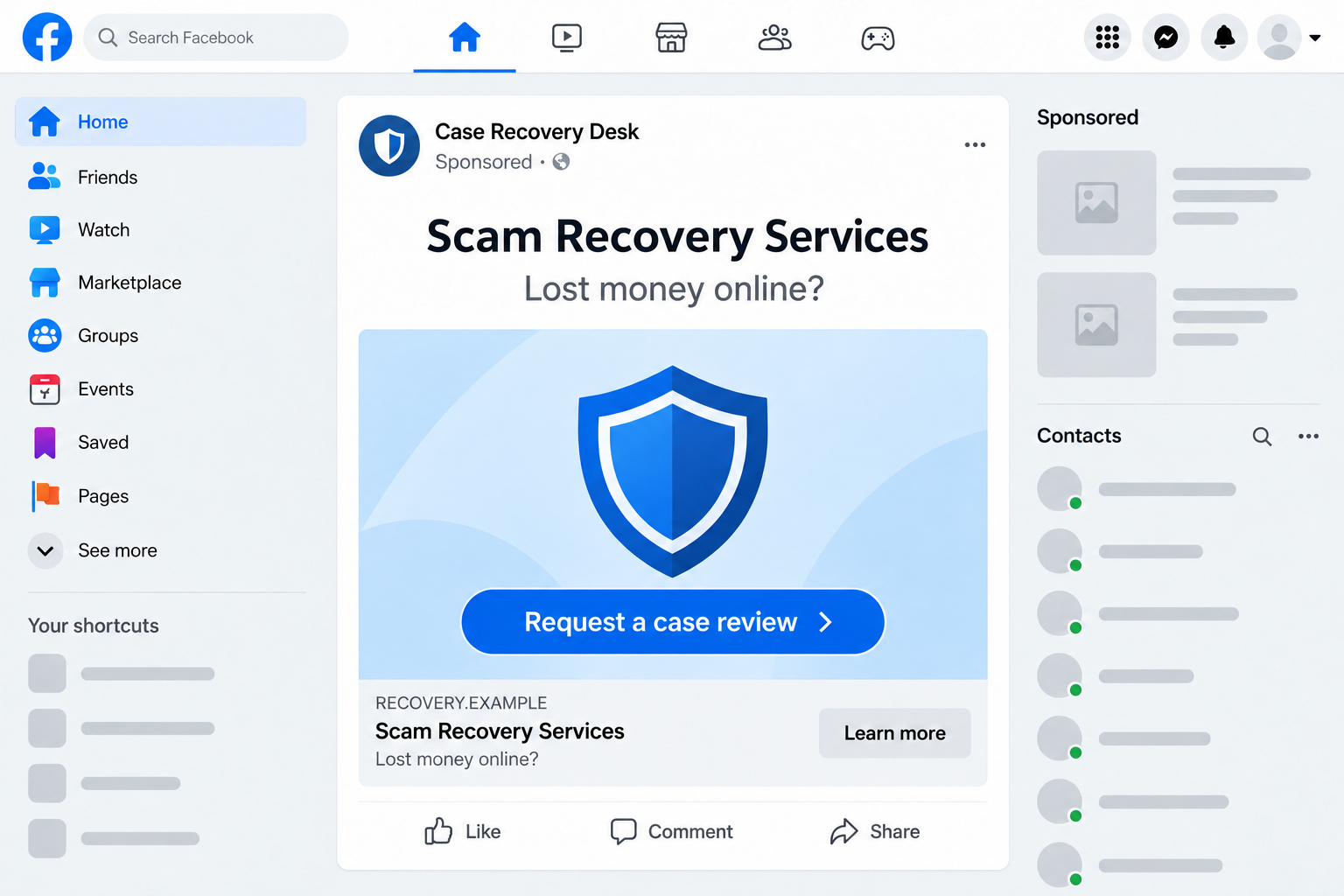
The lead image illustrates a fictional recovery promotion. It is not a captured advertisement, an actual police endorsement, or evidence about a particular advertiser.
Your existing loss needs a separate, trusted route
Before responding to any recovery pitch, separate what the advertiser promises from the organizations that can actually examine your original payment.
- Your bank can review transactions and explain the available dispute process.
- A payment provider can investigate a transfer made through its service.
- Police can receive a report through their established reporting channels.
- A social media advertisement cannot prove any of those organizations appointed its operator.
- A promise to recover everything is not the same as an actual recovery.
You deserve help after a scam. You don’t need to accept help from whoever happens to appear next in your feed.
Why a Police Figure Changes the Way the Offer Feels
An ordinary recovery advertisement invites questions about fees, experience, and accountability. An apparent police announcement can make those questions feel unnecessary.
You may assume the service was vetted, that an investigation already exists, or that a government agency has powers unavailable to your bank.
Those assumptions are doing work for the advertiser. A uniform or familiar insignia doesn’t establish an appointment, a case assignment, or access to your funds.
Nor does a convincing video establish that the person shown recorded it. In this campaign, the AI-generated presentation is identified by the official warning.
You don’t need to inspect every frame for a strange mouth movement. Checking the claimed service through the actual police organization is the stronger test.
Don’t treat natural-looking speech as the deciding factor. The central question is whether the institution really offers the service being advertised.
That question remains useful when the next version looks cleaner or uses a different apparent officer. It doesn’t depend on recognizing one particular face.
Keep the accusation in the right place, too. The fraudulent ad abuses police authority; it isn’t proof that the real officer or police force operates the scheme.
How the Fake Police Recovery Ad Scam Works
Step 1: The promise speaks directly to an earlier loss
The opening isn’t a new investment or prize. It is the possibility of undoing something painful that already happened.
That can make a reader more willing to explain their circumstances. Sharing a case feels like asking for assistance, rather than handing information to an unknown business.
Pause before giving the advertiser a timeline, identity document, account statement, or wallet details. First establish who operates the service through an independent source.
The fact that a service understands common scam stories doesn’t mean it has investigated yours. It may simply be using a pitch aimed at people with similar experiences.
Step 2: An apparent officer lends the pitch official weight
The fabricated police presentation gives the recovery promise an authority it hasn’t earned. This is the specific impersonation documented in the ScamShield alert.
A sponsored label only describes advertising placement. It doesn’t mean the platform or the police have certified the recovery claim.
Before accepting that connection, leave the ad and check the police force’s actual website or published contact route. Don’t ask the advertiser to validate itself.
A badge on a profile, official-sounding page name, or comments praising the service cannot replace that independent check.
Step 3: The recovery invitation draws you toward a private exchange
An offer to review a case gives you a reason to click or start communicating. That is where a seemingly public announcement can become a personal interaction.
Don’t assume the conversation is official because it began beside a police image. The destination and the person replying still need verification.
Be cautious about moving to another messaging account or providing documents through a link the advertiser supplies. Changing platforms doesn’t establish authority.
The exact follow-up can differ. You don’t have to reach a payment demand before rejecting a service whose claimed police backing is false.
Step 4: Additional requests can turn attempted recovery into another loss
The FTC’s recovery-scam guidance describes demands for advance fees or financial details from people who claim they can recover lost money.
That broader pattern is worth knowing if someone requests a processing charge, access to an account, or information supposedly needed to return funds.
It is not a verified price list for the specific police ads. Treat each new demand as a separate action requiring a trustworthy explanation.
Don’t let an earlier loss become the reason to risk another payment. The amount already gone doesn’t make an unverified recovery promise more likely to work.
The Difference Between Reporting a Scam and Hiring Its Advertiser
You can report the original loss directly to the real police. A Facebook advertiser doesn’t have to become the middleman.
Use the reporting route listed on the actual police website. If you already have a report reference, contact the relevant service through previously verified details.
Don’t assume a reference repeated by a stranger proves they were assigned to the case. Describe the contact to the genuine organization before following instructions.
For the financial side, approach the provider that handled your payment. Ask what options remain for that transfer, card charge, or account transaction.
Be precise about timing and payment method. A bank transfer and a card purchase don’t necessarily have the same process or recovery prospects.
Ask which deadlines apply to your situation. Avoid relying on a recovery advertiser’s claim that its own fee must be paid before your rights expire.
You may need to speak with both police and a financial institution. One report doesn’t automatically initiate every other organization’s procedure.
A legitimate investigation also isn’t a promise that all funds will be returned. Honest uncertainty is different from an advertiser’s guaranteed outcome.
What to Keep Private When Looking for Help
It’s understandable to search publicly for someone with a similar experience. But a detailed post can expose information useful to another impersonator.
Keep full account numbers, identity documents, authentication codes, and private case correspondence out of public comments and direct messages from strangers.
For cryptocurrency, never send a recovery phrase or private key to someone offering assistance. A phrase that controls a wallet isn’t merely a reference number.
A screenshot of a supposed recovered balance is also not proof that money is available to you. Look for the actual transaction in your own account.
Don’t log into a wallet or banking page from a link supplied by a recovery contact. Use the service’s established app or independently opened website.
If a genuine provider needs evidence, ask for its secure submission process. You can cooperate without making every sensitive record available to an advertiser.
When someone claims confidentiality prevents independent verification, step back. Checking who you’re dealing with doesn’t obstruct a legitimate report.
You don’t owe a stranger continued access to your story because they listened sympathetically. You can end contact without explaining or defending the decision.
When the Bank Can’t Promise the Answer You Want
A recovery pitch can become especially attractive after a disappointing conversation with your bank. You may feel the official route has already let you down.
That frustration is real. It doesn’t give an advertiser powers that the claimed institution says it isn’t offering.
Ask your existing provider to explain its decision, any remaining review options, and the records it needs. Keep that conversation tied to your actual transaction.
If you want independent professional advice, choose and verify the professional yourself. Don’t accept a police endorsement manufactured inside an unsolicited advertisement.
A useful adviser should be able to explain their role without pretending a social media video appointed them to your case.
You can also ask a trusted person to sit with you while reviewing the options. Another pair of eyes can help when the original loss feels overwhelming.
The objective is a clear next step, not a promise that everything can be undone. An impossible guarantee can make a second loss sound like hope.
What to Do if You Have Fallen Victim to This Scam
-
Stop the recovery conversation. Don’t make a final payment, supply a missing document, or complete another verification step to unlock the promised result.
If you only saw the advertisement, avoid engaging with it. Its appearance doesn’t mean the advertiser has access to your accounts.
-
Contact the provider used for any new payment. Explain that an impersonating recovery service induced the transaction.
Give the amount, date, beneficiary details, and transaction reference through the provider’s secure channel. Ask what can be stopped, disputed, or investigated.
Keep the original scam loss and the recovery-service payment separately identified. Combining them into one unexplained amount can make the timeline harder to follow.
-
Secure the information you disclosed. Tell your financial institution if you shared a card, bank credentials, or an authentication approval.
If a password was reused, replace it on the affected genuine services. Start with the email account used for recovery messages if it shared that password.
If a wallet secret was disclosed, use the wallet provider’s verified security guidance. Don’t ask the same recovery contact to secure it for you.
-
Address any remote access or software installation. If someone gained control of your device, end that access and use a trusted device to contact your bank.
Malwarebytes can help check suspicious software or downloads. AdGuard can limit some harmful ads and destinations, but neither retrieves funds or validates a recovery operator.
Software cleanup and financial reporting are different jobs. Don’t postpone an urgent payment report until a device scan finishes.
-
Preserve both parts of the story. Save the recovery ad, advertiser name, conversation, payment instructions, and any existing original scam report.
Record where you first encountered the offer. Don’t return to a suspicious page just to improve a screenshot if you already have enough to identify it.
Keep sensitive records private. A redacted copy can warn others without revealing the banking or identity information an impersonator might reuse.
-
Report the false police connection. Notify the real police through their official reporting channel and report the advertisement to the platform.
In Singapore, ScamShield’s official guidance points to the 1799 helpline for checking suspicious approaches. That isn’t a guarantee of payment recovery.
If you’re elsewhere, use your own jurisdiction’s police and financial-fraud reporting routes rather than assuming a foreign helpline handles your case.
-
Tell someone you trust what happened. Ask them to help you evaluate any new recovery contact before money or documents are sent.
You don’t need to retell every painful detail. A clear agreement to pause and check together can be enough to interrupt another rushed decision.
Expect that a later helper may make the same promise under a different name. A fresh profile doesn’t establish that the earlier problem has been solved.
Frequently Asked Questions
Does the Singapore Police Force advertise scam recovery services?
ScamShield’s warning says SPF does not advertise these recovery services. Don’t contact a Facebook advertiser because an apparent officer appears in its promotion.
How do we know the police imagery is AI-generated?
The official alert identifies it that way. This warning doesn’t depend on guessing from a face, video artifact, or automated detector score.
Does a sponsored Facebook post mean the service was approved?
No. Advertising placement doesn’t establish a police appointment or validate the recovery claim. Verify the claimed organization outside the advertisement.
Is every professional who helps fraud victims a scammer?
No. This warning concerns a documented false police-backed promotion. Don’t turn it into an accusation against every lawyer, adviser, investigator, or genuine support service.
Should I send my existing police report to the advertiser?
Not before independently establishing who they are and why they need it. A report can contain private details useful to another impersonator.
What if they say my money has already been recovered?
Don’t accept a screenshot or dashboard as proof. Check your own financial account and refuse an extra payment demanded to release the supposed funds.
The Bottom Line
Don’t engage with fake police recovery ads on Facebook. The claimed official backing is false, and an earlier loss isn’t a reason to trust the advertiser.
If you’ve paid or shared sensitive information, contact the relevant financial provider and genuine police channel. Report the second approach without sending it anything further.

Join the discussion
0 commentsShare your experience or ask a question about this article.
Discussion
Start the conversation
Have a question or something useful to share? Add the first comment.