

A message says someone has reviewed your CV and has flexible work available. Between unanswered applications, even a brief introduction from an HR team can feel promising.
If that message uses The Goat Agency’s name, pause before moving the conversation to WhatsApp. There’s an important difference between finding the company and verifying the offer.
Overview
The real agency has disowned these job messages
The Goat Agency is a real marketing business. Scammers use its name to make unsolicited offers of easy remote work appear connected to an established employer.
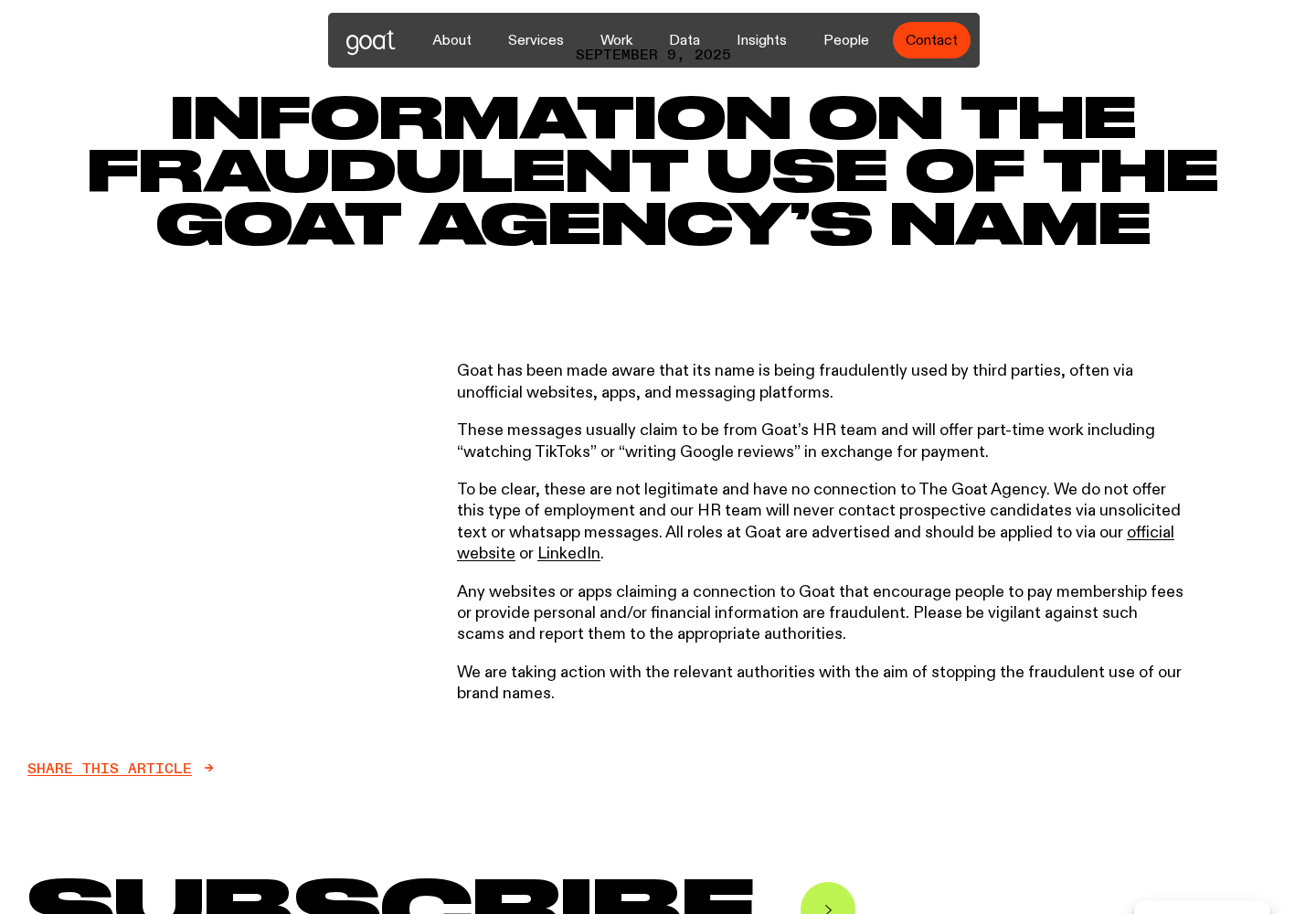
The company has published a warning about this impersonation. It identifies offers involving watching TikToks or writing Google reviews as unrelated to its genuine employment.
It also says its HR team won’t approach candidates through unsolicited texts or WhatsApp messages. Genuine roles should be found through its official website or LinkedIn.
The recommendation is clear: don’t accept this unsolicited task-work offer or pay anyone claiming you must fund an account to start earning.
A simple task can become a request for your money
The opening pitch may involve reviews, likes, product promotion or another task that sounds easy to complete from home. A familiar agency name supplies borrowed credibility.
In the wider task-scam pattern, apparent earnings accumulate inside a website or app. The supposed employer later asks the worker to deposit money.
The FTC documents that pattern, including small initial payouts and demands for cryptocurrency to unlock work or withdrawals. Those are general mechanics, not a verified transcript of every Goat-branded exchange.
- The agency exists, but that doesn’t authenticate the person messaging you.
- A logo or employee name can be copied into a WhatsApp profile.
- A displayed commission isn’t proof that you can withdraw real wages.
- Paying to release supposed earnings turns the job offer into a financial demand.
The evidence concerns impersonation, not misconduct by Goat
The company’s warning makes the distinction explicit: these messages have no connection to its business. The agency is the identity being abused, not the employer offering these tasks.
That also means an office address, genuine employee profile or positive client review cannot validate the impostor. All may belong to the real organization.
Check the contact and the job separately. Finding a legitimate company after receiving an unsolicited offer answers only one of those questions.
Why This Offer Can Arrive at the Right Moment
You’re waiting for replies, so an unfamiliar approach feels plausible
After submitting several applications, it’s easy to lose track of which recruiters might respond. A message mentioning your CV can fit the story you’re already expecting.
But the sender doesn’t prove they have your application simply by mentioning it. The wording can be sent to many people who never applied at all.
Keep the original job listing and application confirmation. You can then compare a new approach with a role you actually pursued, rather than reconstructing it from memory.
A marketing business makes review-related work sound believable
The task description benefits from the borrowed name. If an agency works in marketing, helping products gain attention can sound like a reasonable entry-level assignment.
You can see why the name fits the pitch. But a plausible connection isn’t a job offer, especially when the real agency warns against it.
Don’t dismiss legitimate marketing careers because scammers exploit them. The problem is a stranger using that industry context to authenticate a job the company rejects.
Friendly guidance can make the next request feel routine
A supposed recruiter may explain tasks patiently, answer basic questions and praise progress. Helpful conversation can make an unusual financial instruction feel like ordinary onboarding.
Evaluate each request on its own. A friendly introduction doesn’t make it appropriate to send cryptocurrency, disclose security codes or install an unfamiliar app.
You don’t need to prove the person is unpleasant before refusing. The payment request and the agency’s own warning are enough reason to stop.
How the Goat Agency Job Scam Works
Step 1: An unexpected contact borrows the agency’s identity
The approach claims a connection to HR or recruitment and describes flexible online work. It may arrive by text or steer you toward a WhatsApp conversation.
The real Goat Agency specifically warns about unsolicited outreach using its name. Treat that conflict as decisive, rather than asking the same sender for reassurance.
Don’t reply with additional CV information to help them locate your application. That gives an unverified contact more details without establishing any legitimate role.
Step 2: A low-effort assignment makes participation feel safe
Watching videos or reviewing products can sound less risky than accepting a complicated financial opportunity. You may think there’s little to lose by trying a few tasks.
The task is the introduction, not necessarily the point where money is taken. It gives the sender a reason to keep you engaged and introduce a platform.
Before opening a work account, check the vacancy independently. A recruitment process shouldn’t depend on your willingness to trust a link before the employer confirms it.
Step 3: A task platform turns clicks into apparent earnings
Task scams commonly display commissions or account credits after each action. A rising number makes it feel as though work has already produced something worth protecting.
Yet the operator controls that display. A commission shown inside an unfamiliar app is a claim about money, not confirmation that wages have reached your account.
Be especially wary if the platform explains its own legitimacy through screenshots of other users’ earnings. Those images provide no independent access to the underlying funds.
Step 4: A small payout supplies a reason to trust a bigger demand
The FTC notes that task scammers sometimes send a small amount to establish trust. Receiving it can make the operation seem different from warnings you’ve read.
A limited payment doesn’t demonstrate that the remaining balance exists or that future withdrawals will work. It may simply make the next request more persuasive.
This isn’t a reason to send money back or forward it elsewhere. If an unfamiliar payment reaches your account, seek guidance from your payment provider.
Step 5: Getting paid becomes conditional on paying first
The conversation changes when you’re told to fund an account, buy access, clear a negative balance or cover a withdrawal requirement. Your own money is now at risk.
Some task platforms describe deposits as temporary operating funds rather than fees. The wording doesn’t change the practical result: you’re financing an unverified stranger’s arrangement.
Do not pay to unlock the display. Asking for another transfer to release supposed commissions is a task-scam warning, not a normal payroll step.
Step 6: The unfinished balance keeps you in the conversation
After a deposit, another condition may appear. The promised payout becomes larger, but so does the amount you’re told must be resolved before leaving.
These are common task-scam escalation tactics, not evidence of one fixed sequence or amount in every message using Goat’s identity.
The way out is to stop funding the arrangement. Trying one final payment to rescue earlier deposits gives the same unverified operator another opportunity.
How to Check the Recruiter Without Following Their Instructions
Start at the company’s actual website
Enter goatagency.com yourself and find its people or careers information. The company’s own warning links readers toward its official recruitment routes.
Don’t use a link supplied by the stranger as your independent check. A copied page can repeat the real company’s address and still collect your information elsewhere.
If you contact the agency, use details you found independently. Ask about the specific role and approach without sending identity documents or private financial records.
Match the role, not just the employee’s name
Check whether the vacancy exists and whether the company confirms the contact. A real employee’s public profile can be copied into an impersonation.
A screenshot of an ID badge or an offer letter is still material supplied by the person asking for trust. It isn’t an independent employer confirmation.
A useful question is whether the supposed work matches the company’s stated process. Here, unsolicited task-work messages conflict with its published warning.
Read the destination before sharing anything
A website can place a brand name in its page title, path or subdomain. The controlling domain may still belong to someone else.
Don’t sign in to personal email through a recruitment page to prove your identity. Real account access can be stolen while you believe you’re completing an application.
Likewise, an app-store listing doesn’t make a recruitment claim genuine. Verify the employer first, then use only the software and access appropriate to an authenticated role.
If You Sent Identity Documents as Part of Onboarding
A passport scan, identity card or tax identifier needs a different response from an ordinary CV. Record precisely what you sent, and when.
Use your country’s official identity-theft guidance to decide what protective steps fit those documents. Contact the issuing authority if you need advice about misuse or replacement.
Don’t send more documents to a supposed verification department within the same chat. Another badge or department name doesn’t make the recipient independent.
Warn trusted household members if the sender learned details that could support a convincing follow-up call. Agree to verify urgent money requests through an established contact.
The Moment to Stop, Even If You’ve Already Done Some Tasks
You can leave when the facts stop matching the promise. Completing an introductory assignment doesn’t oblige you to finance the next one or protect the sender’s commission.
Time already spent can make a deposit feel like the fastest route to getting paid. But that time doesn’t establish the balance as a recoverable asset.
Tell someone outside the chat what is being requested. Explaining that a stranger wants money before releasing wages often makes the decision easier to see clearly.
You don’t owe the recruiter a debate. Preserve the records, stop sending information and move any recovery effort to your bank, exchange or official reporting channel.
What to Do if You Have Fallen Victim to This Scam
-
End the work and stop deposits.
Do not pay a membership fee, account deficit or withdrawal charge. Don’t borrow money because a supposed supervisor promises the next task will release everything.
If a pending transfer can still be canceled through your bank or payment service, contact that provider immediately through its trusted contact route.
-
Save the recruitment conversation and transaction trail.
Export the chat if available, and retain the sender’s number, profile, platform address, claimed vacancy and payment instructions. Record dates and amounts in order.
For cryptocurrency, keep transaction hashes, receiving addresses and exchange receipts. Never include a wallet recovery phrase or private key in a report or public post.
-
Tell the provider that moved your money what happened.
Explain that a job impersonation induced the payment. Ask about a recall, dispute or recipient-account review appropriate to the payment method and jurisdiction.
A transfer you approved under false pretenses isn’t automatically classified as an unauthorized transaction. Describe the events accurately so the provider can assess available options.
-
Protect any accounts the recruiter touched.
If you entered a password, change it through the real service and replace reused versions elsewhere. Review active sessions, recovery details and unfamiliar access.
If you shared a verification code or approved a login prompt, notify that account provider. A password change alone may not address an already active session.
-
Address software exposure only if it happened.
If you installed an unfamiliar app or remote-access tool, stop using it and seek appropriate device-cleanup help. Malwarebytes can help assess malware on supported devices.
AdGuard can reduce exposure to some malicious advertising during browsing. Neither tool can retrieve task deposits, authenticate a recruiter or make an unsafe platform trustworthy.
-
Report the impersonation and avoid recovery offers.
Report the account through the messaging platform, notify the real agency through its official contact route, and use your country’s fraud-reporting service.
US readers can report to the FTC or FBI’s IC3. UK readers should follow the current reporting route shown on official police or government websites.
Ignore unsolicited specialists promising to unlock the balance for a fee. The financial trail should go to your provider and investigators, not another stranger requesting payment.
Frequently Asked Questions
Is The Goat Agency itself a scam?
No. This warning concerns impersonators exploiting a real agency’s identity. The company has publicly rejected the unsolicited task-work offers described here.
Does an HR message prove someone reviewed my CV?
No. That phrase can be sent without access to an application. Compare the contact with your saved application and verify the claimed role independently.
Are Goat Agency WhatsApp task offers legitimate?
The agency says it does not offer the described TikTok-watching or Google-review work and won’t recruit through unsolicited texts or WhatsApp approaches.
What if the platform already paid me once?
A small payout doesn’t verify later balances or withdrawal promises. Stop if continuing requires depositing your own money, regardless of an earlier successful payment.
Can I pay the deficit to recover my commissions?
Do not fund the deficit. The displayed commission may be fictitious, and further deposits can produce further demands instead of a usable payout.
Should I delete the chat and block the recruiter?
Preserve the conversation and payment evidence first. Then report and block the account, while pursuing any financial recovery through your provider rather than the sender.
The Bottom Line
Do not take the unsolicited Goat Agency task-job offer or pay to release its supposed earnings. The real agency has disowned this recruitment approach.
If you’ve already sent money, stop the deposits and contact your payment provider now. Save the conversation so the impersonation can be reported without losing the evidence.

Join the discussion
0 commentsShare your experience or ask a question about this article.
Discussion
Start the conversation
Have a question or something useful to share? Add the first comment.