

A $750 Walmart card could make a real difference when groceries are already stretching the household budget. That is what makes this offer so tempting.
Before answering its eligibility questions, take a closer look at the Walmart SNAP Relief Program pitch. The details behind that reassuring name deserve your attention.
Overview
A grocery benefit is used to sell the click
The Walmart SNAP Relief Program scam presents a $750 gift-card offer as help for people concerned about food costs or SNAP assistance.
The advertised route associated with this campaign used snaprelief.pages.dev before directing visitors toward commercial reward pages, including uplevelrewards.com and reward4spot.com.
That is a very different journey from applying through a state SNAP agency. A grocery-themed page cannot approve government benefits or turn a promotional reward into assistance.
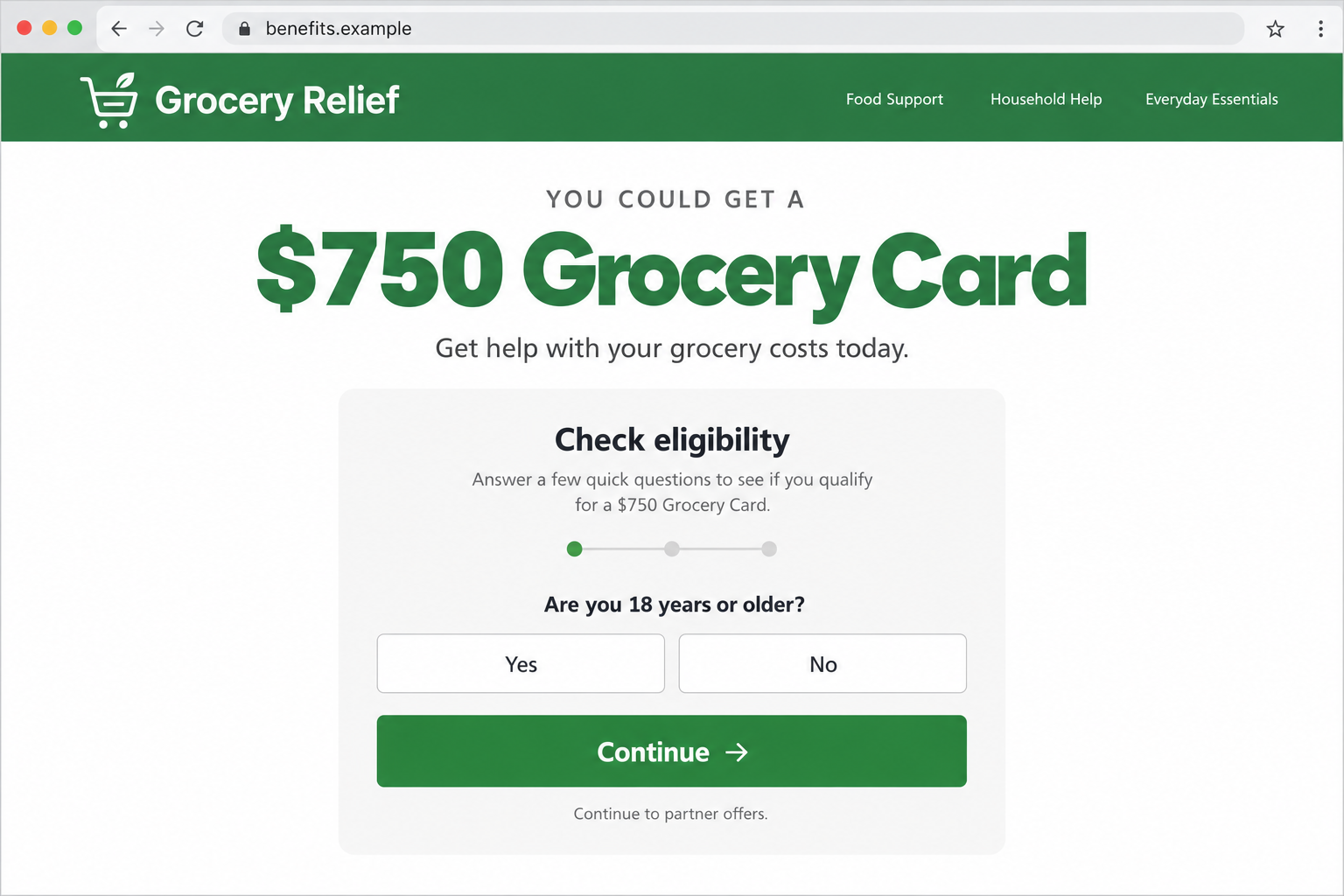
The lead illustration uses an invented interface to make that distinction easier to recognize. Its layout is not a capture of the original campaign.
The apparent eligibility check becomes a marketing journey
The attraction is simple: answer a few questions and obtain a substantial card. The important conditions may only emerge after the reader has started.
Reward programs can involve registration, identity checks, deadlines, and qualifying partner offers. Some offers may involve spending or a subscription rather than a free survey.
Those requirements must be read in the actual program’s rules. They are not the same as receiving SNAP benefits, and clicking through does not mean a reward is approved.
What readers should understand before continuing
- A Walmart logo does not authenticate a food-assistance advertisement.
- A reward account is not an application to your state benefits agency.
- A survey result is not a guarantee that a $750 card will arrive.
- Every paid partner offer can have its own cancellation and billing terms.
The deceptive part is the relief-program presentation. This does not establish that every participant in an underlying rewards program is denied payment.
Do not use the promotion to apply for assistance. Go directly to your state agency if you need to check eligibility or the status of existing benefits.
Why the SNAP Label Changes the Meaning of the Offer
A normal rewards advertisement asks whether you want to complete commercial activities for an incentive. A relief advertisement suggests that help is already available to people in need.
That difference affects expectations. Someone looking for food assistance may assume the questions concern a public program rather than a marketing qualification process.
The familiar Walmart name adds another shortcut. Since many households buy groceries there, a Walmart card can sound like a practical way to distribute assistance.
But a useful-looking payment method is not evidence of authorization. A retailer’s name and a public program’s initials can be placed together by an unrelated advertiser.
Genuine SNAP administration runs through state agencies. When an offer claims an urgent new benefit, verify it with the agency rather than through the ad’s link.
Use the federal government’s SNAP information page to find the proper state application route. Keep your EBT card number and PIN away from promotional forms.
A household should not have to gamble limited grocery money on unrelated subscriptions to discover whether a supposed relief payment exists.
How the Walmart SNAP Relief Program Scam Works
Step 1: A social post offers help with an immediate grocery problem
The pitch begins with a fixed $750 amount and an assistance-related name. It is designed to feel relevant before the reader examines the business behind it.
Food costs make the promise emotionally powerful. People may be especially receptive when they are unsure about benefits, waiting for an application, or worried about the next shop.
A presenter, a familiar logo, or encouraging comments can make the offer seem established. None replaces an announcement on the actual retailer’s or agency’s website.
Save the ad if you are uncertain. You can check its claims separately without continuing through the form or supplying your household’s details.
Step 2: A relief-themed landing page asks you to qualify
The intermediate page gives the promotion its own setting. A title, short questionnaire, and prominent button make the process resemble an eligibility check.
The pages.dev address in the documented route is a hosting address, not a government domain. Hosting on a legitimate service does not mean the service endorses the page.
Questions about age or shopping preferences may feel harmless. Their main effect can be to keep the visitor moving toward the next page.
Check what the button actually promises. Continuing a questionnaire is different from approval, enrollment in SNAP, or an entitlement to receive a gift card.
Step 3: The visitor arrives at a commercial rewards program
The original relief framing may fade as the destination introduces reward rules and partner activities. You are now dealing with a separate commercial arrangement.
A change of domain matters because the party collecting information and setting conditions may not be the name that appeared in the advertisement.
Read the reward terms before registering. Find the required activities, eligibility restrictions, claim process, completion deadline, and any identity-verification requirements.
If the headline promised simple relief but the destination requires a complicated deal sequence, the headline has not accurately prepared you for the offer.
Step 4: Progress depends on completing qualifying offers
A visitor may encounter games, trials, purchases, or other partner promotions. The exact obligations depend on the current program and reward level.
Do not assume that opening an offer counts as completing it. Tracking rules may require a particular purchase, account, waiting period, or activity.
Read the payment page for each partner separately. A low introductory amount may not be the full future cost if a trial renews.
A reward deadline also does not cancel a subscription. If you leave the reward process, any separately accepted contract still needs its own cancellation.
Step 5: The reader has supplied data or spent money without receiving relief
At this stage, the reader may have provided contact details, created several accounts, or paid for offers while still waiting to qualify for the advertised card.
The resulting exposure can be marketing contact, unwanted spending, or a dispute over whether activities met the reward rules. It is not automatically theft of SNAP benefits.
EBT theft becomes a separate concern if you disclosed a card number, PIN, login, or other sensitive benefit information. Take that exposure directly to the issuing agency.
The safest exit is before registering or purchasing. Do not spend more merely because the process says you are almost finished.
The Difference Between a Possible Reward and Guaranteed Assistance
A commercial program may have real rules under which some participants receive rewards. That possibility does not make an unrelated relief advertisement truthful.
Consider a hypothetical offer requiring several paid trials. Even if the participant eventually qualifies, the advertised card must be weighed against costs, time, and cancellation obligations.
That is not how most people understand emergency food help. They expect eligibility to relate to their circumstances, not to completing a chain of commercial activities.
Do not let the advertised $750 become an amount you mentally spend before receiving anything. Pending points, progress meters, and congratulatory messages are not usable grocery funds.
Ask three concrete questions: Who owes the reward? What exact actions create that obligation? What evidence will prove that you completed those actions?
If you cannot answer them from accessible terms, stop. The promise in the ad is not enough to resolve a later disagreement about qualification.
Similarly, a long privacy policy does not establish an official partnership. It describes a service’s practices, not permission to borrow a retailer’s identity in an advertisement.
Keep a separate record for each offer rather than trusting one dashboard to explain everything. Record the provider, price, trial end, and steps needed to cancel.
If an activity fails to track, do not repeat a paid purchase automatically. Ask the program what evidence it accepts before creating another obligation.
Save the rules that applied when you enrolled. A screenshot showing your progress may be useful, but it cannot replace the eligibility and completion conditions.
Be especially careful when the card is advertised as money you need for this week’s groceries. A contingent reward has no dependable arrival date until properly confirmed.
Tell anyone helping with the household budget that the card remains uncertain. This prevents an attractive online promise from displacing a workable plan for immediate food needs.
You can also ask the state agency about other appropriate assistance resources. An official benefits inquiry does not require completing unrelated retail deals first.
The goal is not to prove you can finish a difficult promotion. It is to obtain useful help without creating charges the household cannot afford.
Protect Your Benefits and Your Household Information
A SNAP-related claim can make requests for personal information seem routine. Keep ordinary reward registration separate from the information needed to manage public benefits.
Never give a promotional page your EBT PIN. Do not send a photograph of your benefits card to prove eligibility for a gift-card offer.
Use the official contact details on your card, agency correspondence, or state website. A number printed inside an unfamiliar promotion may lead back to the promoter.
If an account requires identity verification, first confirm whose account it is and why the information is necessary. Do not upload documents merely to keep a progress meter moving.
Be alert to follow-up messages referring to the reward. Knowing your name or the amount advertised does not prove the sender is a benefits worker.
Another warning sign is a request for a processing payment using gift cards or cryptocurrency. Genuine assistance should not be authenticated by paying an unknown contact.
Walmart’s fraud guidance advises treating gift-card details like cash. Do not disclose redemption numbers to someone promising to activate or release a prize.
What to Do If You Entered Your Details or Paid for Offers
-
Stop the offer chain. Close the relief page and make a list of every destination where you registered, paid, or accepted a trial.
Avoid another purchase to recover time already spent. Each additional offer can create a separate charge without bringing you closer to genuine assistance.
-
Identify any live subscriptions. Check welcome messages, receipts, app-store subscriptions, and account settings for trial endings and renewal dates.
Cancel unwanted services through the provider that actually bills you. Keep the request and confirmation, including the date, account identifier, and promised cancellation effective date.
-
Ask about disputed charges quickly. Contact the merchant and, where appropriate, your card issuer. Explain whether the problem is an unauthorized renewal, an unexpected total, or a missing service.
Be accurate about what you authorized. Your bank can explain the available process, supporting evidence, and deadlines; a refund is not automatic.
-
Protect exposed benefit access. If you shared EBT details or a PIN, contact your state’s issuing agency immediately through independently verified contact information.
Ask about securing the card, checking recent activity, and reporting missing benefits. Procedures and any replacement eligibility depend on the applicable program rules.
-
Reduce follow-up contact. Use the relevant program’s privacy and communication controls, revoke unwanted marketing permission, and block suspicious messages without opening their new links.
If you reused an important password, replace it on the genuine account. Use IdentityTheft.gov if sensitive identity information was exposed.
-
Report the misleading relief claim and seek real help separately. Submit the ad to its platform and provide the original landing address when reporting to ReportFraud.ftc.gov.
Then contact your local SNAP office about actual assistance. Leaving a promotional funnel does not prevent you from applying through the proper channel.
If you have already spent time trying to qualify, it is understandable to feel frustrated. The useful next step is an account-by-account cleanup, not another round of offers.
Keep reward support questions separate from benefits questions. A commercial rewards operator cannot restore an EBT balance or approve your state assistance application.
Frequently Asked Questions
Is the Walmart SNAP Relief Program an official SNAP benefit?
The advertised reward funnel is not a state SNAP application. Verify food-assistance programs with your state agency rather than relying on a retailer-themed social advertisement.
Will a short survey automatically give me a $750 Walmart card?
No automatic entitlement follows from answering a questionnaire. Commercial reward rules can require additional activities and successful verification before a reward becomes payable.
Does this mean every rewards website refuses to pay?
No. The issue is an assistance-style promotion that disguises the commercial journey. Whether a participant qualifies depends on the specific program’s legitimate rules and completed activities.
Can the promotion affect my existing SNAP account?
Simply viewing it does not change your benefits. Sharing EBT credentials or sensitive identity information creates a different risk and should be reported to the issuing agency.
Do I need to cancel trials if I abandon the reward?
Yes, cancel any unwanted trial with its actual provider. Quitting a reward program does not necessarily terminate subscriptions you accepted elsewhere.
Where should I check for genuine food-assistance updates?
Use your state SNAP agency and official USDA information. Avoid relying on a sponsored video, comment thread, or unfamiliar page claiming a new universal payout.
The Bottom Line
Do not use the Walmart SNAP Relief Program ad to obtain food assistance. It leads into a commercial reward journey, not a guaranteed $750 benefit.
If you already participated, cancel unwanted partner offers, review charges, and protect any exposed EBT information. Contact your state agency separately for genuine assistance.

Join the discussion
0 commentsShare your experience or ask a question about this article.
Discussion
Start the conversation
Have a question or something useful to share? Add the first comment.