

A court notice arrives by text. It looks formal, carries Multnomah County’s name, and leaves you wondering whether you have missed something serious.
With a deadline hanging over you, even an unfamiliar QR code can seem like the quickest way to get an answer.
Overview
The message turns an unexpected notice into an urgent task
The Multnomah County Circuit Court text scam uses a court-style document to make an unsolicited payment demand feel like an official obligation.
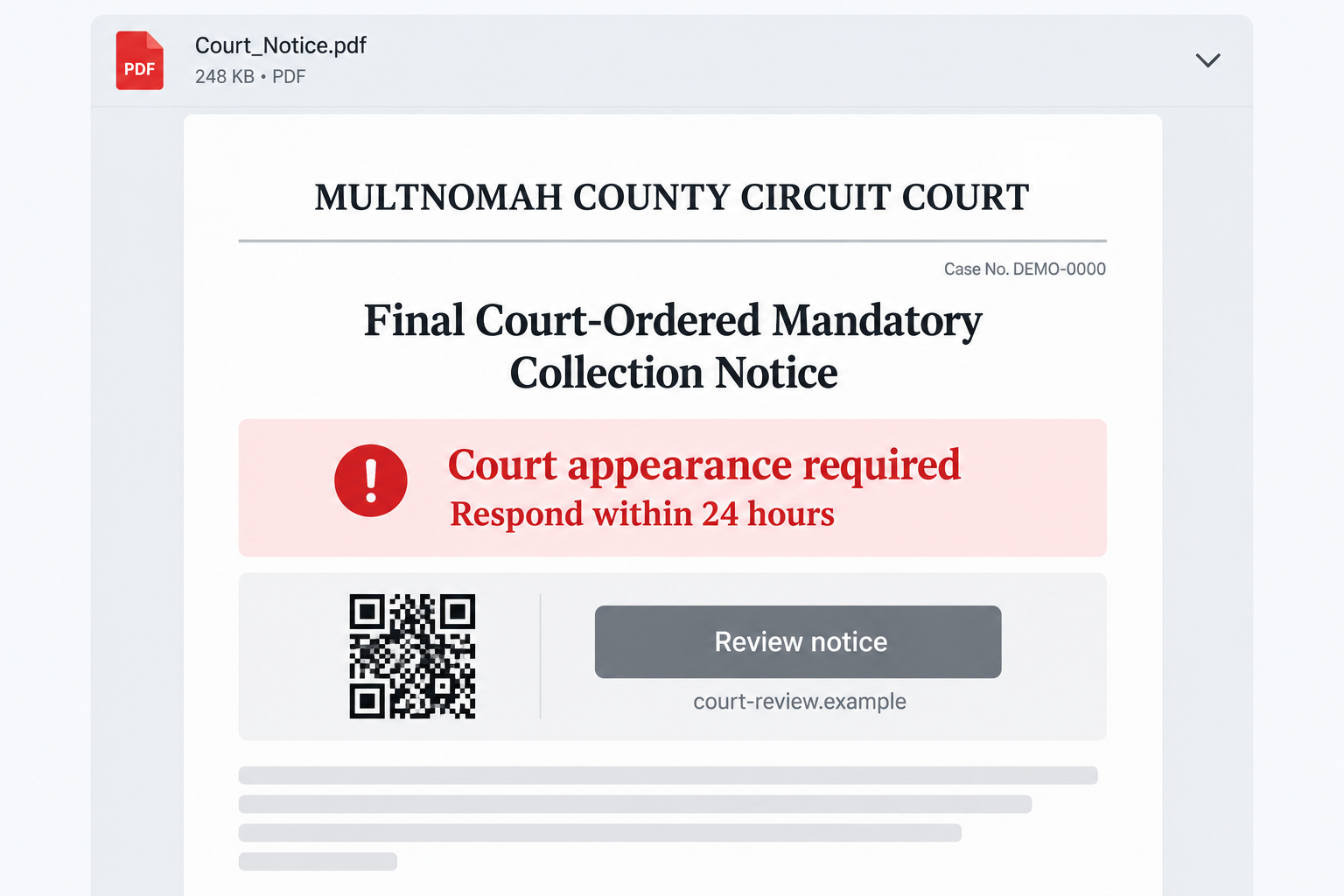
One documented version arrives as an image headed “Final Court-Ordered Mandatory Collection Notice.” It includes invented hearing information and instructions to scan a QR code.
Another warning describes texts threatening fines or arrest unless recipients attend a court appearance within 24 hours. The pressure matters more than the document’s polished layout.
The lead image illustrates that document-style approach. It is not an original received notice; its example address, case reference, and QR-like square are nonfunctional.
Oregon authorities have identified the impersonation
The Oregon Judicial Department’s court-notice scam warning identifies the Multnomah image and its payment QR code as fraudulent.
The Multnomah County Sheriff’s Office warning separately confirms that reported texts announcing urgent court appearances were not legitimate.
These warnings establish the deceptive messages, not a claim that every communication mentioning the court is suspicious. Real court matters still deserve independent attention.
- The recognizable court name supplies authority.
- The image resembles paperwork rather than ordinary advertising.
- The threat discourages the recipient from waiting or asking someone else.
- The QR code moves the interaction toward a destination chosen by the sender.
A genuine reminder is different from a payment threat
Oregon courts do send certain hearing reminders. The state’s text-message FAQ explains that these supplement official notices rather than replace them.
That distinction prevents a dangerous shortcut: assuming either that all court texts are genuine or that every real reminder should be ignored.
The safe response is to verify the case through independently located court contacts. Do not use an unverified notice’s QR code to decide whether you owe money.
Why a Court Document Can Feel More Convincing Than a Scam Text
A plain message demanding payment is easy to question. A document with headings, a case reference, and legal language can make the same demand feel procedural.
You may start looking for your mistake instead of examining the sender’s authority. Perhaps an old ticket was unpaid, or a letter went to your previous address.
The image format also creates a practical obstacle. You cannot always inspect its destination as easily as an ordinary written link.
A QR code compresses the next action into a familiar gesture. Scanning can feel like checking a document, even though it opens a separate website.
Neither a QR code nor a formal heading is inherently fraudulent. The problem is treating either as authentication when the message has not been independently verified.
A real case number can be checked through the court. A reference printed by an unknown sender is only a claim until that check succeeds.
How the Multnomah County Court Text Scam Works
Step 1: A surprise message borrows a familiar institution’s name
The message places Multnomah County Circuit Court or law enforcement at the center of an unexpected legal problem. It reaches you before you have context.
That arrival is important. Rather than answering a question you asked, the sender introduces both the alleged problem and the proposed way to resolve it.
You may recognize the institution even if you have never visited the courthouse. Familiarity with its name can substitute for familiarity with its actual procedures.
The sender does not need to prove that a case exists if the recipient assumes the document itself is proof. That assumption carries the next stage.
Stop at the source question: did you independently reach the court, or did a stranger introduce a claim while controlling every contact detail?
Step 2: The attachment makes invented details look official
The documented collection version uses an image containing court-style language and fabricated hearing information. The layout encourages readers to treat it like paperwork already issued.
Legal vocabulary can make a demand sound specific without making it accurate. A title such as “mandatory collection” does not establish an enforceable debt.
Some related notices mention Judge Michael Rodriguez. Oregon’s judicial warning stated that no Oregon state court judge had that name when the warning was issued.
Keep that finding in its proper scope. It concerns the Oregon impersonation; it is not a declaration about everyone with that name elsewhere.
Do not try to authenticate a message by identifying one believable detail. A scammer can combine a real courthouse name with an invented proceeding.
Step 3: A short deadline makes verification feel risky
The sheriff’s warning describes appearances supposedly scheduled within 24 hours, with penalties ranging from fines to immediate arrest for failing to attend.
These threats push you toward action before you have time to locate the real court. Calling a relative may suddenly feel like wasting precious minutes.
That is the point where a useful instinct becomes exploitable. Wanting to resolve a legal issue promptly is reasonable; following an unknown sender’s instructions is not verification.
A deadline printed in a text does not create a court order. If you have an actual pending case, check its real schedule through established channels.
Do not travel to an unfamiliar location or send identification simply because the message says compliance is urgent. Confirm what the court actually requires.
Step 4: The QR code offers a shortcut into the sender’s process
The collection notice directs recipients to scan a QR code for payment. That changes the interaction from reading a claim to visiting a destination.
A code can open a page with official-looking colors, logos, or a payment form. Those features are reproducible and cannot establish who operates the page.
The official warning identifies the payment instruction, but does not authenticate a complete checkout or specify every field each version collects.
Do not assume the printed notice tells you what happens after scanning. A payment instruction alone cannot verify the website or its operator.
Opening a page is also different from submitting information. If you already scanned, base your response on what you actually entered, downloaded, or approved.
Step 5: Fear can turn into a payment or disclosure
Once the recipient accepts the supposed case, an information request can feel necessary. A payment demand may appear to be the final step toward ending the threat.
Do not enter card details, bank credentials, identity documents, or security codes to test the page. Testing with real information creates the exposure you are investigating.
The aim is to obtain money or personal information by exploiting fear. What matters for recovery is what you actually supplied or paid.
A person who only received the text has a different situation from someone who paid. Avoid assuming an account compromise simply because the message reached you.
If the interaction continues by phone, the same verification boundary applies. A caller’s confident explanation cannot validate the document that supplied the number.
Step 6: Independent contact breaks the sender’s control
Leave the message and find the court through the Oregon Judicial Department. Use contact information obtained there, not a number copied from the suspicious attachment.
Describe the alleged case and ask how to verify it. You can explain that an unsolicited text named the court without accepting its claims.
If someone is impersonating a deputy, use independently found law-enforcement contacts. A displayed caller ID or an offered badge number is not a substitute.
Separating the claim from the contact route removes the scammer’s strongest advantage: being the only person available to explain the emergency they created.
This does not mean abandoning a real legal responsibility. It means finding out whether that responsibility exists before acting on instructions from a stranger.
Checks That Help Without Creating False Reassurance
Confirm the institution and the case separately
A real court’s existence tells you nothing about whether it sent this message. Confirming the institution is only the beginning of checking the claim.
Ask the court how to verify the relevant case or hearing. If the supplied reference cannot be located, do not let the sender invent another explanation.
An inability to find a case yourself is not a reason to ignore authentic paperwork. Contact the court if you remain uncertain about an actual obligation.
Do not let an address disguise the destination
Oregon’s warning identifies courts.oregon.gov as the official state-court web address. Read the actual hostname, not just familiar words appearing elsewhere in a link.
A name embedded in a page title or path is not the same as the official host. Likewise, an encrypted connection does not verify a court.
If you cannot confidently establish the destination, do not open it for a closer look. Navigate independently and ask the court for the appropriate service.
Keep legitimate hearing reminders in perspective
The Oregon text FAQ says hearing notifications are supplemental communications. They do not replace official notices or your responsibility to know an actual court date.
A verified reminder connected to your case is different from an unsolicited demand to send sensitive information or satisfy a threat through a QR code.
There is no need to memorize every approved template. Independent contact is more dependable than deciding whether punctuation, capitalization, or formatting looks sufficiently professional.
What to Do if You Have Fallen Victim to This Scam
-
Stop the interaction and record what happened. Keep the text, sender details, attachment, and any payment confirmation before reporting or deleting the conversation.
Write down what you shared and when. Distinguish receiving the message, opening its destination, entering information, and approving a transaction.
Do not post unredacted case references, personal documents, or account details publicly. Preserve a private copy for the organizations handling your report.
-
Verify the alleged court matter independently. Find the real court through Oregon’s judicial website and explain the notice you received.
If you already have a case, ask about its actual hearing schedule and payment process. Do not assume the scam cancels a genuine obligation.
Give staff the suspicious reference when requested through their verified channel. There is no need to contact the sender again for permission.
-
Contact the payment provider promptly if you paid. Use its official app, the number on your card, or another independently verified route.
Explain accurately whether you authorized a payment under deception or noticed a transaction you never approved. Ask what dispute, recall, or replacement options apply.
Keep case numbers and follow-up instructions. Recovery is not guaranteed, and your bank needs the actual transaction details rather than a general description of the scam.
-
Protect accounts affected by disclosed information. If you entered a password, change it through the genuine service and review available security settings.
Replace reused passwords on other accounts. If payment-card data was submitted, ask the issuer whether the card should be blocked or replaced.
Merely receiving or viewing the text does not justify treating every account as compromised. Match these actions to the information actually exposed.
-
Get an identity-recovery plan if sensitive identity information was shared. Use IdentityTheft.gov for steps suited to the exposure.
Discuss appropriate fraud alerts or freezes with the relevant providers. Keep records of disputed activity and check for unfamiliar accounts or changes.
Do not send additional identification to the original sender to “close the case.” That request would extend the same unverified interaction.
-
Report the impersonation through legitimate channels. Oregon’s court warning directs suspicious communications to the Federal Trade Commission.
Use ReportFraud.ftc.gov and contact local law enforcement when appropriate, especially after financial loss or threats.
Choose reporting contacts independently. If someone claims to be investigating your report, verify their identity before sharing further personal or financial information.
-
Warn anyone who helped you respond. A relative may have scanned the code, made the payment, or entered details while trying to help.
Work through each person’s actual exposure. Tell them the notice was fraudulent without forwarding a live link that invites another accidental visit.
Anyone promising guaranteed recovery for an advance payment should be treated with suspicion. Paying another stranger cannot authenticate the original demand.
Frequently Asked Questions
Is the Multnomah County collection notice with a payment QR code real?
Oregon authorities identified that document-style text as fraudulent. Verify any actual court matter independently instead of using its payment code.
Do Oregon courts ever send text messages?
Yes. They send certain hearing and jury reminders. That does not authenticate unsolicited threats, requests for sensitive information, or the documented fake collection notice.
Does Judge Michael Rodriguez authenticate the notice?
No. Oregon’s warning specifically stated that no Oregon state court judge had that name when the warning was issued.
Have I paid a fine just by scanning the QR code?
No. Opening a destination is not itself a payment authorization. Check whether you entered details, approved a transaction, or downloaded anything before deciding your response.
Should I ignore a real hearing because I received a scam?
No. Contact the actual court to verify existing obligations. The fraudulent text and any genuine case are separate matters.
Can a professional layout prove that a court issued the document?
No. Headings, logos, and case references can be copied or invented. The court must confirm the claim through independently obtained contact information.
The Bottom Line
Do not pay through the Multnomah County court scam text or scan its code to resolve a threat. Oregon authorities have identified the impersonation.
Verify through the real court. If you already paid or disclosed information, contact the relevant provider promptly and preserve the message for your report.

Join the discussion
0 commentsShare your experience or ask a question about this article.
Discussion
Start the conversation
Have a question or something useful to share? Add the first comment.