

A dental appointment can make a simple daily tablet sound tempting, particularly when you’re worried about what the next examination might cost.
DentaTonic puts a saliva-enzyme story behind that appeal. Before making room for it beside your toothbrush, look at what the offer actually explains.
Overview
A swallowed tablet is sold through a dental-filtration explanation
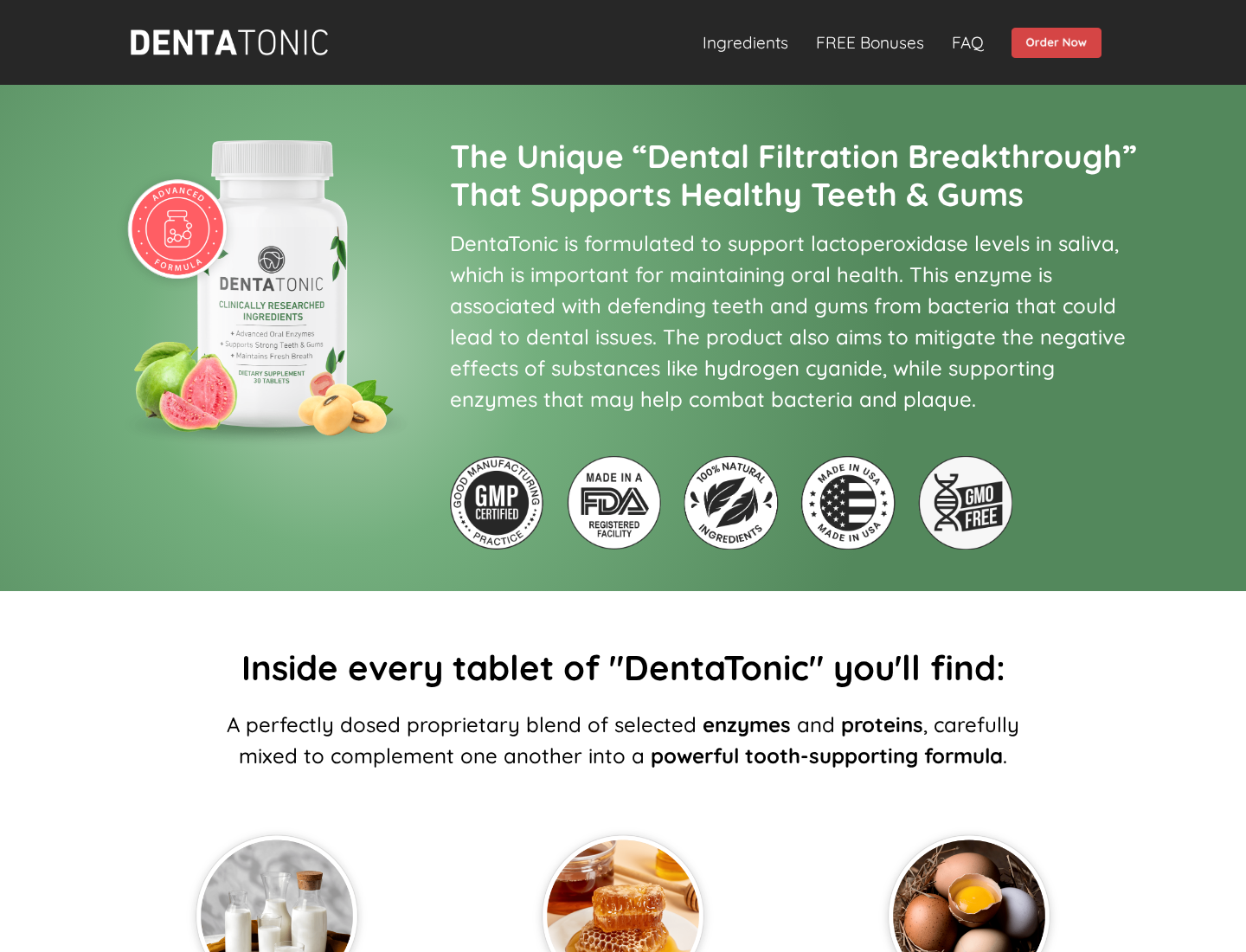
DentaTonic is an oral-health supplement promoted for teeth, gums, and saliva’s protective functions. The website instructs customers to take one tablet daily with water.
Its explanation focuses on lactoperoxidase, an enzyme found in saliva. The pitch connects supporting that enzyme with protection against bacteria, plaque, and substances such as hydrogen cyanide.
Those scientific subjects are not automatically evidence for the tablet. The relevant question is whether this finished formula produces the dental benefit implied by its presentation.
The evidence and purchase conditions leave important gaps
The main concerns are specific enough to check before spending anything:
- The explanatory ingredient list does not give individual quantities.
- Research about other oral-care products is not a trial of this exact tablet.
- The safety language broadly covers all ages and medical conditions.
- The vendor advises three months of use despite a 60-day refund period.
- The vendor and checkout start their refund clocks on different dates.
There is a real order route: the inspected one-bottle ClickBank page named DentaTonic and displayed a provisional $69 total.
A working checkout can identify a transaction. It cannot establish that a supplement prevents a cavity, treats gum disease, or repairs a tooth.
A one-time purchase still needs a convincing reason to buy
The website expressly describes one-off purchases without hidden autoship. No repeating payment schedule appeared in the one-bottle route examined.
Do not buy DentaTonic as a proven solution to a dental problem. The sales explanation goes beyond what the product-specific support establishes.
No tablets were ordered, used, or laboratory-tested here. The pages, cited research descriptions, checkout, and refund terms were inspected without contacting support.
What the Saliva-Enzyme Story Leaves Out
A real biological system can still be used in an overstretched pitch
Saliva plays a role in oral health, and enzymes can have useful biological functions. The problem isn’t that lactoperoxidase is an invented substance.
The missing bridge is between that background and the commercial tablet. How much reaches the relevant place, in what form, for how long, and with what measured result?
Simply swallowing a tablet containing an enzyme does not answer those questions. Neither does explaining how an enzyme behaves under different laboratory conditions.
Someone buying because their gums bleed needs evidence relevant to that concern, not just a convincing diagram of a protective system.
The bibliography includes different products and settings
The sales page lists work involving enzyme toothpastes, mouthwash, saliva substitutes, oral bacteria, and related subjects. Some references concern laboratory or animal research.
Those studies may supply background for a hypothesis. They should not be presented to the reader as though participants took the exact DentaTonic tablet being offered.
Route of use matters. A toothpaste applied while brushing, a rinse held in the mouth, and a tablet swallowed with water are different preparations.
So do concentration, frequency, participants, comparison groups, and outcomes. A paper measuring bacterial activity isn’t necessarily measuring fewer cavities or improved long-term tooth survival.
Ask for the finished-product study rather than trying to assemble one from a long reference list. The relevant result should concern the formula you would receive.
A frightening chemical name is not your dental diagnosis
The page discusses hydrogen cyanide as part of the dental-filtration explanation. Seeing a worrying chemical name can make a supplement seem more urgently necessary.
But the presentation hasn’t measured your saliva or identified a particular exposure. It doesn’t establish that this is the reason for your tooth sensitivity or gum trouble.
Keep the practical question simple: what did your dentist actually find, and what evidence supports the treatment proposed for that finding?
A supplement story shouldn’t persuade you to postpone an examination while trying to fix a problem that hasn’t been diagnosed.
Seven Named Ingredients Still Leave the Amounts Unanswered
The main list identifies lactoperoxidase, dextranase, lysozyme, lactoferrin, microcrystalline hydroxyapatite, beta-glucanase, and amylase. It describes their combination as a proprietary blend.
The explanatory section does not provide a separate quantity for each component. That prevents a straightforward comparison between the serving and a study involving a particular ingredient.
It also leaves the shopper dependent on the actual label for a complete formulation. Request the panel, inactive ingredients, allergen information, and serving instructions before considering use.
Do not infer that every enzyme-containing product is interchangeable. A familiar ingredient name does not tell you its activity, formulation, or suitability for the same purpose.
The page’s broad assurance about suitability for all ages and conditions deserves particular caution. A generic safety statement cannot account for an individual’s allergies, medication, or health history.
The same site advises people with medical conditions or prescriptions to show the bottle to a doctor. Treat that as a necessary conversation, not a formality.
How the DentaTonic Sales and Refund Process Works
Step 1: A simple daily routine is framed as a dental breakthrough
The presentation begins with a bottle and an enzyme explanation rather than a conventional oral-care routine. The appeal is doing something easy that seems to address a hidden problem.
Before accepting that framing, separate supportive nutrition from treating an existing dental condition. The simplicity of taking a tablet says nothing about whether it meets that need.
Also keep your normal care in place. Buying a supplement is not a reason to stop brushing, cleaning between teeth, or attending examinations.
Step 2: Quality badges and customer counts make the purchase feel established
The visible badge describes an FDA-registered facility. That doesn’t mean the FDA evaluated and approved the tablet’s dental benefits.
The page also displays large customer and review counts. These are seller-published figures, not independently verified clinical outcomes.
A positive review may describe a person’s satisfaction. It does not establish what happened to plaque, tooth structure, or gum disease under controlled conditions.
Step 3: Discounts reward a larger first order
The advertised packages are one bottle for $69, three for $177, and six for $294. The larger options include digital guides.
The page says 96% of customers choose six, but that figure doesn’t establish what a new shopper needs. It normalizes the largest upfront commitment.
Compare totals rather than focusing on the lowest unit price. Six bottles cost $294 today even if the individual bottle figure looks more appealing.
Bonus guides about whitening or digestive detox do not supply missing evidence for the tablet. Their assigned retail values are not clinical benefits.
Step 4: The one-bottle checkout identifies ClickBank as retailer
The opened checkout correctly named DentaTonic and showed $69, free shipping, and $0 tax before a destination or payment information was supplied.
That was a provisional summary, not a completed sale. Location-specific charges must still be checked before anyone approves an actual transaction.
The displayed statement descriptor was CLKBANK*DentaTonic. Keep that detail with the confirmation if you later need to trace an order.
No recurring schedule appeared. If you later see an unexpected charge, compare it with the agreement on your receipt before deciding what happened.
The website’s broad free-shipping presentation also carries an international qualification. Its footer says fees apply outside the US, so overseas buyers should not assume the domestic summary applies.
Check the selected country before relying on a price screenshot. Currency conversion and destination-specific costs can change the amount that ultimately appears on a payment statement.
Save that final summary with the product listing. It connects the particular package and delivery terms to the transaction rather than to a general advertisement.
Step 5: The suggested trial can overrun the guarantee
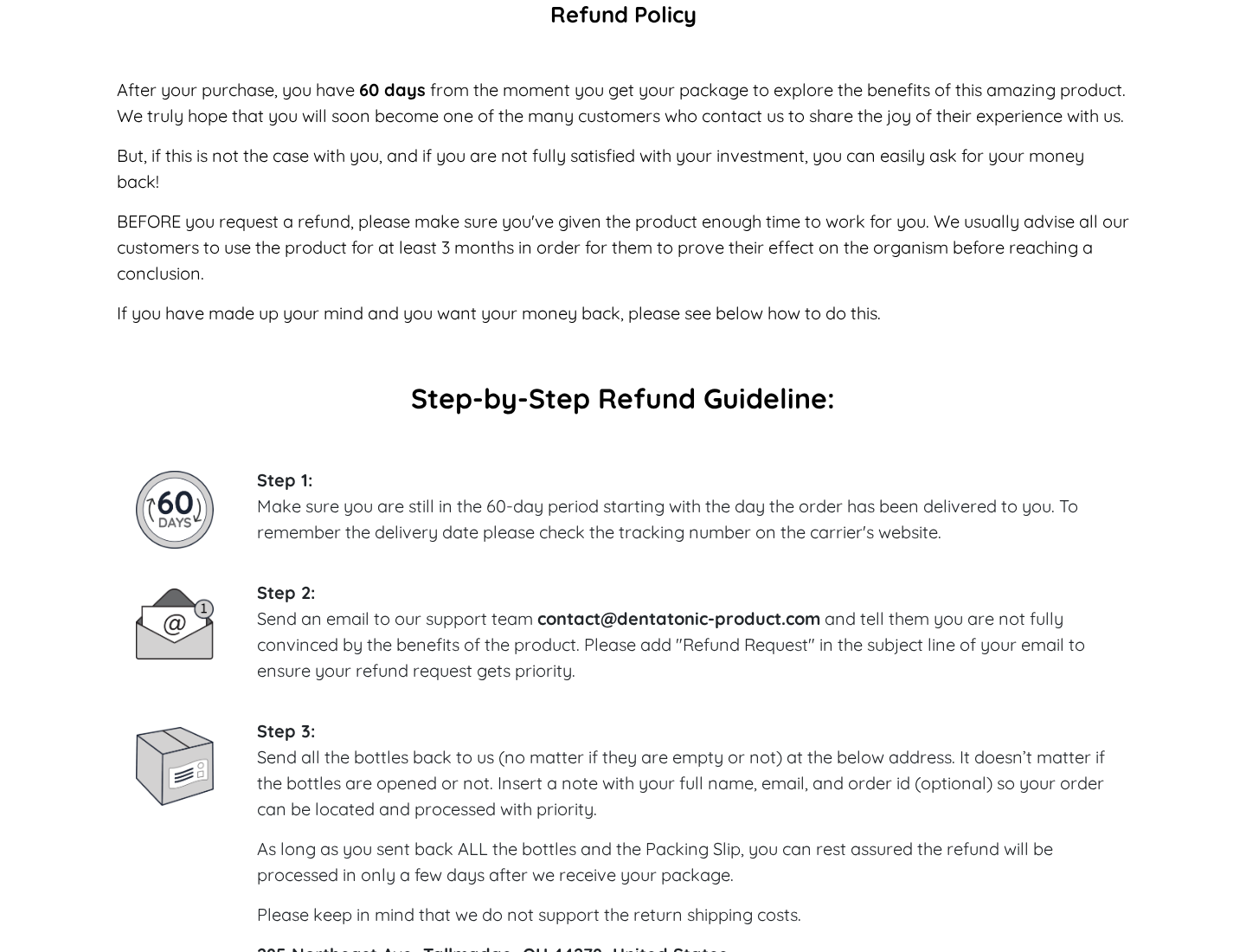
The vendor refund page gives 60 days from delivery, then advises at least three months of use before deciding whether the product worked.
Following that advice could put a dissatisfied customer outside the printed return period. A three-month evaluation and a 60-day deadline are not the same offer.
ClickBank’s checkout measures its guarantee from purchase instead. Shipping time can make that deadline earlier than the vendor’s delivery-based description.
If you want a refund, contact the relevant support promptly. Don’t wait for a longer trial merely because a sales or policy paragraph encourages it.
Retailer Details, Product Support, and Bottle Returns
The brand and retailer perform different roles
The website names ClickBank as retailer and identifies Click Sales Inc. Its published address is 1444 South Entertainment Ave, Suite 410, Boise, Idaho 83709.
The accompanying disclaimer says that retail role is not endorsement or review of the promotional claims. A recognizable transaction platform is not a dental recommendation.
Keep the retailer record and product-support details together. One may handle the order while another answers questions about the label or return requirements.
The return destination is in Ohio
The vendor’s refund instructions publish 285 Northeast Ave, Tallmadge, OH 44278. That is a returns address, not proof of a manufacturing facility.
The policy asks customers to send every purchased bottle, including opened or empty bottles, along with the packing slip. The buyer pays return postage.
Confirm authorization and the current destination first. Keep the packaging and containers while you decide, instead of discovering later that discarded bottles were required.
Support exists, but responsiveness was not tested
The product email is contact@dentatonic-product.com. ClickBank order help is available through clkbank.com and the published US number 1-800-390-6035.
No calls or emails were sent during this review. Keep your own dated request, responses, and case number so any later escalation has a clear record.
The label matters more than a quality graphic
Ask for the manufacturer or distributor, complete composition, lot, expiry, directions, and warnings. Manufacturing badges alone don’t connect those details to a particular shipment.
Check that the delivered form is the tablet you expected. Don’t apply instructions from another dental product or assume a swallowed supplement is a toothpaste replacement.
What to Do If You Ordered DentaTonic
-
Match the purchase to your receipt. Record the date, bottle quantity, total, shipping, retailer, and CLKBANK*DentaTonic descriptor.
Save the offer and guarantee that accompanied your order. A later website version may not reproduce the promise you relied on.
-
Request a refund before the earliest relevant deadline. Contact product support or genuine ClickBank order help without waiting three months.
Explain the purchase-based and delivery-based wording and ask for the applicable deadline in writing. Retain proof of when the request was sent.
-
Keep all bottles and the packing slip. Opened and empty containers are included in the vendor’s stated return process.
Obtain current mailing instructions, use a tracked service, and retain the receipt. Photograph the contents before closing the parcel.
-
Have persistent dental symptoms examined. Tell your dentist about pain, bleeding, sensitivity, damaged teeth, or changes that prompted the purchase.
Don’t wait through a supplement supply while symptoms worsen. A professional examination can identify whether prevention, restoration, or another treatment is needed.
-
Check suitability before taking more tablets. Show the actual ingredient and warning label to an appropriate healthcare professional, particularly if you have allergies or take medication.
A broad all-ages safety claim isn’t individualized advice. Seek medical help if you suspect an adverse reaction rather than continuing to complete the advertised trial.
-
Escalate a stalled refund with documentation. Give your payment provider the receipt, correspondence, authorization, return tracking, and the specific promise in dispute.
Ask about the provider’s time limits. Describe the purchase accurately rather than treating ordinary disappointment as proof of an unauthorized payment.
Keep Proven Dental Care in the Picture
The American Dental Association’s cavity guidance recommends fluoride toothpaste, cleaning between teeth, and regular dental visits as part of prevention.
Those measures address everyday risk without requiring a proprietary dental-filtration story. Your dentist can explain what is appropriate for the actual condition of your mouth.
A formed cavity and early mineral loss are not interchangeable. Don’t assume a supplement will rebuild a damaged tooth because an ingredient appears in other oral-care research.
If cost is the reason you’re delaying treatment, ask the dental office about practical options. Repeated purchases of unproven tablets can use money needed for actual care.
Frequently Asked Questions
Is DentaTonic a toothpaste or a tablet?
The inspected site sells a tablet taken with water. Its use should not be confused with brushing using an enzyme-containing or hydroxyapatite toothpaste.
Does the bibliography prove the finished formula works?
No. Research about ingredients, mouthwash, toothpaste, or laboratory systems doesn’t automatically establish the outcome of this particular swallowed tablet.
Can used DentaTonic bottles qualify for a refund?
The vendor instructions accept opened and empty bottles but request the entire order and packing slip back. Confirm the deadline and postage requirements for your transaction.
Should I follow the recommendation to wait three months?
Not if you’re considering a return. That advice exceeds the 60-day refund period, and ClickBank’s displayed guarantee begins at purchase.
Was DentaTonic sold as an automatic subscription?
The inspected page says no hidden autoship, and no recurring schedule appeared in the opened checkout. Your own agreement should still be preserved.
Should I buy it instead of getting dental treatment?
No. Skip DentaTonic for that purpose. It hasn’t established a substitute for diagnosing and treating the problem that concerns you.
The Bottom Line
Do not buy DentaTonic as a proven dental-filtration treatment. The ingredient story doesn’t establish the finished tablet’s benefit, and the suggested trial conflicts with its refund clock.
If you’ve ordered, keep every bottle, request return instructions promptly if dissatisfied, and get dental symptoms assessed without waiting for the supplement to solve them.

Join the discussion
0 commentsShare your experience or ask a question about this article.
Discussion
Start the conversation
Have a question or something useful to share? Add the first comment.